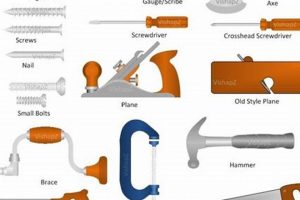
This pointed hand tool is primarily employed for marking or piercing materials, most commonly wood. It creates a pilot hole, guiding screws or nails, preventing splitting, and aiding in accurate joinery. For example, it can be used to create a starting point for drilling, ensuring the drill bit doesn’t wander off course.
Its significance lies in its contribution to precision and quality in woodworking projects. By creating clean, controlled indentations, it minimizes the risk of material damage and improves the overall fit and finish of assembled pieces. Historically, this instrument has been a fundamental component of the woodworker’s toolkit, predating power tools and serving as a reliable method for material preparation.
With a foundational understanding of this essential instrument established, the discussion can now extend to its various types, proper usage techniques, and maintenance procedures, all crucial for achieving optimal results in woodworking endeavors.
Practical Guidance for Using a Pointed Marking Instrument
The following guidelines provide essential insights for maximizing the effectiveness and longevity of a pointed marking instrument in woodworking applications. Adherence to these recommendations will enhance precision and minimize the risk of material damage.
Tip 1: Select the Appropriate Type: Different variations exist, each suited for specific tasks. A scratch variant is ideal for marking lines, while a birdcage is designed for creating deeper indentations. Choose the implement that aligns with the project requirements.
Tip 2: Maintain a Sharp Point: A dull point compromises accuracy and increases the force required for penetration. Regularly sharpen the point using a honing stone or file to ensure clean, precise markings.
Tip 3: Apply Consistent Pressure: Uneven pressure can result in inconsistent depths and inaccurate markings. Maintain a steady, controlled pressure during use to ensure uniformity.
Tip 4: Utilize a Sturdy Backing Surface: Employ a solid workbench or other stable surface to prevent movement during the marking process. This will improve accuracy and reduce the likelihood of slippage.
Tip 5: Mark Before Cutting: Always mark the desired cut lines prior to initiating any cutting operations. This ensures accurate material removal and reduces the risk of errors.
Tip 6: Proper Storage: Store the implement in a secure location, away from moisture and other elements that could cause corrosion or damage to the point. A dedicated tool holder or case is recommended.
Tip 7: Consider Grain Direction: When marking wood, pay attention to the grain direction. Marking along the grain will generally result in a cleaner indentation than marking against it.
Consistent application of these techniques will contribute to improved precision, reduced material waste, and enhanced overall quality in woodworking projects.
With these practical considerations addressed, the article will now proceed to examine advanced techniques and specialized applications.
1. Marking precision

The successful execution of woodworking projects hinges significantly on the accuracy of initial markings. The pointed hand tool is instrumental in achieving this precision. A well-defined mark, created by this tool, serves as a reliable guide for subsequent cuts, shaping, and joinery operations. The relationship is causal: improved marking directly leads to higher accuracy, while inadequate marking compromises the integrity of the entire project. An example involves dovetail joinery, where precise marking of the dovetail and pin locations dictates the strength and aesthetic appeal of the joint.
Furthermore, achieving precision is not solely dependent on the tool itself; technique plays a crucial role. Consistently applying the tool at the correct angle and pressure is essential. In situations where exacting measurements are required, such as crafting intricate inlays, the ability to create a minute, well-defined starting point is paramount. Without a precise mark, errors accumulate, leading to misaligned components and structural weaknesses.
In summary, marking accuracy forms a cornerstone of woodworking, and the use of a pointed tool directly contributes to this accuracy. Maintaining the tool’s sharpness and employing proper marking techniques are essential for realizing its full potential. Challenges in achieving precision can arise from dull tools or unstable work surfaces, highlighting the importance of proper tool maintenance and stable setups.
2. Material preparation
A crucial aspect of woodworking involves adequately preparing materials before assembly, and a pointed hand tool is instrumental in this stage. The connection lies in creating pilot holes that facilitate the insertion of screws or nails, especially in hardwoods or dense materials prone to splitting. Absent such preparation, the forceful driving of fasteners can lead to cracking and structural weakness, diminishing the integrity of the finished piece. Using this tool directly mitigates these risks. For instance, when attaching a delicate molding to a frame, it allows precise starting points for fasteners, preventing splintering and ensuring a secure, aesthetically pleasing bond.
Furthermore, the utility of this preparation extends beyond merely preventing damage. It contributes to fastener alignment and consistent depth, thereby improving the overall quality of the joinery. Consider the construction of a cabinet door: by creating pilot holes that are slightly smaller than the fastener diameter, it ensures a tight, secure fit. In essence, it acts as a controlled intervention, preempting potential problems and optimizing the outcome of the assembly process. This method allows for finer adjustments and corrections during assembly, as opposed to forcing a fastener directly into unprepared wood.
In conclusion, this preparation plays a vital role in ensuring structural integrity and aesthetic quality in woodworking projects. While seemingly a small step, the practice of creating pilot holes with a pointed hand tool directly impacts the longevity and appearance of the final product. Improper material preparation can negate even the most skillful joinery techniques, underscoring the importance of mastering this fundamental skill.
3. Pilot hole creation

Pilot hole creation is a primary function facilitated by a pointed hand tool in woodworking. The instruments design, featuring a sharpened point, enables the controlled piercing of material, initiating a channel for subsequent fastener insertion. The creation of pilot holes mitigates the risk of splitting, particularly in hardwoods or when working close to an edge. This constitutes a cause-and-effect relationship: the action of piercing the wood (cause) results in a pre-formed pathway for screws or nails (effect). The absence of a pilot hole can lead to material failure, undermining the structural integrity of the joint.
The importance of this function stems from its direct impact on the longevity and stability of woodworking constructions. For instance, constructing a frame without pre-drilling pilot holes with a pointed implement increases the likelihood of the wood splitting when screws are driven in. This is especially crucial when working with hardwoods like oak or maple, which offer greater resistance to fastener penetration. The pilot hole essentially reduces the stress on the wood fibers, allowing the fastener to grip the material securely without causing it to fracture. The use of it also helps to keep the screw straight during insertion, which further improves the alignment and strength of the finished piece. For projects requiring precision like antique furniture restoration, creating a pilot hole with it becomes an indispensable step.
In summation, pilot hole creation represents a critical application of the pointed hand tool. Its role in preventing splitting, ensuring accurate fastener placement, and enhancing joint stability underscores its practical significance in woodworking. Challenges associated with this process, such as selecting the appropriate size for the pilot hole, are addressed through experience and adherence to established woodworking practices. Mastery of this technique contributes significantly to the quality and durability of woodworking projects.
4. Joinery accuracy

Joinery accuracy, the precision with which wooden components are interlocked and secured, is paramount to the structural integrity and aesthetic quality of woodworking projects. The pointed hand tool plays a vital role in achieving this accuracy by facilitating precise marking and pilot hole creation, both essential steps in the joinery process.
- Precise Layout and Marking
Accurate marking of joinery locations is the foundational step for achieving precise fits. The tool, with its fine point, enables the woodworker to transfer measurements and designs onto the material with a high degree of fidelity. This is particularly crucial in complex joints like dovetails or mortise-and-tenon, where even slight inaccuracies can lead to misalignment and weakened structures. Without it, achieving the necessary precision becomes significantly more challenging.
- Pilot Hole Alignment for Fasteners
Many joinery methods rely on fasteners such as screws or nails to reinforce the connection. Correctly aligned pilot holes are essential for ensuring that the fasteners enter the wood straight and at the intended angle. A pointed implement is used to create these pilot holes, preventing the fastener from wandering and potentially splitting the wood. Accurate pilot hole alignment contributes directly to the strength and stability of the joint.
- Consistent Depth Control
The depth to which the marking instrument is used to create an indentation affects the subsequent alignment of components. Too shallow a mark, and the saw may drift. Too deep, and the wood may split, or the fastener head may sink excessively. Consistent application of the tool to the right depth, therefore, has a positive effect on alignment and fit.
- Mitigating Material Splitting
The creation of pilot holes, facilitated by the marking tool, is critical in preventing splitting, particularly when working with hardwoods or when driving fasteners close to the edge of a board. By pre-forming a path for the screw or nail, it reduces stress on the wood fibers, thereby minimizing the risk of damage. This is especially important in intricate joinery where minimizing material waste is essential.
In summary, the accurate execution of joinery is inextricably linked to the precise marking and material preparation that the tool enables. By facilitating accurate layouts, aligned pilot holes, and material splitting mitigation, it contributes directly to the strength, stability, and aesthetic appeal of woodworking projects. Its use is not merely a convenience, but a necessity for achieving high-quality joinery.
5. Point maintenance

The sustained performance of any pointed marking instrument in woodworking is directly contingent upon consistent and proper maintenance of its point. A dull, damaged, or improperly shaped point diminishes accuracy and increases the effort required for effective use. Regular maintenance extends the tool’s lifespan and preserves its utility.
- Regular Honing for Optimal Sharpness
The tip of a pointed hand tool will inevitably dull with use. Regular honing, using a fine grit stone or appropriate sharpening tool, restores the point’s sharpness, enabling clean and precise markings. Neglecting this process results in less defined marks, potential wood fiber tearing, and increased risk of tool slippage, impacting overall accuracy.
- Protection Against Corrosion and Damage
Exposure to moisture and improper storage can lead to corrosion, which compromises the point’s integrity. Protecting the tool from these elements through proper storage, such as in a dry environment or a protective sheath, prevents deterioration. Damage from impact or improper use necessitates repair or replacement to maintain optimal functionality.
- Reshaping for Specific Applications
Different woodworking tasks may require a specific point shape. For example, a finer point might be preferred for delicate work, while a more robust point is suitable for marking harder materials. The ability to reshape the point to meet the demands of the task enhances versatility and precision. Incorrect shaping can negatively impact performance.
- Safe Handling Practices
Safe handling practices are integral to point maintenance. Dropping or mishandling the tool can damage the point, rendering it less effective. Proper grip and storage techniques minimize the risk of accidental damage, ensuring the tool remains in optimal condition for extended use.
These maintenance aspects are not isolated tasks, but rather integrated practices that ensure the pointed marking implement functions effectively throughout its lifespan. Ignoring point maintenance can negate the benefits of even the highest-quality tool, leading to inaccurate work and increased frustration. A well-maintained tool is a reliable tool, contributing significantly to the precision and quality of woodworking projects.
Frequently Asked Questions
This section addresses common inquiries regarding the pointed hand tool, providing clarity on its use, maintenance, and selection within woodworking contexts.
Question 1: What is the primary function of a pointed marking instrument in woodworking?
Its primary function is to create precise starting points for screws, nails, and drill bits, minimizing the risk of material splitting and enhancing joinery accuracy.
Question 2: How does one maintain the point of a marking tool to ensure optimal performance?
Regular honing with a fine-grit stone or sharpening tool is essential. Additionally, protecting it from corrosion and physical damage is critical for longevity.
Question 3: Are there different types of pointed marking instruments available, and if so, what are their specific applications?
Yes. Variations exist, including scratch variants for marking lines and birdcage variants for creating deeper indentations. Selection depends on the intended task.
Question 4: What materials are best suited for use with a pointed marking implement?
It is effective on a wide range of materials, but is particularly useful on hardwoods and dense materials prone to splitting. Proper technique should be used to prevent damage.
Question 5: How does the tool contribute to overall joinery accuracy in woodworking projects?
It facilitates precise marking and pilot hole creation, which are fundamental to achieving tight, well-aligned joints. Accurate markings reduce errors in cutting and assembly.
Question 6: What are the common mistakes to avoid when using it in woodworking?
Common mistakes include using a dull implement, applying uneven pressure, and neglecting to create pilot holes when working with dense materials. Avoid these errors.
These FAQs provide a foundational understanding of the pointed hand tool. Adherence to these principles enhances woodworking skills and promotes project success.
This concludes the FAQ section. The next discussion will focus on advanced applications.
Conclusion
This exploration has examined the pointed hand tool, detailing its function in marking, material preparation, pilot hole creation, and joinery accuracy. Point maintenance was emphasized as crucial to sustained performance. Its significance lies in enhancing precision and minimizing material damage throughout the woodworking process.
The understanding and proper utilization of this instrument are essential components of skilled woodworking. Continued adherence to established techniques and a commitment to regular maintenance will ensure its enduring contribution to quality craftsmanship. Mastering its use provides a foundation for success in a wide range of woodworking endeavors.