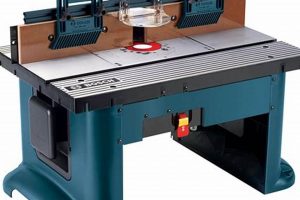
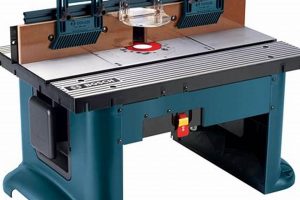
A specialized workbench fixture designed to hold a power tool securely inverted for various shaping and jointing operations is a crucial element for many woodworkers. This setup transforms a handheld tool into a stationary machine, enhancing precision and control. The inverted tool projects its bit upwards through an opening in the table surface, allowing the operator to guide the workpiece along the bit for controlled material removal.
Such a fixture enhances efficiency, safety, and repeatability in numerous woodworking tasks. Its use facilitates the creation of consistent profiles on edges, the cutting of grooves and rabbets, and the formation of complex joints. Historically, these fixtures developed as woodworkers sought more stable and accurate methods for performing intricate routing operations, evolving from simple homemade solutions to sophisticated, commercially manufactured units.
Further discussion will explore the components of this fixture, the specific applications it enables, techniques for safe operation, and factors to consider when selecting a suitable model.
Router Table Usage Tips
Employing a specialized workbench fixture effectively requires adherence to best practices for safety and accuracy.
Tip 1: Secure Workpiece Support: Ensure the workpiece remains consistently flat against the table and fence throughout the cut. Featherboards and hold-downs provide essential stability, minimizing vibration and potential kickback.
Tip 2: Climb Cutting Awareness: Recognize the dangers of climb cutting, where the bit pulls the material in the direction of rotation. This technique is exceptionally risky and should only be employed with extreme caution and a thorough understanding of its mechanics. Multiple light passes are safer.
Tip 3: Gradual Depth of Cut: Avoid removing excessive material in a single pass. Multiple shallow cuts reduce stress on the tool, bit, and workpiece, yielding cleaner results and minimizing the risk of tear-out.
Tip 4: Fence Adjustment Precision: Carefully adjust the fence position to achieve the desired cut depth or profile. Use accurate measuring tools and test cuts to ensure precise results.
Tip 5: Proper Bit Selection: Choose the appropriate bit for the task at hand. Consider factors such as bit profile, cutting diameter, and shank size to optimize performance and safety.
Tip 6: Dust Collection Integration: Connect a dust collection system to the fixture to maintain a clean and safe working environment. Effective dust removal improves visibility and reduces the risk of respiratory hazards.
Tip 7: Regular Maintenance: Routinely inspect and maintain the fixture and its components. Check for loose hardware, damaged surfaces, and worn bits. Proper maintenance extends the lifespan of the equipment and ensures safe operation.
Adherence to these guidelines promotes safer and more accurate use of the fixture, enhancing the quality and precision of woodworking projects.
The following sections will provide additional context regarding safety considerations and selection criteria.
1. Stability

Stability represents a cornerstone characteristic impacting the performance and safety of any routing operation conducted on a woodworking fixture. It directly influences the consistency of cuts, the accuracy of profiles, and the overall quality of the finished workpiece. A lack of stability can lead to inaccuracies, dangerous kickback, and compromised project outcomes.
- Solid Base and Construction
The foundation of stability begins with the base and overall construction of the fixture. A heavy, well-built base minimizes vibration and movement during operation. Materials such as cast iron or heavy-gauge steel provide inherent mass and rigidity, damping vibrations effectively. Lightweight or poorly constructed units are prone to shifting and flexing, negatively affecting cut precision.
- Secure Tool Mounting
The method of securing the power tool is crucial. A robust mounting plate, typically made of thick aluminum or phenolic material, ensures the tool remains firmly attached to the table surface. The mounting system should prevent any wobble or play, which would translate to inaccuracies in the cut. Fasteners should be appropriately sized and tightened to the correct torque specifications.
- Fence Rigidity and Alignment
The fence serves as a crucial reference point for guiding the workpiece. A rigid fence, constructed from a stable material like MDF or aluminum, resists deflection during the cutting process. Precise alignment of the fence to the bit is essential for achieving straight cuts and consistent profiles. A fence that shifts or bows under pressure introduces inaccuracies and potential safety hazards.
- Workpiece Support and Control
Maintaining consistent contact between the workpiece and the table surface and fence is essential for stability. Auxiliary aids such as featherboards, hold-downs, and outfeed supports enhance control and prevent the workpiece from lifting or shifting during the cut. Adequate support minimizes vibration and ensures a smooth, uniform cut.
In summary, stability in a woodworking fixture stems from the synergistic effect of a solid base, secure tool mounting, a rigid and aligned fence, and effective workpiece support. Addressing each of these elements contributes to a safer and more accurate routing experience. A stable platform directly translates to higher quality woodworking projects and a reduction in potential hazards.
2. Precision

Precision is a defining characteristic of a woodworking fixture’s utility. The capacity to execute cuts with high accuracy and repeatability separates it from freehand routing. The secure, stable platform provided directly enables greater control over the cutting process. This control manifests in consistent depth, precise edge profiles, and accurately formed joints.
For example, creating identical moldings for cabinetry requires precise cuts. A woodworking fixture allows for setting the fence and bit height to exact measurements, ensuring each molding matches the others. In contrast, freehand routing can easily lead to variations in shape and size. Similarly, crafting intricate dovetail joints demands accuracy. A woodworking fixture, equipped with appropriate jigs, enables the consistent creation of these joints, ensuring a strong and aesthetically pleasing connection. Without this level of precision, the structural integrity and visual appeal of the finished product would be compromised.
Achieving precision relies on the quality of the fixture itself. Stable construction, accurate fence adjustment mechanisms, and a flat, true table surface are essential. Investing in a high-quality fixture and using appropriate measuring tools are critical to maximizing precision. Understanding the interplay between the fixture’s components and their impact on the final cut is paramount for any woodworker seeking to achieve professional results. The pursuit of precision directly enhances the overall quality and value of woodworking projects.
3. Versatility

The adaptability of a woodworking fixture to accommodate a diverse range of tasks is a key consideration when evaluating its overall value. This capability allows it to function as a central tool in a woodworking shop, reducing the need for multiple specialized machines and streamlining various processes.
- Profile Creation
A primary function involves shaping edges and creating decorative profiles. With a variety of router bits, the fixture can produce coves, rounds, ogees, and other complex shapes on wood stock. This capability extends to creating moldings, trim, and decorative elements for furniture and architectural details. Different bit profiles expand the possibilities for design and customization, limited only by the availability of bits.
- Jointing Operations
The fixture facilitates the creation of various woodworking joints, including rabbets, dados, and grooves. Utilizing a straight bit and the fence, precise and consistent cuts can be achieved for joinery. Specialized jigs further enhance the ability to create dovetails, tenons, and other intricate joints, providing strong and aesthetically pleasing connections between wooden components.
- Shaping and Contouring
Beyond edge profiling, the fixture allows for shaping and contouring of workpieces. By using template routing techniques, complex curves and shapes can be accurately reproduced. A template is affixed to the workpiece, and a flush trim bit follows the template’s contours, transferring the shape to the wood. This method is applicable for creating curved furniture components, signs, and other decorative items.
- Material Removal
In addition to shaping, the fixture can be used for controlled material removal. This is useful for tasks such as creating inlays, carving designs, or flattening surfaces. With appropriate bits and techniques, the fixture provides a precise means of removing specific amounts of material, resulting in detailed and accurate results.
The fixture’s adaptability significantly broadens the scope of woodworking projects that can be undertaken. This versatility translates to increased efficiency, reduced equipment costs, and enhanced creative possibilities within the workshop.
4. Safety

Safety constitutes a paramount consideration in the operation of any woodworking machinery, including the specialized fixture designed to invert a handheld power tool. The potential for injury necessitates a rigorous understanding and adherence to safety protocols. This section will outline critical safety facets.
- Eye and Ear Protection
The high-speed rotation of cutting bits generates projectiles and substantial noise levels. Safety glasses or a face shield are indispensable for protecting the eyes from flying debris, such as wood chips and splinters. Similarly, earplugs or earmuffs are necessary to mitigate the risk of hearing damage from prolonged exposure to elevated noise. Failure to utilize appropriate personal protective equipment can result in irreversible eye or auditory impairment.
- Safe Workpiece Handling
Maintaining control over the workpiece is crucial to prevent kickback, a dangerous phenomenon where the bit forcefully ejects the material. Hands should be positioned away from the cutting bit, and auxiliary aids like featherboards and hold-downs should be employed to secure the workpiece against the fence and table. Avoid reaching over or behind the bit during operation, as this significantly increases the risk of injury. A firm, controlled grip and proper support mechanisms are essential for safe workpiece handling.
- Bit Selection and Condition
The selection of an appropriate bit for the task at hand and ensuring its proper condition are vital safety measures. Incorrectly sized or dull bits require more force to cut, increasing the likelihood of kickback or breakage. Inspect bits for damage, such as cracks or chipped edges, before each use. Use only bits designed for the material being cut and operate them within their recommended speed range. A well-maintained, properly selected bit contributes significantly to safer and more efficient operation.
- Power and Lockout Procedures
Prior to making any adjustments to the fixture or changing bits, the power tool must be completely disconnected from the power source. This prevents accidental activation and potential injury. Engaging the tool’s spindle lock and using appropriate wrenches for bit changes ensures secure tightening and prevents slippage during operation. Following proper lockout/tagout procedures is a fundamental safety practice that must be strictly adhered to.
These safety facets are interconnected and contribute to a safer working environment when operating the specialized woodworking fixture. Consistent application of these practices minimizes risk and promotes responsible tool usage.
5. Adjustability
Adjustability, with respect to a specialized woodworking fixture, is a pivotal element directly influencing its versatility and utility. It allows for adaptation to a spectrum of woodworking operations, accommodating varying material thicknesses, bit profiles, and desired cut depths. Without sufficient adjustability, the utility of the fixture is significantly limited.
- Fence Positioning
The capacity to precisely position the fence is fundamental. This adjustment governs the distance between the cutting bit and the fence, directly determining the width of the cut or the depth of a profile. Fine-tuning mechanisms, such as micro-adjusters, enable minute alterations, ensuring accurate and repeatable results. For instance, creating a precise rabbet requires the ability to adjust the fence with a high degree of accuracy.
- Bit Height Control
The means to control the vertical position of the cutting bit is similarly essential. This adjustment dictates the depth of the cut or the height of a profile. Mechanisms may include a crank or a lever system to raise or lower the tool. The ability to fine-tune bit height is critical for tasks such as creating precisely sized dados or shaping intricate profiles in multiple passes. A locking mechanism to maintain the set height is also necessary to prevent unintentional movement during operation.
- Table Surface Features
Certain models incorporate adjustable table inserts or surfaces. These features allow for fine-tuning the opening around the bit, minimizing gaps that could cause workpiece instability or tear-out. Adjustable inserts can accommodate different bit sizes and shapes, optimizing support for the material being cut. Some tables also offer adjustable leveling feet to ensure a flat and stable work surface, crucial for maintaining accuracy.
- Angle Adjustments
Some advanced fixtures offer the capability to adjust the angle of the fence or the entire table relative to the bit. This allows for specialized operations such as creating angled grooves, chamfers, or bevels. Angle adjustment mechanisms typically involve protractors or scales for precise setting. This feature expands the versatility of the fixture, enabling the creation of unique and complex designs.
In summary, adjustability empowers the user to tailor the fixture to specific project requirements. The capacity to fine-tune fence positioning, bit height, table surface features, and angle adjustments enhances precision, repeatability, and overall efficiency. A fixture with a wide range of adjustment capabilities provides greater flexibility and expands the scope of woodworking projects that can be undertaken.
6. Dust Collection

Effective dust collection is an integral component of any functional woodworking station that incorporates a specialized fixture for routing operations. The high-speed rotation of a routing bit generates significant quantities of fine particulate matter, consisting of wood dust and debris. This dust, if left uncollected, poses health risks to the operator and degrades the working environment. The connection is causative: the routing operation produces dust; dust collection mitigates its negative effects. A fixture without an effective dust collection system is incomplete and potentially unsafe.
The health risks associated with prolonged exposure to wood dust are well-documented and include respiratory problems, skin irritation, and, in some cases, certain types of cancer. Moreover, accumulated dust can create a fire hazard and obscure the operator’s vision, increasing the risk of accidents. An integrated dust collection system, typically comprising a shroud or port connected to a vacuum or dust collector, captures dust at the source, preventing it from becoming airborne. This enhances visibility, reduces the risk of respiratory issues, and maintains a cleaner workspace. For instance, consider a craftsman creating detailed moldings. The resulting fine dust, if not captured, would quickly accumulate, obscuring the work and posing a health risk. A connected dust collector immediately removes this dust, allowing for precise work and a healthier environment.
In conclusion, dust collection is not merely an accessory but a fundamental aspect of a functional and safe routing station. It mitigates health hazards, improves visibility, and contributes to a more efficient workflow. The absence of effective dust collection undermines the benefits of the specialized woodworking fixture itself. While challenges may exist in achieving perfect dust capture, the benefits of even a partially effective system are significant and outweigh the costs of implementation.
Frequently Asked Questions about Woodworking Fixtures for Routers
The following addresses common inquiries regarding specialized woodworking fixtures designed to hold power routers inverted.
Question 1: What is the primary benefit of using a router mounted on a table as opposed to handheld?
The primary benefit lies in enhanced stability and control. Mounting the tool to a fixed surface transforms it into a stationary machine, allowing the operator to guide the workpiece with both hands. This increases accuracy, reduces vibration, and enhances safety compared to handheld operation.
Question 2: Are specific safety precautions necessary when operating a table-mounted routing device?
Yes. Critical precautions include wearing eye and ear protection, using featherboards and hold-downs to secure the workpiece, avoiding climb cutting, and ensuring the bit is sharp and properly installed. Disconnecting power before making adjustments is also essential.
Question 3: What type of router is best suited for use with these woodworking fixtures?
A router with variable speed control and a robust motor is generally recommended. Models with above-table height adjustment mechanisms simplify bit changes and depth adjustments. Mid-size to larger routers typically offer the power and stability required for a wide range of operations.
Question 4: What materials are commonly used in the construction of these specialized tables?
Table surfaces are often constructed from MDF (Medium Density Fiberboard) or phenolic resin, providing a flat, stable surface. Fences are typically made of aluminum or hardwood. Bases may be constructed of steel, cast iron, or wood, with heavier materials generally offering greater stability.
Question 5: Can these woodworking fixtures be used for jointing operations?
Yes, these fixtures can be employed for creating various joints, including rabbets, dados, and grooves. By using a straight bit and carefully positioning the fence, precise and consistent cuts can be achieved. Specialized jigs can further expand the range of jointing capabilities.
Question 6: How important is dust collection when using a specialized routing table?
Dust collection is critically important. The routing process generates fine wood dust, which poses health risks. Connecting a dust collection system to the table significantly reduces airborne dust, improving visibility, protecting respiratory health, and minimizing fire hazards.
In summary, understanding the advantages, safety protocols, and appropriate equipment is critical to maximizing the benefits of specialized routing tables.
The following sections will offer information regarding table selection criteria and maintenance procedures.
Conclusion
This discussion has explored the multifaceted nature of what is a router table woodworking, emphasizing its function as a stability-enhancing fixture, its contribution to precision and versatility, and the critical importance of safety and dust management. A specialized woodworking fixture fundamentally alters the capabilities of a handheld power tool, providing a secure platform for repeatable and intricate operations.
The decision to integrate such a device into a woodworking shop should be predicated on a thorough understanding of its benefits and limitations. Careful consideration of factors such as construction quality, adjustability, and safety features is essential. Continued adherence to established safety protocols and investment in proper maintenance procedures will ensure long-term utility and minimize potential hazards.
![Best Woodworking Plans Drafting Table [Guide] for Table | Step-by-Step Guides, Tools & Inspiration to Build Beautiful Wooden Decor on a Budget](https://woodfromhome.com/wp-content/uploads/2026/05/th-80-300x200.jpg "Best Woodworking Plans Drafting Table [Guide] for Table Step-by-Step Guides, Tools & Inspiration to Build Beautiful Wooden Decor on a Budget")