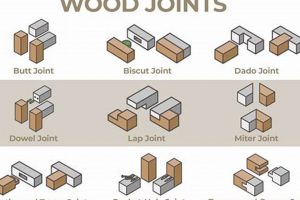
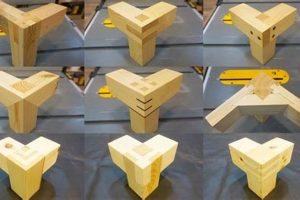
A technique employed in woodworking, this method involves interlocking projections and recesses cut to resemble a dove’s tail in shape. When properly executed, it yields a strong and visually appealing connection between two pieces of wood. A common application is in the construction of drawers, boxes, and cabinet carcasses where durability and resistance to pulling forces are paramount.
The employment of this joint offers several advantages. It provides exceptional strength due to the mechanical interlocking of the components, often eliminating the need for fasteners like screws or nails. Historically, its use reflects a commitment to craftsmanship and longevity in furniture making. The joint’s inherent resistance to racking forces makes it ideal for items subjected to stress or frequent movement.
The following sections will delve into specific aspects of this woodworking practice, including the various types, tools required, and steps involved in its creation. Techniques for both hand-cut and machine-made versions will be addressed, offering a comprehensive guide for understanding and implementing this enduring joint.
Essential Guidance for Precision Woodworking
The following tips are intended to enhance the accuracy and strength of joinery achieved through interlocking methods, crucial for durable and aesthetically pleasing results. Attention to detail throughout the process is paramount.
Tip 1: Material Selection is Critical: Employ hardwoods of consistent density for optimal joint strength. Avoid using woods with excessive knots or grain irregularities near the joint area, as these can compromise structural integrity.
Tip 2: Accurate Layout is Non-Negotiable: Precisely mark the pin and tail locations using a sharp marking knife and a reliable square. Any deviation from the intended layout will manifest as gaps or misalignments in the final assembly.
Tip 3: Sharp Tools Ensure Clean Cuts: Maintain chisels and saws with razor-sharp edges. Dull tools will tear the wood fibers, resulting in a weak and unsightly joint. Regular honing and sharpening are essential.
Tip 4: Consider the Grain Direction: Orient the components so that the grain direction allows for expansion and contraction. Failure to account for wood movement can lead to joint failure over time.
Tip 5: Dry Fitting is Mandatory: Before applying any adhesive, dry-fit the joint to verify proper alignment and fit. Make any necessary adjustments at this stage to ensure a seamless connection.
Tip 6: Glue Application Requires Restraint: Apply glue sparingly to avoid excessive squeeze-out, which can interfere with the finish and require extensive cleanup. Even distribution is more important than quantity.
Tip 7: Clamping is Necessary for Success: Use appropriate clamps to apply even pressure during the glue-up process. Uneven pressure can result in a skewed or weakened joint. Protect the wood surface with cauls to prevent clamp marks.
Mastering interlocking joinery requires patience, precision, and a commitment to quality. Adhering to these principles will yield robust and visually appealing woodworking projects that withstand the test of time.
The subsequent sections will explore advanced techniques and troubleshooting tips to further refine the execution of this time-honored woodworking method.
1. Joint Strength
Joint strength, a critical attribute in any woodworking project, is significantly enhanced through the precise execution of this specific woodworking method. The interlocking design inherently resists separation, making it particularly suitable for applications requiring durability and longevity.
- Mechanical Interlock
The primary source of strength lies in the physical interlocking of the “tails” and “pins.” This mechanical bond resists pulling forces, distributing stress across the entire joint surface. Unlike butt joints relying solely on adhesive, the interlocking geometry provides inherent resistance to separation, making it suitable for drawers and cabinets subjected to frequent use.
- Glue Surface Area
The intricate design increases the surface area available for glue adhesion. A larger glued surface translates to a stronger bond, further reinforcing the mechanical interlock. This is especially critical in applications where the joint is subjected to shear forces or repetitive stress.
- Resistance to Tensile Stress
Properly executed, this woodworking connection resists tensile stress along the grain direction of the wood. This is crucial in applications where the joint is subjected to significant pulling forces, such as the corners of a drawer or the carcass of a cabinet. The interlocking “tails” and “pins” act as anchors, preventing the wood from splitting or separating.
- Material Selection Impact
The overall strength is greatly influenced by the choice of wood. Hardwoods such as oak, maple, or cherry provide superior holding power for the joint compared to softwoods like pine. The density and fiber structure of the wood directly impact the joint’s ability to withstand stress and resist deformation.
The interplay of these facets underscores the superior joint strength achievable through careful execution of this woodworking method. Its mechanical and adhesive properties, when combined with appropriate material selection, yield a connection demonstrably stronger and more durable than simpler joinery methods.
2. Wood Selection

Wood selection is paramount to the success and longevity of joinery involving interlocking methods. The inherent properties of the chosen material directly impact the strength, stability, and aesthetic appeal of the finished piece. Careful consideration of species characteristics is therefore crucial for optimal results.
- Hardness and Density
The hardness and density of the wood significantly influence the joint’s resistance to wear and tear. Hardwoods like oak, maple, and cherry provide superior strength and durability compared to softwoods like pine or fir. Dense woods offer a more secure grip for the interlocking components, minimizing the risk of joint failure under stress. For instance, a drawer constructed from oak will withstand considerably more use than one made from pine using the same joinery technique.
- Grain Direction and Stability
The grain direction and overall stability of the wood affect the potential for warping or cracking. Straight-grained woods with minimal figure are generally preferred, as they exhibit more predictable behavior and are less prone to movement with changes in humidity. Quarter-sawn lumber, with its vertical grain orientation, is particularly stable and well-suited for applications where dimensional stability is critical. Careful alignment of grain direction during assembly is also essential to minimize stress and prevent joint failure over time.
- Workability
The workability of the chosen wood influences the ease and precision with which the joint can be created. Some hardwoods, while strong, can be difficult to cut and shape, requiring specialized tools and techniques. Softer woods are easier to work but may lack the necessary strength for demanding applications. The ideal wood strikes a balance between workability and structural integrity, allowing for accurate and efficient joint construction without compromising long-term durability. For example, walnut is often favored for its combination of moderate hardness and excellent workability.
- Aesthetic Considerations
The color, figure, and texture of the wood contribute significantly to the visual appeal of the finished piece. Different wood species offer a wide range of aesthetic options, allowing the craftsman to tailor the appearance of the joint to the desired style. The choice of wood should complement the overall design and enhance the beauty of the finished product. Combining woods with contrasting colors or grains can create visually striking effects, highlighting the craftsmanship and attention to detail.
In conclusion, the selection of wood for joinery should be a deliberate decision based on a thorough understanding of its physical properties and aesthetic characteristics. By carefully considering factors such as hardness, stability, workability, and appearance, the woodworker can ensure that the resulting joint is not only strong and durable but also visually appealing and well-suited to its intended application. The proper wood choice significantly elevates the quality and longevity of the finished piece.
3. Accuracy

The successful execution of interlocking woodworking joints hinges critically on accuracy. Deviations from precise measurements and cuts directly impact the joint’s strength, stability, and aesthetic appeal. Each element, from the angle of the tails to the fit of the pins, demands exacting precision, measured often in fractions of a millimeter. Failure to adhere to these tolerances results in gaps, weakened glue surfaces, and a compromised structural integrity. Consider, for instance, a drawer constructed with poorly fitted joints. The drawer front might exhibit noticeable gaps, the drawer bottom could sag under load, and the overall lifespan of the piece would be significantly diminished. Such outcomes underscore the cause-and-effect relationship between accuracy and the performance of this joint.
Accuracy manifests in several key areas during the creation of these joints. Precise layout is paramount; transferring measurements from the drawing to the workpiece must be done with meticulous care. The cuts themselves must be clean, square, and aligned to the layout lines. This requires sharp tools, controlled movements, and a thorough understanding of the wood’s behavior. Furthermore, accurate clamping during glue-up is essential to maintain alignment and ensure even pressure across the joint surface. An example highlighting this point is in the restoration of antique furniture. Often, the original joinery, while expertly crafted, has loosened over time. Recreating these joints requires not only matching the original design but also replicating the original level of precision to ensure the restored piece retains its structural integrity and historical value.
In summary, accuracy is not merely a desirable attribute in the creation of interlocking joints; it is a fundamental requirement for achieving a robust, aesthetically pleasing, and long-lasting result. The challenges lie in mastering the necessary skills, utilizing appropriate tools, and maintaining a steadfast commitment to precision throughout the entire process. The understanding that inaccuracies inevitably lead to compromised performance is essential for any woodworker seeking to create high-quality pieces using this time-honored technique. The pursuit of precision, therefore, is an integral aspect of achieving excellence in woodworking.
4. Tool Sharpness

In the context of creating interlocking joints, tool sharpness is not merely a convenience but a fundamental prerequisite for achieving precision and structural integrity. The inherent complexity of these joints demands clean, accurate cuts, a feat achievable only with properly sharpened tools. Compromised sharpness inevitably leads to deviations from intended dimensions and a weakened final product.
- Clean Cut Facets
Sharp tools sever wood fibers cleanly, leaving a smooth surface ideal for glue adhesion. Dull tools, conversely, crush and tear fibers, resulting in a rough surface that inhibits proper bonding. This is crucial for the joint’s long-term strength. For instance, tails cut with a dull saw will have ragged edges, diminishing the glue surface area and weakening the bond between the tail board and the pin board.
- Precision and Accuracy
Sharp tools allow for precise cuts along layout lines. This accuracy is essential for ensuring a tight, gap-free fit between the pins and tails. A dull chisel, for example, is prone to wandering, making it difficult to pare precisely to the marked lines. This imprecision accumulates across multiple joints, leading to cumulative errors and a poorly fitting assembly.
- Reduced Tear-Out
Sharp tools minimize tear-out, a common problem encountered when working with wood. Tear-out occurs when wood fibers are pulled out ahead of the cutting edge, resulting in a jagged or uneven surface. Sharp chisels and saws slice through the wood fibers cleanly, preventing this damage and preserving the integrity of the joint’s edges. Tear-out can be particularly problematic when cutting the baseline of the tails, as it compromises the visual appeal of the joint.
- Enhanced Control and Safety
Sharp tools provide greater control and reduce the risk of accidents. A sharp chisel, for example, requires less force to use, reducing the likelihood of slipping and cutting oneself. Similarly, a sharp saw tracks straighter and requires less effort to push, reducing fatigue and improving accuracy. Dull tools, on the other hand, require more force, increasing the risk of losing control and potentially causing injury.
The facets described above underscore the inseparability of tool sharpness and quality interlocking joinery. While technique and wood selection play significant roles, the condition of the tools directly influences the precision, strength, and safety of the woodworking process. Therefore, maintaining razor-sharp edges on all relevant tools is an investment in both the quality of the finished piece and the well-being of the woodworker.
5. Grain Direction

Grain direction in woodworking, specifically concerning interlocking joints, is a critical factor that influences the joint’s structural integrity and resistance to seasonal wood movement. Ignoring grain orientation can lead to joint failure and diminished aesthetic appeal.
- Longitudinal Grain Orientation in Tails
The tails, typically cut into the drawer side or case side, should ideally have the grain running longitudinally. This orientation provides maximum strength against the pulling forces exerted on the joint when the drawer is opened or the case is stressed. If the grain runs perpendicular or diagonally, the tails become significantly weaker and prone to snapping under load, especially in woods with pronounced grain patterns. An example includes drawer sides made with flatsawn lumber, where the curved grain weakens the tail’s ability to resist tensile stress, leading to premature failure.
- Perpendicular Grain Orientation in Pins
The pins, cut into the drawer front or case front, inherently have a grain direction that is perpendicular to the tails when the joint is assembled. This perpendicularity is structurally advantageous, as it interlocks with the longitudinal grain of the tails to resist racking forces. However, consideration must be given to the pin board’s potential for expansion and contraction across the grain. The pins should be sized appropriately to accommodate this movement without putting undue stress on the tails. Ignoring this can lead to the tails cracking or the entire joint becoming distorted over time, particularly in environments with significant humidity fluctuations.
- Accommodating Wood Movement
Wood expands and contracts across the grain with changes in humidity. In interlocking joinery, this movement must be accounted for to prevent joint failure. The tails, being typically wider than the pins, are more susceptible to causing issues if expansion is constrained. Techniques such as slightly angling the sides of the pins (allowing for a small amount of expansion room) or using a less dense wood for the pin board (allowing it to compress slightly) can mitigate this risk. An example is seen in antique furniture, where poorly planned grain orientation often leads to cracked drawer fronts or split case sides, necessitating repair or restoration.
- Mitigating Seasonal Stress
Seasonal changes in humidity induce stress within the joint due to differential expansion and contraction. The tails and pins, being oriented perpendicularly, react differently to these changes. Proper wood selection, such as using quarter-sawn lumber for the case sides, can minimize this stress, as quarter-sawn lumber exhibits less tangential movement compared to plain-sawn lumber. Additionally, finishing the wood with a moisture-resistant coating can help to slow down the rate of moisture absorption and desorption, reducing the severity of seasonal stress on the interlocking joint.
In conclusion, the interaction between grain direction and interlocking joinery is a complex but crucial consideration for woodworkers aiming to create durable and aesthetically pleasing pieces. Understanding the mechanical properties of wood and how it responds to environmental changes is essential for designing and executing joints that will withstand the test of time. Ignoring these principles can result in compromised structural integrity and premature failure, negating the benefits of this time-honored technique.
6. Glue Application
The effectiveness of interlocking joinery is inextricably linked to the proper application of adhesive. While the mechanical interlock of the tails and pins provides inherent strength, glue serves as a critical secondary reinforcement, filling gaps, preventing movement, and creating a bond that resists both tensile and shear stresses. A deficient glue application diminishes the joint’s overall strength and long-term stability. For example, a drawer constructed with interlocking joints but insufficient glue coverage may exhibit racking or separation over time, particularly under heavy loads or in environments with fluctuating humidity. Conversely, a properly glued joint integrates the wood fibers, creating a homogenous connection that distributes stress evenly.
Several factors contribute to optimal adhesive usage. Surface preparation is paramount; the wood surfaces must be clean and free of contaminants that could impede adhesion. Glue should be applied evenly and in sufficient quantity to coat all mating surfaces without excessive squeeze-out. The type of glue also plays a significant role. Yellow aliphatic resin glue (often referred to as “wood glue”) is commonly used due to its strength, gap-filling properties, and relatively long open time, allowing for accurate alignment and clamping. However, in specialized applications, such as exterior woodworking or situations requiring increased water resistance, other adhesives like epoxy or polyurethane glue may be more suitable. Clamping pressure must also be carefully controlled to ensure proper contact between the glued surfaces, facilitating maximum bond strength.
In summary, glue application is an indispensable component of robust interlocking joinery. The mechanical interlock provides a foundation, but the adhesive creates the cohesive bond that resists separation and distributes stress. Proper surface preparation, appropriate glue selection, even application, and controlled clamping pressure are all essential for achieving optimal results. Recognizing the significance of glue application allows for the creation of woodworking pieces with superior strength, durability, and aesthetic longevity. Failure to give it due consideration directly undermines the time and effort invested in cutting the joint itself.
7. Clamping Pressure

Clamping pressure, in the context of interlocking woodworking, represents a critical variable directly influencing the joint’s ultimate strength and integrity. The interlocking geometry provides initial mechanical resistance; however, effective clamping during adhesive curing maximizes the contact area between the wood surfaces, facilitating optimal bond formation. Inadequate pressure hinders proper adhesion, leading to gaps and a compromised joint. Conversely, excessive pressure can starve the joint of adhesive, resulting in a similarly weakened connection. A balance must be achieved to ensure the glue line is thin and uniform, maximizing the bond’s cohesive strength. Consider, for instance, a drawer constructed with interlocking joints. Insufficient clamping results in weak glue bonds, allowing the drawer to rack or even separate under stress. Excessive clamping might squeeze out too much glue, creating a glue-starved joint. The ideal clamping scenario provides uniform pressure across all mating surfaces, yielding a robust and long-lasting bond.
The application of appropriate clamping pressure necessitates careful consideration of several factors, including the type of wood, the adhesive used, and the geometry of the joint itself. Hardwoods, due to their greater density, generally require more clamping pressure than softwoods. Different adhesives also exhibit varying requirements regarding clamping pressure; epoxy, for example, often necessitates less pressure than traditional yellow glue. Complex joint geometries, with intricate interlocking features, demand even distribution of pressure to ensure consistent contact. Common clamping methods include bar clamps, pipe clamps, and band clamps, each offering different advantages in terms of pressure distribution and accessibility. Cauls, or clamping blocks, are often employed to distribute pressure evenly and prevent clamp marks on the wood surface. A real-world example of optimized clamping pressure is evident in high-end cabinet making, where precision joinery and meticulous clamping techniques contribute to the exceptional durability and longevity of the finished product. A cabinetmaker might use a series of bar clamps in conjunction with custom-fitted cauls to apply even pressure across the entire joint, ensuring a tight and seamless bond.
In summary, clamping pressure is not merely a mechanical process; it is an integral aspect of achieving robust interlocking woodworking. The application of appropriate pressure, carefully calibrated to the materials and joint geometry, directly influences the bond strength and long-term stability of the connection. Addressing challenges related to pressure distribution and adhesive selection allows for the creation of woodworking pieces that exhibit both structural integrity and aesthetic excellence. This understanding reinforces the importance of a holistic approach to woodworking, where each step in the process, from material selection to final assembly, contributes to the overall quality and longevity of the finished piece.
Frequently Asked Questions
This section addresses common inquiries and misconceptions concerning the design, construction, and application of interlocking woodworking joints. The information provided aims to offer clarity and informed guidance for both novice and experienced woodworkers.
Question 1: What distinguishes the method from other woodworking joints in terms of strength and durability?
The primary distinction lies in the mechanical interlock formed by the tails and pins. This geometric configuration provides inherent resistance to tensile forces, eliminating the reliance solely on adhesive strength as found in butt joints. The increased glue surface area further enhances durability, creating a robust connection capable of withstanding significant stress and racking forces over extended periods.
Question 2: Which wood species are best suited for creating robust and long-lasting interlocking joints?
Hardwoods such as oak, maple, cherry, and walnut are generally preferred due to their higher density and tighter grain structure. These species offer superior resistance to wear, splitting, and deformation, resulting in a stronger and more durable joint. Softwoods like pine and fir can be used, but require careful selection and may necessitate reinforcement in high-stress applications.
Question 3: What are the essential tools required for accurately cutting interlocking joints by hand?
Essential tools include a sharp dovetail saw, a set of high-quality chisels, a marking gauge, a marking knife, a square, and a mallet. Precision is paramount; therefore, maintaining the sharpness of these tools is critical for achieving clean, accurate cuts. The specific sizes and types of chisels will depend on the scale and complexity of the joint being created.
Question 4: What are the key considerations for ensuring proper glue adhesion in interlocking joints?
Surface preparation, adhesive selection, and clamping pressure are crucial. Wood surfaces must be clean, dry, and free of contaminants. Yellow aliphatic resin glue (wood glue) is commonly employed due to its strength and gap-filling properties. Clamping pressure must be sufficient to ensure intimate contact between the mating surfaces without starving the joint of adhesive.
Question 5: How does wood movement affect interlocking joints, and what measures can be taken to mitigate potential problems?
Wood expands and contracts across the grain with changes in humidity. This movement can induce stress within the joint, potentially leading to cracking or separation. Proper grain orientation, the use of quarter-sawn lumber, and allowing for slight play in the pin dimensions can help accommodate wood movement and minimize stress on the joint.
Question 6: What are the common mistakes to avoid when creating interlocking joints?
Common mistakes include inaccurate layout, dull tools, improper glue application, insufficient clamping pressure, and neglecting grain orientation. Paying meticulous attention to detail, using sharp tools, and understanding the properties of wood are essential for avoiding these pitfalls and achieving successful results.
In summary, mastering interlocking woodworking requires a combination of technical skill, careful planning, and a thorough understanding of the materials and processes involved. Addressing these common questions and avoiding potential pitfalls will contribute to the creation of robust, durable, and aesthetically pleasing woodworking pieces.
The following section will provide a detailed step-by-step guide to creating a specific type of interlocking joint.
Conclusion
The preceding exploration has illuminated the intricacies of dovetail joint woodwork, underscoring its significance in achieving both structural integrity and aesthetic refinement in woodworking projects. Key points addressed include the crucial role of accurate layout, tool sharpness, wood selection, appropriate glue application, and controlled clamping pressure. Furthermore, consideration was given to the effects of grain direction and wood movement on the joint’s long-term stability.
Mastery of dovetail joint woodwork demands a commitment to precision and a thorough understanding of wood properties. Its application signifies a dedication to enduring craftsmanship. Continued refinement of technique and an appreciation for its inherent strengths will ensure the perpetuation of this valuable woodworking tradition, contributing to the creation of pieces that stand as testaments to both skill and artistry.