



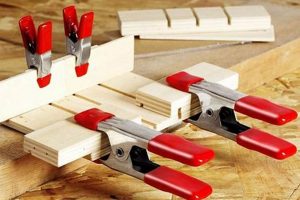
These devices are a type of clamping tool specifically designed to apply pressure quickly and efficiently in woodworking projects. Characterized by their one-handed operation and rapid adjustment mechanisms, they secure workpieces for gluing, fastening, and assembly. An example is a spring clamp applied to hold mitered corners together while adhesive cures.
The use of rapid-action fasteners enhances productivity in woodworking environments. Their speed and ease of use reduce setup time, allowing woodworkers to focus on craftsmanship. Historically, these tools represent an evolution from traditional screw-based clamps, addressing the need for more agile clamping solutions.
This article will examine the different types available, explore their optimal applications, discuss selection criteria, and provide guidance on maintenance for longevity and reliable performance.
Maximizing Efficiency with Rapid-Action Fasteners
Effective utilization of these clamping tools is essential for achieving optimal results in woodworking. The following tips provide guidance on best practices for their selection, application, and maintenance.
Tip 1: Choose the Appropriate Type: Select the clamp style based on the project’s specific requirements. Bar clamps are suitable for large surface areas, while spring clamps are effective for smaller, more delicate tasks. Handi clamps excel in projects where space is constricted.
Tip 2: Consider Jaw Depth and Capacity: Ensure the clamp’s jaw depth is sufficient to reach the desired clamping point on the workpiece. Furthermore, verify that the clamping capacity accommodates the maximum thickness of the materials being joined. Avoid exceeding the clamp’s specified load limit.
Tip 3: Employ Protective Pads: Utilize clamp pads, either commercially purchased or self-made from soft materials like cork or leather, to protect the workpiece surface from damage and prevent indentation during clamping. Even pressure distribution will protect the project from scuffs and dents.
Tip 4: Distribute Clamping Force Evenly: Position multiple clamps strategically to distribute clamping force uniformly across the joint. This minimizes the risk of warping or misalignment, resulting in a stronger and more aesthetically pleasing bond.
Tip 5: Avoid Over-Tightening: Refrain from applying excessive force when tightening the clamps. Over-tightening can damage the workpiece or strip the clamp’s mechanism. Apply only enough pressure to achieve a secure hold.
Tip 6: Clean and Maintain Regularly: Routinely clean the clamps to remove glue residue, sawdust, and other debris. Lubricate moving parts periodically with a light machine oil to ensure smooth operation and prevent corrosion.
Tip 7: Store Properly: Store the fasteners in a clean, dry environment to prevent rust and damage. Hanging them on a wall or storing them in a designated container helps keep them organized and readily accessible.
Implementing these strategies will improve the efficiency and quality of woodworking projects. Proper clamp selection, application, and maintenance will extend the life of the tools and enhance their overall effectiveness.
The following sections will explore specific types, their uses, and maintenance procedures in greater detail.
1. Material

The composition of rapid-action woodworking fasteners directly impacts their durability, performance, and suitability for various applications. Material selection considers strength, weight, resistance to corrosion, and potential for workpiece marring.
- Steel Construction
Many fasteners utilize steel for its high tensile strength and ability to withstand significant clamping forces. Steel components are often heat-treated to enhance hardness and durability, making them suitable for heavy-duty applications. However, steel is susceptible to corrosion if not properly coated or treated. The risk of workpiece indentation also exists, necessitating the use of protective pads.
- Aluminum Alloys
Aluminum alloys offer a lighter alternative to steel, providing a balance between strength and weight. They are naturally corrosion-resistant, making them suitable for environments with high humidity. Aluminum alloys may not possess the same load-bearing capacity as steel, limiting their use in certain demanding applications. Careful design and alloy selection can mitigate these limitations.
- Reinforced Plastics/Composites
High-strength plastics and composite materials offer advantages in terms of weight reduction and resistance to corrosion. They can be molded into complex shapes, facilitating ergonomic designs and integrated features. However, plastics and composites may exhibit lower stiffness and strength compared to metals, potentially limiting their suitability for applications requiring high clamping forces or resistance to deformation. They can also degrade over time with exposure to UV light or certain chemicals.
- Wood Components
The handles and grips of quick clamps are often made of wood, particularly hardwood varieties such as maple or beech. Wood provides a comfortable and ergonomic grip, reducing fatigue during prolonged use. Wood is susceptible to moisture damage and may require periodic maintenance, such as oiling or varnishing, to prevent cracking or warping. The use of wood in clamping tools offers a classic aesthetic and a tactile connection to the woodworking craft.
The choice of material for rapid-action fasteners requires careful consideration of the intended application, clamping force requirements, environmental conditions, and desired tool lifespan. A balance must be struck between strength, weight, corrosion resistance, and cost to optimize performance and usability in woodworking projects.
2. Clamping Force
Clamping force represents a critical parameter in woodworking, defining the amount of pressure exerted by a quick clamp to securely hold workpieces together. Insufficient force compromises joint integrity, while excessive force can damage materials. Therefore, selecting clamps with appropriate force capabilities is paramount for successful woodworking projects.
- Magnitude and Material Compatibility
The required clamping force varies depending on the material being worked. Softwoods generally require less force than hardwoods to achieve a secure bond. Over-clamping softwoods can lead to indentation or crushing, while insufficient force on hardwoods may result in weak glue lines. Adjustable clamps allow for precise force modulation to match material properties.
- Joint Type and Force Distribution
Different joint types necessitate varying levels of clamping force and strategic distribution. Miter joints, for instance, benefit from even pressure across the entire joint surface to prevent gaps. Mortise and tenon joints require force concentrated at the tenon shoulders. Clamps with broad, flat jaws are suitable for distributing force, while specialized clamps address specific joint configurations.
- Clamp Mechanism and Force Generation
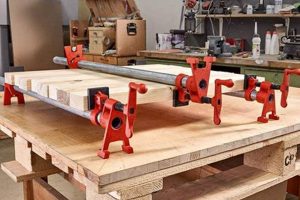
The mechanism by which a quick clamp generates force directly affects its usability and effectiveness. Ratcheting mechanisms provide incremental force adjustment and consistent pressure maintenance. Spring clamps offer rapid application but may lack the force necessary for demanding applications. Bar clamps, while not always considered “quick,” offer substantial force capacity and wide adjustability.
- Force Measurement and Control
While precise force measurement is not always practical in woodworking, understanding the relative force output of different clamps is beneficial. Some manufacturers provide force ratings for their products, allowing users to make informed decisions. Users can develop a sense of appropriate force through experience and observation, monitoring workpiece behavior during clamping.
The interplay between clamping force, material properties, and joint type dictates the success of woodworking operations. Selecting quick clamps with appropriate force capabilities and understanding how to apply that force effectively are essential skills for achieving strong, durable, and aesthetically pleasing woodworking results.
3. Jaw Opening Range
Jaw opening range is a fundamental characteristic of woodworking quick clamps, determining the maximum workpiece thickness the tool can accommodate. Its selection directly impacts project feasibility and clamping effectiveness.
- Maximum Capacity and Project Suitability
A quick clamp’s maximum jaw opening dictates the upper limit of workpiece dimensions it can secure. Selecting a clamp with an insufficient range renders it unusable for larger projects. Conversely, opting for excessive range may result in cumbersome handling for smaller workpieces. Matching range to anticipated project needs is crucial.
- Minimum Capacity and Thin Stock Clamping
While maximum range is important, minimum jaw opening is also a consideration, particularly when working with thin stock. Some clamps may struggle to exert sufficient pressure on very thin materials due to their inherent design. Specialized clamps with low-profile jaws address this limitation.
- Adjustability and Incremental Range
The adjustability of a clamp’s jaw opening is critical for accommodating varying workpiece thicknesses. Clamps with fine-threaded spindles or quick-release mechanisms provide precise adjustments. Incremental range refers to the smallest increment by which the jaw opening can be adjusted, impacting the clamp’s versatility.
- Throat Depth and Clamping Point Access
Jaw opening range is closely related to throat depth, the distance from the clamp’s bar to the clamping point. A greater throat depth allows the clamp to reach further into the workpiece, facilitating edge clamping or securing pieces in the center of a larger assembly. However, increasing throat depth may reduce clamping force and stability.
Therefore, careful consideration of jaw opening range, encompassing both maximum and minimum capacities, adjustability, and its interplay with throat depth, is essential for selecting appropriate quick clamps that fulfill the demands of diverse woodworking tasks.
4. Throat Depth Capacity
Throat depth capacity, within the context of woodworking quick clamps, refers to the distance from the clamp’s bar to the clamping point on the workpiece. This dimension dictates the clamp’s reach and influences its suitability for various woodworking applications.
- Accessibility of Internal Joints
A clamp’s throat depth determines its ability to apply pressure to joints located away from the edge of a board or assembly. For projects involving frames, boxes, or casework, a greater throat depth is essential to secure internal joints effectively. Insufficient depth limits clamping options and may necessitate alternative joining methods.
- Edge Clamping Applications
Edge clamping, where pressure is applied along the edge of a board to join it to another, benefits from adequate throat depth. This prevents the clamp’s bar from interfering with the alignment of the boards. A deeper throat allows for clamping further away from the edge, distributing pressure more evenly across the joint.
- Balancing Depth and Clamping Force
Increasing throat depth can impact the clamp’s overall clamping force. Clamps with very deep throats may exhibit reduced force at the clamping point due to increased leverage. Therefore, selecting a clamp involves balancing the need for reach with the requirement for sufficient holding power. Design considerations and material choices influence this balance.
- Clamp Design Variations
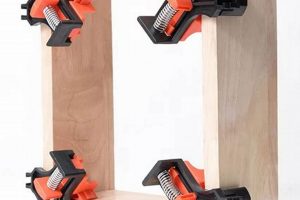
Different quick clamp designs exhibit varying throat depths. Bar clamps typically offer greater depths compared to handi-clamps or spring clamps. Specialized clamps, such as edge clamps or miter clamps, are designed with specific throat depths optimized for their intended applications. Understanding these design variations is crucial for selecting the appropriate clamp type.
The interaction between throat depth capacity, clamping force, and joint location is a crucial consideration when selecting quick clamps for woodworking. Proper selection ensures that pressure can be applied effectively and efficiently, leading to stronger and more durable woodworking projects.
5. Application Speed
Application speed, within the context of woodworking quick clamps, denotes the time required to secure a workpiece. This factor significantly influences project efficiency and overall productivity, making it a critical consideration for woodworkers.
- One-Handed Operation and Reduced Setup Time
Many woodworking quick clamps feature designs that allow for one-handed operation. This capability minimizes the time spent securing workpieces, freeing up the user’s other hand for alignment or other tasks. Consequently, projects progress more rapidly as setup time is reduced.
- Rapid Adjustment Mechanisms and Workflow Optimization
Quick-release mechanisms and fast-adjusting spindles enable swift changes in clamping pressure and jaw opening. These features streamline the workflow, particularly in situations requiring frequent adjustments or repositioning of the clamps. Workflow optimization directly translates to time savings and increased output.
- Clamp Type and Task-Specific Efficiency
The application speed varies among different types of quick clamps. Spring clamps offer the fastest application, while bar clamps provide greater force but necessitate more setup time. Selecting the appropriate clamp type for a specific task optimizes efficiency. For repetitive tasks, prioritize clamps that offer both sufficient force and rapid application.
- Ergonomics and User Fatigue Mitigation
Ergonomic designs contribute to application speed by minimizing user fatigue. Clamps with comfortable handles and intuitive mechanisms allow for prolonged use without discomfort. Reduced fatigue translates to sustained productivity throughout the duration of a project.
In summary, application speed represents a pivotal characteristic of woodworking quick clamps. By prioritizing clamps with features that enhance speed and reduce fatigue, woodworkers can significantly improve their efficiency and overall project throughput. The interplay between clamp design, user ergonomics, and task-specific requirements dictates the optimal selection for maximizing application speed.
6. Clamp Maintenance

The longevity and reliable performance of woodworking quick clamps are directly contingent upon proper maintenance. Regular care ensures these tools function optimally, providing consistent clamping force and preventing premature failure.
- Cleaning and Debris Removal
Accumulated glue, sawdust, and other debris impede clamp operation and contribute to corrosion. Regular cleaning using a brush and appropriate solvent removes these contaminants. Failing to clean clamps results in reduced clamping force and potential damage to the workpiece. An example is the removal of dried glue from the threaded spindle of a bar clamp to ensure smooth operation.
- Lubrication of Moving Parts
Moving parts, such as threaded spindles, ratcheting mechanisms, and pivot points, require periodic lubrication. A light machine oil or silicone lubricant reduces friction, preventing wear and ensuring smooth operation. Lack of lubrication leads to increased resistance, difficulty in applying clamping force, and potential for seizing. An example is lubricating the sliding arm of a quick-release clamp to maintain easy adjustment.
- Rust Prevention and Corrosion Control
Metal components of clamps are susceptible to rust and corrosion, particularly in humid environments. Applying a rust inhibitor or protective coating prevents oxidation and extends the lifespan of the tool. Neglecting rust prevention can weaken the clamp’s structure and compromise its ability to apply force safely. An example is coating the steel bar of a clamp with wax or oil to prevent rusting during storage.
- Inspection and Component Replacement
Regular inspection of clamps identifies worn or damaged components, such as pads, handles, or threaded rods. Replacing these parts promptly prevents further damage and ensures safe operation. Ignoring component wear leads to reduced clamping effectiveness and potential for accidents. An example is replacing worn clamping pads to protect the workpiece from damage.
These facets of clamp maintenance collectively contribute to the sustained functionality and reliability of woodworking quick clamps. Diligent adherence to these practices ensures that these tools provide consistent service, contributing to the quality and efficiency of woodworking projects.
Frequently Asked Questions About Woodworking Quick Clamps
This section addresses common inquiries regarding the selection, application, and maintenance of rapid-action fasteners in woodworking. Clarity on these aspects contributes to optimal tool utilization and project outcomes.
Question 1: What distinguishes a “quick clamp” from a traditional clamp in woodworking?
The primary distinction lies in the speed and ease of operation. Rapid-action devices feature mechanisms for swift application and adjustment, often operable with a single hand, whereas traditional clamps typically require more extensive setup and manual tightening.
Question 2: Is there a recommended clamping force for various wood types?
Softwoods generally require less clamping force than hardwoods. Excessive force can indent or crush softwoods, while insufficient force may compromise the bond on hardwoods. Experimentation and observation are essential to determine the appropriate force for each material.
Question 3: How does throat depth capacity affect clamp selection for specific projects?
Throat depth determines the clamp’s reach from its bar to the clamping point. Greater depth facilitates clamping of internal joints or edges away from the board’s edge. Selection hinges on the project’s geometry and joint locations.
Question 4: What are the best practices for preventing workpiece damage during clamping?
The utilization of protective pads between the clamp jaws and the workpiece is essential. Soft materials like cork or leather distribute pressure evenly, minimizing the risk of indentation or marring.
Question 5: How frequently should quick clamps be cleaned and lubricated?
Cleaning and lubrication frequency depends on usage intensity and environmental conditions. Clamps used regularly should be cleaned after each project and lubricated monthly. Infrequent use warrants less frequent maintenance, but periodic inspection is advisable.
Question 6: Are there specific storage recommendations for quick clamps to prolong their lifespan?
Storing clamps in a clean, dry environment minimizes rust and corrosion. Hanging them or storing them in a dedicated container prevents damage and ensures easy accessibility.
Proper selection and maintenance enhance the functionality and longevity of these tools.
The succeeding section will provide a comparative analysis of different brands.
Conclusion
The preceding discussion has explored critical facets of quick clamps for woodworking, encompassing material composition, clamping force considerations, jaw opening range, throat depth capacity, application speed, and maintenance protocols. The effective utilization of these fastening devices hinges on understanding and applying these core principles.
Mastery of the selection and implementation techniques ensures optimal results in various woodworking endeavors. A continued focus on innovation and refinement within the clamping technology sector will likely yield even more efficient and robust solutions for the craft.
![Top-Rated: Best Quick Clamps for Woodworking Projects [2024] | Step-by-Step Guides, Tools & Inspiration to Build Beautiful Wooden Decor on a Budget](https://woodfromhome.com/wp-content/uploads/2026/04/th-264-300x200.jpg "Top-Rated: Best Quick Clamps for Woodworking Projects [2024] Step-by-Step Guides, Tools & Inspiration to Build Beautiful Wooden Decor on a Budget")