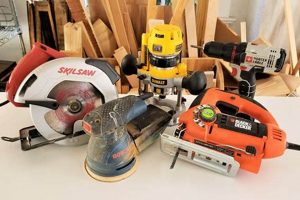
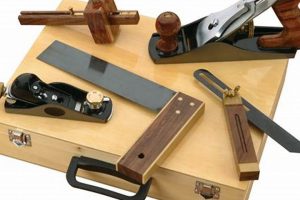
Materials and tools vital for crafting items from timber are fundamental to woodworking. These items encompass a broad range, from hand tools like chisels and planes to power equipment such as saws and routers. Additionally, the category includes consumables such as adhesives, fasteners, and finishing products essential for assembly and surface treatment. An example includes various types of lumber, screws, sandpaper, and a multitude of specialized implements tailored to specific woodworking tasks.
The availability of appropriate implements significantly impacts the efficiency and quality of woodworking projects. Access to quality tools and materials enables precise execution, contributing to durable and aesthetically pleasing results. Historically, the procurement of necessary items dictated the scope and complexity of woodworking endeavors. The evolution of manufacturing processes and distribution networks has expanded access, empowering artisans to realize increasingly intricate designs and production volumes.
Following discussion will delve into specific categories of items essential for woodworkers, covering the selection criteria, maintenance procedures, and innovative advancements that enhance the craft. A comprehensive understanding of these products is crucial for anyone engaged in shaping wood, from hobbyists to professional cabinetmakers.
Enhancing Woodworking Projects
Optimizing woodworking projects necessitates careful attention to selecting and utilizing appropriate items. The following tips provide guidance on making informed decisions and maximizing the utility of implements, ultimately enhancing the quality and longevity of completed works.
Tip 1: Material Selection Based on Project Requirements: Wood exhibits varying characteristics in terms of hardness, grain, and workability. Selecting the correct species for the intended application, considering factors such as moisture resistance, strength, and aesthetic appeal, is crucial. For instance, using cedar for outdoor projects due to its inherent resistance to decay is advisable, while hardwoods like maple are better suited for high-stress furniture components.
Tip 2: Prioritizing Quality Hand Tools: Investment in high-quality hand tools provides superior control and precision. A sharp, well-maintained chisel or hand plane allows for finer detailing and cleaner cuts compared to cheaper alternatives. While initial costs may be higher, durability and performance justify the investment over the long term.
Tip 3: Implementing Dust Collection Systems: Woodworking generates substantial dust, which poses health hazards and impairs visibility. Implementing a robust dust collection system, including a dust collector and appropriate ductwork, safeguards respiratory health and ensures a cleaner working environment.
Tip 4: Utilizing Appropriate Fasteners: Selecting the correct fasteners, such as screws or nails, for specific applications prevents structural failure and ensures lasting joints. Consider factors such as load-bearing capacity, material compatibility, and corrosion resistance when choosing fasteners. For example, using stainless steel screws for outdoor projects minimizes rust and degradation.
Tip 5: Maintaining Sharp Cutting Edges: Sharp cutting edges are essential for efficient and clean cuts. Regular sharpening of blades, chisels, and plane irons minimizes tear-out and reduces the risk of accidents. Invest in sharpening stones or systems and develop proficiency in sharpening techniques.
Tip 6: Applying Appropriate Finishes: The application of appropriate finishes enhances the aesthetic appeal of the workpiece while providing protection against moisture, UV radiation, and physical damage. Select finishes based on desired appearance, durability requirements, and ease of application. Options range from penetrating oils to protective varnishes and lacquers.
Tip 7: Proper Storage and Organization: Maintaining an organized workspace streamlines workflow and prevents damage to essential items. Implement effective storage solutions for tools, materials, and fasteners. This includes designated areas for each item and a system for maintaining inventory levels.
Adherence to these guidelines optimizes the woodworking process, promoting safety, efficiency, and the creation of high-quality finished products. Careful planning, informed selection of items, and diligent maintenance are crucial for success in this craft.
The subsequent section will explore advanced techniques and contemporary trends in woodworking, further enhancing the skills and knowledge of practitioners.
1. Essential Hand Tools

Essential hand tools represent a foundational element within the broader category of supplies for woodworkers. The availability of quality hand tools directly influences the precision, control, and overall craftsmanship achievable in woodworking projects. Without an adequate selection of these implements, executing intricate cuts, shaping complex curves, or achieving fine surface finishes becomes significantly more challenging. A chisel, for instance, is required for precise mortise creation; a hand plane refines surfaces to a smooth, even plane, and a marking gauge ensures accurate layout of joinery. The absence of these items necessitates reliance on less accurate or more cumbersome methods, potentially compromising the project’s integrity.
The selection of essential hand tools constitutes a significant portion of a woodworker’s initial investment and ongoing expenditures. These items, when properly maintained, provide decades of service, becoming indispensable extensions of the artisan’s skill. Consider the difference between a novice’s attempts at dovetailing with inadequate saws and chisels versus the precision achieved by an experienced woodworker with a finely tuned dovetail saw and sharp chisels. The quality and suitability of these instruments directly correlate to the efficiency and quality of the work. Moreover, the integration of hand tools with power tools often forms the most effective approach. A router may remove bulk material, while a hand plane ensures a flawlessly smooth and leveled surface.
In conclusion, essential hand tools are not merely optional accessories but rather integral components of the resources woodworkers require. Understanding the connection between these tools and their impact on project outcomes allows for informed purchasing decisions, promoting efficient and high-quality craftsmanship. Overlooking this crucial element can lead to compromised work and hindered skill development. The ongoing need to sharpen, repair, or replace these items further highlights their prominent position within the context of resources necessary for woodworking success.
2. Quality Power Equipment

Quality power equipment constitutes a critical subset within resources for woodworkers. These motorized implements, encompassing items such as table saws, routers, sanders, and planers, significantly amplify efficiency and precision in executing a range of woodworking tasks. Deficiencies in the quality or functionality of this equipment directly impede project outcomes, potentially leading to inaccuracies, material wastage, and compromised safety. A table saw with inadequate power, for example, may struggle to accurately rip thick hardwoods, resulting in uneven cuts and potential kickback hazards. Similarly, a router with excessive runout can produce undesirable vibrations and inaccurate profiles. The investment in robust, well-engineered power equipment, therefore, directly translates to enhanced work quality and reduced risk.
The selection and maintenance of quality power equipment bear a substantial influence on a woodworker’s operational capacity. For instance, a properly calibrated jointer ensures square and true board edges, essential for accurate joinery. The use of variable-speed sanders allows for controlled material removal and optimal surface preparation for finishing. Furthermore, advanced features such as digital readouts, laser guides, and dust collection ports contribute to improved accuracy and a cleaner, safer work environment. Consider the impact of a stationary planer capable of accurately thicknessing lumber: this substantially reduces the labor involved and ensures dimensional consistency across multiple pieces, a crucial requirement for projects such as cabinetmaking and furniture construction.
In summation, quality power equipment is an indispensable component of the tools available to woodworkers. Its selection should be guided by careful consideration of project requirements, anticipated usage frequency, and adherence to safety standards. The long-term benefits of investing in dependable and well-maintained power tools extend beyond mere time savings, encompassing enhanced precision, improved safety, and the capacity to undertake more complex and ambitious woodworking projects. Recognizing this fundamental connection reinforces the importance of prioritizing quality in all aspects of woodworking.
3. Wood Material Selection

The procurement and effective utilization of wood constitute a foundational element within the broader scope of woodworker requirements. Careful selection directly influences the structural integrity, aesthetic appeal, and longevity of finished projects. Understanding the properties of various wood species and their suitability for specific applications is, therefore, paramount.
- Species-Specific Characteristics
Different wood species exhibit distinct physical and mechanical properties. Hardwoods, such as oak and maple, offer superior strength and durability, making them suitable for furniture and high-stress applications. Softwoods, like pine and cedar, are more easily worked and are often employed for construction and decorative elements. The density, grain pattern, and moisture resistance of each species dictate its appropriateness for various uses. An inappropriate selection can lead to premature failure or aesthetic deficiencies.
- Dimensional Stability and Moisture Content
Wood is hygroscopic, meaning it absorbs and releases moisture in response to ambient conditions. This characteristic can lead to dimensional changes, such as warping, cupping, and cracking. Selecting wood that has been properly seasoned and dried to an appropriate moisture content is essential for minimizing these effects. Understanding the equilibrium moisture content (EMC) for the project’s intended environment is critical for ensuring stability.
- Workability and Tooling Requirements
The ease with which a particular wood species can be shaped, cut, and joined varies significantly. Softer woods are generally easier to work with hand tools, while denser hardwoods may require specialized power equipment and sharp cutting edges. The presence of knots, grain irregularities, and resin pockets can also affect workability. Consideration of these factors is crucial for efficient project execution and minimizing tool wear.
- Aesthetic Considerations and Finishing Properties
The natural color, grain pattern, and texture of wood contribute significantly to the visual appeal of finished projects. Selecting wood with desirable aesthetic characteristics, such as figured grain or unique color variations, enhances the overall design. The wood’s ability to accept stains, paints, and other finishes also influences its aesthetic potential. Some species require specific surface preparation techniques to achieve optimal finish adhesion and color uniformity.
The informed selection of wood, based on its inherent properties and intended application, is an integral aspect of responsible. This consideration directly impacts project success, ensuring structural integrity, aesthetic appeal, and long-term durability. Knowledge of these interconnected factors is vital for woodworkers seeking to create lasting and aesthetically pleasing products.
4. Adhesives and Fasteners

The category of adhesives and fasteners represents a critical and indispensable subset within the broader realm of supplies for woodworkers. The structural integrity and longevity of woodworking projects are fundamentally dependent on the appropriate selection and application of these binding agents and mechanical connectors. The inability to adequately secure joints and components inevitably leads to compromised projects, characterized by instability, premature failure, and diminished aesthetic quality. The effectiveness of wood joints, whether achieved through mechanical fastening or chemical bonding, dictates the overall performance and durability of the assembled structure.
Adhesives, encompassing various formulations such as polyvinyl acetate (PVA), polyurethane, epoxy, and cyanoacrylate, provide diverse bonding characteristics suited for specific applications. PVA, commonly known as wood glue, offers excellent strength for general joinery. Polyurethane adhesives excel in gap-filling and moisture resistance, vital for outdoor applications. Epoxy provides exceptional strength and chemical resistance, suitable for demanding structural bonds. Fasteners, including screws, nails, dowels, and bolts, offer mechanical means of securing wood components. Screws provide superior holding power compared to nails, particularly in hardwoods. Dowels reinforce joints and provide alignment. Bolts offer maximum clamping force for structural assemblies. The selection of the appropriate adhesive or fastener is paramount, requiring consideration of wood species, joint design, environmental conditions, and anticipated load. The omission of this step can result in joint failure, such as glue bond degradation or screw stripping.
In summary, the proper selection and application of adhesives and fasteners are pivotal elements for woodworkers. This subset of implements ensures structural stability, durability, and aesthetic integrity. Mastery of this domain is crucial for successful woodworking endeavors, safeguarding against project failure and enhancing the longevity of finished products. Understanding these elements constitutes a fundamental component for effective utilization of resources required for quality woodworking.
5. Finishing Products
The application of finishing products represents a crucial stage in woodworking, directly influencing both the aesthetic appeal and protective qualities of completed projects. These products, ranging from oils and varnishes to lacquers and stains, constitute a significant category within resources for woodworkers, impacting the final result.
- Aesthetic Enhancement
Finishes enhance the natural beauty of wood by accentuating grain patterns, adding color, and imparting sheen. Stains, for example, can alter the wood’s tone, while clear finishes, such as varnish, highlight the existing grain. The choice of finish directly affects the visual impact and is a key consideration within a woodworker’s decisions.
- Surface Protection
Finishing products provide a protective barrier against moisture, UV radiation, and physical abrasion. Varnishes and lacquers form durable coatings that resist scratches and water damage, extending the lifespan of the workpiece. Exterior finishes, designed for outdoor use, offer additional protection against the elements.
- Application Techniques and Equipment
The successful application of finishes requires specific techniques and equipment. Brushes, spray guns, and wiping cloths are commonly used to apply finishes evenly and achieve desired results. Surface preparation, including sanding and cleaning, is essential for proper adhesion and a smooth finish. The selection and utilization of appropriate implements is fundamental.
- Health and Safety Considerations
Many finishing products contain volatile organic compounds (VOCs) that pose health risks. Proper ventilation and personal protective equipment, such as respirators and gloves, are necessary when working with these materials. Water-based finishes offer a safer alternative with lower VOC content. Awareness of potential hazards and adherence to safety guidelines are paramount.
The diverse range of finishing products available provides woodworkers with numerous options for achieving desired aesthetic and protective qualities. Informed selection, proper application, and adherence to safety protocols are crucial for maximizing the benefits of these resources. The skillful use of these elements contributes significantly to the quality and longevity of woodworking projects.
6. Safety Equipment

The integration of safety equipment into the broader sphere of is a critical and non-negotiable aspect of woodworking practice. The inherent risks associated with woodworking machinery, sharp tools, and the generation of dust particles necessitate the consistent and diligent use of appropriate protective gear. The absence of such provisions directly correlates with an elevated probability of injury, potentially resulting in both short-term and long-term health consequences. Consider the operation of a table saw without proper eye protection; projectiles ejected from the blade can cause severe ocular trauma. Similarly, prolonged exposure to wood dust without respiratory protection can lead to chronic respiratory ailments. The acquisition and conscientious utilization of safety equipment, therefore, constitutes a fundamental element within any responsible woodworker’s toolkit.
Effective safety protocols extend beyond mere possession of implements; rather, an understanding of each item’s purpose and correct application is paramount. Hearing protection, such as earplugs or earmuffs, mitigates noise-induced hearing loss from power tools. Gloves protect hands from splinters, abrasions, and chemical irritants found in finishes and adhesives. Dust collection systems, integrated with power tools, reduce airborne particulate matter. The proper fit and maintenance of each item further contribute to its efficacy. For example, a respirator with a compromised seal offers inadequate protection against fine dust particles. Instruction and ongoing training in safe woodworking practices are necessary for fostering a culture of safety and ensuring adherence to established guidelines. This should also address compliance with regional safety regulations.
In conclusion, the availability and consistent use of safety equipment are integral to the responsible practice of woodworking. The proactive integration of these elements into the overall resource pool not only mitigates the risk of injury and illness but also promotes a sustainable and healthy engagement with the craft. Neglecting this dimension represents a serious oversight, potentially undermining the long-term well-being of the individual and the integrity of the craft itself. Prioritizing safe woodworking practices is a shared responsibility, involving both individual diligence and institutional support.
7. Maintenance Implements

Maintenance implements constitute a critical, often overlooked, segment within woodworker resources. A direct correlation exists between the availability and consistent use of these instruments and the longevity, performance, and safety of tools and equipment fundamental to woodworking practices. The degradation of cutting edges, the accumulation of resin on blades, and the misalignment of machinery components inevitably lead to diminished precision, increased physical exertion, and elevated risks of accidents. The regular employment of honing stones for sharpening chisels, wire brushes for cleaning saw blades, and precision gauges for calibrating machinery stands as an essential element in preserving the functionality and extending the service life of primary woodworking instruments. Neglecting these tasks results in premature tool wear, increased operational costs, and potentially hazardous working conditions.
The practical significance of maintenance implements extends beyond mere preservation of existing tools. A sharp chisel, for instance, not only reduces the force required for cutting but also minimizes the likelihood of splitting or tearing wood fibers, thus improving the quality of the finished product. Similarly, a properly aligned table saw fence ensures accurate cuts, reducing material waste and preventing dangerous kickback incidents. Furthermore, the use of lubricants on moving parts minimizes friction, extending the lifespan of machinery and reducing energy consumption. Access to and proficiency in the use of these items are therefore inextricable from responsible woodworking practice, impacting both the quality of workmanship and the economic efficiency of the undertaking. Woodworker Resources should provide a variety of items that would take care of regular usage tools.
In summary, maintenance implements are not peripheral add-ons but integral components within comprehensive woodworker resources. Their availability and effective utilization are essential for preserving the functionality, safety, and longevity of primary tools and equipment. The economic and practical benefits derived from consistent maintenance practices far outweigh the costs associated with acquiring and utilizing these implements. Integrating maintenance implements into the routine workflow, therefore, represents a fundamental commitment to responsible and sustainable woodworking practice.
Frequently Asked Questions Regarding Woodworker Supply
The following addresses common inquiries concerning essential items for woodworking, providing concise and factual responses.
Question 1: What constitutes an adequate initial investment in items for a novice woodworker?
An appropriate initial investment hinges on project scope and frequency. A minimal setup encompasses essential hand tools like a saw, chisels, measuring devices, and safety equipment. Power tool acquisition should be staged, starting with versatile items like a drill and circular saw. A budget of $500-$1000 is reasonable for basic functionality; however, higher-quality equipment necessitates a greater financial commitment.
Question 2: How does the selection of lumber impact project outcomes?
Lumber selection directly influences project aesthetics, structural integrity, and workability. Hardwoods, like oak and maple, provide superior strength and durability. Softwoods, such as pine, are more easily worked but offer less resistance to wear. The choice should align with the project’s intended use, environmental conditions, and design requirements.
Question 3: What are the key considerations when selecting adhesives for woodworking?
Adhesive selection demands consideration of wood species, joint type, environmental exposure, and required strength. Polyvinyl acetate (PVA) adhesives are suitable for general-purpose joinery. Polyurethane adhesives offer moisture resistance. Epoxy provides superior strength for demanding applications. The appropriate adhesive ensures joint integrity and long-term durability.
Question 4: How frequently should woodworking tools undergo maintenance?
Maintenance frequency depends on usage intensity. Cutting edges should be sharpened regularly, ideally before each project. Power tools require periodic inspection, lubrication, and cleaning. Prompt attention to maintenance tasks preserves tool performance and extends service life.
Question 5: What constitutes essential safety equipment for woodworking?
Essential safety equipment comprises eye protection, hearing protection, respiratory protection, and appropriate work clothing. Eye protection shields against projectiles. Hearing protection mitigates noise-induced hearing loss. Respiratory protection safeguards against dust inhalation. Adherence to safety protocols is paramount.
Question 6: Where can reliable woodworker supply be obtained?
Reliable resources include specialized woodworking stores, reputable online retailers, and established hardware stores. Prioritize vendors offering quality products, knowledgeable staff, and comprehensive customer service. Research vendor reputation and product reviews prior to purchase.
Effective woodworking requires informed decisions regarding item selection and maintenance. Prioritizing quality, safety, and appropriate application ensures successful project outcomes.
Following discussion will address emerging trends and technological advancements impacting woodworker tools.
Conclusion
This discourse has underscored the criticality of adequate for successful woodworking endeavors. From the nuanced selection of lumber to the meticulous maintenance of precision tools, each element contributes to the quality and longevity of finished products. The informed acquisition and responsible utilization of adhesives, fasteners, and finishing products further determine the structural integrity and aesthetic appeal of completed works. Safety equipment, often undervalued, constitutes an indispensable safeguard against inherent occupational hazards.
The availability of appropriate resources transcends mere convenience; it dictates the scope and potential of woodworking projects. Prioritizing informed selection and diligent maintenance of tools and materials ensures not only project success but also the preservation of both the craft and the well-being of the practitioner. Ongoing engagement with the evolving landscape of implements is imperative for maintaining proficiency and realizing increasingly complex and ambitious woodworking aspirations. The conscientious and informed approach will be the key to woodworkers success.