



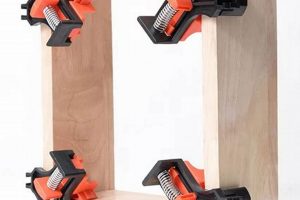
Right-angle clamping tools are essential for achieving precise 90-degree joints in woodworking projects. These devices hold components securely while adhesives dry or fasteners are applied, ensuring accurate assembly. A common example is securing the corners of a box or frame during glue-up, preventing movement and guaranteeing a square result.
The use of these clamping aids contributes significantly to the overall quality and structural integrity of finished pieces. By preventing racking and misalignment during assembly, they minimize the need for corrective measures later in the construction process. Historically, jigs and fixtures have played a critical role in woodworking, evolving from simple wedges and hand-screws to more sophisticated, specialized tools.
The subsequent sections will explore various types of these tools, focusing on their specific applications, advantages, and disadvantages. A detailed discussion of selection criteria and best practices for employing these devices effectively will also be presented.
Effective Use of Right-Angle Clamping Tools
The following guidelines promote accurate and efficient utilization of right-angle clamping devices for woodworking projects, minimizing errors and maximizing structural integrity.
Tip 1: Prioritize Accuracy in Setup: Before applying any clamping pressure, ensure that all components are aligned precisely at 90 degrees. Misalignment at this stage will compound as pressure is applied, resulting in an inaccurate final assembly. Use a reliable square to verify the angle.
Tip 2: Distribute Clamping Force Evenly: Avoid over-tightening clamps on one side of the joint. Uneven pressure can warp the material or cause the joint to fail. Apply pressure gradually and alternately between clamps to ensure uniform distribution.
Tip 3: Protect Wood Surfaces: Use cauls or pads between the clamp jaws and the wood surface to prevent indentation or marring of the material. Softwood species are particularly susceptible to damage from direct clamp pressure.
Tip 4: Check for Squareness After Clamping: Even with careful setup, slight movements can occur during the clamping process. After applying initial pressure, re-check the squareness of the joint using a reliable measuring tool and make necessary adjustments before fully tightening the clamps.
Tip 5: Select Appropriate Clamp Type: Different clamp designs are suited to different applications. Consider the size and shape of the workpiece, as well as the type of joint being assembled, when selecting the appropriate clamping tool. Corner clamps are ideal for box construction, while bar clamps may be more suitable for larger frames.
Tip 6: Allow Adequate Drying Time: Adhesives require sufficient time to cure under pressure. Premature removal of clamps can compromise the strength of the joint. Refer to the adhesive manufacturer’s instructions for recommended clamping times.
Tip 7: Consider Using Multiple Clamps: For larger or more complex assemblies, multiple clamps may be necessary to ensure uniform pressure and prevent movement during glue-up. Strategic placement of clamps along the joint line will maximize stability.
Adherence to these recommendations will result in more precise, durable, and aesthetically pleasing woodworking projects, minimizing rework and maximizing efficiency.
The subsequent section will delve into a case study highlighting the benefits of these tools in a real-world woodworking application.
1. Joint Accuracy

Joint accuracy is inextricably linked to the effective application of right-angle clamping in woodworking. The primary function of these clamping tools is to maintain precise 90-degree angles during the assembly process. A failure to achieve joint accuracy compromises the structural integrity and aesthetic quality of the finished piece. The relationship is one of direct cause and effect: inaccurate clamping leads to skewed joints, while precise clamping ensures square and stable assemblies. Consider a cabinet construction project. If the cabinet’s corners are not square due to inadequate clamping, the doors will not align properly, rendering the unit both visually unappealing and functionally deficient.
The significance of joint accuracy extends beyond mere aesthetics. In structural applications, such as furniture frames or load-bearing elements, accurate right-angle joints are essential for distributing weight evenly and preventing stress concentrations that can lead to premature failure. For example, a table leg that is not perfectly perpendicular to the tabletop will be subjected to uneven stress, increasing the likelihood of breakage. Furthermore, accurate joints minimize the need for corrective measures, such as shimming or planing, which can weaken the assembly and add unnecessary complexity to the project.
In summary, joint accuracy is a critical determinant of success in woodworking projects involving right-angle joints. Right-angle clamping tools are indispensable for achieving and maintaining this accuracy. Challenges may arise from variations in material dimensions or inconsistencies in clamping pressure. Addressing these challenges through careful setup, precise measurements, and consistent technique is essential for realizing the full benefits of these clamping tools and producing durable, aesthetically pleasing woodworking creations.
2. Clamp Pressure

Clamp pressure constitutes a critical variable within the domain of right-angle clamping applications in woodworking. The applied force directly influences joint integrity during adhesive curing or mechanical fastening. Insufficient pressure compromises bond strength, leading to potential joint failure under stress. Conversely, excessive pressure risks material deformation, indentation from clamp jaws, or glue starvation within the joint. Accurate control of this force is therefore essential for achieving optimal results.
Examples illustrating the importance of appropriate clamp pressure abound in woodworking practice. When assembling delicate frames, such as those used in picture framing, excessive pressure may crush the soft wood fibers, resulting in visible imperfections and weakened joints. In contrast, constructing sturdy boxes requires sufficient pressure to ensure a tight, gap-free bond between the mating surfaces. Utilizing cauls, protective layers between the clamp and workpiece, helps distribute pressure evenly, mitigating the risk of damage. Pneumatic or hydraulic clamping systems, often used in production environments, offer precise and repeatable pressure control, enhancing consistency and efficiency.
In summation, the connection between clamp pressure and right-angle woodworking manifests as a critical balance between ensuring adequate joint cohesion and preventing material damage. Effective application of clamping techniques necessitates careful consideration of wood species, joint design, and adhesive properties to determine optimal pressure levels. Employing appropriate clamping tools, utilizing protective cauls, and understanding the principles of force distribution are all indispensable components of successful woodworking outcomes. Challenges arise from material variability and the subjective nature of pressure assessment, but adherence to established best practices minimizes risks and optimizes joint performance.
3. Material Protection
Right-angle clamping in woodworking necessitates a deliberate focus on material protection to prevent damage during the assembly process. The direct application of clamp pressure, without adequate safeguards, can cause indentation, crushing of wood fibers, and marring of the workpiece surface. This degradation not only impacts the aesthetic appeal of the finished product but can also compromise structural integrity, particularly in softer wood species. Failure to implement material protection strategies negates the benefits of precise angular alignment achieved through right-angle clamping, resulting in a substandard outcome.
The implementation of cauls serves as a practical method for distributing clamping pressure evenly across the workpiece surface, mitigating localized stress concentrations. These cauls, typically constructed from wood or resilient synthetic materials, act as a buffer between the clamp jaws and the workpiece. Furthermore, protective pads, made from cork, felt, or similar materials, are often affixed to clamp jaws to prevent direct contact with the wood surface. Consider the construction of a delicate dovetailed drawer: without appropriate material protection, the clamp pressure required to ensure a tight joint could easily damage the edges of the dovetails, diminishing both their visual appeal and structural strength. Such damage necessitates repair or even complete reconstruction of the component, resulting in wasted time and resources. The selection of appropriate clamping accessories and the implementation of careful clamping techniques are thus essential for preserving the material’s integrity.
In summary, material protection is an indispensable component of effective right-angle clamping. The relationship is one of preventing unintended damage to the material while simultaneously achieving accurate and secure joints. The integration of protective measures ensures the preservation of both the aesthetic and structural qualities of the final product. Challenges may arise in selecting appropriate protective materials or adapting clamping techniques to accommodate irregularly shaped workpieces. However, the application of sound woodworking principles and attention to detail will yield superior results, maximizing the benefits of right-angle clamping while minimizing the risk of material damage.
4. Clamp Selection

The efficacy of achieving precise right angles in woodworking is intrinsically linked to appropriate clamp selection. The type of clamp employed directly influences the accuracy and stability of the resulting joint. Choosing an inappropriate clamp for a given task can lead to misalignment, insufficient pressure, or damage to the workpiece, thereby negating the intended benefits of utilizing right-angle clamping techniques. The cause-and-effect relationship is clear: the selection of a suitable clamp is a prerequisite for achieving optimal outcomes in applications demanding 90-degree accuracy. Corner clamps, for example, are specifically designed to facilitate the creation of square corners in box and frame construction. Conversely, attempting to use a bar clamp in this scenario would likely result in a less accurate and stable joint.
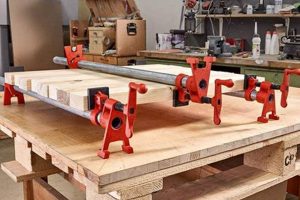
Clamp selection is a critical component of effective right-angle woodworking because it dictates the degree of control and precision attainable during the assembly process. Different clamp designs offer varying levels of adjustability, pressure distribution, and workpiece compatibility. The use of band clamps, for instance, is well-suited for clamping irregular shapes, while miter clamps excel at securing mitered corners. In a practical scenario, consider the construction of a picture frame. Utilizing miter clamps to secure the four mitered corners ensures that the frame remains square and true during glue-up, resulting in a professional-quality finished product. Conversely, using standard pipe clamps without proper cauls and support can easily distort the frame, leading to an unacceptable result.
In summary, the success of any right-angle woodworking project hinges upon the careful selection of appropriate clamping tools. Understanding the strengths and limitations of different clamp types is essential for maximizing accuracy and minimizing the risk of errors. While challenges may arise in choosing the optimal clamp for complex or unconventional projects, a thorough understanding of clamping principles and the specific requirements of the task will invariably lead to superior outcomes. The ability to select the right clamp is therefore a fundamental skill for any woodworker striving for precision and quality in their work.
5. Assembly Stability
Assembly stability, in the context of woodworking, directly correlates with the utilization of right-angle clamping. The function of these clamps is to maintain consistent angular relationships between components during the adhesion or fastening process. Inadequate or absent clamping during assembly inevitably compromises stability, leading to racking, misalignment, and a reduction in the overall structural integrity of the final product. Thus, the employment of these clamping devices is a fundamental prerequisite for achieving a stable and robust assembly. For example, constructing a bookcase without properly clamped right-angle joints will result in shelves that are not level and sides that are not perpendicular, compromising the bookcase’s ability to support weight and maintain its structural integrity.
The impact of assembly stability extends beyond the immediate structural integrity of the piece; it influences the long-term durability and functionality. Unstable assemblies are more susceptible to stress fractures, warping, and premature failure. The precise application of clamping techniques ensures that forces are distributed evenly across the joint, promoting a uniform bond and minimizing stress concentrations. Consider a table construction: proper right-angle clamping of the legs to the apron ensures that the tabletop is adequately supported and that the legs remain firmly attached, preventing wobbling or collapse. The choice of clamp type and clamping strategy must also align with the material properties and joint design to maximize assembly stability.
In summation, assembly stability is a critical factor in determining the quality and longevity of woodworking projects involving right-angle joints. Right-angle clamping tools are indispensable for achieving and maintaining this stability, ensuring accurate and durable assemblies. The challenges involved in achieving optimal assembly stability include selecting appropriate clamping strategies, mitigating material inconsistencies, and managing adhesive curing times. However, adherence to sound woodworking principles and careful execution will result in stable and reliable structures, maximizing the value and lifespan of the finished product.
6. Dimensional Consistency

Dimensional consistency is fundamentally intertwined with effective right-angle clamping in woodworking. The precision achieved through such clamping is contingent upon the constituent parts possessing accurate and uniform dimensions. Variability in material thickness, width, or length undermines the ability of right-angle clamps to establish and maintain true 90-degree angles during assembly. This relationship is cause-and-effect: inconsistent dimensions necessitate adjustments during clamping, potentially compromising joint strength and overall squareness, while dimensionally accurate components ensure that the clamps can function as intended, producing precise and robust joints.
Consider the construction of a cabinet carcass. If the plywood panels used for the sides, top, and bottom vary in thickness by even a small fraction of an inch, achieving perfectly square corners using right-angle clamps becomes significantly more challenging. The clamps will force the joints together, but the inherent dimensional discrepancies will introduce stress and potential misalignment. Conversely, if the panels are precisely cut and dimensionally consistent, the right-angle clamps will effortlessly pull the joints into perfect square, allowing for a strong and accurate bond. This illustrates the crucial role of dimensional consistency in maximizing the efficacy of right-angle clamping techniques.
In summary, dimensional consistency is an indispensable prerequisite for successful right-angle clamping in woodworking. The accuracy and reliability of the clamping process are directly dependent upon the uniformity of the materials being assembled. The challenges associated with achieving dimensional consistency include variations in material properties, inaccuracies in cutting tools, and human error. However, diligent measurement, precise cutting techniques, and the use of calibrated machinery will enable woodworkers to produce dimensionally consistent components, thereby unlocking the full potential of right-angle clamping and creating projects of superior quality and durability.
7. Adhesive Compatibility
Adhesive compatibility exerts a significant influence on the success of right-angle clamping in woodworking. The adhesive’s characteristics must align with the material properties and joint configuration to ensure a secure and lasting bond under clamping pressure. Incompatibility can manifest as weak joints, adhesive failure, or compromised structural integrity. The appropriate selection and application of adhesives are therefore integral to realizing the intended benefits of right-angle clamping techniques. For instance, using a slow-curing epoxy adhesive on a tight-fitting miter joint, held by right-angle clamps, may provide ample time for precise alignment and gap filling, resulting in a robust and virtually invisible seam. Conversely, attempting to use a water-based adhesive on an oily wood species without proper surface preparation will likely lead to a weak and unreliable bond, regardless of the clamping force applied.
The interaction between adhesive type and clamp pressure is also crucial. Some adhesives require sustained pressure during their curing process to achieve optimal bond strength. Right-angle clamps provide this sustained pressure, ensuring intimate contact between the joining surfaces and facilitating proper adhesive bonding. The selection of an adhesive with appropriate open time, viscosity, and gap-filling capabilities is paramount. Polyurethane adhesives, for example, expand slightly during curing, effectively filling minor gaps in the joint while maintaining a strong bond under clamping pressure. Conversely, cyanoacrylate adhesives, while fast-curing, may not be suitable for applications requiring gap-filling or sustained clamping pressure, potentially resulting in brittle and unreliable joints.
In summary, adhesive compatibility is an indispensable consideration in right-angle clamping. The relationship is one of mutual dependence: the effectiveness of the clamp relies on the adhesive’s ability to create a strong and lasting bond under pressure, and the adhesive’s performance is often enhanced by the sustained pressure provided by the clamp. While challenges arise in selecting the ideal adhesive for specific wood species and joint configurations, a thorough understanding of adhesive properties and the principles of woodworking will ensure superior outcomes, maximizing the value and longevity of the finished product. Careful attention to surface preparation, adhesive application techniques, and clamping pressure is therefore essential for achieving optimal results in right-angle woodworking.
Frequently Asked Questions about Right-Angle Clamping in Woodworking
This section addresses common inquiries regarding the application of right-angle clamping techniques in woodworking, providing clarity and dispelling potential misconceptions.
Question 1: What constitutes a suitable alternative to dedicated right-angle clamps?
When specialized right-angle clamps are unavailable, a combination of standard clamps and accurately cut wooden cauls can serve as a viable substitute. The cauls, positioned at 90 degrees, provide a stable reference surface for aligning the workpieces, while the standard clamps apply the necessary pressure.
Question 2: How does one prevent clamp-induced damage to delicate wood surfaces?
Employing soft padding materials, such as cork or felt, between the clamp jaws and the wood surface mitigates the risk of indentation or marring. Distributing pressure evenly across a larger surface area using wider clamp jaws or wooden cauls further minimizes potential damage.
Question 3: What is the optimal clamping pressure for ensuring a strong joint without material deformation?
The appropriate clamping pressure varies depending on the wood species, adhesive type, and joint design. A general guideline is to apply sufficient pressure to close any gaps and ensure intimate contact between the mating surfaces, without compressing the wood fibers excessively. Experimentation and careful observation are recommended.
Question 4: How can squareness be verified after clamp application?
A reliable square, precision measuring tool, or digital angle finder can be used to verify the accuracy of the right-angle joint after applying clamping pressure. Any deviations from squareness should be corrected promptly by adjusting the clamp positions or applying gentle pressure until the desired angle is achieved.
Question 5: What role does adhesive selection play in right-angle clamping applications?
The adhesive must be compatible with the wood species and joint type. Factors to consider include open time, viscosity, gap-filling capabilities, and curing time. Selecting an adhesive that provides adequate strength and durability under the anticipated service conditions is crucial.
Question 6: How does one manage clamping pressure when assembling multiple joints simultaneously?
Distributing clamping pressure evenly across all joints is essential to prevent distortion or misalignment. Applying clamps in an alternating sequence and monitoring the joint alignment throughout the clamping process can help maintain consistent pressure distribution.
Successful application of right-angle clamping in woodworking hinges on a combination of accurate material preparation, appropriate clamp selection, and meticulous execution. Attention to these details ensures the creation of durable, aesthetically pleasing, and structurally sound woodworking projects.
The subsequent section will explore advanced techniques for optimizing right-angle clamping in specialized woodworking applications.
Square Clamp Woodworking
This exploration has underscored the integral role of right-angle clamping in achieving precision and stability within woodworking projects. The discussion encompassed clamp selection, application techniques, material compatibility, and the critical importance of dimensional accuracy. Effective utilization, as detailed, directly influences the structural integrity and aesthetic quality of finished pieces.
The commitment to meticulous application of these principles will yield demonstrably superior results. Continued investigation into specialized applications and evolving clamping technologies remains vital for advancing the craft and ensuring the longevity of woodworking traditions. The principles of squareness are non-negotiable; their mastery defines excellence.

![Top-Rated: Best Quick Clamps for Woodworking Projects [2024] | Step-by-Step Guides, Tools & Inspiration to Build Beautiful Wooden Decor on a Budget](https://woodfromhome.com/wp-content/uploads/2026/04/th-264-300x200.jpg "Top-Rated: Best Quick Clamps for Woodworking Projects [2024] Step-by-Step Guides, Tools & Inspiration to Build Beautiful Wooden Decor on a Budget")