



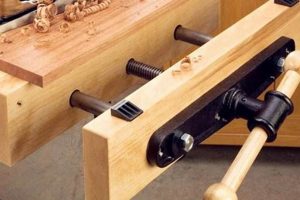
These devices are essential tools in woodworking, securing materials to a workbench during assembly, shaping, or finishing operations. They exert pressure to hold pieces firmly in place, enabling precise and safe work. An example includes fastening a board to a benchtop while routing a decorative edge.
Their significance lies in enhancing accuracy and safety. Firmly held workpieces reduce the risk of slippage and incorrect cuts. Historically, these implements have evolved from simple wooden wedges to sophisticated mechanical devices, each improvement contributing to greater efficiency and precision in woodworking.
The following sections will explore different types, selection criteria based on project needs, proper usage techniques, maintenance tips for longevity, and innovative applications that maximize their utility within a woodworking shop.
Effective Usage of Bench Clamps
Optimizing the use of these workholding devices is crucial for efficient and precise woodworking. Consider the following guidelines for enhancing project outcomes.
Tip 1: Select the Appropriate Type: Different woodworking operations necessitate specific clamp designs. Face clamps excel at joining boards edge-to-edge, while hold-down clamps secure stock flat against the bench. Using the correct clamp minimizes potential damage and maximizes holding power.
Tip 2: Evenly Distribute Pressure: Applying uneven pressure can warp or damage the workpiece. Use multiple clamps spaced appropriately to distribute force uniformly across the joint or surface being secured. This is especially critical when gluing large panels.
Tip 3: Protect Delicate Surfaces: Direct contact between metal clamp jaws and wood can leave indentations. Employ protective pads, such as softwood scraps or commercial clamp pads, to prevent marring the material’s surface. This precaution preserves the aesthetic quality of the finished piece.
Tip 4: Avoid Over-Tightening: Excessive clamping force can cause joint failure or crush the wood fibers. Tighten the clamps sufficiently to secure the workpiece, but avoid exceeding the material’s resistance. A moderate, firm pressure is generally sufficient.
Tip 5: Inspect Clamps Regularly: Ensure that clamps are clean and in good working order before each use. Check for damaged threads, bent frames, or worn pads. Damaged clamps compromise safety and holding performance, potentially leading to project failures.
Tip 6: Consider Clamp Placement: Position clamps strategically to avoid interfering with cutting tools or other operations. Plan the clamping arrangement in advance to ensure accessibility and optimal workspace utilization. This step minimizes interruptions and maximizes efficiency.
Tip 7: Use Auxiliary Supports: For complex assemblies or oddly shaped workpieces, employ auxiliary supports, such as cauls or clamping blocks. These supports help distribute pressure evenly and maintain proper alignment during the clamping process. Such additions prevent deformation and ensure precise joinery.
Implementing these tips promotes safer, more accurate, and more efficient woodworking practices. Proper utilization extends the lifespan of equipment and enhances the quality of finished projects.
The subsequent sections will delve into advanced clamping techniques and innovative applications of these essential tools.
1. Holding Power

Holding power is a paramount characteristic when evaluating workholding solutions. It directly influences the stability of the workpiece, impacting the precision and safety of woodworking operations. Effective holding power minimizes movement during cutting, shaping, and assembly, thus ensuring accurate results.
- Clamp Design and Mechanism
The design and clamping mechanism of a device directly correlate with its holding capacity. Screw-operated, cam-action, and quick-release designs each offer varying levels of clamping force. Screw-operated versions generally provide the highest force, while cam-action offer quicker application but potentially lower force. The mechanical advantage inherent in the design dictates the achievable clamping pressure.
- Jaw Surface and Material
The surface texture and material composition of the jaws influence grip. Serrated or textured jaws increase friction, enhancing hold on smooth surfaces. Softer materials, such as rubber or wood pads, offer protection against marring while still providing adequate grip. The combination of grip and protection is essential for versatile applications.
- Clamping Force Distribution
Uniform distribution of clamping force across the workpiece is critical. Uneven pressure can lead to warping or deformation, compromising the integrity of the joint or the workpiece itself. The number and placement of clamps, along with the use of cauls or spreaders, contribute to equitable pressure distribution.
- Material Compatibility and Rigidity
The material composition and rigidity of the frame influences its ability to maintain clamping pressure. Flexible or poorly constructed versions may lose holding power over time, particularly under stress or vibration. High-quality steel or cast iron frames offer superior rigidity and sustained clamping force. Also be aware of compatibility when it comes to the work material being clamped, for example avoiding iron clamps on woods with tannin.
The interplay of design, material, force distribution, and rigidity determines the overall effectiveness in securing a workpiece. Selecting appropriate devices that optimize these factors is essential for safe and accurate woodworking. Further consideration should be given to the specific requirements of each project to ensure adequate holding capacity.
2. Clamp Type
The category “Clamp Type” is integral to the efficacy of workholding during woodworking processes. The selection of a suitable clamp type directly influences the precision, stability, and overall quality of the completed project. Different designs serve distinct purposes, optimizing force application for various joinery and assembly needs.
- Bar Clamps
Bar clamps, characterized by their long bars and adjustable jaws, excel in providing consistent pressure over extended lengths. In woodworking, these clamps are frequently employed for assembling large panels, tabletops, and casework where uniform clamping force is crucial to prevent warping or misalignment. Their extended reach accommodates broader workpieces compared to other clamp designs.
- Parallel Jaw Clamps
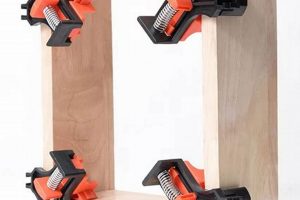
These clamps are distinguished by jaws that remain parallel throughout their range of motion, ensuring consistent pressure distribution across the entire clamping surface. This attribute is particularly valuable when assembling face frames or joining components with perfectly square edges, as it minimizes the risk of uneven clamping pressure leading to distorted joints.
- Pipe Clamps
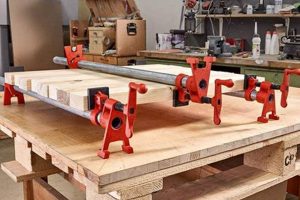
Pipe clamps utilize standard threaded pipes to create variable-length clamping solutions. Woodworkers often employ pipe clamps for assembling large projects, such as table legs to aprons, since the length of the pipe dictates the maximum clamping capacity. The modular nature of pipe clamps offers flexibility in adapting to diverse project scales.
- Hand Screw Clamps
Hand screw clamps, constructed with wooden jaws and threaded spindles, offer precise control over clamping pressure. Their non-marring wooden jaws are especially suited for delicate workpieces where minimizing surface damage is paramount. Cabinetmakers frequently employ hand screw clamps for intricate joinery tasks and securing fragile components.
These clamp variations illustrate the interconnectedness between tool selection and project demands. Understanding the strengths and limitations of each clamp type is essential for achieving reliable and accurate results in woodworking endeavors. Incorrect clamp selection can compromise joint integrity, leading to project failure or aesthetic imperfections.
3. Jaw Protection

Jaw protection within the context of workholding devices is a critical consideration impacting the final quality of woodworking projects. The direct contact between metal clamp jaws and wooden surfaces can cause indentation, compression, or marring of the material, especially when using substantial clamping pressure. Softwoods and figured hardwoods are particularly vulnerable. Without adequate protection, the aesthetic value and structural integrity of the workpiece can be compromised. A common example includes the use of bar clamps directly on a delicate cherry tabletop, resulting in unsightly pressure marks that necessitate additional sanding and refinishing.
Several methods exist to mitigate this damage. Commercially available clamp pads made from rubber, cork, or plastic provide a cushioning layer between the jaw and the wood. Alternatively, woodworkers often fabricate their own protective pads using softwood scraps, leather, or felt. The choice of material depends on the specific requirements of the project, considering factors such as the type of wood, the required clamping pressure, and the desired level of protection. Furthermore, the design of the clamp itself can incorporate jaw protection features, such as swivel pads that conform to the workpieces surface, distributing pressure more evenly and reducing the risk of damage.
In conclusion, the implementation of jaw protection is an integral aspect of responsible woodworking practice. Neglecting this element can lead to costly repairs, reduced aesthetic appeal, and diminished structural integrity. The selection and application of appropriate protective measures represent a fundamental component in achieving high-quality results, thereby enhancing both the functional and visual characteristics of finished woodworking projects. The need for careful consideration of material compatibility and pressure distribution, when coupled with effective jaw protection, addresses a common challenge in achieving superior outcomes.
4. Pressure Distribution

Effective pressure distribution is crucial in woodworking when employing workholding solutions. Uneven force application can lead to warping, deformation, or joint failure. Proper distribution ensures consistent contact and stability, resulting in stronger, more accurate assemblies.
- Clamp Placement and Quantity
Strategic placement and the number of clamps utilized directly affect pressure distribution. Insufficient quantity or improper positioning concentrates force in specific areas, potentially distorting the workpiece. Evenly spacing multiple clamps disperses pressure, minimizing localized stress. Example: Clamping a long glue-up requires several clamps placed equidistantly to prevent bowing.
- Cauls and Spreader Blocks
Cauls, rigid bars or boards placed between the clamp jaws and the workpiece, distribute pressure over a broader area. Similarly, spreader blocks prevent clamp jaws from digging into the wood, mitigating concentrated force. These auxiliary aids are particularly useful when clamping thin or delicate materials. Example: Using a caul when clamping a thin veneer prevents the clamp from indenting the veneer surface.
- Clamp Jaw Design and Material
The design and material of the clamp jaws influence how force is transferred. Jaws with larger surface areas and compliant materials, such as rubber or cork, provide more uniform pressure distribution. Jaws that swivel or conform to the workpiece further enhance even pressure. Example: A parallel jaw clamp exerts force more uniformly than a bar clamp with narrower jaws.
- Joint Geometry and Preparation
The geometry of the joint being clamped affects the effectiveness of pressure distribution. Poorly fitted joints require excessive clamping force to close gaps, leading to concentrated pressure at the points of contact. Proper joint preparation, including accurate milling and fitting, minimizes this issue. Example: A poorly cut miter joint requires excessive clamping to close, potentially damaging the surrounding wood fibers.
Optimizing these elements of pressure distribution contributes to superior outcomes in woodworking. Proper clamping techniques, combined with appropriate auxiliary aids and attention to joint preparation, minimize the risk of workpiece damage and enhance the overall quality of finished projects. The consistent application of these principles facilitates accurate and reliable woodworking results.
5. Material Compatibility

The relationship between material compatibility and workholding devices is significant within woodworking. Dissimilar material pairings can precipitate unintended chemical reactions or physical damage, compromising both the workpiece and the equipment. Specific wood species contain tannins or acids that, when in prolonged contact with certain metals, induce corrosion or staining. For instance, clamping oak, which is high in tannic acid, with uncoated iron clamps can lead to black staining of the wood, permanently affecting its aesthetic quality. Conversely, applying excessive force with steel clamps on softwoods such as pine or balsa can crush the wood fibers, resulting in irreversible indentations.
Proper selection of clamp materials is crucial for mitigating these risks. Clamps with coated jaws, such as those featuring rubber, plastic, or specialized finishes, provide a barrier against direct contact between the metal and the wood. Alternatively, using clamps constructed from non-reactive materials like wood or certain polymers eliminates the risk of chemical interaction altogether. In situations where metal clamps are unavoidable, applying protective pads made of cork, leather, or softwood can provide a buffer against staining or compression. Furthermore, careful consideration of clamping pressure is essential; minimizing force minimizes the potential for fiber damage, particularly when working with delicate or porous woods.
Understanding material compatibility is an integral component of responsible woodworking. The selection of appropriate workholding solutions, informed by a knowledge of wood species characteristics and clamp material properties, directly influences the longevity and aesthetic integrity of finished projects. While various solutions mitigate compatibility issues, awareness of potential interactions and proactive implementation of preventative measures are paramount for achieving consistent and high-quality woodworking outcomes.
Frequently Asked Questions
This section addresses common queries regarding the selection, usage, and maintenance of workholding devices within a woodworking context.
Question 1: What factors dictate the selection of a particular type of clamp?
Clamp selection is predicated on several factors: the size and shape of the workpiece, the type of joint being created, and the required clamping pressure. Bar clamps are suitable for large panels, while hand screws excel at delicate joinery. Matching the clamp to the task ensures optimal results.
Question 2: How can one prevent clamp-induced damage to a workpiece?
Clamp-induced damage is preventable through several methods. Protective pads constructed from softwood, cork, or rubber provide a buffer between the clamp jaws and the wood surface. Avoiding over-tightening and distributing pressure evenly are also crucial preventative measures.
Question 3: What is the significance of clamping pressure in woodworking?
Clamping pressure directly influences joint strength and workpiece integrity. Insufficient pressure results in weak joints, while excessive pressure can crush wood fibers or distort the material. Applying adequate, but not excessive, force is essential for optimal results.
Question 4: How does joint geometry impact clamp usage?
Joint geometry significantly influences the effectiveness of clamping. Poorly fitted joints require more clamping force to close gaps, potentially leading to concentrated pressure and damage. Accurate joint preparation, including precise milling and fitting, minimizes this risk.
Question 5: What maintenance procedures extend the lifespan of workholding devices?
Regular maintenance extends the lifespan of these devices. Cleaning threads, lubricating moving parts, and inspecting for damage are crucial steps. Promptly addressing any issues, such as bent frames or worn pads, prevents further deterioration and ensures safe operation.
Question 6: How does material compatibility affect the interaction between clamps and wood?
Material compatibility is a critical consideration. Certain wood species contain tannins that react with iron, causing staining. Using coated clamps or protective pads prevents this interaction. Clamping pressure must also be modulated to avoid crushing softwoods.
Proper application, maintenance, and material awareness ensure effective and damage-free woodworking practices.
The subsequent section will delve into advanced techniques and innovative solutions utilizing workholding equipment.
Bench Clamps for Woodworking
This exposition has detailed the multifaceted role of bench clamps for woodworking, emphasizing their influence on precision, safety, and overall project quality. The discussions encompassed various types, effective usage techniques, pressure dynamics, material compatibility considerations, and maintenance procedures. Each aspect is critical in maximizing their utility and minimizing potential complications.
A thorough understanding of these factors equips woodworkers to make informed decisions regarding clamp selection and application. Consistent application of best practices ensures optimal workholding performance, ultimately resulting in stronger, more aesthetically pleasing, and structurally sound woodworking projects. Continued research and adaptation to evolving techniques will further enhance the integration of these essential tools in the craft.
![Top-Rated: Best Quick Clamps for Woodworking Projects [2024] | Step-by-Step Guides, Tools & Inspiration to Build Beautiful Wooden Decor on a Budget](https://woodfromhome.com/wp-content/uploads/2026/04/th-264-300x200.jpg "Top-Rated: Best Quick Clamps for Woodworking Projects [2024] Step-by-Step Guides, Tools & Inspiration to Build Beautiful Wooden Decor on a Budget")