



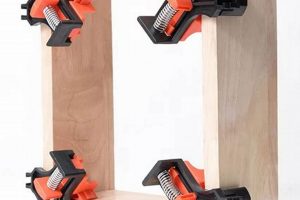
Devices designed to hold workpieces at a 90-degree angle during assembly are essential for achieving precise and strong corner joints. These tools, often featuring adjustable jaws and clamping mechanisms, ensure that materials remain aligned while adhesives dry or fasteners are applied. A common application involves framing, cabinet making, and other woodworking projects where accurate corners are paramount.
The utilization of these alignment tools significantly enhances the efficiency and accuracy of woodworking processes. They reduce the likelihood of misaligned joints, which can compromise the structural integrity and aesthetic appeal of finished pieces. Historically, woodworkers relied on more rudimentary methods for achieving square corners; however, advancements in clamping technology have provided more reliable and user-friendly solutions. This has broadened the accessibility of high-quality craftsmanship to both professional and amateur woodworkers.
Subsequent sections will explore the different types available, factors to consider when selecting suitable options, and best practices for their effective implementation in diverse woodworking scenarios. The features and functionality that make these tools indispensable for achieving precise, professional-quality results will also be discussed.
Essential Usage Guidelines
Employing alignment and securing devices during woodworking projects necessitates adherence to specific techniques to ensure optimal outcomes and prevent potential complications.
Tip 1: Material Compatibility. Confirm the device’s clamping pressure is appropriate for the material being used. Excessive force can damage softer woods, while insufficient pressure may not adequately secure denser materials.
Tip 2: Precise Alignment Verification. Prior to tightening, meticulous verification of the joint’s alignment is crucial. Utilize a square to confirm the accuracy of the 90-degree angle before applying full clamping force.
Tip 3: Protective Padding Implementation. Integrate protective pads, such as wood shims or rubber inserts, between the device’s jaws and the workpiece. This minimizes the risk of indentation or marring of the material’s surface.
Tip 4: Gradual Pressure Application. Apply clamping pressure incrementally. Over-tightening can distort the joint or compromise the structural integrity of the workpiece. Monitoring the joint during pressure application is essential.
Tip 5: Adhesive Considerations. When used in conjunction with adhesives, ensure adequate cleanup of any squeeze-out prior to the adhesive setting. The device can become bonded to the workpiece if excess adhesive is not promptly removed.
Tip 6: Joint Reinforcement. Consider supplementing the device with mechanical fasteners, such as screws or dowels, to enhance the long-term stability and strength of the joint.
Tip 7: Device Maintenance. Regular maintenance, including cleaning and lubrication, is vital for ensuring the smooth operation and longevity of the device. Remove any adhesive residue or debris that may accumulate.
Proper utilization contributes significantly to the creation of strong, accurate, and aesthetically pleasing corner joints. Adhering to these guidelines maximizes the efficacy of these alignment and securing tools in woodworking applications.
The subsequent section provides a concluding summary of the key benefits and considerations discussed, highlighting the importance of these tools in achieving professional-grade results.
1. Right Angles

The fundamental objective of corner clamps in woodworking is the establishment and maintenance of precise right angles during the assembly of joints. A right angle, defined as a 90-degree intersection, is critical for structural integrity and visual appeal in various woodworking applications, including cabinet construction, picture framing, and furniture making. The absence of true right angles results in skewed structures, compromised load-bearing capacity, and an unprofessional aesthetic. Corner clamps address this issue by physically holding the component pieces at the correct angle while adhesives cure or mechanical fasteners are applied. For example, in assembling a cabinet carcass, clamps ensure that the sides are perfectly perpendicular to the top and bottom, which directly influences the overall stability and squareness of the finished product.
The efficacy of these tools depends on their capacity to consistently exert uniform pressure across the joint. Deviations from a perfect right angle, even by a fraction of a degree, can accumulate and create significant discrepancies in larger assemblies. Several designs exist, including those that utilize adjustable jaws, band clamps with corner blocks, and specialized clamping squares, each optimized for specific project types and material thicknesses. Proper utilization entails verifying the accuracy of the clamp itself, as manufacturing tolerances can sometimes introduce minor imperfections. The use of supplemental measuring tools, such as precision squares, is often necessary to ensure absolute accuracy, particularly in high-precision applications.
In conclusion, the connection between right angles and corner clamps in woodworking is direct and indispensable. Corner clamps are instrumental in translating the theoretical concept of a right angle into a tangible, structural reality. While the tools simplify the process of achieving accurate corners, a thorough understanding of both the principles of geometry and the limitations of the tools themselves remains essential for successful woodworking projects. The integration of careful measurement, proper clamp selection, and adherence to best practices minimizes the risk of error and maximizes the probability of producing professional-quality results.
2. Clamping Pressure
Clamping pressure, the force exerted by corner clamps to hold workpieces together, is a critical determinant of joint strength and overall project quality in woodworking. The appropriateness and consistency of this force directly impact the integrity and longevity of assembled structures. Understanding the nuances of clamping pressure is therefore essential for effective utilization of these tools.
- Adequate Force Distribution
Consistent distribution of force across the entire joint surface is vital to ensure uniform adhesion or secure mechanical fastening. Uneven clamping pressure can lead to gaps in the joint, compromising its structural integrity. For example, when gluing a mitered frame, insufficient pressure at any point along the mitered edge can result in a weak bond, eventually leading to separation. The design and adjustment mechanisms of the corner clamp must facilitate even pressure application.
- Material-Specific Considerations
The ideal clamping pressure varies depending on the type of wood or material being used. Softwoods, such as pine, are susceptible to compression damage from excessive force, which can mar the surface or weaken the joint. Conversely, hardwoods, such as oak or maple, require greater clamping pressure to achieve proper adhesion or fastening. Adjustability of the corner clamp to accommodate different material properties is crucial.
- Adhesive Properties and Requirements
Different woodworking adhesives have specific pressure requirements for optimal bonding. Polyvinyl acetate (PVA) glues typically require moderate clamping pressure to ensure proper contact between the wood surfaces. Epoxy resins, on the other hand, may require lower pressure to prevent the resin from being squeezed out of the joint. Consult the adhesive manufacturer’s recommendations for guidance on appropriate clamping pressure.
- Mechanical Fastener Integration
When using corner clamps in conjunction with mechanical fasteners, such as screws or nails, clamping pressure plays a vital role in ensuring proper alignment and preventing movement during the fastening process. The clamp holds the pieces securely while the fastener is installed, minimizing the risk of misalignment or joint failure. Proper clamping pressure also helps to ensure that the fastener is driven straight and true, further enhancing the strength and integrity of the joint.
In conclusion, clamping pressure is an indispensable factor in corner clamps woodworking, impacting everything from the aesthetic quality to the long-term durability of the finished product. The correct application of force, tailored to the material and adhesive used, is a critical skill for any woodworker seeking to achieve professional results. Understanding and controlling clamping pressure is paramount to successful joint assembly.
3. Material Compatibility
The selection of corner clamps in woodworking is intrinsically linked to the materials being joined. Different materials exhibit varying degrees of density, compressive strength, and surface characteristics, thereby influencing the required clamping force and the potential for surface damage. Compatibility, therefore, dictates the effectiveness and safety of using a specific clamp type on a given workpiece. The use of an inappropriately aggressive clamp on a softwood, such as pine or cedar, can result in indentation or crushing of the wood fibers, leading to a weakened joint and an aesthetically unappealing surface. Conversely, employing a clamp with insufficient force on a hardwood, such as oak or maple, may fail to achieve the necessary tight joint, compromising the structural integrity of the assembly.
Considerations extend beyond the simple hardness or softness of the material. Composite materials, such as plywood or MDF, exhibit unique characteristics. Plywood, with its alternating grain layers, can be more resistant to crushing than solid wood, but the thin veneer layers are easily damaged by excessive pressure. MDF, lacking a distinct grain structure, distributes clamping force more evenly but is also more prone to edge damage if not properly protected. Clamps with adjustable pressure settings and broad clamping surfaces are advantageous when working with a variety of materials, as they allow for fine-tuning to avoid damaging the workpiece. Moreover, the use of protective pads or shims between the clamp jaws and the material provides an additional layer of safeguarding against surface imperfections.
In conclusion, material compatibility is not merely a peripheral concern but a central determinant in corner clamp selection and application. A thorough understanding of the material’s properties and the clamp’s capabilities is crucial for achieving strong, accurate, and visually acceptable joints. Failure to account for material compatibility can lead to structural weaknesses, aesthetic flaws, and project failures, underscoring the importance of careful consideration in the woodworking process.
4. Joint Accuracy

The attainment of joint accuracy is a primary objective in woodworking, directly influencing structural integrity, aesthetic quality, and overall functionality. Corner clamps function as instrumental tools in achieving this accuracy, facilitating the precise alignment and secure holding of workpieces during assembly. Their proper utilization significantly mitigates the risk of misalignment and dimensional inaccuracies.
- Precise Alignment
The foremost contribution of corner clamps is to maintain precise alignment of workpieces at 90-degree angles. Misalignment, even by fractions of a degree, can accumulate and propagate inaccuracies throughout an entire assembly. For example, in cabinet making, misaligned corners compromise the squareness of the cabinet, potentially affecting door alignment and overall structural stability. Clamps ensure that components remain perfectly aligned while adhesives cure or fasteners are applied.
- Dimensional Consistency
Achieving dimensional consistency across multiple joints is crucial for producing professional-quality woodworking projects. Corner clamps aid in maintaining uniform dimensions by consistently holding pieces in the correct position during assembly. This is particularly important in applications such as frame construction, where variations in joint dimensions can lead to a distorted and uneven final product. Clamps contribute to repeatability and consistency, essential for mass production or complex assemblies.
- Mitigation of Error Accumulation
Even minor inaccuracies in individual cuts can compound as more joints are assembled. Corner clamps help to minimize the accumulation of these errors by forcing components into alignment and holding them securely. By correcting for small imperfections, clamps enable woodworkers to achieve overall accuracy in complex projects. This is vital in large-scale projects where cumulative errors can lead to significant deviations from the intended design.
- Enhancement of Glue Joint Strength
Joint accuracy directly correlates with the strength and longevity of glue joints. Precise alignment ensures maximum surface contact between the pieces being joined, resulting in a stronger and more durable bond. Corner clamps apply consistent pressure to the joint, promoting optimal adhesive distribution and adhesion. A well-aligned and tightly clamped joint is significantly less prone to failure over time compared to a poorly aligned one.
The capacity of corner clamps to facilitate precise alignment, dimensional consistency, error mitigation, and enhanced glue joint strength underscores their indispensability in achieving joint accuracy. By addressing common challenges associated with corner assembly, these tools empower woodworkers to create high-quality, structurally sound, and visually appealing projects.
5. Durability
Durability, defined as the ability to withstand wear, pressure, or damage, represents a critical attribute in corner clamps designed for woodworking applications. The operational lifespan and reliability of these tools are directly contingent upon their capacity to endure the rigors of repeated use, exposure to environmental factors, and the stresses inherent in securing workpieces. Consequently, material selection, construction methods, and design features significantly influence the overall durability and long-term value of corner clamps.
- Material Composition
The materials employed in the construction of corner clamps exert a substantial influence on their resistance to wear and deformation. High-strength metals, such as hardened steel or aluminum alloys, offer superior durability compared to less robust materials like plastic or low-grade metals. Steel components, particularly those subjected to heat treatment processes, exhibit enhanced resistance to bending and breakage under load. Aluminum alloys provide a balance of strength and lightweight properties, making them suitable for clamps that require portability and ease of handling. The selection of appropriate materials directly correlates with the clamp’s ability to maintain its structural integrity over prolonged use.
- Construction Techniques
The manner in which corner clamps are assembled and joined contributes significantly to their overall durability. Welded joints, particularly those executed with precision and using appropriate welding techniques, provide a robust and permanent connection between components. Riveted joints, while less strong than welded joints, offer a degree of flexibility and can be suitable for applications where some movement or adjustability is required. The use of high-quality fasteners, such as bolts and screws, ensures that components remain securely connected, even under significant stress. The integration of reinforcing elements, such as gussets or braces, enhances the structural rigidity of the clamp and minimizes the risk of deformation.
- Surface Treatments and Coatings
Surface treatments and coatings serve to protect corner clamps from corrosion, abrasion, and other forms of environmental damage. Powder coating, a durable and chemically resistant finish, provides a protective barrier against moisture, solvents, and other corrosive agents. Anodizing, a process used to enhance the surface hardness and corrosion resistance of aluminum components, creates a durable and aesthetically pleasing finish. Plating, using metals such as zinc or chrome, offers a cost-effective means of protecting steel components from rust and corrosion. The application of appropriate surface treatments significantly extends the lifespan of corner clamps, particularly in environments with high humidity or exposure to corrosive substances.
- Design and Ergonomics
The design and ergonomic features of corner clamps also influence their durability and ease of use. Clamps with robust and well-supported jaws are less prone to bending or breaking under pressure. Adjustable mechanisms, such as threaded spindles or quick-release levers, should be designed to withstand repeated use without wearing out or becoming damaged. Ergonomic handles and grips enhance user comfort and control, reducing the likelihood of accidents or misuse that could damage the clamp. A well-designed clamp is not only more effective but also more likely to withstand the stresses of regular woodworking activities.
The facets of material composition, construction techniques, surface treatments, and design characteristics collectively define the durability of corner clamps employed in woodworking. The selection of durable materials, the implementation of robust construction methods, the application of protective surface treatments, and the integration of ergonomic design features are each critical for ensuring the long-term reliability and performance of these essential woodworking tools. The consideration of durability as a primary selection criterion contributes significantly to the efficiency, safety, and overall quality of woodworking projects.
Frequently Asked Questions
This section addresses common inquiries regarding the selection, application, and maintenance of corner clamps in woodworking, offering insights into best practices and clarifying potential misconceptions.
Question 1: What are the primary advantages of using corner clamps in woodworking projects?
The principal benefits include ensuring accurate 90-degree angles during assembly, maintaining precise alignment of workpieces, facilitating even distribution of clamping pressure, and enhancing the overall structural integrity of corner joints. These advantages contribute to both the aesthetic quality and the long-term durability of finished projects.
Question 2: What factors should be considered when selecting a corner clamp for a specific woodworking task?
Critical factors include the material type and thickness of the workpieces, the required clamping pressure, the adjustability of the clamp, the size and shape of the joint, the durability of the clamp, and the ease of use. The intended application and the frequency of use should also inform the selection process.
Question 3: How can damage to workpieces from corner clamp pressure be prevented?
Employing protective padding, such as wood shims or rubber inserts, between the clamp jaws and the workpiece is essential. Applying clamping pressure gradually and avoiding over-tightening also helps to minimize the risk of indentation or marring of the material surface. Selecting clamps with adjustable pressure settings is advisable for working with delicate materials.
Question 4: What maintenance procedures are recommended to prolong the lifespan of corner clamps?
Regular cleaning to remove adhesive residue and debris is vital. Lubricating moving parts, such as threaded spindles, ensures smooth operation. Inspecting the clamp for signs of wear or damage, such as cracks or deformation, and replacing worn components as needed, is also crucial.
Question 5: Are there specific types of corner clamps best suited for particular woodworking applications?
Yes. Band clamps with corner blocks are effective for framing applications. Right-angle clamps are well-suited for cabinet making and box construction. Miter clamps are designed for assembling mitered joints. The selection should align with the specific requirements of the project.
Question 6: How critical is the precision of a corner clamp in achieving accurate joints?
Precision is paramount. Even slight deviations from a true 90-degree angle can accumulate and compromise the overall squareness and structural integrity of an assembly. It is advisable to verify the accuracy of the clamp itself and to use supplemental measuring tools, such as precision squares, to ensure optimal results.
Corner clamps, when properly selected, applied, and maintained, represent invaluable tools for achieving professional-quality results in woodworking. Understanding their capabilities and limitations is essential for maximizing their effectiveness.
The concluding section will summarize the key advantages and best practices discussed throughout this article, providing a concise overview of corner clamps in woodworking.
Conclusion
This article has explored the diverse facets of corner clamps woodworking, emphasizing their importance in achieving accurate, durable, and aesthetically pleasing corner joints. From material compatibility and clamping pressure to joint accuracy and tool durability, these tools play a critical role in woodworking. Selection depends heavily on project specifics.
The investment in quality corner clamps, coupled with a thorough understanding of their application, significantly enhances project outcomes. Woodworkers who prioritize these tools are better equipped to produce consistently professional results, ensuring both structural integrity and visual appeal in their creations.
![Top-Rated: Best Quick Clamps for Woodworking Projects [2024] | Step-by-Step Guides, Tools & Inspiration to Build Beautiful Wooden Decor on a Budget](https://woodfromhome.com/wp-content/uploads/2026/04/th-264-300x200.jpg "Top-Rated: Best Quick Clamps for Woodworking Projects [2024] Step-by-Step Guides, Tools & Inspiration to Build Beautiful Wooden Decor on a Budget")