



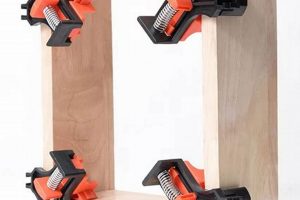
These specialized tools are designed to hold workpieces at a precise 90-degree angle during assembly. Their purpose is to ensure accuracy and stability when joining materials like wood, metal, or plastic. For instance, during the construction of a box, a mitered frame, or a cabinet, these devices maintain the squareness of the corners while fasteners, such as screws or glue, are applied.
Employing these devices significantly streamlines assembly processes and enhances the quality of finished projects. Historically, craftspeople relied on jigs and fixtures to achieve similar results; however, modern versions offer greater adjustability and ease of use. The consistent and precise angles they provide minimize the need for rework, contributing to time savings and reduced material waste. Furthermore, they often free the user’s hands, allowing for more efficient application of adhesives or mechanical fasteners.
The subsequent sections will delve into various types, materials of construction, selection criteria, and best practices for utilizing these essential workshop aids, offering a detailed exploration of their applications and advantages in diverse construction and fabrication contexts.
Essential Usage Guidelines
Optimal utilization requires a clear understanding of the tool’s capabilities and limitations. The following guidelines promote accuracy, efficiency, and longevity when employing these devices.
Tip 1: Material Compatibility: Consider the materials being joined. High-pressure applications on delicate substrates may necessitate protective shims to prevent marring or indentations.
Tip 2: Clamping Pressure Modulation: Excessive force can distort or damage workpieces. Adjust pressure incrementally to achieve secure holding without causing deformation.
Tip 3: Surface Preparation is Critical: Ensure mating surfaces are clean, dry, and free of debris. This promotes optimal adhesion when using adhesives in conjunction with these devices.
Tip 4: Verify Squareness Prior to Fastening: Before applying permanent fasteners, use a precision square to confirm the joint is at a true 90-degree angle. Minor adjustments can be made while the device is engaged.
Tip 5: Select the Appropriate Style: Various designs exist, each suited to specific applications. Corner models, edge models, and miter models serve distinct purposes. Choose the type that best matches the project requirements.
Tip 6: Consider Adjustability Features: Opt for versions with adjustable jaws or arms to accommodate varying material thicknesses and joint configurations. This increases versatility and adaptability.
Tip 7: Maintenance and Storage: Regularly clean and lubricate moving parts to ensure smooth operation. Store in a dry environment to prevent corrosion and maintain optimal performance.
Adhering to these guidelines will significantly improve the precision and durability of assembled components, ultimately leading to superior finished products.
The subsequent section will cover common troubleshooting scenarios and solutions, providing further practical insights for effective usage in demanding applications.
1. Precise Angle Maintenance
Precise angle maintenance is intrinsically linked to the function and value proposition of right angle clamps. These clamps are fundamentally designed to hold components at a 90-degree angle during assembly, ensuring that the resulting structure exhibits squareness and dimensional accuracy. The failure to maintain this precision directly impacts the overall quality of the finished product, leading to structural weaknesses, misalignments, and aesthetic defects. For instance, if a cabinet frame is not assembled at perfectly right angles, the doors may not align properly, resulting in gaps and functional impairment. The clamp’s ability to secure the joint at a consistent, accurate angle is, therefore, the primary determinant of its effectiveness.
The importance of precise angle maintenance extends beyond simple aesthetics. In load-bearing structures or intricate joinery, even slight deviations from a true right angle can create stress points that compromise the integrity of the entire assembly. Consider the construction of a wooden brace or support. If the angles are not precise, the brace may not distribute weight evenly, leading to premature failure under load. Similarly, in metal fabrication, a lack of precision in angled joints can weaken welds and increase the risk of structural failure. In each of these cases, accurate angle maintenance, facilitated by the clamp, is paramount to achieving a strong and reliable final product.
In summary, right angle clamps are not merely tools for holding materials together; they are instruments for ensuring dimensional accuracy and structural integrity through precise angle maintenance. The ability of these devices to consistently maintain a 90-degree angle is critical to their effectiveness, as deviations directly translate to compromised quality and reduced lifespan of assembled components. This understanding underscores the need for careful selection, proper usage, and regular maintenance of these essential workshop aids, and, in this way, it reveals the link between effective assembly and quality craftsmanship.
2. Clamping Force Distribution
Clamping force distribution, in the context of woodworking, constitutes a critical factor influencing the success and quality of assembled joints. Right angle clamps apply pressure to hold components at a 90-degree angle, and the manner in which this force is distributed directly impacts the structural integrity and aesthetic appearance of the finished product. Unevenly distributed force can cause several detrimental effects, including workpiece deformation, joint misalignment, and ultimately, a weakened connection. An example of this effect is a frame constructed from softwood; excessive clamping pressure in localized areas may result in indentation or crushing of the wood fibers, permanently marring the surface and compromising the joint’s strength.
The objective is to achieve uniform pressure across the entire joint surface to ensure consistent adhesion when using adhesives, or secure mechanical fastening without distorting the materials. This necessitates careful adjustment of the clamp and, in some cases, the use of protective shims or cauls to distribute the force more evenly. Clamps with adjustable pressure settings or wider clamping surfaces are often preferred for applications where uniform force distribution is paramount, such as assembling large cabinet frames or constructing complex joinery. Failure to adequately distribute the clamping force can negate the benefits of using a right angle clamp, leading to rework, material waste, and a compromised final product.
In conclusion, understanding and controlling clamping force distribution is integral to the proper utilization of right angle clamps in woodworking. Proper distribution ensures joint integrity, prevents workpiece damage, and contributes to an enhanced final product. Challenges in achieving optimal distribution can often be mitigated through careful clamp selection, appropriate pressure adjustment, and the use of supplementary tools. An understanding of these issues is essential for both novice and experienced woodworkers aiming for durable and aesthetically pleasing results.
3. Material Compatibility
The selection and application of right angle clamps in woodworking must consider material compatibility to ensure effective joint construction and prevent damage. The interaction between the clamp’s construction materials and the workpiece can significantly affect the outcome. Clamping dissimilar materials, such as metal and softwood, introduces potential complications. Direct contact with a steel clamp, for instance, may leave indentations or stains on softer woods, necessitating the use of protective shims or pads to distribute pressure and prevent surface marring.
The type of finish applied to the wood is also relevant. Freshly applied finishes, like varnish or paint, can be susceptible to damage from the clamping pressure, leading to imperfections in the final appearance. In such cases, it’s advisable to allow finishes to cure fully before clamping or to use clamps with non-marring surfaces. Furthermore, certain wood species contain natural oils or acids that can react with the clamp’s metal components, causing corrosion or discoloration over time. Maintaining awareness of the workpiece composition and selecting clamps constructed of appropriate materials is crucial to prevent these issues.
Understanding material compatibility is not merely a matter of preventing cosmetic damage; it directly impacts the structural integrity of the joint. Inappropriate clamp selection can lead to compromised adhesion when using adhesives, or weaken mechanical fastenings if the workpiece is distorted during clamping. Prioritizing material compatibility during the selection and use of these tools ensures that the resulting joint is both aesthetically pleasing and structurally sound, thus meeting the requirements for quality craftsmanship.
4. Adjustability Features

Adjustability features within right angle clamps directly dictate the tool’s versatility and applicability across diverse woodworking projects. The capacity to modify dimensions, clamping pressure, or angle settings enables accommodation of varying material thicknesses, joint configurations, and assembly techniques. Absent these features, a clamp’s utility becomes severely limited, restricting its use to a narrow range of standardized tasks. For instance, a fixed-size clamp cannot effectively secure workpieces of varying thicknesses without risking either insufficient clamping force or excessive pressure that could damage softer materials.
A clamp with adjustable jaws facilitates working with materials ranging from thin veneers to thick lumber, maximizing the investment’s value. Similarly, adjustable clamping pressure allows for delicate handling of easily marred materials while providing sufficient force for stronger joinery. Certain models offer angle adjustment, enabling the creation of joints beyond a standard 90-degree configuration. An inability to adapt to such varied requirements increases the need for multiple specialized clamps, adding expense and clutter to the workshop. Consider the construction of a frame with non-right-angle corners; a non-adjustable right angle clamp would be rendered entirely useless.
Therefore, the presence and quality of adjustability features directly influence the practicality and efficiency of right angle clamps in woodworking. By enabling adaptability to diverse materials, dimensions, and joint configurations, these features expand the range of projects that can be undertaken with a single tool. Selection of a clamp with suitable adjustability contributes to improved precision, reduced material waste, and enhanced overall productivity, and, therefore, is crucial for both professional and amateur woodworkers aiming to optimize their workflow and results.
5. Durable Construction

Durable construction constitutes a fundamental attribute of any effective tool, and its importance is particularly pronounced in the context of woodworking, where precision and reliability are paramount. When considering devices designed to maintain right angles during joinery, the resilience of their construction directly translates to the accuracy and longevity of the work they facilitate. Inferior materials or poor manufacturing processes compromise a clamp’s ability to consistently hold angles and withstand the stresses of repeated use, thus undermining its core function.
- Material Selection and its Impact on Longevity
The type of materials utilized in the construction significantly affects resistance to deformation and wear. High-carbon steel, known for its strength and rigidity, is frequently employed in critical components such as jaws and frames. Aluminum, offering a balance between weight and durability, finds applications in lighter-duty clamps. Plastics, while less robust, may be incorporated in handles and pads to enhance grip and protect workpieces from marring. The choice of these materials, their treatment, and their assembly directly impact the lifespan and precision of the clamp.
- Joint Integrity and Load-Bearing Capacity
The points at which different components are joined represent potential weak spots in the construction. Welds, rivets, or mechanical fasteners must be robust enough to withstand repeated stress without failing. The load-bearing capacity, or the amount of force the clamp can exert while maintaining its shape, is directly related to the quality of these joints. A poorly constructed joint may flex or break under pressure, compromising the accuracy of the angle and rendering the clamp unreliable. Consider a miter clamp; a weld failure would render the clamp useless and potentially damage the workpiece.
- Resistance to Environmental Factors
Woodworking environments often expose tools to humidity, dust, and chemical substances. Durable construction extends beyond mere structural integrity to include resistance to these environmental factors. Protective coatings, such as powder coating or plating, can prevent corrosion and maintain the clamp’s smooth operation over time. Bearings and threads must be sealed or lubricated to prevent dust accumulation and ensure consistent performance. Clamps that are not resistant to these factors are prone to premature failure, requiring frequent replacement.
- Design Considerations for Extended Use
Certain design elements can contribute to long-term reliability. Ergonomic handles reduce user fatigue, encouraging proper usage and minimizing the risk of accidental damage. Replaceable parts, such as pads or screws, extend the clamp’s lifespan by allowing for easy repair and maintenance. A well-engineered design considers not only the clamp’s initial performance but also its continued functionality over years of use. An example is an adjustable clamp that allows for screw replacements; this small adjustment ensures the clamp will remain functional for a longer time.
These facets of durable construction collectively determine the ultimate value and practicality of right angle clamps in woodworking. Clamps constructed with high-quality materials, robust joints, environmental resistance, and thoughtful design provide consistent, reliable performance over extended periods, justifying their investment and contributing to the creation of durable and aesthetically pleasing woodworking projects.
Frequently Asked Questions
This section addresses common inquiries regarding the selection, application, and maintenance of right angle clamps in woodworking, providing clarity and guidance for optimal usage.
Question 1: What types of right angle clamps are best suited for different woodworking projects?
Corner clamps are effective for assembling boxes and frames, while edge clamps are suitable for securing edges of boards. Miter clamps are specifically designed for joining mitered corners. Consider the specific joint configuration and workpiece dimensions when selecting the appropriate clamp type.
Question 2: How is proper clamping pressure determined to avoid damaging the workpiece?
Apply pressure gradually, monitoring for any signs of deformation or indentation. Use protective shims or cauls to distribute the force evenly, particularly when working with softwoods or delicate materials. Over-tightening can lead to weakened joints or irreversible damage.
Question 3: What maintenance procedures prolong the lifespan of right angle clamps?
Regularly clean and lubricate moving parts to ensure smooth operation. Store the clamps in a dry environment to prevent corrosion. Inspect for worn or damaged components and replace them as needed. Proper maintenance ensures consistent performance and extends the tool’s lifespan.
Question 4: How do adjustability features impact the utility of right angle clamps?
Adjustable jaws or arms accommodate varying material thicknesses and joint configurations, increasing the versatility of the clamp. Adjustable pressure settings allow for precise control of clamping force, preventing damage to sensitive materials. Prioritize adjustability when selecting right angle clamps for diverse woodworking applications.
Question 5: What materials are preferred in the construction of durable right angle clamps?
High-carbon steel is commonly used for critical components, such as jaws and frames, due to its strength and rigidity. Aluminum offers a balance between weight and durability. Plastics are often incorporated in handles and pads to enhance grip and protect workpieces. Material selection directly impacts the clamp’s longevity and performance.
Question 6: How can the accuracy of a right angle joint be verified during the clamping process?
Use a precision square or protractor to check the angle of the joint before applying permanent fasteners. Make minor adjustments while the clamp is engaged to ensure a true 90-degree angle. Accurate angle verification is crucial for structural integrity and aesthetic quality.
Consistent with the above, careful consideration and implementation of the topics within the frequently asked questions section regarding right angle clamps ensures that woodworkers will be able to produce superior woodworking projects.
Proceeding onward to the next portion of this overview, a set of guidelines for the application of right angle clamps will be assessed.
Conclusion
The preceding exposition detailed various facets of right angle clamps woodworking, underscoring their pivotal role in ensuring precision, stability, and structural integrity within diverse construction contexts. Key considerations encompassed material compatibility, clamping force modulation, adjustability features, and the implications of durable construction. Mastery of these elements is instrumental in maximizing the utility and longevity of these essential workshop tools.
Ongoing refinement of designs and materials promises to further enhance the efficacy of these devices, contributing to improved efficiency and accuracy across a spectrum of fabrication endeavors. A continued emphasis on informed selection, diligent maintenance, and adherence to best practices will optimize the benefits derived from these tools, thus fostering superior craftsmanship and lasting structural results.
![Top-Rated: Best Quick Clamps for Woodworking Projects [2024] | Step-by-Step Guides, Tools & Inspiration to Build Beautiful Wooden Decor on a Budget](https://woodfromhome.com/wp-content/uploads/2026/04/th-264-300x200.jpg "Top-Rated: Best Quick Clamps for Woodworking Projects [2024] Step-by-Step Guides, Tools & Inspiration to Build Beautiful Wooden Decor on a Budget")