



These clamping tools are designed to apply even pressure across the entire surface of a workpiece. Unlike traditional clamps that can cause bowing or misalignment, these specialized clamps maintain a 90-degree angle between the clamp face and the bar, ensuring consistent and accurate pressure. A common example involves assembling a cabinet where face frames must be perfectly aligned and glued.
Their significance lies in their ability to create strong, reliable joints and prevent common woodworking errors. The precise alignment they provide reduces the need for extensive sanding or corrective measures after glue-up. Historically, woodworkers relied on less accurate methods, often resulting in weaker joints and increased labor. The introduction of these clamps marked a significant advancement in woodworking precision and efficiency.
The following sections will explore various types of these tools, their specific applications in different woodworking projects, factors to consider when selecting the optimal tool for a given task, and best practices for their maintenance and long-term use.
Tips for Effective Use
Maximize the benefits obtained through the use of these tools by observing specific techniques. Proper employment ensures joint integrity and reduces potential workpiece damage.
Tip 1: Even Distribution: Employ multiple tools spaced evenly along the joint. This distributes pressure uniformly, preventing localized stress and potential warping. For example, when assembling a tabletop, space units every 6-8 inches.
Tip 2: Protective Cauls: Utilize wooden cauls between the clamp faces and the workpiece surface. Cauls prevent direct contact, distributing pressure further and guarding against indentations, especially on softwoods like pine.
Tip 3: Consistent Pressure: Avoid over-tightening. Excessive force does not necessarily improve joint strength and can damage the wood fibers. Apply sufficient pressure to close the joint completely and extrude a small bead of glue.
Tip 4: Square Alignment: Prior to tightening, ensure the faces are perfectly square to the workpiece. Misalignment can induce stress within the joint and compromise its structural integrity. Use a square to verify alignment before applying final pressure.
Tip 5: Regular Maintenance: Keep the threaded rods clean and lubricated. Dust and debris can hinder smooth operation, while lubrication prevents corrosion and extends the tool’s lifespan. Apply a dry lubricant periodically.
Tip 6: Correct Bar Length: Select the appropriate bar length for the project. Using clamps with excessively long bars can create instability and increase the risk of misalignment. Choose a length that provides adequate reach without unnecessary extension.
By adhering to these techniques, optimal joint strength, workpiece protection, and tool longevity are achieved.
The concluding section will summarize the advantages of using these tools and offer final considerations for their selection and application.
1. Parallelism

Parallelism is the defining characteristic of these tools, serving as the fundamental principle behind their efficacy. The term describes the consistent 90-degree relationship maintained between the clamp jaws and the bar, irrespective of the clamping force applied. This contrasts with traditional clamps, where tightening often results in angled pressure, leading to misalignment and compromised joints. The consistent perpendicularity inherent in these tools directly causes uniform pressure distribution across the work surface. The result is reduced stress on the wood fibers and minimized risk of bowing or warping. For instance, when assembling a large tabletop, the lack of parallelism in the clamps could cause uneven glue lines or a surface that is not perfectly flat. In contrast, these tools maintain consistent contact, ensuring a seamless and structurally sound assembly.
The consistent alignment afforded by parallelism is essential in various woodworking applications. Cabinet construction relies heavily on the ability to create square and true frames. Door assembly requires perfectly aligned components to ensure proper closure and functionality. Edge joining boards for tabletops or panels demands a flat and seamless surface. In each of these scenarios, even slight deviations from parallelism can lead to significant problems in the final product. The practical implications include reduced rework, minimized material waste, and improved overall project quality. For example, consider building a cabinet door. Without parallelism, the door frame may not be square, leading to gaps or difficulty in installing hinges and hardware.
Understanding the connection between parallelism and these tools is crucial for any woodworker seeking to achieve professional-quality results. While these tools represent a significant investment, the benefits in terms of accuracy, efficiency, and reduced material waste often outweigh the initial cost. Challenges may arise when dealing with irregularly shaped workpieces or requiring specialized clamping configurations. However, the core principle of parallelism remains paramount. Mastering this aspect of clamping technique will invariably lead to stronger, more aesthetically pleasing, and longer-lasting woodworking projects.
2. Clamping Force
Clamping force, the measure of pressure exerted by a clamp on a workpiece, is a critical determinant of joint integrity in woodworking. The effective application of force directly relates to the quality and longevity of bonded assemblies, particularly when utilizing parallel clamps. Optimal clamping force ensures secure adhesion and prevents joint failure.
- Magnitude of Force
The magnitude of force required varies with wood species, adhesive type, and surface area. Hardwoods necessitate greater force compared to softwoods. Insufficient force results in weak bonds, whereas excessive force risks crushing wood fibers. Determining the appropriate magnitude requires considering the specific materials and joint configuration. An example is gluing a miter joint in hardwood, which demands significant force to ensure tight closure and prevent gaps.
- Distribution of Force
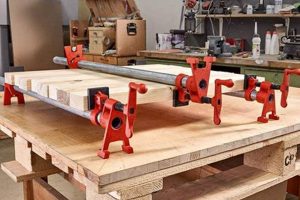
Parallel clamps excel at distributing force evenly across the entire joint surface. This uniform distribution prevents localized stress points that compromise joint strength. Traditional clamps often concentrate force unevenly, leading to distorted joints. The broad, flat faces of parallel clamps facilitate the consistent application of pressure. For instance, when edge-gluing boards to form a tabletop, these clamps ensure that each board is pressed firmly against its neighbor, creating a flat and seamless surface.
- Sustained Force Over Time
Adhesives require a specific curing period under sustained pressure to achieve maximum bond strength. Parallel clamps maintain consistent force over this duration, preventing movement or separation of the joint components. The robust construction of these clamps resists slippage or loosening. Consider assembling a mortise and tenon joint; maintaining sustained pressure during the glue’s curing time is essential for creating a strong and durable connection.
- Force and Joint Geometry
The geometry of the joint dictates the optimal direction and magnitude of clamping force. Complex joints, such as dovetails or complex miters, require careful consideration of force vectors to ensure proper alignment and adhesion. Parallel clamps, with their ability to apply force squarely and consistently, simplify the clamping process for intricate joints. For example, when clamping a dovetail joint, the clamp force must be directed to pull the joint tightly together without causing any shifting or misalignment.
Understanding and appropriately applying clamping force, particularly with parallel clamps, is crucial for achieving professional-grade woodworking results. Optimal force, coupled with even distribution and sustained application, ensures strong, durable, and aesthetically pleasing joints.
3. Jaw Capacity
Jaw capacity is a critical specification of parallel clamps, directly influencing their applicability across a range of woodworking projects. It defines the maximum thickness of material that the clamp can effectively accommodate, thereby dictating the scope of tasks for which a particular clamp is suitable. Selecting a clamp with appropriate jaw capacity is essential for achieving secure and accurate clamping.
- Definition and Measurement
Jaw capacity refers to the maximum distance between the clamping faces when the clamp is fully opened. It is typically measured in inches or millimeters and represents the limiting dimension for workpiece thickness. Accurately determining jaw capacity requirements is crucial for project planning. For instance, a cabinet face frame constructed from 3/4-inch stock requires a clamp with sufficient capacity to accommodate the combined thickness of the frame components.
- Influence on Project Scope
The available jaw capacity directly restricts the size and type of projects that can be undertaken. Clamps with limited capacity are suitable for smaller, thinner stock, such as picture frames or small boxes. Conversely, larger projects involving thick panels or complex assemblies necessitate clamps with greater jaw capacity. Failing to account for jaw capacity can render a clamp unusable for a specific task. Consider assembling a large dining table; a clamp with insufficient capacity would be unable to secure the thick tabletop boards during glue-up.
- Impact on Clamping Force and Stability
Operating a clamp at or near its maximum jaw capacity can reduce its clamping force and stability. The further the jaws are extended, the greater the potential for deflection or slippage. Selecting a clamp with a capacity slightly exceeding the workpiece thickness ensures optimal clamping force and minimizes the risk of instability. Attempting to clamp a very thick workpiece using a clamp at its maximum extension could result in inadequate pressure and a compromised joint.
- Types of Parallel Clamps and Jaw Capacity
Parallel clamps are available in a range of jaw capacities to suit different woodworking needs. Smaller clamps may have a capacity of only a few inches, while larger, heavy-duty clamps can accommodate workpieces exceeding several feet in thickness. The type of parallel clamp selected should align with the typical dimensions of the projects undertaken. A professional cabinetmaker would likely require a selection of clamps with varying jaw capacities to handle diverse project requirements.
The specification of jaw capacity is not merely a number; it is a fundamental consideration that directly impacts the efficacy and utility of parallel clamps. Careful evaluation of jaw capacity requirements ensures that the selected clamps are suitable for the intended tasks, promoting accurate and robust clamping.
4. Bar Length

Bar length, a fundamental specification of parallel clamps, directly dictates the maximum span a clamp can accommodate. Its proper selection is crucial for effective and efficient woodworking, ensuring the ability to secure workpieces of varying dimensions. Inadequate bar length renders a clamp unusable, while excessive length can impede maneuverability.
- Defining Clamping Range
Bar length establishes the working range of a parallel clamp, defining the distance between the clamp’s fixed and adjustable heads when fully extended. This measurement determines the largest workpiece dimension the clamp can effectively secure. An accurate understanding of project dimensions is essential for selecting clamps with appropriate bar lengths. For example, clamping a 48-inch wide tabletop requires parallel clamps with a bar length exceeding 48 inches to ensure complete engagement.
- Influence on Project Size
The available bar length directly influences the size of projects a woodworker can undertake. Shorter bar lengths are suitable for smaller tasks such as assembling drawers or small frames. Larger projects, such as constructing cabinets or large furniture pieces, necessitate longer bar lengths. Restricting oneself to clamps with limited bar lengths inherently limits the scope of potential projects. A woodworker intending to build large bookcases must possess parallel clamps with sufficient bar length to accommodate the bookcase’s width and height.
- Impact on Stability and Leverage
Excessive bar length can negatively impact the stability and leverage of a parallel clamp. As the bar extends further, the potential for deflection or bowing increases, reducing clamping force and accuracy. Optimizing bar length for the specific project ensures stable and consistent clamping pressure. Employing excessively long clamps to secure a small workpiece can result in uneven pressure distribution and potential damage to the wood fibers.
- Types of Parallel Clamps and Bar Length Availability
Parallel clamps are manufactured with varying bar lengths to address diverse woodworking requirements. Common lengths range from 12 inches to over 96 inches, providing flexibility for projects of all sizes. Professional woodworkers often maintain a collection of parallel clamps with different bar lengths to accommodate the varying dimensions of their projects. A cabinetmaker, for example, might require a selection of clamps ranging from 24 inches to 72 inches to handle different cabinet sizes and components.
The correlation between bar length and parallel clamps is inextricable. Thoughtful consideration of bar length is paramount for selecting the right tool for the task, promoting secure, accurate, and efficient woodworking practices. Bar length, therefore, forms a cornerstone of successful parallel clamp utilization.
5. Ease of Use
The practical value of parallel clamps in woodworking is significantly enhanced by their ease of use. The efficiency and precision afforded by these tools are directly proportional to the intuitiveness of their design and operation, impacting project completion time and minimizing potential errors.
- Quick-Action Mechanisms
Parallel clamps frequently incorporate quick-action mechanisms for rapid adjustment and clamping. These mechanisms allow for efficient positioning and securement of the workpiece with minimal effort. A rapid-release feature further streamlines the process by enabling swift disassembly following glue-up. For example, a clamp with a simple lever-action mechanism can be adjusted and tightened much faster than a traditional threaded clamp, saving valuable time in production environments.
- Ergonomic Design
Ergonomic considerations in the design of parallel clamps contribute significantly to user comfort and reduced fatigue. Features such as comfortable handles and balanced weight distribution minimize strain during prolonged use. Clamps designed with user ergonomics in mind allow for precise control and consistent application of clamping force. Consider a clamp with a padded handle; this reduces hand fatigue during extended clamping operations, ensuring consistent pressure and reducing the likelihood of errors.
- Clear Marking and Measurement
Many parallel clamps include clear markings and measurement scales to facilitate accurate positioning and repeatable setups. These features enable precise alignment of workpieces and consistent application of clamping pressure. Clear markings reduce the risk of misalignment and ensure that projects are assembled according to specifications. An example of this is a clamp with engraved scales on the bar, which allows for precise adjustment and repeatable setups when assembling multiple identical components.
- Minimal Setup Time
Parallel clamps are designed for minimal setup time, allowing woodworkers to focus on the task at hand rather than struggling with complicated adjustments. Intuitive designs and straightforward mechanisms enable rapid deployment and efficient utilization. Reduced setup time translates to increased productivity and reduced labor costs. Compare a parallel clamp with a simple, self-squaring design to a traditional clamp requiring shims and manual alignment; the parallel clamp significantly reduces setup time and improves overall efficiency.
The facets of ease of use inherent in parallel clamps directly impact their overall value in woodworking applications. Streamlined mechanisms, ergonomic designs, clear markings, and minimal setup times contribute to increased efficiency, reduced fatigue, and improved accuracy, ultimately leading to higher-quality woodworking projects.
6. Durability
The longevity and reliability of parallel clamps directly influence their economic value and suitability for professional woodworking. Durability, in this context, represents the capacity of a clamp to withstand repeated use and sustained stress without structural failure or significant degradation in performance. The inherent design and materials used in manufacturing these clamps dictate their resistance to wear, corrosion, and deformation under clamping pressure. Inferior materials or construction techniques result in premature failure, requiring frequent replacement and increasing operational costs. A cabinet shop employing poorly constructed parallel clamps might experience frequent breakage, resulting in project delays and increased material waste due to inconsistent clamping pressure. Conversely, durable clamps provide years of dependable service, justifying their initial investment.
Several factors contribute to the overall durability of parallel clamps. The quality of the steel used in the bar and threaded components is paramount, with hardened steel offering superior resistance to bending and wear. The design and construction of the clamp head and jaw mechanisms also play a critical role, with robust designs minimizing the risk of breakage under heavy clamping force. Furthermore, protective coatings, such as powder coating or galvanization, enhance resistance to corrosion and extend the lifespan of the clamp. For example, a parallel clamp subjected to daily use in a humid environment will benefit significantly from a corrosion-resistant coating, preventing rust and maintaining smooth operation of the threaded components. The effectiveness of these protective measures determines long-term serviceability and minimizes maintenance requirements.
The durability of parallel clamps is not merely a matter of cost savings; it also directly impacts the quality and consistency of woodworking projects. Reliable clamps maintain consistent clamping force over extended periods, ensuring secure adhesion and preventing joint failure. Durable clamps also resist deformation, preserving the parallelism between the jaws and preventing misalignment of the workpiece. Ultimately, investing in durable parallel clamps translates to improved project quality, reduced waste, and enhanced operational efficiency. While lower-cost alternatives may seem appealing, the long-term benefits of durable, high-quality clamps far outweigh the initial price difference.
7. Versatility
The connection between versatility and parallel clamps lies in the tool’s adaptability to a wide range of woodworking tasks. This adaptability stems from the clamp’s design, allowing it to function effectively across diverse project types and material thicknesses. The ability to perform well in multiple applications is a primary driver for selecting these clamps. The clamps’ value is amplified by their capacity to serve numerous purposes. For instance, a set of parallel clamps can be employed for assembling cabinet frames, edge-joining boards for tabletops, and constructing intricate joinery, eliminating the necessity for specialized clamps for each specific task. This multi-functionality directly reduces the overall tool investment required for a comprehensive woodworking setup.
The versatility of parallel clamps extends beyond basic assembly tasks. Their capacity to apply even pressure over large surfaces makes them suitable for laminating curved forms, creating complex moldings, and securing jigs or fixtures during machining operations. For example, when laminating thin veneers around a curved form, parallel clamps ensure uniform contact and prevent voids or distortions in the final product. Furthermore, the precise alignment afforded by these clamps is crucial when assembling mitered frames or intricate joinery where accuracy is paramount. The ability to perform these diverse tasks contributes significantly to the overall efficiency and quality of woodworking projects.
In summary, the versatility of parallel clamps is a key attribute that enhances their practical significance in woodworking. Their ability to perform diverse tasks effectively reduces tool investment, increases project efficiency, and improves the overall quality of finished products. While specialized clamps may offer advantages in certain niche applications, the versatility of parallel clamps makes them an indispensable tool for any woodworker seeking a comprehensive and adaptable clamping solution.
Frequently Asked Questions
This section addresses common inquiries regarding the selection, application, and maintenance of parallel clamps in woodworking.
Question 1: What distinguishes parallel clamps from traditional bar clamps?
Parallel clamps maintain a consistent 90-degree angle between the clamping face and the bar, ensuring even pressure distribution. Traditional bar clamps often exert angled pressure, potentially causing misalignment. This distinction is crucial for achieving precise and square joints.
Question 2: What clamping force is appropriate for various wood species?
Hardwoods generally require greater clamping force than softwoods. Excessive force can damage wood fibers. Experimentation and experience are necessary to determine the ideal pressure for specific materials and joint configurations.
Question 3: How is the appropriate bar length determined for a given project?
Bar length should slightly exceed the widest dimension of the workpiece being clamped. Excessively long bars can reduce stability and leverage. Accurate measurement of project components is essential for selecting the appropriate bar length.
Question 4: What is the purpose of using cauls with parallel clamps?
Cauls, typically wooden boards, are placed between the clamp jaws and the workpiece. They distribute pressure evenly, preventing indentations and protecting the wood surface, especially with softer species.
Question 5: How frequently should parallel clamps be cleaned and lubricated?
Cleaning and lubrication frequency depends on usage and environmental conditions. Regular cleaning removes dust and debris. Lubrication, using a dry lubricant, prevents corrosion and ensures smooth operation. A schedule of monthly maintenance is generally recommended for frequent users.
Question 6: What are the signs of a damaged or failing parallel clamp?
Signs of damage include bent bars, stripped threads, cracked jaws, and inconsistent clamping force. Damaged clamps should be repaired or replaced to prevent compromised joints and potential injury.
These answers provide essential information for effectively using and maintaining parallel clamps. Proper application and care contribute to improved woodworking results and extended tool lifespan.
The concluding section summarizes the key advantages of parallel clamps in woodworking and offers final recommendations.
Parallel Clamps for Woodworking
The preceding analysis underscores the pivotal role of parallel clamps in achieving precision and structural integrity in woodworking projects. Key attributes, including parallelism, clamping force, jaw capacity, bar length, ease of use, durability, and versatility, collectively determine their efficacy. The proper selection and application of these tools are essential for minimizing errors, maximizing joint strength, and ensuring project longevity.
The enduring value of parallel clamps rests in their capacity to enhance the quality and efficiency of woodworking practices. Woodworkers are encouraged to carefully consider the specific requirements of each project when selecting these tools and to adhere to recommended maintenance procedures. The consistent application of these principles will contribute to superior results and sustained operational effectiveness.
![Top-Rated: Best Quick Clamps for Woodworking Projects [2024] | Step-by-Step Guides, Tools & Inspiration to Build Beautiful Wooden Decor on a Budget](https://woodfromhome.com/wp-content/uploads/2026/04/th-264-300x200.jpg "Top-Rated: Best Quick Clamps for Woodworking Projects [2024] Step-by-Step Guides, Tools & Inspiration to Build Beautiful Wooden Decor on a Budget")