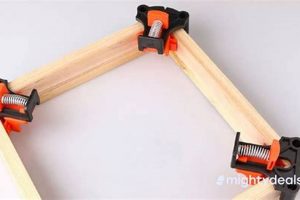
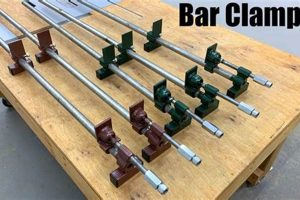
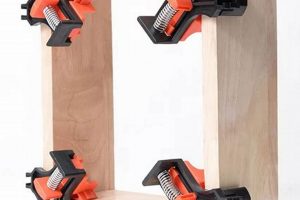
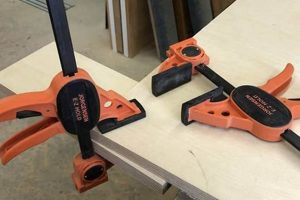
These devices apply pressure evenly across the surface of wood components, holding them securely together while adhesives cure. They are essential tools used to create large, flat surfaces from multiple boards. Examples include bar clamps, pipe clamps, and specialized clamps designed explicitly for panel construction.
The use of such tools ensures strong, seamless joints, preventing warping or misalignment during the bonding process. Historically, woodworkers relied on weighted objects or rudimentary clamping systems. Modern versions provide greater accuracy, efficiency, and force, leading to enhanced structural integrity and aesthetic appeal in finished projects.
The subsequent sections will delve into the different types available, considerations for selecting the optimal tool for a specific task, and best practices for their effective utilization in woodworking projects.
Effective Utilization Techniques
Employing these tools correctly is crucial for achieving flat, durable wood panels. Adherence to the following tips will optimize performance and minimize potential issues.
Tip 1: Staggered Placement: Position devices alternately above and below the panel surface to distribute pressure uniformly and prevent bowing.
Tip 2: Protective Cauls: Use wooden or composite cauls between the clamp jaws and the wood surface to prevent marring and further distribute force.
Tip 3: Even Spacing: Maintain consistent intervals between each device. Closer spacing is recommended for thinner or more flexible materials.
Tip 4: Moderate Pressure: Over-tightening can lead to joint failure or surface indentations. Apply sufficient pressure to close the joints without excessive force.
Tip 5: Consistent Alignment: Ensure all boards are flush and properly aligned before tightening the clamping system. Misalignment can result in uneven surfaces.
Tip 6: Dry Run: Conduct a dry run of the entire process before applying adhesive to verify proper fit and accessibility.
Tip 7: Wax Paper Protection: Place wax paper between the cauls and the panel to prevent the adhesive from bonding the cauls to the panel.
Applying these techniques ensures that the tool functions at its peak performance to produce professional-grade wood panels.
The subsequent section will provide a comparison of different product variants and their intended applications.
1. Pressure distribution

Uneven pressure distribution during panel glue-up invariably leads to defects in the final product. These defects can manifest as bowing, warping, or weakened joints. Woodworking panel clamps are, therefore, engineered to exert uniform force across the entire surface of the panel. The cause is often inadequate clamping force in certain areas, or excessive force in others. The effect is a panel that is not flat, square, or structurally sound. For example, using only a few clamps spaced far apart will concentrate pressure at those points, creating a scalloped effect along the joint lines as the glue cures.
The design of the panel clamp is critical for ensuring optimal pressure distribution. Bar clamps, for instance, are prone to concentrated pressure near the bar unless used in conjunction with cauls. Cauls, which are rigid members placed between the clamp jaws and the panel, distribute the force more evenly. Another option is specialized panel clamps, which incorporate multiple pressure points or a wide clamping surface specifically designed to minimize localized pressure. For instance, a cabinet maker constructing a large tabletop might utilize a frame-style clamp with numerous individual clamping points to maintain consistent pressure over the entire area. Correct pressure ensures a strong, gap-free bond between the boards.
Therefore, understanding the principles of pressure distribution is paramount when selecting and utilizing woodworking panel clamps. Failing to account for this factor can result in wasted material, increased labor costs, and structurally deficient finished goods. The proper tool, employed with attention to pressure distribution, allows for creation of flat, stable, and visually pleasing panels, a hallmark of quality woodworking.
2. Joint alignment

Precise joint alignment is paramount when constructing wood panels. Misalignment during the adhesive curing process can result in weak bonds, uneven surfaces, and compromised structural integrity. Woodworking panel clamps serve as vital tools in maintaining proper joint alignment by exerting controlled, consistent pressure. The consequence of inadequate alignment is often visible seams, gaps, or stress points that detract from both the appearance and the functionality of the panel. A panel clamps capacity to maintain coplanarity between adjacent boards is therefore critical.
Consider the fabrication of a tabletop from several individual boards. Without proper joint alignment, the resulting surface will exhibit noticeable height variations at each seam, requiring extensive sanding or planing to achieve a smooth, level plane. This additional processing increases labor costs and can reduce the overall thickness of the panel. The woodworking panel clamp, when properly applied, prevents such discrepancies by holding the boards perfectly aligned during the adhesive curing stage, minimizing post-assembly processing.
Ultimately, the effectiveness of woodworking panel clamps hinges on their ability to enforce and sustain accurate joint alignment. Challenges such as board twist or curvature may necessitate specialized clamping techniques or the use of cauls to distribute pressure evenly. Addressing joint alignment proactively is a prerequisite for producing high-quality, durable wood panels, underscoring the significance of selecting and employing appropriate clamping systems.
3. Adhesive compatibility
The success of any woodworking panel construction hinges not only on the strength of the clamp itself but also on the adhesive’s interaction with the clamped materials. Adhesive compatibility refers to the chemical and physical compatibility between the chosen adhesive, the wood species, and the clamping pressure exerted. Incompatibility can manifest as weakened bonds, premature adhesive failure, or even chemical reactions that degrade the wood itself. For example, certain acidic adhesives, when used with reactive wood species under high clamping pressure, might lead to discoloration or accelerated corrosion of metal fasteners within the wood structure.
The role of the panel clamp is to maintain consistent pressure that facilitates optimal adhesive bond formation. However, if the adhesive requires specific conditions (e.g., a certain gap fill or cure time) that are not met due to the clamp’s pressure or release schedule, the bond can be compromised. Woodworkers must, therefore, select adhesives and clamping techniques that complement each other. Polyurethane adhesives, known for their gap-filling capabilities, might necessitate different clamping pressures and durations compared to traditional polyvinyl acetate (PVA) glues, which require tighter joint lines and longer clamp times for optimal strength. Applying excessive pressure with a PVA glue on a poorly fitted joint, for example, could starve the joint of adhesive, resulting in a weak and unreliable bond.
Therefore, adhesive selection should be an integral part of the clamping process. Understanding the adhesive’s properties, compatibility with the wood species, and optimal clamping conditions allows woodworkers to achieve strong, durable, and long-lasting bonds. The proper woodworking panel clamp, used in conjunction with a compatible adhesive, ensures that the adhesive can perform its intended function without being compromised by excessive or insufficient pressure, or by other factors related to the clamping process. Attention to this critical detail will minimize failures and improve the overall quality and longevity of the finished wood panel.
4. Clamp stability
Clamp stability is a critical factor influencing the success of woodworking panel construction. Consistent force and alignment, achieved through stable clamping systems, directly affect the quality and integrity of the finished panel. Any instability can lead to compromised joints, uneven surfaces, and ultimately, structural weaknesses.
- Thread Engagement and Locking Mechanisms
The integrity of the clamp’s threaded components and locking mechanisms determines its ability to maintain consistent pressure over extended periods. Insufficient thread engagement or a poorly designed locking system can result in slippage or gradual pressure reduction. For example, a pipe clamp with worn threads may fail to hold the desired tension, leading to gaps forming along glue lines as the adhesive cures. Properly engineered clamps employ robust threads and reliable locking mechanisms to mitigate this risk, ensuring stable clamping force throughout the curing process.
- Frame Rigidity and Material Selection
The rigidity of the clamp frame is fundamental to maintaining stability. A flexible or weak frame will deform under pressure, leading to uneven force distribution and potential panel distortion. High-quality clamps are constructed from durable materials, such as steel or cast iron, and feature robust frame designs to resist bending or twisting. Consider a comparison between a lightweight aluminum clamp and a heavy-duty steel clamp: the steel clamp will invariably provide superior stability, particularly when clamping large or thick panels that require substantial force.
- Base and Foot Design
The design of the clamp’s base and feet contributes significantly to its stability, especially when used on uneven surfaces. A wide, flat base provides a stable platform, preventing the clamp from tipping or shifting during the clamping process. Clamps with adjustable feet can compensate for minor surface irregularities, ensuring even pressure distribution. An unstable base can introduce uneven pressure, creating stress points within the panel and potentially leading to warping or joint failure.
- Resistance to Vibration and External Forces
In a workshop environment, clamps are often subjected to vibrations from machinery or accidental bumps. A stable clamp is designed to resist these external forces, maintaining its position and pressure despite minor disturbances. Clamps with secure locking mechanisms and robust construction are less likely to be affected by vibrations, ensuring consistent clamping pressure. Consider the difference between a quick-release clamp, which may be more susceptible to accidental release, and a threaded clamp with a locking nut, which offers greater resistance to unintended movement.
In summary, clamp stability is not merely a feature but a prerequisite for successful panel construction. Each of these aspects of stability contributes directly to the integrity of the finished product, making it essential to select woodworking panel clamps that exhibit robust construction, reliable locking mechanisms, and a stable base to ensure consistent and even pressure throughout the adhesive curing process.
5. Material thickness

Material thickness directly dictates the type and configuration of woodworking panel clamps necessary for effective panel construction. Thicker materials demand more robust clamps capable of exerting greater pressure to ensure tight joints and prevent warping. The consequence of using inadequate clamps for thick stock is often visible gaps, uneven surfaces, and compromised structural integrity. Conversely, excessive clamping pressure on thin materials can result in surface indentations or even crushing of the wood fibers. Therefore, understanding material thickness is fundamental to selecting appropriate clamping strategies. Consider the difference between clamping 1/4-inch plywood versus 2-inch hardwood: the former requires gentle, even pressure distributed over a wide area, while the latter necessitates substantial force concentrated at the joint lines.
The depth of the clamp throat, or the distance between the clamp bar and the clamping surface, also becomes a critical consideration with increasing material thickness. Insufficient throat depth limits the clamp’s reach, preventing it from applying pressure effectively at the center of the panel. Specialized panel clamps with extended throats or the use of multiple clamps strategically positioned are necessary to address this challenge. An example would be constructing a butcher block countertop; the significant thickness of the individual boards would require heavy-duty bar clamps with long reaches to apply adequate pressure along the entire length of the joints. Furthermore, the type of wood influences pressure requirements; softwood panels are more susceptible to compression than hardwood panels of the same thickness, necessitating a more delicate approach.
In conclusion, material thickness is a primary factor in determining the appropriate selection and application of woodworking panel clamps. Matching the clamp’s capacity to the material’s dimensions is crucial for achieving strong, stable, and aesthetically pleasing wood panels. Overlooking this critical relationship can lead to structural defects, wasted materials, and increased labor costs. By carefully considering material thickness, woodworkers can optimize their clamping techniques and produce high-quality results, a hallmark of skilled craftsmanship.
Frequently Asked Questions about Woodworking Panel Clamps
This section addresses common inquiries concerning the selection, application, and maintenance of these essential tools for woodworking.
Question 1: What types of materials are best suited for use with woodworking panel clamps?
These clamps are suitable for a wide range of wood species, including hardwoods (e.g., oak, maple) and softwoods (e.g., pine, fir). The choice of clamp and clamping pressure should be adjusted according to the wood’s density and compressibility. Composites, such as plywood and MDF, can also be effectively clamped, although care must be taken to avoid surface damage.
Question 2: How does one determine the appropriate number of clamps required for a given panel?
The quantity of clamps depends on the panel’s dimensions, material thickness, and the flatness of the boards being joined. A general guideline is to space clamps every 6-12 inches. Thinner or more flexible materials will require closer spacing to prevent bowing. Larger panels may benefit from additional clamps positioned along the length to ensure uniform pressure distribution.
Question 3: What is the recommended clamping pressure for wood panel assembly?
Excessive clamping pressure can crush wood fibers or starve joints of adhesive, while insufficient pressure can result in weak bonds. The optimal pressure is typically sufficient to close the joints tightly without causing indentation. A moderate, consistent pressure applied evenly across the panel surface is the goal.
Question 4: How can one prevent glue squeeze-out from adhering to the clamps?
Applying a release agent, such as wax paper or polyethylene sheeting, between the clamp jaws and the wood surface can prevent adhesive from bonding to the clamps. These barriers allow for easy removal of the clamps once the adhesive has cured, without damaging the panel surface.
Question 5: What are the best practices for maintaining woodworking panel clamps?
Regular cleaning to remove adhesive residue is essential. Threads should be lubricated periodically to ensure smooth operation. Damaged or worn parts should be replaced promptly. Storing clamps in a dry environment will prevent rust and corrosion.
Question 6: Are there alternative clamping methods for individuals without access to specialized panel clamps?
While specialized panel clamps offer advantages in terms of efficiency and pressure distribution, alternative methods can be employed. Pipe clamps, bar clamps, and even homemade clamping jigs can be used effectively. However, these methods often require greater attention to detail to ensure even pressure and accurate alignment.
Proper selection and utilization of these tools contribute significantly to the success of woodworking projects. Adherence to best practices will maximize their effectiveness and prolong their lifespan.
The subsequent section will provide guidance on troubleshooting common issues encountered during the clamping process.
Conclusion
This exploration has underscored the multifaceted role of woodworking panel clamps in achieving high-quality results. From pressure distribution and joint alignment to adhesive compatibility, clamp stability, and considerations for material thickness, the proper selection and application of these tools are paramount. Their influence extends beyond mere assembly, affecting the structural integrity and aesthetic appeal of the final product.
As woodworking practices evolve, the fundamental principles governing the use of woodworking panel clamps remain critical. Continued attention to detail, adherence to best practices, and a commitment to understanding material properties will ensure successful and enduring woodworking projects for generations to come.