



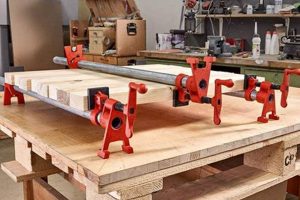
These devices, vital in furniture construction and various wood-assembling tasks, apply consistent pressure to join components securely during adhesive drying. The numerical fraction denotes the standard diameter of iron or steel tubing that serves as the clamp’s central bar. Users connect specialized head and tail pieces to threaded pipe ends, creating a clamping mechanism. For example, when building a tabletop from multiple boards, these instruments ensure a flat, even surface is maintained until the glue sets.
Their significance stems from their ability to exert substantial force over long spans, crucial when working with large panels or complex structures. They offer a cost-effective alternative to dedicated bar clamps, since the length is easily customized by selecting tubing of appropriate dimensions. The use of pipe-based clamping systems dates back decades, evolving alongside woodworking practices to meet the demands of both hobbyists and professional artisans.
The following sections will delve into the selection criteria, proper utilization techniques, maintenance protocols, and safety considerations associated with achieving optimal results in woodworking projects that require the effective application of clamping force.
Essential Usage Tips
Optimal application of these devices ensures project stability and structural integrity. Adhering to best practices maximizes their effectiveness and prolongs their lifespan.
Tip 1: Select Appropriate Pipe Grade: Employ Schedule 40 steel tubing for enhanced rigidity and resistance to bending under significant pressure. Inferior grades may deform, compromising clamping force.
Tip 2: Lubricate Threads Regularly: Apply a thin film of machine oil to the threaded ends of the pipe and the clamp heads to ensure smooth operation and prevent seizing. Neglecting lubrication leads to increased friction and potential damage.
Tip 3: Utilize Protective Pads: Place wood or rubber pads between the clamp jaws and the workpiece to prevent marring or indentation of the wood surface. Direct contact can leave unsightly marks, particularly on softwoods.
Tip 4: Distribute Clamping Pressure Evenly: Employ multiple clamps spaced at regular intervals along the glue line to ensure uniform distribution of force. Uneven pressure results in gaps or misalignments.
Tip 5: Avoid Over-Tightening: Apply sufficient pressure to close the joints, but refrain from excessive tightening, which can crush the wood fibers or damage the clamps. Listen for creaking sounds as a warning sign.
Tip 6: Clean and Store Properly: After each use, remove any adhesive residue from the pipe and clamp heads. Store the clamps in a dry environment to prevent rust and corrosion.
Tip 7: Inspect for Damage: Before each use, thoroughly inspect all components for signs of wear, cracks, or deformation. Replace damaged parts immediately to maintain safety and effectiveness.
Implementing these techniques leads to more consistent and professional results, while also extending the utility of these essential woodworking tools.
Considerations for long-term maintenance will be addressed in the subsequent section.
1. Clamping Force

Clamping force, the pressure exerted by these devices to hold woodworking components together during adhesive setting, is a critical determinant of joint strength and overall structural integrity. Insufficient force leads to weak bonds and potential failure, while excessive force can damage the wood fibers. The relationship between applied pressure and material response is therefore crucial in woodworking applications.
- Material Compression and Joint Closure
Effective clamping force achieves intimate contact between mating surfaces, squeezing out excess adhesive and ensuring complete joint closure. The ideal force level depends on the wood species, adhesive type, and joint design. For instance, hardwoods require greater force than softwoods to achieve comparable joint integrity. Over-compression, especially in porous woods, weakens the structure.
- Force Distribution and Alignment
Even distribution of clamping force across the joint line is paramount to prevent localized stress concentrations. These localized concentrations can lead to warping or uneven glue lines. Proper spacing and alignment of multiple clamps mitigates this risk. A single clamp, regardless of its applied pressure, is insufficient for large or complex joints.
- Impact of Pipe Diameter and Clamp Design
The diameter of the pipe used in these systems influences the maximum clamping force achievable. Larger diameter pipes, particularly those constructed from Schedule 40 steel, exhibit greater resistance to bending and deflection under load, allowing for the application of higher clamping forces without deformation. The design of the clamp head and tail also affects force transmission and distribution.
- Adhesive Type and Curing Time
The optimal clamping force is also influenced by the adhesive’s properties and recommended curing time. Certain adhesives require sustained pressure throughout the curing process to achieve maximum bond strength. Deviations from the manufacturer’s specifications can compromise joint integrity. Some adhesives expand, requiring different clamping strategies.
These facets of clamping force are interconnected and require careful consideration when utilizing these tools in woodworking. Proper selection and application of pipe clamps, guided by an understanding of material properties and adhesive requirements, ensures consistent and durable results, contributing to the overall quality and longevity of woodworking projects.
2. Pipe Material

The selection of tubing material fundamentally impacts the performance and lifespan of systems utilizing 3/4-inch pipe. Material characteristics directly influence clamping force, resistance to deformation, and susceptibility to corrosion, thus determining the suitability for diverse woodworking applications.
- Steel Grade and Strength
The steel grade dictates the pipe’s tensile strength and yield strength, affecting its ability to withstand clamping forces without bending or breaking. Schedule 40 steel is commonly recommended due to its robust properties, providing a balance between cost and structural integrity. Lower-grade steel may deform under pressure, compromising the accuracy and effectiveness of the clamping process. For instance, using black iron pipe may be suitable for less demanding applications, whereas galvanized steel offers enhanced corrosion resistance but may affect adhesive bonding if in direct contact with the wood.
- Wall Thickness and Rigidity
Wall thickness, directly related to the pipe schedule (e.g., Schedule 40), influences the pipe’s resistance to bending. Thicker walls provide greater rigidity, maintaining consistent clamping pressure over extended periods and large spans. Inadequate wall thickness can lead to deflection, resulting in uneven glue lines and weakened joints. When clamping long workpieces, using a thinner-walled pipe may result in bowing at the center, even with moderate clamping force. For highly demanding applications, thicker-walled steel, or even using a pipe filled with concrete or other rigid materials may improve clamping force.
- Surface Treatment and Corrosion Resistance
Surface treatment impacts the pipe’s resistance to corrosion, a critical consideration for longevity, particularly in humid environments. Galvanized steel, coated with a layer of zinc, offers enhanced protection against rust compared to bare steel. However, the galvanization process may affect the ability of certain adhesives to bond directly to the pipe’s surface. Regular cleaning and application of protective coatings, such as wax or oil, can mitigate corrosion in untreated steel. A rusted pipe can reduce clamping force.
- Dimensional Accuracy and Thread Quality
Dimensional accuracy of the pipe, specifically its outer diameter and straightness, affects compatibility with the clamp heads. Variations in diameter can result in loose or insecure connections. High-quality threads ensure a secure and reliable interface between the pipe and the clamp mechanism, preventing slippage under load. Inconsistencies in thread quality can lead to premature wear and failure of the clamping system. The use of improper pipe threading might damage the clamp head connection, reduce the clamping force, or result in unsafe use.
Therefore, careful attention to material properties and specifications is essential when selecting tubing for creating these woodworking systems. Choosing the appropriate pipe grade, considering surface treatments, and verifying dimensional accuracy are crucial steps in ensuring reliable and durable performance in diverse woodworking projects. Understanding each pipe’s capabilities and limitations will affect the longevity and usefulness in woodworking.
3. Thread Compatibility
Thread compatibility, within the context of woodworking utilizing 3/4 pipe clamps, is the precise matching of threading standards between the pipe ends and the corresponding clamp heads. Mismatched threads can have cascading effects, ranging from compromised clamping force to complete system failure. The industry standard threading for these devices is typically National Pipe Thread (NPT), ensuring interchangeability and reliable engagement. When the thread pitch or diameter deviates, the clamp head cannot properly seat on the pipe, leading to instability and a reduced capacity to apply consistent pressure. For example, attempting to use a clamp head designed for a metric thread on an NPT pipe will result in a loose, unreliable connection.
The importance of this matching is directly proportional to the size and complexity of the woodworking project. Small projects may appear to hold with improperly matched threads, but the lack of a secure connection can result in movement during the curing process, leading to misaligned joints. Larger, more demanding projects require the full rated clamping force to maintain structural integrity; mismatched threads inherently diminish this force, potentially causing catastrophic failure. The practical significance lies in the need for meticulous inspection and verification of thread compatibility before initiating any clamping operation.
Ensuring thread compatibility presents challenges, particularly when sourcing components from different manufacturers or dealing with older equipment. Thread gauges provide a reliable method for verifying thread standards. Furthermore, the potential for corrosion and thread damage necessitates regular inspection and maintenance. Ultimately, understanding and ensuring proper thread engagement is not merely a technical detail, but a fundamental prerequisite for achieving strong, accurate, and durable results in woodworking applications utilizing these specific devices.
4. Jaw Design
Jaw design is a critical determinant of a pipe clamp’s effectiveness in woodworking. It directly influences the distribution of clamping pressure, the stability of the clamped assembly, and the prevention of damage to the workpiece. Different jaw configurations cater to specific woodworking needs, and selecting the appropriate design is essential for achieving optimal results. The surface area of the jaw is a primary consideration. Wider jaws distribute force over a larger area, reducing the risk of indentation or crushing of the wood fibers, particularly in softer woods. Conversely, narrower jaws may be preferred when clamping smaller or more delicate components. For example, creating a frame for a painting typically necessitates narrow jaws to apply pressure at the mitered joints without damaging the visible surfaces.
The presence of features such as swivel heads or articulating pads further enhances the adaptability of these clamps. Swivel heads allow the jaws to self-align to non-parallel surfaces, ensuring even pressure distribution across the entire joint. Articulating pads, often made of rubber or plastic, provide a cushioning effect, minimizing the risk of marring or staining the wood. Consider a scenario where a slightly warped board is being glued to a flat surface; a clamp with swivel heads will compensate for the unevenness, resulting in a stronger bond. Furthermore, jaw depth plays a role in accommodating different workpiece thicknesses. Deeper jaws enable the clamping of thicker materials or components that are set back from the edge of the workpiece.
In summary, the intricacies of jaw design are integral to the overall performance of woodworking clamps. Understanding the relationship between jaw characteristics and specific woodworking tasks enables informed selection of clamps, leading to improved joint strength, reduced workpiece damage, and enhanced efficiency in the woodworking process. Ignoring these design aspects could result in inconsistent clamping pressure, damaged materials, and ultimately, compromised structural integrity of the finished product. Thus, a careful consideration of jaw design in the selection process is imperative for achieving consistently high-quality woodworking outcomes.
5. Span Capacity
Span capacity, the maximum length a 3/4 pipe clamp can effectively secure, is a direct function of the pipe’s length. This characteristic is paramount because it dictates the size of workpieces that can be accommodated. A limited span renders the clamp unsuitable for large panels or long assemblies. The length of the pipe acts as the primary determinant, although the pipe’s material composition and the clamp head design also play secondary roles. For instance, when assembling a large tabletop from multiple boards, a clamp with insufficient span would necessitate multiple setups or prove entirely unusable. The relationship between span capacity and project dimensions must therefore be carefully considered.
Effective utilization of available span involves optimizing clamp placement. Clamps should be positioned strategically to distribute pressure evenly along the joint line, typically spaced at intervals dictated by the material being clamped. For example, hardwoods may require closer spacing than softwoods to prevent bowing or gaps. When clamping particularly long pieces, intermediate supports may be necessary to prevent the pipe itself from sagging, which can compromise clamping pressure. A deeper understanding of span limitations enables woodworkers to plan projects effectively, minimizing material waste and ensuring structural integrity. Utilizing pipe extensions can increase span capacity, but this approach also increases the risk of deflection or instability.
Ultimately, the selection of clamps should align with the anticipated scale of woodworking projects. Investing in a range of pipe lengths provides versatility and mitigates the limitations imposed by a fixed span capacity. Ignoring span limitations can lead to compromised joint strength, increased material waste, and potentially unsafe working conditions. Therefore, understanding span capacity is not merely a matter of convenience but a critical element of responsible woodworking practice.
6. Maintenance

The longevity and effectiveness of 3/4 pipe clamps in woodworking are directly correlated with consistent and appropriate maintenance protocols. The operational environment exposes these tools to wood glue, sawdust, moisture, and varying degrees of clamping force. Neglecting maintenance results in corrosion, thread damage, reduced clamping pressure, and ultimately, premature failure. For example, dried wood glue on the pipe or threads impedes smooth operation, increasing friction and potentially damaging the threads. This necessitates regular cleaning and lubrication as preventative measures, ensuring unrestricted movement of the clamp head.
Maintenance practices extend beyond mere cleaning. Periodic inspection for signs of wear, such as cracked or bent jaws, deformed threads, or corrosion, is crucial. Identifying and addressing minor issues proactively prevents them from escalating into significant problems requiring costly replacements. Applying a thin coat of rust inhibitor to the pipes, particularly in humid climates, minimizes the risk of corrosion, maintaining their structural integrity. Proper storage also contributes to longevity; storing clamps in a dry environment, preferably hung or organized in a way that prevents contact with moisture and debris, reduces the likelihood of rust formation and physical damage. For instance, if a pipe clamp remains unused for an extended duration in a humid workshop, rust can compromise its ability to maintain a tight hold.
The economic implications of proper maintenance are substantial. A well-maintained set of pipe clamps can provide reliable service for decades, representing a significant return on investment compared to frequent replacements. Furthermore, effective maintenance ensures consistent clamping force, contributing to higher-quality woodworking projects. Consistent maintenance and care increases the lifespan and is crucial for the integrity and functionality of the system. In conclusion, diligent and consistent maintenance is not merely an ancillary task but an integral component of responsible woodworking practice, ensuring the long-term utility and performance of these essential clamping tools.
Frequently Asked Questions
The following section addresses common inquiries regarding the selection, application, and maintenance of devices essential for woodworking tasks.
Question 1: What distinguishes 3/4 pipe clamps from other clamping systems?
The primary distinction lies in their customizable span capacity. Standard bar clamps have fixed lengths, whereas pipe clamps utilize readily available, user-specified pipe lengths. This allows for adaptation to projects of varying dimensions, proving cost-effective for larger assemblies.
Question 2: Is Schedule 40 steel pipe mandatory for woodworking applications?
While not strictly mandatory, Schedule 40 steel offers superior rigidity and resistance to bending under pressure compared to thinner-walled alternatives. The selection depends on the anticipated clamping force and project size; for heavy-duty applications, Schedule 40 is advisable.
Question 3: How is proper clamping pressure determined to avoid damaging the wood?
The optimal pressure varies based on wood species and adhesive type. Hardwoods generally require greater force than softwoods. Over-tightening can crush wood fibers. Observe the joint line; sufficient pressure is achieved when the adhesive is evenly distributed and the joint is closed without excessive squeezing.
Question 4: What are the best practices for preventing rust and corrosion on pipe clamps?
Regular cleaning to remove adhesive residue, application of a rust inhibitor (e.g., paste wax or oil), and storage in a dry environment are crucial. Galvanized pipe offers enhanced corrosion resistance, though proper surface preparation may be needed for certain adhesives.
Question 5: Can pipe extensions be used to increase the span of pipe clamps?
Pipe extensions can increase span, but introduce the risk of deflection and reduced clamping force. This approach should be approached cautiously. Consider the weight of the project and the pipe diameter. Reinforcements may be needed.
Question 6: What are the indicators that a pipe clamp needs replacement?
Visible signs of wear, such as cracked jaws, severely corroded threads, bent pipes, or slippage under pressure, indicate that a clamp’s structural integrity has been compromised. Replacement is necessary to ensure safety and effective clamping.
Correct utilization and consistent upkeep ensures consistent and accurate application, delivering reliable long-term performance in woodworking endeavors.
The subsequent section will address the safety concerns to keep in mind.
Conclusion
This exploration of 3/4 pipe clamps for woodworking has highlighted their customizable span, material considerations, thread compatibility, jaw design influence, and the critical importance of maintenance. The factors discussedclamping force, pipe material, thread engagement, jaw features, and span limitationscollectively dictate the effectiveness and longevity of these indispensable tools.
Ultimately, informed selection, diligent maintenance, and adherence to safety protocols are paramount to ensuring consistent, accurate, and structurally sound results. Failing to appreciate the nuances of these devices risks compromised project integrity and potential injury. Therefore, a thorough understanding and conscientious application of these principles are essential for any woodworking endeavor utilizing 3/4 pipe clamps.
![Top-Rated: Best Quick Clamps for Woodworking Projects [2024] | Step-by-Step Guides, Tools & Inspiration to Build Beautiful Wooden Decor on a Budget](https://woodfromhome.com/wp-content/uploads/2026/04/th-264-300x200.jpg "Top-Rated: Best Quick Clamps for Woodworking Projects [2024] Step-by-Step Guides, Tools & Inspiration to Build Beautiful Wooden Decor on a Budget")