



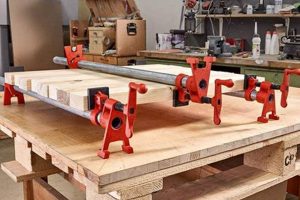
These essential tools, commonly found in workshops, provide a strong, adjustable grip to hold workpieces together during assembly and gluing. Characterized by a long steel bar and movable clamping head, these implements allow for even pressure distribution over extended lengths. An example includes securing a tabletop panel while the adhesive cures, ensuring a flat, unified surface.
Their utilization is vital for achieving precise and durable bonds in a variety of projects. The consistent pressure applied prevents warping and misalignment. Historically, simpler forms have existed for centuries, evolving into the robust, easily operated designs available today, thus facilitating more complex construction.
Understanding the different types available, selecting the appropriate size and strength for a given task, and employing correct clamping techniques are crucial for successful outcomes. The subsequent sections will explore these aspects in greater detail.
Essential Techniques for Effective Clamping
Proper clamping technique is paramount to achieving strong, aesthetically pleasing results in woodworking projects. The following guidelines will improve the efficacy of these devices and minimize potential issues.
Tip 1: Use Protective Cauls: Always employ cauls made of wood or a similar material between the clamp faces and the workpiece. This distributes pressure evenly and prevents marring of the wood surface.
Tip 2: Stagger Clamp Placement: Avoid placing clamps in a straight line. Staggering the arrangement enhances pressure distribution and minimizes the risk of bowing or warping.
Tip 3: Apply Even Pressure: Ensure each clamp exerts approximately equal pressure. Over-tightening can damage the wood fibers and compromise the joint’s integrity. Conversely, insufficient pressure will result in a weak bond.
Tip 4: Check for Square: Before the adhesive sets, verify that the assembly is square. Adjust clamp pressure or add shims as needed to correct any discrepancies.
Tip 5: Clean Excess Glue: After clamping, immediately remove any squeezed-out adhesive. This prevents unsightly glue lines and simplifies finishing.
Tip 6: Select the Correct Clamp Length: Ensure the implement extends sufficiently beyond the edges of the workpiece. Attempting to clamp beyond the tools maximum capacity reduces effectiveness and increases the risk of failure.
Effective utilization of these tools contributes directly to the strength, accuracy, and aesthetic appeal of woodworking projects. Adherence to these techniques promotes successful outcomes and minimizes potential errors.
The next section will discuss the maintenance and storage of these devices to ensure their longevity and continued performance.
1. Clamping Pressure

Clamping pressure, the force exerted by a clamping device onto a workpiece, is a critical determinant of joint integrity in woodworking. These clamping devices provide the means to apply and maintain this pressure during adhesive curing. Inadequate pressure results in weak bonds, while excessive pressure can crush wood fibers, compromising structural integrity. The capacity of the bar determines the maximum force applicable, directly influencing suitability for different project sizes and wood densities. Examples include securing frame components where consistent, moderate pressure ensures flush joints and prevents warping. Achieving optimal pressure requires careful consideration of wood species, adhesive type, and joint design.
The relationship between the tool and the desired force is not always linear. A longer bar may flex under significant pressure, reducing effective clamping force at the joint. Conversely, a shorter bar, while more rigid, may lack the necessary reach for larger assemblies. The specific thread design of the tool also affects the mechanical advantage, influencing the user’s ability to generate substantial pressure with minimal effort. Gluing up a large tabletop necessitates even pressure across all joints to prevent gaps or uneven surfaces.
Understanding the nuances of force application with these clamping tools is essential for successful woodworking. Achieving the correct clamping force is a skill honed through experience and a detailed understanding of materials and the tools themselves. The challenges of achieving perfect pressure balance underscore the importance of selecting appropriately sized and designed implements for each specific task. This skill set ultimately contributes to the production of durable, aesthetically pleasing finished products.
2. Jaw Protection

Jaw protection, a crucial aspect of woodworking practices, directly affects the integrity and aesthetic quality of projects utilizing these clamping devices. These tools exert substantial pressure, and without proper mitigation, their jaws can inflict damage upon the wood surface.
- Preventing Indentation
The primary function of jaw protection is to prevent the jaws from directly contacting and indenting the wood. Clamps concentrate force in a small area; thus, without a buffer, they readily leave impressions, particularly on softer wood species. An example includes clamping a delicate molding where direct contact from the jaws would permanently mar the surface.
- Distributing Pressure Evenly
Beyond preventing indentation, jaw protection aids in distributing clamping pressure more evenly across the workpiece. Uneven pressure can lead to distortion or misalignment of joined components. Wood cauls, for instance, conform to slight irregularities in the wood surface, ensuring uniform pressure application. An example of this benefit arises when clamping boards for a tabletop, where uniform pressure is essential for a flat, even surface.
- Protecting Against Staining
Some clamp jaws are made of metal that can react with certain wood species or finishes, leading to staining or discoloration. Jaw protection provides a barrier between the metal and the wood, preventing unwanted chemical reactions. For instance, tannin-rich woods, like oak, can react with steel, causing black staining. A protective layer eliminates this risk.
- Minimizing Slippage
Certain protective materials, such as rubber or textured pads, increase friction between the clamp jaws and the workpiece, reducing the likelihood of slippage during clamping. Slippage can lead to misalignment and weakened joints. Consider gluing up a complex mitered frame, where the clamping force is not perpendicular to the joint line. The jaws require additional friction to avoid movement.
The implementation of jaw protection, through the use of wood cauls, cork pads, or commercially available clamp jaw covers, is essential for achieving professional-quality results in woodworking. It safeguards the workpiece from damage, promotes even pressure distribution, prevents staining, and minimizes slippage, contributing to stronger, more aesthetically pleasing finished pieces. Proper jaw protection elevates the overall quality of projects utilizing these tools.
3. Parallel Alignment

Parallel alignment, in the context of woodworking and the utilization of these clamping devices, refers to maintaining consistent, equidistant spacing between the clamping surfaces and the workpiece edges. This ensures uniform pressure distribution and prevents structural distortions during assembly.
- Preventing Twisting and Warping
Failure to maintain parallel alignment can induce twisting or warping in the workpiece as the clamp pressure is applied. Uneven force concentrates stress on specific areas, causing the wood to deform. An example is clamping a wide panel where non-parallel clamping results in a bowed or uneven surface, compromising the integrity of the finished product.
- Ensuring Square Joints
For joinery involving right angles, parallel alignment is critical to achieving square and structurally sound connections. If the clamping surfaces are not parallel to the edges being joined, the resulting joint will be skewed, leading to instability and aesthetic flaws. Building a cabinet frame requires meticulous parallel alignment during clamping to ensure perfectly square corners and a rigid structure.
- Optimizing Glue-Line Pressure
Parallel alignment facilitates optimal glue-line pressure. Consistent pressure across the entire joint surface is necessary for a strong and durable bond. Non-parallel clamping creates variations in pressure, leading to areas of adhesive starvation and weakened connections. During edge-gluing boards for a tabletop, parallel alignment guarantees uniform adhesive distribution and a reliable bond throughout the entire surface.
- Facilitating Accurate Assembly
Maintaining parallel alignment greatly simplifies the assembly process. When the clamping surfaces are properly aligned, the components fit together precisely, reducing the need for corrective adjustments and minimizing the risk of errors. Constructing a multi-drawer chest benefits from parallel alignment during each stage to maintain consistent dimensions and prevent cumulative inaccuracies.
The importance of parallel alignment when employing these clamping tools cannot be overstated. Neglecting this aspect can lead to structural weaknesses, aesthetic imperfections, and significant rework. Achieving consistent and accurate parallel alignment contributes directly to the creation of durable, visually appealing, and professionally crafted woodworking projects.
4. Optimal Spacing

Optimal spacing in the context of these devices refers to the strategic placement of individual implements along a workpiece to achieve consistent and uniform pressure distribution. The effectiveness of these tools relies heavily on the correct interval between each unit, ensuring a robust bond and preventing structural defects.
- Preventing Bowing and Warping
Inadequate quantity or irregular placement invites bowing or warping, particularly when joining long or wide components. The absence of sufficient support between these devices allows the wood to deflect under pressure, creating an uneven surface. Edge-gluing several boards to form a tabletop requires consistent spacing to prevent individual boards from bowing upward, resulting in an unlevel assembly.
- Maximizing Glue-Line Contact
Proper spacing ensures that the adhesive is evenly distributed along the joint. Excessive distance allows for glue starvation in areas between the implements, weakening the bond. Insufficient spacing, conversely, can lead to excessive glue squeeze-out and potential joint failure due to lack of complete surface contact. Aligning the stiles and rails of a cabinet door necessitates consistent intervals to ensure proper adhesive distribution for a strong and seamless joint.
- Accommodating Wood Movement
Wood expands and contracts with changes in humidity. Optimal spacing allows for minor wood movement without compromising the integrity of the joint. Over-clamping with closely spaced units can restrict natural expansion, leading to stress and potential cracking. Equally spacing while attaching breadboard ends to a solid wood table allows the table to expand and contract with the seasons.
- Balancing Clamp Quantity and Efficiency
Finding the ideal balance between the number of implements used and the efficiency of the clamping process is crucial. Employing too many is wasteful and time-consuming, while using too few compromises the structural integrity. Strategic placement maximizes the effectiveness of each implement, minimizing material cost and labor. Efficiently assembling a large frame requires a careful balance. Sufficient support without cluttering the workspace is crucial for workflow.
Optimal spacing, therefore, represents a critical consideration when utilizing these implements. Through careful planning and strategic placement, the woodworker can ensure a strong, durable, and aesthetically pleasing finished product. The correct interval not only optimizes the effectiveness of each individual device but also contributes to the overall structural integrity and longevity of the assembled workpiece. This principle is fundamental to realizing quality outcomes when using these tools.
5. Appropriate Length

The selection of implements with an appropriate bar length is a fundamental consideration in woodworking operations. An inadequate length renders the tool ineffective, preventing secure engagement with the workpiece, while excessive length introduces unnecessary bulk and reduces maneuverability. The selection directly impacts the ability to apply consistent and sufficient pressure across the joint being assembled. For example, a short clamping device, when applied to a wide table top glue-up, will fail to reach across all necessary joints. Conversely, a longer clamping device, when used on a small box, will get in the way, and require a delicate balancing act to secure the pieces together properly.
This consideration extends beyond simple reach. The length of the bar influences the stability of the setup. A longer implement can exhibit increased flex under pressure, particularly if the bar is of insufficient thickness. This flexing can lead to uneven pressure distribution, compromising joint integrity. Similarly, the excess length can increase the likelihood of accidental dislodgement or interference with other tools or materials in the workspace. Gluing up a long segmented turning blank, for instance, benefits from appropriately sized implements, minimizing wobble and maintaining even pressure to avoid misalignment during the curing process.
Therefore, the selection of an appropriate length is a critical aspect of effective woodworking. Careful consideration of the workpiece dimensions and the physical constraints of the workspace are essential for optimizing clamping performance. This choice is not merely a matter of convenience; it directly impacts the quality, strength, and longevity of the finished product. The ability to correctly assess and select the proper tool length reflects a fundamental understanding of woodworking principles and a commitment to achieving professional-grade results.
6. Thread Lubrication
Thread lubrication is an essential maintenance practice directly affecting the performance and longevity of woodworking implements. The threaded components of these tools are responsible for generating and maintaining clamping pressure. Friction within the threads, if left unaddressed, increases the force required to achieve the desired clamping pressure, leading to premature wear, reduced clamping force, and potential seizing. For example, attempting to clamp large workpieces with an unlubricated tool requires excessive physical exertion, increasing the risk of inaccurate alignment and compromised joint strength.
Regular application of a suitable lubricant, such as a dry Teflon spray or paraffin wax, minimizes friction, allowing for smoother operation and more precise pressure control. This practice also protects the threads from corrosion, particularly in humid environments. Neglecting thread lubrication leads to increased strain on the threads, potentially causing deformation or stripping, rendering the implement unusable. Properly lubricated tools provide consistent clamping force, contributing to the quality and durability of the assembled workpiece. Consider, for instance, clamping delicate hardwood components. Smoother thread operation ensures even pressure distribution, preventing marring or crushing of the wood fibers.
In conclusion, thread lubrication is not merely a superficial maintenance step but an integral aspect of responsible tool care. It optimizes performance, extends tool life, and ultimately contributes to the consistent production of high-quality woodworking projects. Overlooking this simple yet crucial practice can result in diminished efficiency, increased physical strain, and potentially costly equipment failures. Lubrication upholds consistent pressure application, extends tool life, and elevates the quality of assembled woodwork, demonstrating its practical significance.
Frequently Asked Questions
The following addresses common inquiries regarding the proper selection, usage, and maintenance of these tools, essential for achieving high-quality woodworking results.
Question 1: What is the recommended clamping pressure for softwood versus hardwood?
Softwoods generally require less pressure than hardwoods. Excessive pressure can crush softwood fibers, while insufficient pressure on hardwoods results in weak joints. A general guideline is to apply enough pressure to see a small amount of adhesive squeeze out from the joint.
Question 2: How does clamp spacing impact the strength of a glue joint?
Inconsistent or excessive spacing can lead to uneven pressure distribution along the glue line. This can result in areas of glue starvation and weakened joints. Optimal spacing ensures uniform adhesive distribution and maximum bond strength.
Question 3: What materials are suitable for use as protective cauls?
Hardwood, cork, and rubber are commonly used. Hardwood cauls distribute pressure evenly and prevent indentation. Cork and rubber provide additional grip and protect against marring of delicate surfaces.
Question 4: What are the common causes of bar clamp failure?
Over-tightening, using clamps beyond their rated capacity, and neglecting thread lubrication are frequent causes. Inspect for signs of wear or damage before each use. Do not exceed the maximum clamping force specified by the manufacturer.
Question 5: How should these woodworking tools be stored to prevent rust and corrosion?
Clean and dry the clamps thoroughly after each use. Apply a thin coat of rust preventative to the bar and threads. Store in a dry environment to minimize exposure to moisture.
Question 6: When is it necessary to use more expensive, heavy-duty options instead of standard bar clamps?
Heavy-duty options are warranted for larger, more demanding projects requiring significant clamping force. Examples include assembling large tabletops or casework where maintaining flatness and joint integrity under substantial pressure is paramount.
The information provided highlights the importance of informed decision-making when selecting and utilizing these essential woodworking tools. Proper application of these principles promotes successful and durable woodworking outcomes.
The next section will address advanced techniques for utilizing these woodworking tools in specialized woodworking applications.
Conclusion
This exploration of bar clamps woodworking has illuminated the critical role these tools play in achieving precise and durable results. From understanding optimal pressure and jaw protection to maintaining parallel alignment and ensuring proper thread lubrication, the preceding sections have underscored the importance of informed technique and tool selection. Various clamping methods, material knowledge, and awareness of the environment are all important to the success of any woodwork project.
Mastery of woodworking entails a commitment to understanding and implementing best practices. Continued refinement of these skills ensures not only the creation of lasting and aesthetically pleasing projects but also promotes a deeper appreciation for the craft. Careful application improves the strength and quality of craftsmanship.
![Top-Rated: Best Quick Clamps for Woodworking Projects [2024] | Step-by-Step Guides, Tools & Inspiration to Build Beautiful Wooden Decor on a Budget](https://woodfromhome.com/wp-content/uploads/2026/04/th-264-300x200.jpg "Top-Rated: Best Quick Clamps for Woodworking Projects [2024] Step-by-Step Guides, Tools & Inspiration to Build Beautiful Wooden Decor on a Budget")