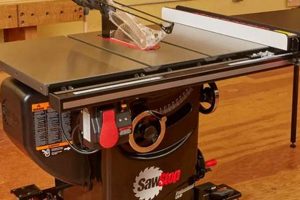
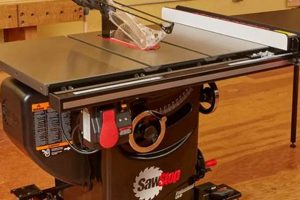
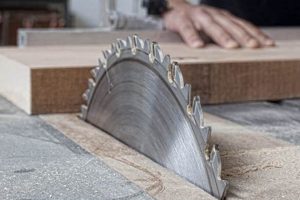
Specialized auxiliary devices designed for use with a stationary cutting machine, these tools enhance precision, safety, and repeatability in woodworking operations. Examples include devices for creating consistent angled cuts, dadoes, tenons, or tapers. These accessories guide the workpiece accurately through the saw blade, minimizing the risk of errors and improving the overall quality of the finished product.
The employment of these supportive structures offers several key advantages. They improve user safety by keeping hands away from the blade, and enhance efficiency by streamlining repetitive tasks. Historically, woodworkers have developed these tools to overcome limitations in standard equipment and to address specific project requirements, leading to greater accuracy and consistent results. The adoption of these devices also contributes to reduced material waste.
The remainder of this article will explore the various types, construction techniques, and applications of these valuable shop aids, covering topics such as miter sleds, tenoning jigs, tapering jigs, and circle-cutting attachments. It will also address considerations for material selection, dimensional accuracy, and safe operational practices when utilizing these enhancements.
Practical Guidance for Table Saw Enhancement
The following points offer practical suggestions for maximizing the utility and safety of supplementary table saw devices. Careful consideration of these recommendations will contribute to improved project outcomes.
Tip 1: Prioritize Safety Hardware: When constructing or using supplemental devices, ensure the inclusion of push sticks, featherboards, and blade guards. These components are paramount in minimizing the risk of injury.
Tip 2: Employ Precision Measurement: Accuracy in construction is critical. Use calibrated measuring tools and double-check all dimensions before cutting materials for jig construction.
Tip 3: Select Appropriate Materials: Baltic birch plywood and solid hardwoods are recommended for durable jig construction. Avoid using materials prone to warping or cracking.
Tip 4: Implement Secure Clamping Mechanisms: Incorporate reliable clamping mechanisms to securely hold workpieces during cutting operations. Eliminate any movement or vibration that could compromise accuracy.
Tip 5: Optimize Jig Design for Specific Tasks: Tailor the design of each device to the specific task for which it is intended. A universal solution is rarely as effective as a purpose-built option.
Tip 6: Routinely Inspect and Maintain Devices: Regularly inspect supplemental devices for signs of wear or damage. Replace worn parts and ensure all components are functioning correctly.
Tip 7: Practice Before Production: Before using a new or unfamiliar device on a critical project, practice on scrap material to ensure familiarity and proper setup.
Adhering to these suggestions will enhance the efficiency, safety, and precision of woodworking operations. The benefits of these auxiliary table saw implements are significantly amplified through careful planning, construction, and execution.
The subsequent sections will address specific examples of applications and advanced techniques for utilizing these important shop accessories.
1. Enhanced Safety Measures

The integration of enhanced safety measures in auxiliary table saw devices significantly mitigates potential risks associated with woodworking operations. These specialized structures, when designed with safety as a primary consideration, offer a crucial barrier between the operator and the saw blade. An example is the implementation of push sticks and push blocks, which maintain control over the workpiece while keeping hands at a safe distance. Featherboards, another example, apply consistent pressure, preventing kickback and minimizing the potential for injury. Proper design and usage of these tools are paramount for a safe working environment.
The incorporation of clear guards and blade covers further contributes to a safer workflow. These shields provide a physical barrier, preventing accidental contact with the spinning blade. Emergency stop mechanisms, integrated into the device or readily accessible, offer an immediate means to halt operation in the event of an unforeseen circumstance. Jig design that considers dust collection also enhances safety by improving visibility and reducing the risk of respiratory issues. Secure clamping systems, when implemented correctly, further prevent workpiece movement, which is a major contributor to accidents.
In summary, the deliberate inclusion of safety measures within the design and application of these supplemental saw accessories is not merely an option, but a necessity. Careful design, material choice, and diligent adherence to safe operating procedures dramatically decrease the likelihood of accidents, promoting a secure and efficient woodworking environment. Challenges remain in ensuring universal adoption of these safety principles and consistent training in their proper application.
2. Accuracy and Repeatability

The attainment of accuracy and repeatability in woodworking is intrinsically linked to the utilization of auxiliary table saw devices. These implements, when properly designed and executed, serve to minimize human error, thereby enhancing the precision of cuts and promoting consistent results across multiple workpieces. This is particularly crucial in projects requiring identical components, such as cabinetmaking or furniture construction, where dimensional discrepancies can significantly compromise the final product.
The causal relationship is evident: A well-constructed jig, calibrated for precise angles or dimensions, effectively removes the variability inherent in freehand cutting. For instance, a miter sled, incorporating precise angle stops, enables the user to repeatedly produce accurate mitered corners. Similarly, a tenoning jig facilitates the creation of consistent tenon dimensions, ensuring tight-fitting joints. The significance of accuracy and repeatability extends beyond mere aesthetics; it directly impacts the structural integrity and overall longevity of the finished piece. In professional settings, the employment of these tools translates to reduced material waste, minimized rework, and increased efficiency. The practical significance lies in the ability to produce high-quality, consistent products with predictable results, fostering client satisfaction and bolstering professional reputation.
In summary, the relationship between auxiliary table saw devices and achieving accuracy and repeatability in woodworking is undeniable. These tools, acting as extensions of the machine itself, serve to translate design specifications into tangible reality with a level of precision unattainable through freehand methods alone. While challenges may exist in initial setup and calibration, the long-term benefits in terms of efficiency, consistency, and quality far outweigh the initial investment of time and resources. As woodworking evolves, the reliance on such devices will likely continue to grow, driven by the increasing demand for precision, efficiency, and repeatability in a competitive marketplace.
3. Project-Specific Design

Project-specific design, within the context of auxiliary table saw devices, refers to the tailoring of these tools to meet the unique demands of a particular woodworking task. The functionality and configuration of these tools are not generic; instead, they are conceived and constructed to address specific cutting requirements, jointing methods, or shaping operations. The effectiveness of a supplementary table saw device is significantly enhanced when its design is aligned with the characteristics of the project at hand.
- Custom Angled Cuts
A project requiring repetitive angled cuts, such as building a picture frame or a complex geometric structure, necessitates a device that can reliably and accurately reproduce the desired angle. This might involve a miter sled with adjustable stops or a dedicated angled cutting jig. The degree of precision achievable with a purpose-built device far exceeds that of freehand methods, resulting in improved accuracy and reduced material waste.
- Dado and Groove Creation
The creation of consistent dadoes or grooves is critical in cabinetmaking and shelving projects. A specialized device, typically a dado jig, ensures that these features are uniform in depth, width, and placement. Such a jig provides a stable platform for the workpiece and guides it precisely across the dado blade, resulting in clean and accurate cuts.
- Tapered Components
Creating tapered legs for furniture or other angled components necessitates a tapering jig. This type of device allows the workpiece to be safely and accurately fed into the blade at the desired angle, creating a consistent taper along its length. The design of the tapering jig must accommodate the dimensions of the workpiece and the degree of taper required for the project.
- Circle and Arc Cutting
The creation of circular or arc-shaped components requires a specialized circle-cutting jig. This device pivots the workpiece around a central point, allowing it to be cut into a perfect circle or arc. The radius of the circle is determined by the distance between the pivot point and the blade, allowing for the creation of circles of varying sizes with precision. This type of jig is crucial for projects like table tops, decorative elements, and curved casework.
The emphasis on project-specific design underscores the importance of careful planning and execution in woodworking. It highlights the transition from general-purpose tools to highly specialized devices tailored to specific tasks. In essence, these attachments, designed for a certain task, become an integral element in achieving high-quality and efficient results. A table saw becomes more versatile and precise through the use of purpose-built supplementary tools.
4. Material Selection Impact

The selection of materials for the construction of auxiliary table saw devices exerts a profound influence on the accuracy, durability, and overall utility of these tools. The chosen materials directly impact the device’s stability, resistance to wear, and capacity to maintain dimensional precision under the stresses of repeated use.
- Dimensional Stability
The extent to which a material retains its original dimensions under varying environmental conditions is paramount. Baltic birch plywood, for instance, exhibits superior dimensional stability compared to solid wood, minimizing warping and distortion that can compromise accuracy. Medium-density fiberboard (MDF), while dimensionally stable, may be less durable under repeated clamping pressure. The impact of humidity changes on material integrity must be considered in the context of long-term performance.
- Wear Resistance
The surfaces of these devices are subject to abrasion from workpieces and clamping mechanisms. Hardwoods such as maple or oak offer greater wear resistance than softer woods like pine or poplar. The application of durable finishes, such as lacquer or polyurethane, can further enhance the wear resistance of the device’s surface, extending its lifespan and maintaining its functionality.
- Friction Characteristics
The coefficient of friction between the device and the workpiece impacts the ease of movement and the precision of cuts. Materials with low friction surfaces, such as certain plastics or laminates, facilitate smooth gliding and reduce the likelihood of workpiece slippage. The selection of appropriate friction materials is crucial for devices designed to guide workpieces across the table saw surface.
- Fastener Retention
The ability of a material to securely hold screws, bolts, and other fasteners is critical for the structural integrity of the device. High-density materials, such as hardwoods and some composite materials, offer superior fastener retention compared to lower-density options. Proper pilot hole drilling and the use of appropriate fastener types are essential for maximizing fastener retention and preventing structural failure.
These considerations underscore the critical relationship between material choice and the overall performance of woodworking table saw jigs. Suboptimal material selection can lead to reduced accuracy, premature wear, and compromised safety. Conversely, judicious material selection, informed by an understanding of the specific demands of the application, can result in durable, accurate, and highly effective auxiliary table saw implements.
5. Efficient Workflow Integration
Auxiliary table saw devices, when strategically integrated into the woodworking process, contribute significantly to enhanced workflow efficiency. The judicious application of these tools minimizes material handling, reduces setup times, and streamlines repetitive operations, ultimately accelerating project completion. The causal relationship is that well-designed supplementary tools proactively address bottlenecks, optimizing the sequence of tasks and reducing wasted effort. This is particularly evident in production environments where consistent output is critical.
An illustrative example is the utilization of a dedicated dado jig for the creation of multiple, identically spaced dadoes in cabinet construction. By eliminating the need for repeated measurements and manual adjustments, this jig enables rapid and precise groove cutting. Similarly, a miter sled, incorporating pre-set angle stops, streamlines the process of creating accurate mitered joints for picture frames or geometric structures. The practical application lies in the reduction of time spent on individual tasks, allowing for a greater volume of work to be completed within a given timeframe. The incorporation of integrated dust collection systems on the supplementary devices further enhances workflow by maintaining a clean and safe working environment.
In conclusion, the seamless integration of supplementary table saw devices into the woodworking workflow represents a strategic optimization of resources. These tools, when thoughtfully selected and implemented, contribute to increased efficiency, reduced waste, and improved overall productivity. The challenges reside in the initial investment of time and resources required for jig design and construction; however, the long-term benefits in terms of time savings and improved quality render this investment a worthwhile endeavor.
Frequently Asked Questions About Woodworking Table Saw Jigs
This section addresses common questions regarding the function, construction, and safe operation of auxiliary table saw implements, providing clarification and practical advice.
Question 1: Are auxiliary devices essential for table saw operation?
While not strictly essential for basic ripping and crosscutting, supplementary implements significantly enhance accuracy, safety, and the range of operations achievable on a table saw.
Question 2: What materials are best suited for constructing supplemental devices?
Baltic birch plywood and hardwoods, such as maple or oak, are recommended due to their dimensional stability, durability, and ability to securely hold fasteners. Material selection should align with the specific demands of the tool.
Question 3: How can the risk of kickback be minimized when using a supplementary table saw implement?
Implementations, such as featherboards and appropriate push sticks, can help maintain control of the workpiece. These reduce the likelihood of kickback when employed with proper cutting techniques.
Question 4: What level of precision is achievable with a well-designed woodworking table saw jig?
When constructed and calibrated accurately, these tools can achieve tolerances within a few thousandths of an inch, significantly exceeding the precision attainable through freehand cutting methods.
Question 5: How often should supplementary devices be inspected for wear and tear?
Regular inspection, ideally before each use, is crucial. Worn components, loose fasteners, and damaged surfaces should be addressed promptly to ensure safe and accurate operation.
Question 6: Is specialized training required for the safe use of a supplemental device?
While not always mandatory, familiarization with the specific implement’s function, proper setup, and safe operating procedures is strongly recommended. Practice on scrap material is advisable before attempting complex cuts.
In summary, woodworking table saw jigs offer substantial benefits regarding precision, safety, and efficiency, provided they are thoughtfully designed, constructed with appropriate materials, and operated with due care. Regular inspection and maintenance are crucial for ensuring their continued performance.
The subsequent section will delve into the specific types of auxiliary table saw implements and their respective applications.
Conclusion
This exploration has illuminated the multifaceted role of woodworking table saw jigs in enhancing the precision, safety, and efficiency of woodworking operations. From project-specific designs to material selection and workflow integration, these auxiliary devices provide a critical bridge between the capabilities of the table saw and the demands of intricate woodworking projects. The implementation of safety measures, coupled with the pursuit of accuracy and repeatability, underscores the significance of these jigs in achieving consistently high-quality results.
As woodworking continues to evolve, the strategic application of these jigs will become increasingly essential for professionals and hobbyists alike. Investing in the knowledge and skill required to design, construct, and utilize these devices represents a commitment to excellence in craftsmanship, paving the way for safer, more precise, and ultimately more rewarding woodworking endeavors. The pursuit of mastery in the utilization of these shop aids warrants dedicated attention, given their substantial contribution to the art and science of woodworking.