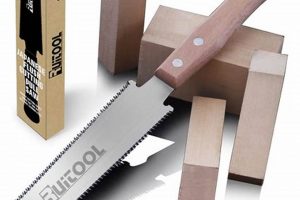
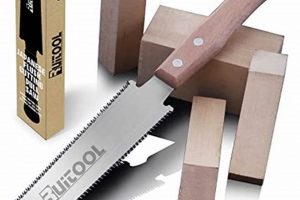
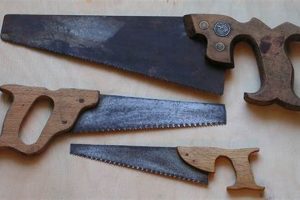
These specialized hand tools are designed to efficiently cut wood parallel to the grain. Their unique tooth geometry, characterized by a greater rake angle and filed for a chisel-like action, facilitates the severing of long wood fibers. An example of its use would be to reduce a wide board to a narrower width along its length.
The effectiveness of this type of saw significantly impacts the speed and ease of creating dimensioned lumber from rough stock. Historically, these tools were indispensable in construction and carpentry, predating widespread power tool adoption. Their continued relevance stems from their portability, control, and suitability for intricate or precise work where power tools may be impractical.
Understanding the various types, tooth designs, and proper techniques is essential for achieving clean, accurate cuts. The following sections will delve into the specifics of selecting the right tool, maintaining its sharpness, and employing efficient cutting methods.
Essential Usage Considerations
Effective employment requires careful consideration of technique and tool condition. Optimizing these factors leads to superior results and increased efficiency.
Tip 1: Selecting Appropriate Tooth Configuration: Opt for fewer teeth per inch (TPI) for thicker stock and faster cutting. Higher TPI configurations are better suited for thinner materials requiring a finer finish.
Tip 2: Maintaining Sharpness: Regular sharpening is crucial. A dull blade requires excessive force, leading to inaccurate cuts and increased user fatigue. Utilize appropriate files and sharpening jigs to maintain consistent tooth geometry.
Tip 3: Establishing a Starting Kerf: Accurately initiate the cut using a pull stroke. This establishes a guide for subsequent strokes, preventing wandering and ensuring a straight cut line.
Tip 4: Employing Full-Length Strokes: Utilize the entire blade length for each stroke. This maximizes cutting efficiency and minimizes unnecessary movement.
Tip 5: Maintaining a Consistent Angle: Maintain a consistent cutting angle (typically around 60 degrees) relative to the workpiece. Deviations from this angle can lead to binding and inaccurate cuts.
Tip 6: Avoiding Excessive Force: Allow the blade to do the work. Applying excessive downward pressure can cause the blade to buckle or bind. A sharp blade and proper technique minimize the need for force.
Tip 7: Utilizing a Saw Bench or Vise: Secure the workpiece firmly using a saw bench or vise. This provides stability and allows for controlled and accurate cutting.
Precise application of these methods enhances the effectiveness of the tool, resulting in cleaner cuts, reduced effort, and improved project outcomes.
The final section of this document will address common troubleshooting issues and provide resources for further learning.
1. Tooth Geometry

Tooth geometry is a critical factor influencing the performance of woodworking tools specifically designed for cutting along the grain of wood. The shape, angle, and set of the teeth determine the efficiency and quality of the cut.
- Rake Angle
The rake angle, defined as the angle of the tooth’s cutting face relative to a line perpendicular to the saw’s length, is significant. Aggressive rake angles are characteristic of tools used to sever wood fibers quickly, providing efficient material removal. A steeper rake angle is suited for softer woods, whereas a more moderate angle is preferable for hardwoods to prevent tear-out.
- Tooth Pitch (TPI)
Tooth pitch, often measured in teeth per inch (TPI), dictates the coarseness of the cut. Lower TPI values result in larger gullets, enabling faster material removal but potentially producing a rougher finish. Higher TPI values yield finer cuts with less tear-out, albeit at a slower cutting speed. The selection of appropriate TPI is dependent on the thickness and density of the material being cut.
- Gullet Depth and Shape
The gullet, the space between the teeth, serves to collect and remove wood chips during the cutting process. Sufficient gullet depth is necessary to prevent clogging, particularly when working with thicker lumber. The shape of the gullet also influences chip ejection; a well-designed gullet facilitates smooth and efficient cutting action.
- Tooth Set
Tooth set refers to the alternating offset of the teeth to either side of the blade. This creates a kerf (the width of the cut) that is wider than the blade’s thickness, preventing binding and reducing friction during the cut. The amount of set must be appropriate for the wood type and cutting task; excessive set can lead to a rough cut, while insufficient set can cause the blade to bind.
These geometrical attributes collectively determine a tool’s performance when used parallel to the grain. Precise understanding and appropriate selection of these features enable woodworkers to achieve optimal cutting efficiency, accuracy, and surface finish.
2. Rake Angle

The rake angle is a fundamental design characteristic of woodworking tools specifically engineered for longitudinal cutting. Its optimization directly impacts the efficiency and quality of the resulting cut.
- Definition and Measurement
The rake angle represents the angle between the tooth’s cutting face and a line perpendicular to the saw’s length. It is typically measured in degrees. A steeper rake angle presents a more aggressive cutting profile, while a shallower angle offers a less aggressive approach.
- Impact on Cutting Efficiency
A high rake angle, common in tools designed for this use, facilitates efficient material removal by creating a more acute cutting edge. This is particularly advantageous when working with softer woods, allowing the saw to slice through the fibers with minimal resistance. Conversely, an excessively high rake angle in hardwoods can lead to tear-out and a rough surface finish.
- Influence on Force Requirements
Rake angle affects the amount of force required to propel the saw through the material. A more aggressive rake angle reduces the necessary cutting force but increases the risk of the saw grabbing or chattering. A less aggressive angle requires more force but provides greater control and a smoother cutting action.
- Adaptation to Wood Species
The optimal rake angle varies depending on the species of wood being processed. Softer woods, like pine or cedar, benefit from steeper rake angles. Harder woods, such as oak or maple, typically perform better with shallower rake angles that prioritize control and minimize splintering.
The selection of an appropriate rake angle is crucial for maximizing cutting efficiency, minimizing effort, and achieving a clean, accurate cut parallel to the grain. Understanding the interplay between rake angle and wood properties enables woodworkers to select and utilize this type of saw effectively across a range of applications.
3. Cutting Stroke

The cutting stroke is the fundamental action dictating the performance of these specialized woodworking tools. Its proper execution determines efficiency, accuracy, and user comfort.
- Angle of Attack
The angle at which the blade engages the wood significantly impacts cutting efficiency. A shallow angle, typically around 45-60 degrees, allows the teeth to effectively sever the fibers parallel to the grain. Maintaining this consistent angle throughout the stroke is crucial for preventing binding and ensuring a straight cut. Deviations from this angle require corrective adjustments in technique.
- Stroke Length and Frequency
Full-length strokes, utilizing the entire blade, maximize cutting efficiency. Short, choppy strokes waste energy and can create an uneven kerf. The frequency of strokes should be consistent and controlled, allowing the teeth to remove material without excessive force. A smooth, rhythmic motion is more effective than rapid, jerky movements.
- Applied Pressure
The amount of downward pressure applied during the cutting stroke must be carefully regulated. Excessive pressure can cause the blade to buckle or bind, leading to inaccurate cuts and increased user fatigue. Conversely, insufficient pressure results in slow cutting and unnecessary effort. A sharp blade and proper technique minimize the need for significant force.
- Body Mechanics and Stance
Adopting a stable and balanced stance is essential for maintaining control and minimizing fatigue. The body should be positioned to allow for a full range of motion and to facilitate the application of controlled force. Utilizing the larger muscle groups in the legs and torso helps to distribute the workload and prevent strain on the arms and shoulders.
Optimizing the cutting stroke, encompassing angle, length, pressure, and body mechanics, enhances the effectiveness of these tools, resulting in cleaner, more accurate cuts and reduced user fatigue. Mastery of this fundamental technique is paramount for achieving professional-quality results in woodworking projects involving longitudinal cuts.
4. Wood Grain

The alignment of wood fibers, commonly referred to as wood grain, dictates the performance and application of tools designed for longitudinal cutting. Understanding its characteristics is paramount for efficient and accurate material removal.
- Grain Direction and Splitting Tendency
Wood grain direction significantly influences splitting tendency. Cutting against the grain increases the likelihood of splintering and tear-out. Specialized tools are designed to sever fibers parallel to their alignment, minimizing this risk. For example, when working with a board exhibiting pronounced grain runout, careful attention must be paid to the direction of cut to avoid compromising the workpiece.
- Density Variations and Cutting Resistance
Variations in density within the grain pattern affect cutting resistance. Knots and areas of denser growth offer increased resistance to the blade. A tool with appropriate tooth geometry and sharpness is essential to navigate these variations effectively. For instance, a hardwood board with tight, dense grain requires a saw with a steeper rake angle compared to a softwood board with open grain.
- Grain Orientation and Surface Finish
The orientation of the grain directly impacts the resulting surface finish. Cutting along the grain produces a smoother, cleaner surface compared to cutting across it. The specific design features, such as tooth set and rake angle, are engineered to optimize surface quality when cutting with the grain. Consider the difference in surface appearance between a board carefully prepared by hand compared to one coarsely processed with a dull blade against the grain.
- Impact on Tool Selection
The type of wood and its grain characteristics directly influence the selection of the appropriate tool. Softwoods with straight grain are more easily cut with tools having a steeper rake angle and lower tooth count. Hardwoods with interlocked or figured grain require saws with a more moderate rake angle and higher tooth count for improved control and reduced tear-out. Choosing the wrong tool can result in inefficient cutting, inaccurate results, and damage to the workpiece.
These facets illustrate the fundamental relationship between wood grain and tool performance. By carefully considering these aspects, woodworkers can select and utilize specialized tools for longitudinal cutting effectively, achieving precise and high-quality results.
5. Sharpening Technique

The efficacy of tools designed for cutting along wood grain hinges directly on the precision of the sharpening technique employed. A dull blade requires excessive force, leading to inaccurate cuts, increased user fatigue, and a greater risk of workpiece damage. Proper sharpening restores the original tooth geometry, allowing the tool to sever wood fibers cleanly and efficiently. Consider the scenario where a craftsman attempts to create a precise tenon joint using a dull saw; the resulting joint will likely be ill-fitting and structurally unsound due to the inaccurate cuts.
Effective sharpening involves several critical steps: jointing, shaping, filing, and setting. Jointing ensures that all teeth are of uniform height, contributing to a consistent cut depth. Shaping restores the correct rake angle, optimized for longitudinal cutting. Filing sharpens each tooth’s cutting edge, and setting imparts the necessary offset to prevent binding within the kerf. Neglecting any of these steps compromises the overall performance. For instance, improper setting can cause the blade to overheat due to excessive friction, potentially damaging the tool and the workpiece.
Mastery of sharpening techniques is essential for maintaining tools designed for cutting along wood grain. Consistent application of these skills ensures optimal performance, extending the tool’s lifespan and contributing to the creation of high-quality woodworking projects. Challenges include achieving consistent tooth geometry and selecting the appropriate files and setting tools. Addressing these challenges through practice and education enhances the woodworker’s ability to maintain these specialized tools effectively.
6. Saw Selection

The appropriate selection of a tool designed for cutting along the grain is paramount to achieving efficiency, accuracy, and safety in woodworking tasks. This process demands careful consideration of several factors, each contributing to the overall suitability of the chosen implement for the intended application. Incorrect selection can result in inefficient cutting, damage to the workpiece, and increased risk of injury.
- Wood Species and Hardness
The type and density of the wood significantly influence tool choice. Softwoods generally require less aggressive tooth geometries and can be efficiently cut with saws having a steeper rake angle. Hardwoods, conversely, necessitate saws with finer teeth and a more moderate rake angle to minimize tear-out and maintain control. For example, a saw designed for pine framing would be unsuitable for fine cabinetry using hardwoods like maple or cherry.
- Thickness and Dimensions of Material
The thickness of the stock dictates the appropriate blade length and tooth pitch. Thicker materials require saws with longer blades to maintain a consistent cutting plane. Finer tooth pitches are suitable for thinner stock, while coarser pitches are more efficient for thicker material removal. Attempting to cut thick stock with a short-bladed saw can result in inaccurate cuts and increased user fatigue.
- Type of Cut Required
The specific type of cut, such as a straight line or a curved profile, also influences tool selection. While primarily designed for straight cuts, certain saws can be adapted for gentle curves with careful technique. However, dedicated curved-cutting saws are generally more appropriate for intricate shapes. For example, a hand saw is not designed for cutting curves.
- User Skill and Experience
The user’s skill level and experience play a crucial role in saw selection. Novice woodworkers may benefit from saws with more forgiving geometries and ergonomic designs. Experienced woodworkers, on the other hand, may prefer saws with more aggressive cutting actions that demand greater control. Consider a beginner attempting to use a vintage saw with a highly aggressive tooth pattern; the learning curve would be significantly steeper compared to a modern saw designed for ease of use.
These considerations are integral to the selection process. Choosing the appropriate tool enhances productivity, reduces the risk of errors, and ultimately contributes to the successful completion of woodworking projects. The intersection of wood properties, cutting requirements, and user capabilities informs the optimal choice, ensuring that the task can be performed efficiently, safely, and with the desired level of precision.
Frequently Asked Questions About Specialized Woodworking Saws
This section addresses common inquiries regarding tools specifically designed for cutting wood along the grain, providing concise and informative answers.
Question 1: What distinguishes this type of woodworking saw from other types of saws?
The primary distinction lies in the tooth geometry. These saws feature teeth with a more aggressive rake angle and are typically filed to a chisel-like edge, optimized for severing wood fibers running parallel to the grain. Crosscut saws, conversely, are designed to sever fibers perpendicular to the grain.
Question 2: How does the tooth pitch (TPI) affect the performance of the saw?
Tooth pitch, measured in teeth per inch (TPI), dictates the coarseness of the cut. Lower TPI values are suitable for thicker materials requiring rapid material removal, while higher TPI values produce finer cuts in thinner materials. Selecting the appropriate TPI depends on the specific application.
Question 3: What is the significance of the rake angle in this type of saw?
The rake angle, the angle of the tooth face relative to a perpendicular line, significantly influences cutting efficiency. A steeper rake angle facilitates faster cutting in softer woods, while a more moderate angle is preferred for hardwoods to minimize tear-out.
Question 4: How often should this type of saw be sharpened?
Sharpening frequency depends on usage and the type of wood being cut. A saw used frequently on hardwoods will require more frequent sharpening than one used sparingly on softwoods. Regular inspection of the teeth is recommended to identify signs of dulling.
Question 5: Can this type of saw be used to cut curves?
While primarily designed for straight cuts parallel to the grain, these saws can be used to execute gentle curves with careful technique. However, dedicated coping saws or bandsaws are better suited for intricate curved profiles.
Question 6: What safety precautions should be observed when using this type of saw?
Essential safety precautions include securing the workpiece firmly, using a sharp blade, maintaining a consistent cutting angle, and wearing appropriate personal protective equipment, such as eye protection. Avoid applying excessive force, which can lead to blade buckling and potential injury.
These FAQs provide a concise overview of key considerations when utilizing saws designed for this specific type of woodworking. Understanding these factors contributes to safer and more efficient woodworking practices.
The following section will address best practices for maintaining these essential woodworking tools.
Conclusion
The preceding discussion has explored the critical facets of rip saws for woodworking, encompassing design principles, operational techniques, and maintenance protocols. A thorough understanding of tooth geometry, rake angles, and appropriate sharpening methods is essential for achieving efficient and accurate cuts. Tool selection, informed by wood species and project requirements, remains a crucial determinant of success.
Effective utilization of these tools demands a commitment to precision and safety. By adhering to established best practices, woodworkers can maximize the performance and longevity of their equipment, contributing to the creation of enduring and structurally sound projects. Continued attention to these principles will ensure the enduring value of this fundamental woodworking technique.