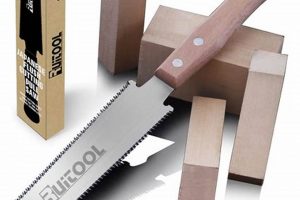
A scroll saw is a power tool employed in woodworking for executing intricate and delicate cuts in various materials. Its primary function is to create curved lines, detailed patterns, and internal cutouts that are difficult or impossible to achieve with other types of saws. Examples include cutting out complex shapes for decorative pieces, creating fretwork, and producing intarsia and marquetry.
The inherent precision of this tool offers woodworkers the ability to produce work with a high level of detail. Its value lies in enabling the creation of custom designs and artistic elements that enhance the aesthetic appeal of woodworking projects. Historically, similar functionality was achieved using hand-operated fret saws, with the powered scroll saw representing a significant advancement in efficiency and control.
Subsequent sections will delve into the specific applications, techniques, and considerations for selecting and using this tool effectively within a woodworking environment. This includes an exploration of blade types, cutting speeds, and safety protocols essential for maximizing the tool’s potential.
Effective Techniques
This section outlines essential techniques for optimizing the utilization of a scroll saw in woodworking, ensuring precision and safety.
Tip 1: Blade Selection: Employ appropriate blade tooth configurations according to the material and desired cut. Finer teeth are better suited for intricate work and thinner materials, while coarser teeth offer faster cutting on thicker stock.
Tip 2: Tension Adjustment: Ensure correct blade tension to prevent breakage and wandering cuts. Consult the tool manual for recommended tension settings, and adjust until the blade produces a clear, ringing tone when plucked.
Tip 3: Feed Rate Control: Maintain a consistent and moderate feed rate to avoid overheating the blade and splintering the wood. Resist forcing the material, allowing the blade to cut naturally.
Tip 4: Internal Cuts: For internal cuts, drill a pilot hole slightly larger than the blade width. This allows for easy insertion of the blade and commencement of the desired cut.
Tip 5: Following Patterns: Adhere the pattern securely to the workpiece with repositionable adhesive. This ensures accurate tracing and minimizes shifting during the cutting process.
Tip 6: Maintaining Blade Perpendicularity: Regularly check the blade’s perpendicularity to the table to ensure square cuts. Adjust the table angle if necessary, referencing a precision square.
Tip 7: Dust Extraction: Utilize a dust collection system to maintain a clear line of sight and minimize airborne particles. Adequate dust extraction is crucial for both precision and respiratory health.
Employing these techniques will enhance the accuracy and quality of work, ensuring that the full capabilities of the tool are realized, while promoting a safer working environment.
The concluding section will summarize the key applications and benefits derived from proper scroll saw usage, solidifying its role in a diverse range of woodworking projects.
1. Intricate cuts

The capacity to produce intricate cuts is fundamentally linked to the operational purpose of a scroll saw in woodworking. The machine’s design, incorporating a fine blade and a reciprocating action, directly facilitates the creation of complex shapes and detailed designs that are exceedingly difficult to achieve with alternative cutting tools. The cause-and-effect relationship is clear: the tool’s mechanics are engineered specifically to enable the execution of intricate cuts. These capabilities are vital for applications requiring precise detail.
The importance of intricate cuts as a core component of this tool’s function is evident in various woodworking applications. For instance, in creating fretwork panels for decorative furniture, the scroll saw precisely follows complex patterns, producing delicate openwork designs. Similarly, in intarsia projects, the tool enables the accurate shaping of small pieces of wood, which are then fitted together to create pictorial mosaics. These examples demonstrate how intricate cuts are not merely an optional feature but an essential part of the tool’s value proposition.
Understanding the scroll saw’s role in enabling intricate cuts also holds practical significance. Woodworkers can leverage this knowledge to select the appropriate tool for projects demanding high precision and complex designs. The tool’s advantages, such as its fine control and ability to make internal cuts without requiring overcuts, make it uniquely suited for such tasks. The challenges, such as the need for meticulous blade control and careful feed rate adjustment, are also important considerations. In summary, the ability to produce intricate cuts is a defining characteristic that positions the scroll saw as an essential tool for specialized woodworking applications.
2. Delicate patterns

The creation of delicate patterns represents a significant application of a scroll saw in woodworking, enabling the production of intricate designs that are often unattainable through other methods. The tool’s precision and control are crucial for executing these complex patterns, making it an indispensable asset for certain woodworking projects.
- Fretwork Applications
Fretwork, characterized by its intricate, open patterns, exemplifies the scroll saw’s capabilities. Fretwork is frequently used in decorative panels, furniture embellishments, and architectural details. The scroll saw’s ability to follow complex lines accurately allows for the creation of visually appealing designs in various materials. The implications are far-reaching, providing artisans with the means to produce custom pieces that enhance the aesthetic value of woodworking projects.
- Marquetry and Intarsia
Marquetry and intarsia involve creating decorative patterns by inlaying different types of wood. The scroll saw plays a crucial role in precisely cutting the various pieces of wood that will be assembled to form the complete pattern. The tool’s accuracy ensures tight-fitting joints and clean lines, contributing to the overall quality and visual appeal of the finished piece. The success of these techniques relies on the scroll saw’s ability to handle delicate and detailed cuts.
- Ornamental Wood Carvings
Ornamental wood carvings, such as those found on antique furniture or decorative boxes, often feature delicate patterns that require the precision of a scroll saw. The tool allows for the creation of intricate details that would be difficult or impossible to achieve with hand tools alone. This enhances the ability to replicate historical designs or create new, complex patterns that add value and visual interest to the finished product.
- Scale Modeling
Scale model construction often requires the creation of miniature, delicate patterns. The scroll saw is ideally suited for cutting small, intricate parts with precision. From model airplanes to dollhouses, the tool enables the creation of realistic and detailed scale models. Its versatility and control are essential for achieving the level of accuracy required in this field.
In summary, the capacity to produce delicate patterns is a defining feature of the scroll saw’s utility in woodworking. The varied applications, from fretwork and marquetry to ornamental carvings and scale modeling, highlight the tool’s importance in achieving complex and visually appealing designs. The ability to create these patterns enhances the value and aesthetic appeal of woodworking projects across a wide range of disciplines.
3. Curved lines
The ability to cut curved lines constitutes a fundamental attribute of the scroll saw’s functionality within the realm of woodworking. The tool’s design, specifically its thin, reciprocating blade, enables the precise navigation of non-linear paths in various materials. This capability directly addresses the challenge of creating shapes and designs that deviate from straight, angular forms. The direct consequence of this design is the expansion of design possibilities for woodworkers.
The importance of curved lines as a core component of the scroll saw’s function is evident in diverse applications. Consider the creation of cabriole legs for furniture. The scroll saw allows a woodworker to execute the complex curves required for this classic design element with a degree of accuracy difficult to achieve with other power tools. Similarly, in the construction of musical instruments, the scroll saw facilitates the shaping of curved soundboards and intricate bracing patterns, which are critical for the instrument’s acoustic properties. In each example, the ability to cut curved lines precisely is not merely an aesthetic choice but a functional necessity. These applications highlight the tool’s value in projects demanding organic shapes and flowing forms.
Understanding the scroll saw’s proficiency in cutting curved lines is of practical significance for woodworkers in several respects. It informs the selection of the appropriate tool for a given project. It also shapes the techniques employed during the cutting process. Challenges such as blade wandering and tear-out can be mitigated through careful blade selection, proper tension adjustment, and controlled feed rates. In summation, the scroll saw’s unique capacity to cut curved lines precisely positions it as an indispensable tool for woodworking projects that require organic shapes and flowing designs.
4. Internal cutouts

The ability to create internal cutouts stands as a key function, expanding the scope of design possibilities for woodworkers. The scroll saws design, featuring a fine blade that can be threaded through a pre-drilled hole, directly facilitates the removal of material from within a workpiece without cutting in from an edge. This capability enables the creation of intricate designs and functional elements within a solid piece of material.
- Creating Fretwork Designs
The production of fretwork patterns exemplifies the importance of internal cutouts. These designs, characterized by open spaces within a wooden panel, rely on the scroll saw to remove specific sections of material while leaving the surrounding structure intact. Examples include decorative screens, speaker grilles, and ornamental panels. The scroll saw’s precision in creating these cutouts is crucial for achieving the desired aesthetic and functional outcome.
- Preparing Inlays and Marquetry
Inlay and marquetry techniques frequently involve the creation of internal cutouts to accommodate contrasting materials. The scroll saw’s ability to precisely remove sections of a substrate material allows for the seamless insertion of inlays, creating intricate patterns and designs. Examples include decorative elements in furniture, musical instruments, and jewelry boxes. The accuracy of these cutouts is essential for ensuring a tight fit and a visually appealing result.
- Manufacturing Puzzle Pieces
The scroll saw is employed to create puzzle pieces, which inherently require internal cutouts to form interlocking shapes. The tool enables the precise shaping of individual pieces, ensuring that they fit together correctly. This application demonstrates the scroll saws ability to produce accurate and repeatable cuts for functional purposes.
- Crafting Lettering and Signage
In creating lettering and signage from wood, internal cutouts are often necessary to define certain letterforms and create visually distinct designs. The scroll saw enables the precise removal of material to form the desired characters and shapes. This application highlights the tools versatility in producing both decorative and functional elements.
The capacity to create internal cutouts significantly enhances the functionality of the scroll saw in woodworking. These examples, from fretwork and marquetry to puzzle making and signage, demonstrate the tool’s importance in achieving complex and visually engaging designs. This capability enables woodworkers to create intricate and detailed work that is challenging or impossible to achieve using other woodworking tools.
5. Fretwork creation

Fretwork creation exemplifies a primary function facilitated by scroll saws in woodworking. The intricate, open designs characteristic of fretwork are highly dependent on the precision and maneuverability afforded by this tool, thereby establishing a direct correlation between the tool’s capabilities and the artistic and functional potential of fretwork.
- Precision Cutting of Complex Shapes
Fretwork designs often involve a network of intertwined shapes and patterns. The scroll saw, equipped with a fine blade and a stable platform, enables the accurate cutting of these complex shapes. Applications include decorative panels, furniture adornments, and ventilation grilles. The precision afforded by the scroll saw directly influences the visual appeal and structural integrity of the fretwork piece.
- Intricate Internal Cutouts
Fretwork frequently necessitates internal cutouts, demanding the removal of material from within a workpiece without severing its outer edges. The scroll saw’s design allows for the blade to be inserted through a pre-drilled hole, enabling the creation of these internal cutouts with precision. This is demonstrated in applications like ornamental screens and decorative partitions, where the negative space contributes significantly to the overall design.
- Adaptability to Various Materials
Fretwork can be created from diverse materials, including wood, plywood, and composite boards. The scroll saw’s adjustable speed settings and compatibility with different blade types facilitate its use across a wide range of materials. This adaptability is essential for creating fretwork designs tailored to specific aesthetic and functional requirements, spanning architectural details to artisanal crafts.
- Replication of Intricate Patterns
The scroll saw allows for the faithful replication of intricate fretwork patterns, whether based on historical designs or original creations. The ability to precisely follow a template or pattern is critical for achieving consistent results and preserving the integrity of the design. This capability is particularly valuable in restoration projects or when producing multiple identical fretwork pieces.
The aforementioned facets highlight how fretwork creation is fundamentally reliant on the scroll saw’s unique capabilities. The tool’s capacity for precision, internal cutouts, material adaptability, and pattern replication converge to make it an indispensable instrument for woodworkers engaged in producing intricate and visually compelling fretwork designs. The tool’s applications, ranging from furniture embellishments to architectural features, underscore the symbiotic relationship between scroll saws and the art of fretwork.
6. Decorative elements

The creation of decorative elements represents a core function fulfilled by scroll saws within woodworking. The tool’s capacity for intricate cutting and precise control directly enables the production of elaborate designs, ornamental features, and aesthetically pleasing details that enhance the visual appeal of woodworking projects. This connection establishes a clear cause-and-effect relationship: the scroll saw’s capabilities directly lead to the creation of various decorative elements. These capabilities are essential for applications requiring embellishment and aesthetic refinement.
The significance of decorative elements as a component of the tool’s function is apparent in multiple applications. For example, in furniture making, scroll saws are utilized to create decorative moldings, intricate inlays, and custom-shaped appliques that elevate the aesthetic of cabinets, tables, and chairs. Similarly, in crafting wooden toys and ornaments, scroll saws enable the creation of detailed shapes, patterns, and characters that enhance the products’ visual appeal and play value. These examples demonstrate how decorative elements are not simply an add-on but an integral aspect of a project’s design and execution. Moreover, the ability of scroll saws to create decorative items is used by hobbyists and professionals to build up their portfolio of designs, showcasing their skills and craftsmanship on platforms like Etsy and Pinterest.
Understanding the tool’s role in producing decorative elements has significant practical implications for woodworkers. It informs tool selection for projects requiring intricate detailing and aesthetic enhancement. It dictates the application of appropriate techniques, such as precise blade control, optimized cutting speeds, and proper workpiece support. Challenges, such as the need for careful pattern design and material selection, must be addressed to achieve the desired decorative outcomes. In conclusion, the scroll saw’s inherent capacity for creating decorative elements positions it as an indispensable tool for woodworkers seeking to add visual appeal, artistic flair, and distinctive detailing to their projects.
7. Thin materials

The scroll saw’s utility is particularly pronounced when working with thin materials in woodworking. Its design characteristics, including a fine blade and precise control mechanisms, render it well-suited for tasks where material thickness presents challenges to other cutting tools. The selection and implementation of appropriate methods are paramount.
- Minimizing Material Damage
Thin materials are inherently susceptible to splintering, cracking, or tearing during cutting operations. The scroll saw’s thin blade and controlled reciprocating action minimize these risks compared to tools that apply greater force. This preservation of material integrity is especially critical in projects where aesthetic quality is paramount. For example, creating intricate fretwork from thin veneer requires the precision afforded by the scroll saw to prevent damage that would compromise the design. The scroll saw helps avoid rework or discarding of materials.
- Achieving Intricate Detail
The scroll saw’s ability to execute tight curves and intricate patterns is significantly enhanced when working with thin materials. The reduced resistance allows for more precise control over the blade’s path, enabling the creation of highly detailed designs that would be difficult or impossible to achieve with thicker stock. Consider the creation of scale models or delicate inlays, where the scroll saw facilitates the accurate shaping of thin pieces with complex contours. A thicker material makes maneuvering and execution less precise.
- Reducing Material Waste
The narrow kerf (the width of the cut made by the blade) of a scroll saw minimizes material waste, which is particularly important when working with expensive or limited supplies of thin materials. This efficiency allows for maximizing yield from each piece of stock, reducing costs and environmental impact. Examples include crafting jewelry components or creating custom shims where minimal material removal is desirable. In short, the accuracy and waste reduction are two reasons why the scroll saw is optimal.
- Enhancing Safety
Working with thin materials on power tools can pose safety risks due to the potential for the material to flex, vibrate, or kick back. The scroll saw’s controlled operation and relatively low cutting force mitigate these hazards, making it a safer option for thin stock than tools that may grab or aggressively engage the material. Creating thin marquetry pieces or delicate wooden toys benefit from the safe use of the scroll saw.
In conclusion, the scroll saw’s compatibility with thin materials is not merely a convenience but a strategic advantage that enables specific woodworking techniques and design outcomes. Its capacity to minimize damage, achieve intricate detail, reduce material waste, and enhance safety renders it an indispensable tool for projects involving thin stock, solidifying its role in woodworking.
Frequently Asked Questions
The following section addresses common inquiries regarding the scroll saw and its specific uses within woodworking, providing factual information and clarifying potential misconceptions.
Question 1: Is a scroll saw suitable for cutting thick lumber?
A scroll saw is generally not recommended for cutting thick lumber. Its primary function is for intricate and detailed cuts in thinner materials. Attempting to cut excessively thick wood can lead to blade breakage, reduced accuracy, and potential damage to the tool.
Question 2: Can a scroll saw be used on materials other than wood?
While primarily designed for woodworking, a scroll saw can cut other materials such as plastic, thin metal, and composites with the appropriate blade. Selecting the correct blade type and adjusting the cutting speed are crucial for achieving satisfactory results and preventing damage to the tool or material.
Question 3: How does a scroll saw differ from a band saw?
A scroll saw excels at intricate, detailed work and internal cutouts, while a band saw is better suited for cutting thicker materials and resawing. A scroll saw’s blade moves reciprocally, whereas a band saw utilizes a continuous loop blade. The band saw is faster but requires the woodworker to manipulate the wood more to follow a design.
Question 4: What safety precautions are essential when using a scroll saw?
Eye protection is paramount to guard against flying debris. Dust collection is also crucial for respiratory health and visibility. Maintaining proper blade tension and employing correct cutting techniques are vital for preventing blade breakage and ensuring safe operation. Also, unplug the saw before changing the blade.
Question 5: How is the cutting speed on a scroll saw adjusted?
Most scroll saws feature a variable speed control, allowing adjustment based on the material being cut and the desired level of detail. Lower speeds are typically used for intricate cuts and harder materials, while higher speeds are suitable for softer materials and straight cuts.
Question 6: What factors determine the appropriate blade selection for a scroll saw?
Blade selection depends on material thickness, desired cut detail, and material type. Finer blades with more teeth per inch (TPI) are appropriate for intricate work in thinner materials, while coarser blades are suited for thicker materials and faster cutting.
This FAQ section aimed to clarify common questions regarding scroll saw applications. Understanding its capabilities, limitations, and safety requirements is essential for effective and safe utilization of the tool.
The subsequent segment will provide a summary of key considerations for choosing the right scroll saw.
What is a Scroll Saw Used For in Woodwork
This exploration has elucidated that the core function lies in its capacity to execute intricate, detailed cuts, particularly within thin materials. This ability facilitates diverse applications, including fretwork creation, the production of delicate patterns, and the crafting of decorative elements. The tool’s design, characterized by a fine blade and precise control mechanisms, directly enables these specialized woodworking techniques.
The scroll saw serves as an instrument for achieving precision and artistry. Its optimal use is contingent upon understanding its inherent limitations and adhering to appropriate safety protocols. Mastery enables woodworkers to fully leverage its unique capabilities and contribute to the creation of designs that are challenging or impossible to realize with alternative woodworking tools.