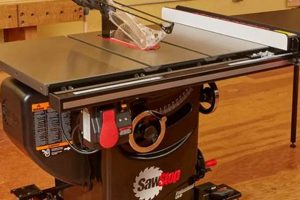
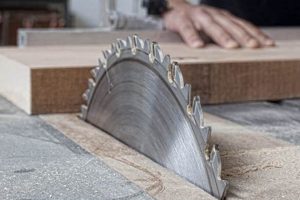
A device designed to enhance safety and precision when using a table saw, typically constructed from a stable base and a fence that guides the workpiece. It allows for controlled movement of the material through the blade, reducing the risk of kickback and improving accuracy in cuts. For instance, crafting perfectly square corners on a box becomes significantly easier and safer with this aid.
This device’s significance stems from its ability to improve the safety profile of table saw operations and enhance cut precision. Its historical context lies in the desire to mitigate the inherent dangers of using a table saw for small or oddly shaped pieces, and to achieve repeatable, accurate cuts. The use of such a tool significantly reduces the risk of hand proximity to the blade and allows for controlled, consistent movement, contributing to cleaner, more precise results. The benefits extend to improved efficiency and reduced material waste.
This article will delve into the various types, construction techniques, and applications of this essential woodworking accessory, providing a comprehensive guide for woodworkers of all skill levels looking to improve their table saw techniques.
Tips
The following tips offer insights into maximizing the utility and safety associated with the table saw accessory.
Tip 1: Material Selection: Opt for high-quality plywood or MDF for the base and fence construction. These materials offer stability and resistance to warping, ensuring consistent performance.
Tip 2: Fence Alignment: Precisely align the fence to be perfectly perpendicular to the saw blade. Use a reliable square and carefully adjust the fence until true. This is crucial for achieving accurate cuts.
Tip 3: Incorporate Hold-Down Clamps: Integrate hold-down clamps into the design. These clamps secure the workpiece firmly to the platform, minimizing movement and enhancing safety during operation.
Tip 4: Utilize a Zero-Clearance Insert: Employ a zero-clearance insert around the saw blade opening. This reduces tear-out and provides greater support for small or thin pieces, improving cut quality.
Tip 5: Implement a T-Track System: Install a T-track system along the fence. This allows for the flexible positioning of stops and other accessories, expanding the tool’s versatility.
Tip 6: Regular Maintenance: Routinely inspect and maintain the device. Check for loose screws, ensure smooth gliding action, and clean away sawdust buildup to prevent binding.
Tip 7: Test Cuts: Before making final cuts on valuable material, perform test cuts on scrap wood. This allows for verifying accuracy and making necessary adjustments to the device’s setup.
Implementing these tips enhances both the precision and safety of table saw operations. Careful attention to design, setup, and maintenance will yield optimal results and prolong the life of the woodworking aid.
The following sections will further examine the practical applications of this tool in various woodworking projects.
1. Enhanced Cutting Accuracy

The implementation of a table saw sled directly addresses the need for enhanced cutting accuracy in woodworking. The consistent support and controlled movement offered by the sled allow for a degree of precision unattainable with freehand methods, resulting in improved joinery and overall project quality.
- Mitigation of Blade Deflection
The sled provides lateral support to the workpiece as it encounters the saw blade. This support minimizes blade deflection, which is a common source of inaccuracy when cutting thin or flexible materials. By reducing blade movement, the sled ensures that the cut follows the intended line with greater fidelity. For example, when slicing thin strips of veneer, the sled prevents the blade from wandering, resulting in uniform thickness and consistent results.
- Precise Angular Control
Many sled designs incorporate adjustable fences or miter gauges, allowing for precise angular cuts. These features enable the creation of accurate miters, bevels, and compound angles, which are essential for complex joinery and decorative elements. For example, crafting a picture frame with perfectly aligned mitered corners relies on the sled’s ability to hold the material at a precise angle throughout the cut.
- Elimination of Workpiece Movement
The sled secures the workpiece to a stable platform, preventing movement or vibration during the cut. This is particularly important when working with small or irregularly shaped pieces that are difficult to hold securely by hand. The elimination of movement reduces the risk of errors and ensures a clean, precise cut. An example of this is safely and accurately cutting small dovetail keys.
- Repeatable Cut Dimensions
Sled designs often include stop blocks or measuring systems that allow for the creation of repeatable cuts with consistent dimensions. This is crucial for projects that require multiple identical pieces, such as cabinet doors or drawer fronts. The ability to set a precise dimension and consistently reproduce it streamlines the workflow and ensures a uniform final product.
These facets collectively contribute to the enhanced cutting accuracy afforded by the table saw accessory. The consistent support, precise angular control, and elimination of workpiece movement, along with the ability to create repeatable dimensions, transform the table saw into a more precise and reliable tool. The benefits are directly reflected in the increased quality and reduced waste observed in woodworking projects.
2. Improved Operator Safety

The incorporation of a table saw sled fundamentally enhances operator safety by mitigating several common hazards associated with standard table saw operation. Primarily, the sled positions the hands away from the blade’s immediate vicinity, reducing the risk of accidental contact. Unlike freehand cutting, where hands are often close to the blade to guide the workpiece, the sled provides a stable platform and guiding fence, allowing the operator to push the entire assembly safely through the saw. For example, cutting small pieces, which inherently require closer hand proximity, becomes significantly safer when the workpiece is secured to a sled. Further, the sled minimizes the potential for kickback, a dangerous event where the saw blade catches the workpiece and violently throws it back towards the operator.
The design of a sled often includes features that provide additional safety. Integrated clamps secure the workpiece to the sled, preventing it from shifting during the cut. This stability is crucial for maintaining control and preventing the blade from binding. A zero-clearance insert around the blade reduces the gap between the blade and the surrounding surface, minimizing the chance of small pieces getting caught and thrown. Moreover, by promoting controlled and predictable movement of the material, the sled reduces the likelihood of sudden, unexpected reactions that can lead to injury. Consider the task of cutting dados: the sled allows for controlled, repeatable passes, reducing the risk of the workpiece catching and causing kickback or injury.
In summary, the integration of this accessory directly contributes to improved operator safety. By maintaining a safe distance between the operator’s hands and the blade, minimizing the risk of kickback, and providing a stable, controlled cutting platform, the sled transforms the table saw into a safer tool. This safety enhancement is not merely theoretical; it translates to a significant reduction in the risk of injury in practical woodworking applications. The improved control and stability afforded by the sled represent a critical safety improvement, particularly for less experienced users or those working with challenging materials.
3. Versatile Project Adaptability
The versatility of a woodworking sled significantly expands the range of projects achievable on a table saw. Its adaptability to various cuts, materials, and project scales makes it an indispensable tool for both novice and experienced woodworkers. This section examines key facets of this adaptability.
- Adaptation to Diverse Cutting Operations
The device facilitates a variety of cutting operations beyond simple rip and crosscuts. Miter cuts, dadoes, rabbets, and even complex joinery cuts become attainable with appropriate sled modifications and setups. For example, a sled equipped with an adjustable miter gauge can produce precise angled cuts for picture frames or intricate geometric patterns. The adaptability to these diverse operations reduces the need for specialized tools, consolidating functionality within a single workstation.
- Material Compatibility
The stable platform offered by the accessory allows for safe and accurate cutting of various materials, including hardwoods, softwoods, plywood, and even plastics. The support provided by the sled minimizes vibration and splintering, resulting in cleaner cuts, especially on delicate or brittle materials. For instance, thin veneers, which are notoriously difficult to cut cleanly with a standard table saw setup, can be processed with greater precision and reduced waste when using a sled.
- Scalability Across Project Sizes
The modular nature of many sled designs allows them to be adapted to projects of varying sizes. Small, dedicated sleds can be used for intricate detail work, while larger sleds provide ample support for processing larger panels. This scalability ensures that the device remains a valuable tool regardless of the project’s dimensions. Constructing small, precisely dimensioned boxes or accurately crosscutting large cabinet panels both benefit from the adaptable support provided by a well-designed sled.
- Jig Integration and Customization
The flat surface of a sled provides an ideal platform for integrating jigs and fixtures, further expanding its versatility. Custom-built fences, stops, and clamping systems can be easily attached to the sled, enabling highly specialized operations. An example of this is the creation of a dedicated sled for cutting dovetails, where precisely positioned fences guide the material to produce accurate and repeatable joints. The ability to customize the sled to specific tasks dramatically increases its utility across a wide range of woodworking projects.
In essence, the capacity to adapt to diverse cutting operations, compatibility with a wide range of materials, scalability across project sizes, and the potential for jig integration contribute to its overall versatility. These facets collectively transform the standard table saw into a highly adaptable and capable woodworking tool, able to tackle a broad spectrum of projects with increased precision and safety.
4. Material Support Enhancement

Material support enhancement is a critical function facilitated by a woodworking sled for table saws. It addresses the inherent instability and potential for vibration or deflection that can compromise cut accuracy and safety when working with various materials. The stable platform and guiding mechanisms of the sled directly counteract these issues, providing a more controlled and predictable cutting environment.
- Minimizing Vibration and Chatter
The broad, stable base of a sled dampens vibration during the cutting process. This is particularly important when working with thinner materials, such as plywood or veneers, which are prone to chatter and splintering. The reduced vibration results in cleaner cuts and minimizes material waste. For instance, accurately cutting thin strips of hardwood for inlay work relies heavily on the sled’s ability to minimize vibration and ensure a smooth, consistent cut.
- Supporting Overhanging Material
When crosscutting long boards or large panels, the sled provides support for the overhanging portion of the material. This prevents the material from sagging or deflecting under its own weight, which can lead to inaccurate cuts. The extended support surface ensures that the material remains square to the blade throughout the cutting process. An example would be precisely trimming a cabinet door panel, where the sled supports the entirety of the panel, preventing any droop that could affect the final dimensions.
- Facilitating Small Part Handling
Small or irregularly shaped pieces are often difficult to hold securely on a table saw, increasing the risk of injury. A sled provides a secure platform for these pieces, allowing them to be safely guided through the blade. Integrated clamps or stops can further secure the material, preventing movement and ensuring accurate cuts. This is particularly beneficial when crafting small components for model making or detailed woodworking projects.
- Ensuring Consistent Material Feed
A sled promotes a consistent feed rate throughout the cutting process. By providing a stable platform and guiding fence, the sled prevents the operator from inadvertently speeding up or slowing down the cut, which can lead to uneven cuts or blade binding. The consistent feed rate contributes to a smoother cut and reduces the risk of kickback. For example, consistently cutting mortises for furniture construction depends on the sled maintaining a steady and controlled feed rate.
These aspects of material support enhancement, achieved through the use of a woodworking sled, collectively contribute to improved cut quality, increased operator safety, and enhanced project accuracy. The stable platform, vibration damping, and controlled feed rate facilitated by the sled transform the table saw into a more versatile and reliable tool for a wide range of woodworking applications. These improvements are particularly noticeable when working with challenging materials or complex cutting operations, underscoring the sled’s value as an essential woodworking accessory.
5. Angle Cutting Precision
Achieving precise angled cuts in woodworking is critical for various applications, from crafting mitered corners to creating complex joinery. A woodworking sled, when properly designed and utilized, can significantly enhance the accuracy and repeatability of angled cuts on a table saw.
- Mitering Accuracy via Adjustable Fences
Many sled designs incorporate adjustable fences or miter bars that allow for setting precise angles. These fences can be calibrated using protractors or digital angle finders, ensuring accurate and repeatable miter cuts. For example, when constructing a picture frame, a sled with an adjustable fence allows for creating perfectly matched mitered corners, resulting in a professional-looking finished product. The accuracy of the fence is paramount to the overall precision of the angled cut.
- Bevel Cutting Stability
For bevel cuts, where the blade is tilted relative to the table surface, a sled provides a stable platform for the workpiece, preventing it from shifting during the cut. This stability is particularly important when cutting bevels on small or awkwardly shaped pieces, which can be difficult to control by hand. The sled maintains consistent contact between the workpiece and the saw blade, reducing the risk of errors and ensuring a clean, accurate bevel. An example is producing angled edges for decorative trim.
- Compound Angle Control
Compound angles, involving both a miter and a bevel, require precise control over two axes simultaneously. While specialized jigs may be required for complex compound angles, a sled provides a solid foundation for creating simpler compound cuts. By combining a mitered fence with a tilted blade, a sled can accurately produce compound angles for applications such as segmented bowls or custom furniture details. Setting these angles accurately is made easier with the stability provided by the sled.
- Repeatability and Consistency
A key advantage of using a sled for angle cutting is the ability to produce repeatable cuts with consistent accuracy. Once the fence or blade angle is set, multiple pieces can be cut to the same exact angle, ensuring uniformity across a project. This is particularly important when constructing multiple components that need to fit together precisely, such as cabinet doors or drawer fronts. Repeatability contributes to efficiency and reduces the risk of errors during assembly.
These facets demonstrate the integral role of a woodworking sled in achieving angle cutting precision. The stability, adjustability, and repeatability offered by a well-designed sled transform the table saw into a more accurate and versatile tool for angled cuts, benefiting a wide range of woodworking projects.
Frequently Asked Questions
The following addresses common inquiries regarding the utility, safety, and construction of a woodworking sled for table saws.
Question 1: What constitutes a woodworking sled for a table saw?
A woodworking sled is a shop-built or commercially manufactured jig designed to enhance the precision and safety of cuts performed on a table saw. It typically consists of a flat platform that rides in the table saw’s miter slots, and incorporates a fence to guide the workpiece. It serves as a controlled platform, improving accuracy and minimizing the risks associated with freehand cutting.
Question 2: How does a woodworking sled improve table saw safety?
The sled improves safety by keeping the operator’s hands further from the blade. By securing the workpiece to the sled and pushing the entire assembly through the saw, the sled eliminates the need to hold the material directly. Furthermore, the sled reduces the potential for kickback by providing consistent support to the wood as it is cut, minimizing the chance of the blade binding.
Question 3: What materials are best suited for constructing a woodworking sled?
High-quality plywood or medium-density fiberboard (MDF) are typically recommended for constructing a woodworking sled. These materials are stable, resistant to warping, and provide a smooth surface for the workpiece to slide upon. Hardwood runners can also be attached to the base of the sled to ensure a snug and accurate fit within the table saw’s miter slots.
Question 4: How does one ensure the sled’s fence is perfectly square to the blade?
Achieving a square fence is crucial for accurate cuts. A reliable square is used to check the fence’s alignment relative to the blade. Adjustments are made by loosening the fence and carefully repositioning it until it is perfectly square. Test cuts are then performed on scrap material to verify the accuracy of the alignment.
Question 5: Is a zero-clearance insert necessary for a woodworking sled?
While not strictly necessary, a zero-clearance insert significantly improves the quality of cuts. It minimizes tear-out, especially when working with thin or delicate materials, and provides greater support close to the blade. A zero-clearance insert can be created by making a cut through the sled’s base after it has been constructed.
Question 6: Can a woodworking sled be used for angled cuts?
Yes, a sled can be adapted for angled cuts. An adjustable fence or miter gauge can be incorporated into the sled’s design, allowing for the creation of precise miter cuts. Additionally, the table saw’s blade can be tilted to create bevel cuts, with the sled providing a stable platform for the workpiece.
In summary, a woodworking sled serves as a valuable aid for enhancing both safety and accuracy in table saw operations. Its construction, alignment, and application require careful consideration to ensure optimal performance.
The following section will explore advanced techniques and modifications for optimizing the use of this woodworking accessory.
Conclusion
The preceding discussion has elucidated the multifaceted benefits of a woodworking sled for table saw operations. From enhanced safety and precision to improved versatility and material support, the evidence indicates a significant advantage in employing this tool. Careful construction, proper alignment, and consistent maintenance are crucial for maximizing its effectiveness.
Given the demonstrated improvements in safety and accuracy, the integration of this device into woodworking practice merits serious consideration. The long-term benefits of reduced risk and improved project quality outweigh the initial investment of time and resources required for construction or purchase. Continued exploration and refinement of woodworking sled designs are expected to further enhance their value in the future.