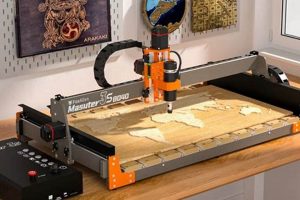
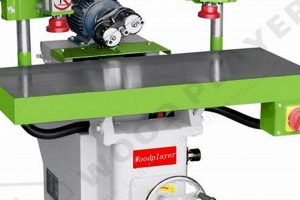
A computer-numerical-controlled (CNC) router is a subtractive manufacturing device used extensively in the creation of wooden components and products. These automated tools employ rotating cutting bits under precise computer control to remove material from a workpiece, following a pre-programmed design. This process allows for intricate shapes, complex joinery, and repeatable accuracy not easily achievable with traditional hand tools or manual machinery.
The incorporation of automated routing solutions provides significant advantages to woodworkers and manufacturers. It drastically reduces production time, minimizes material waste through optimized nesting and cutting paths, and enhances safety by limiting operator interaction with the cutting process. Historically, the introduction of this technology has transformed woodworking from a primarily artisan-based trade to a manufacturing sector capable of mass production and highly customized designs with equivalent ease. The evolution of computer control has enabled smaller workshops to leverage capabilities previously restricted to large industrial operations.
The subsequent sections will detail the primary components of these systems, the variety of applicable software solutions, relevant material considerations for successful operation, and the range of projects and applications where computer-controlled routing provides compelling advantages.
Guidance for Optimal CNC Routing in Woodworking
The following guidance aims to enhance the efficiency and quality of projects utilizing computer-numerical-controlled (CNC) routers for woodworking applications. These suggestions focus on best practices for setup, operation, and maintenance to maximize the benefits of this technology.
Tip 1: Precise Workholding is Paramount. Securely fixture the workpiece to the CNC router bed. Inadequate workholding results in vibration, chatter, and inaccurate cuts. Vacuum tables, clamps, and specialized jigs should be considered based on the size and shape of the material.
Tip 2: Optimize Cutting Parameters. Feed rate and spindle speed must be appropriately calibrated for the wood species and cutting tool. Excessive feed rates can cause tool breakage, while insufficient speeds lead to burning and poor surface finish. Conduct test cuts to determine optimal settings.
Tip 3: Select Appropriate Cutting Tools. Employ router bits specifically designed for woodworking. Compression bits, upcut spiral bits, and downcut spiral bits each offer distinct advantages depending on the cut type and material properties. Incorrect tool selection negatively impacts cut quality and tool lifespan.
Tip 4: Implement Effective Dust Extraction. Woodworking operations generate significant amounts of dust, which can compromise machine performance and operator health. A robust dust collection system is essential for maintaining a clean and safe working environment and preventing premature wear on machine components.
Tip 5: Program Efficient Toolpaths. Optimize toolpaths within the CAM software to minimize travel distance and cutting time. Consider climb milling versus conventional milling and prioritize smooth, continuous movements to reduce stress on the machine and workpiece.
Tip 6: Regularly Inspect and Maintain the Machine. Conduct routine maintenance checks, including lubrication of moving parts, tightening of fasteners, and cleaning of debris. Periodic inspections help prevent costly repairs and ensure consistent performance.
Tip 7: Account for Material Properties. Wood is a natural material with varying grain patterns, density, and moisture content. These factors influence machinability and require adjustments to cutting parameters and tool selection. Proper material conditioning can also minimize warping and cracking.
Adherence to these recommendations enables a more productive and precise workflow, leading to higher-quality finished products and extended machine longevity. These practices promote both efficiency and the consistent realization of design intent.
The subsequent section will explore specific applications and project examples that demonstrate the versatility and capabilities of automated routing solutions in woodworking.
1. Precision Cutting

Precision cutting represents a fundamental advantage facilitated by computer-numerical-controlled (CNC) machinery in woodworking. Its integration elevates accuracy and repeatability, resulting in intricate designs and exacting dimensions previously unattainable through manual methods. The following outlines specific facets that underscore the importance of precision cutting in this domain.
- Dimensional Accuracy
CNC routers ensure adherence to specified dimensions with minimal deviation. This accuracy is critical for applications requiring tight tolerances, such as joinery for cabinets and furniture. The precise execution of mortise and tenon joints, for example, yields enhanced structural integrity and aesthetic refinement.
- Repeatability
The capacity to replicate identical components consistently is a core strength. CNC technology guarantees that each part matches the original design, crucial for mass production or complex assemblies. Manufacturing multiple chair spindles or drawer fronts becomes a streamlined process with predictable outcomes.
- Intricate Geometries
CNC machining enables the creation of complex curves, profiles, and three-dimensional shapes beyond the scope of conventional woodworking tools. Carving intricate patterns on panels or creating sculpted furniture elements are examples of this capability. This promotes design freedom and artistic expression.
- Minimized Material Waste
Precise material removal and optimized nesting strategies reduce waste during the cutting process. CNC software calculates the most efficient layout of parts on a given sheet of material, thereby maximizing yield. This contributes to cost savings and environmental responsibility.
The attributes of dimensional accuracy, repeatability, geometric complexity, and waste reduction collectively demonstrate the significance of precision cutting facilitated by CNC routers in woodworking. This synergy transforms raw materials into finished products with increased efficiency and design sophistication, thereby increasing productivity and promoting innovative fabrication methodologies.
2. Material Optimization

Material optimization, in the context of automated routing, refers to strategies and techniques aimed at minimizing waste and maximizing yield from raw material stock. The integration of computer-numerical-controlled (CNC) machinery is a primary driver of material efficiency. This connection arises from the ability of CNC systems to execute precise cutting paths defined by sophisticated software, allowing for the efficient nesting of parts. Nesting software algorithms calculate the optimal arrangement of components within a given material sheet, minimizing unused areas and scrap. For instance, consider a cabinet manufacturer using plywood sheets. A CNC router, guided by nesting software, can strategically position cabinet doors, drawer fronts, and side panels to maximize the number of parts obtained from each sheet, thus reducing material costs and waste disposal expenses. This contrasts sharply with manual cutting methods, which are often less precise and less efficient in material utilization.
The cause-and-effect relationship is evident: the utilization of a CNC system causes greater material optimization, while conversely, neglecting CNC technology often results in increased material waste. Beyond nesting, material optimization extends to strategies such as utilizing scrap pieces for smaller components or employing advanced toolpath strategies to minimize the amount of material removed during the cutting process. For example, a furniture maker might use remnants from larger pieces to create smaller decorative elements, maximizing the utility of each sheet of wood. Failure to consider material properties and grain direction during CNC programming can lead to inefficient material usage and structural weaknesses in the final product, further underscoring the need for proper optimization techniques.
In summary, material optimization is an indispensable component of CNC woodworking. The capacity of CNC systems to execute intricate cutting plans, coupled with advanced software solutions, enables precise material utilization, minimized waste, and reduced production costs. Understanding this connection is crucial for woodworking businesses seeking to improve efficiency, profitability, and environmental sustainability. The challenges lie in selecting appropriate nesting software, properly calibrating cutting parameters for different materials, and training personnel to effectively utilize these tools and strategies, ensuring these aspects are handled efficiently maximizes the benifits of cnc machine.
3. Design Complexity

The intersection of design complexity and computer-numerical-controlled (CNC) woodworking presents a paradigm shift in manufacturing capabilities. CNC routing allows the realization of intricate designs that are either impractical or impossible to execute with traditional woodworking tools and techniques. This capacity to handle complex geometries is not merely an aesthetic advantage; it directly impacts the functionality, structural integrity, and market value of the finished product. For example, consider the fabrication of complex curved furniture components. The creation of such forms via manual methods would require extensive hand carving and shaping, resulting in significant labor costs and potential inconsistencies. A CNC router, guided by precise digital models, can accurately reproduce these curves with minimal intervention, reducing production time and ensuring uniformity across multiple units. Without the precision of CNC, design complexity would be heavily constrained by the limitations of manual skill and the economic viability of labor-intensive processes.
The ability to manage design complexity extends beyond mere geometric replication. CNC technology facilitates the creation of intricate joinery, such as complex mortise and tenon configurations, dovetail joints with varying pitches, or custom interlocking systems. These sophisticated joints enhance the structural strength and durability of wooden structures, allowing for lighter, more efficient designs. In architectural woodworking, CNC routers enable the production of custom moldings, ornate trim details, and intricate relief carvings that would be prohibitively expensive to produce manually. This precision permits architects and designers to incorporate intricate details into their projects, increasing the aesthetic appeal and functional characteristics of the designs.
In summary, the correlation between design complexity and CNC woodworking is synergistic: the technology empowers the creation of previously unrealizable designs, while the demand for such designs drives the advancement of CNC capabilities. Challenges remain in optimizing toolpaths for complex geometries, selecting appropriate cutting tools for specific materials, and developing efficient workflows for managing intricate projects. However, the benefits of increased design freedom, enhanced structural performance, and improved production efficiency are compelling, underscoring the critical role of CNC technology in modern woodworking practices. The successful application of this relationship relies on the combination of skillful design and skillful execution through the machines.
4. Automated Production
Automated production, enabled by computer-numerical-controlled (CNC) routers, fundamentally alters the landscape of woodworking. The integration of these automated systems reduces manual labor, increases production speed, and enhances the consistency of output. The following details aspects of automated production in this context.
- Reduced Labor Costs
CNC machining minimizes the need for skilled manual labor. One operator can oversee multiple machines, reducing labor costs and freeing up skilled woodworkers to focus on design and finishing tasks. The automation of repetitive tasks, such as cutting and shaping, leads to significant savings in labor expenses over time.
- Increased Production Speed
CNC routers operate at significantly higher speeds than manual woodworking equipment. The ability to machine parts with precision and consistency allows for faster production cycles. Mass production of components, such as furniture parts or cabinet elements, becomes significantly more efficient, meeting higher-volume demands effectively.
- Enhanced Consistency and Accuracy
Automated processes minimize human error, resulting in consistent and accurate output. CNC machines follow programmed instructions precisely, ensuring that each part meets the specified dimensions and tolerances. This consistency is critical for projects requiring multiple identical components, such as large-scale furniture manufacturing.
- Scalability and Flexibility
CNC routers can easily adapt to changing production needs. Programs can be quickly modified to accommodate different designs or material types. This flexibility allows for the production of both large-volume orders and customized, one-off pieces with equal ease, enhancing scalability and responsiveness to market demands.
The facets of reduced labor, increased speed, enhanced consistency, and greater scalability demonstrate the transformative impact of automated production in the realm of computer-numerical-controlled woodworking. These benefits translate into higher profitability, greater efficiency, and improved product quality, solidifying the role of CNC technology in modern woodworking industries. Efficient utilization of CNC systems is essential for companies looking to remain competitive and satisfy the demands of modern industry.
5. Consistency

Consistency is a critical attribute in modern woodworking, particularly when employing computer-numerical-controlled (CNC) machinery. This consistency extends beyond mere dimensional accuracy to encompass repeatability, surface finish, and adherence to design specifications. The degree of consistency achieved directly impacts product quality, production efficiency, and overall profitability.
- Dimensional Repeatability
CNC routers excel at producing identical parts repeatedly. This attribute is crucial for manufacturing multiple units of the same furniture piece, ensuring that each component aligns perfectly within the assembly. For instance, creating multiple chair legs that precisely match in shape and size is easily achieved with CNC, whereas manual production may introduce variations.
- Surface Finish Uniformity
The consistency of the surface finish achieved by a CNC router minimizes the need for extensive sanding or manual finishing. The pre-programmed cutting parameters maintain a consistent feed rate and spindle speed, resulting in a uniform surface texture across all machined parts. This uniformity reduces labor costs associated with manual finishing and ensures a higher-quality final product.
- Adherence to Design Specifications
CNC machining guarantees that each component precisely matches the original design specifications. Deviations from the intended design are minimized, ensuring that the final product aligns with the designer’s vision. This adherence to design is particularly important for complex geometries or intricate details that would be difficult to replicate manually.
- Material Behavior Predictability
While wood is a natural material with inherent variations, CNC processes, when properly configured, can control for many of these variations. Consistent clamping methods, optimized cutting parameters for specific wood species, and tool wear monitoring all contribute to predictable material behavior during machining. This predictability enhances the consistency of the final product and reduces the likelihood of defects.
In summary, the consistency afforded by CNC machines in woodworking is a multifaceted advantage. Dimensional repeatability, surface finish uniformity, adherence to design specifications, and predictable material behavior all contribute to higher-quality products, increased production efficiency, and reduced manufacturing costs. This consistency is a key driver of the adoption of CNC technology in woodworking industries seeking to optimize their operations and enhance their competitive advantage.
Frequently Asked Questions
The following section addresses common inquiries regarding the utilization of computer-numerical-controlled (CNC) machinery within woodworking contexts. The information provided aims to clarify key aspects and dispel potential misconceptions.
Question 1: What is the primary advantage of employing a CNC router versus traditional woodworking methods?
The primary advantage lies in increased precision, repeatability, and efficiency. CNC routers execute pre-programmed designs with minimal deviation, ensuring consistent output across multiple components. This reduces material waste and labor costs while enabling the production of intricate designs not easily achievable with manual methods.
Question 2: Is specialized training required to operate a CNC machine for woodworking?
Yes, specialized training is essential for safe and effective operation. Operators must understand CNC programming, machine setup, toolpath optimization, and material properties. Formal training courses and on-the-job experience are recommended to develop the necessary skills.
Question 3: What types of wood materials are suitable for CNC machining?
A wide range of wood materials can be processed using CNC routers, including hardwoods, softwoods, plywood, MDF, and composite materials. The selection of appropriate cutting tools and parameters is crucial for achieving optimal results with different material types. Material properties, such as density and grain direction, should be considered when planning a project.
Question 4: How does a CNC router contribute to improved material utilization?
CNC software enables optimized nesting of parts on raw material sheets, minimizing waste and maximizing yield. This efficient material utilization reduces production costs and promotes sustainability by reducing scrap and resource consumption. Material nesting strategies take into account material thickness and grain direction.
Question 5: What are the key maintenance considerations for CNC routers used in woodworking?
Regular maintenance is crucial for ensuring optimal machine performance and longevity. Key considerations include lubrication of moving parts, cleaning of debris and dust, inspection of cutting tools, and calibration of machine axes. Preventive maintenance helps prevent costly repairs and downtime.
Question 6: What software is typically used for designing and programming CNC routers for woodworking applications?
Commonly used software includes CAD (Computer-Aided Design) programs for creating designs and CAM (Computer-Aided Manufacturing) programs for generating toolpaths and G-code. Integrated CAD/CAM solutions offer a streamlined workflow from design to production. Selection depends on the complexity of the design and capabilities of the machine.
Effective utilization of these machines relies on proper training, suitable material selection, and consistent upkeep. This combination supports both productivity and the realization of intended design.
The subsequent article section will explore common misconceptions around CNC operations.
Conclusion
The preceding analysis has detailed the core attributes and advantages associated with cnc machine for woodworking. It has been established that the employment of computer-numerical-controlled routing offers significant improvements in precision, material utilization, design complexity, production automation, and overall consistency compared to traditional woodworking methods. The efficient application of these technologies necessitates specialized training, appropriate material selection, and diligent machine maintenance.
Considering the demonstrable benefits and the ongoing advancements in CNC technology, its continued integration into woodworking industries is anticipated. Businesses committed to innovation, efficiency, and product quality should carefully evaluate the potential for incorporating these systems into their operations to maintain competitiveness and meet evolving market demands. Proactive exploration and investment in these capabilities offer a pathway to enhanced productivity and manufacturing excellence.