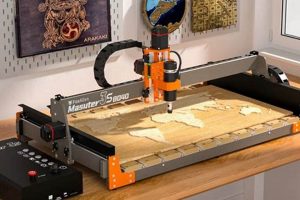
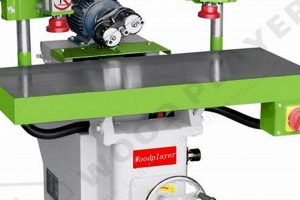
Computer Numerical Control (CNC) machines tailored for wood processing represent automated tools designed to precisely cut, carve, and shape wood materials according to pre-programmed instructions. These machines, ranging from compact desktop models to large-scale industrial systems, utilize various cutting tools and techniques to produce intricate designs and complex geometries in wood. As an illustration, a furniture manufacturer might employ such a machine to create identical chair legs with consistent accuracy and speed.
The utilization of these automated woodworking systems offers significant advantages in terms of efficiency, precision, and repeatability. They reduce material waste, minimize human error, and enable the production of intricate designs that would be difficult or impossible to achieve manually. Historically, woodworking relied heavily on skilled artisans and hand tools; the introduction of CNC technology has revolutionized the industry, allowing for mass production, customization, and the creation of complex architectural elements.
Subsequent sections will delve into the critical factors to consider when selecting a system for wood processing, including machine size, power, software compatibility, and material handling capabilities. Furthermore, a comparative analysis of different types of machines and their specific applications within the woodworking sector will be provided.
Tips for Selecting Woodworking CNC Machines
Careful consideration of specific requirements is crucial when investing in automated wood processing equipment. Aligning machine capabilities with project needs ensures optimal performance and return on investment.
Tip 1: Assess Project Size and Complexity: Determine the maximum dimensions and intricacy of typical projects. This will dictate the required work area and axis configuration (3-axis, 4-axis, 5-axis) of the equipment.
Tip 2: Evaluate Material Compatibility: Different wood types possess varying densities and hardness. The machine’s spindle power and tooling must be suitable for the intended materials, ranging from softwoods to hardwoods and composites.
Tip 3: Analyze Software Integration: The CNC machine’s control software should be compatible with industry-standard Computer-Aided Design (CAD) and Computer-Aided Manufacturing (CAM) programs. Ease of use and robust features are essential for efficient programming and execution.
Tip 4: Consider Dust Collection: Woodworking generates significant dust. An effective dust collection system is vital for maintaining a clean and safe working environment, as well as preventing damage to machine components.
Tip 5: Determine Required Precision: The level of accuracy needed for the finished product will influence the choice of machine. Consider factors such as backlash compensation, servo motor resolution, and overall machine rigidity.
Tip 6: Evaluate Maintenance Requirements: Understand the routine maintenance tasks required to keep the machine operating at peak performance. Access to spare parts and readily available technical support are also important considerations.
Tip 7: Budget for Tooling and Accessories: The initial investment in the machine is only part of the overall cost. Factor in the expense of various cutting tools, clamps, and other accessories necessary for different woodworking applications.
Selecting equipment aligned with precise project parameters and operational needs streamlines woodworking processes, enhances output quality, and improves overall profitability.
The subsequent sections will explore specific brands and models of woodworking CNC machines, providing a detailed comparison of their features, capabilities, and applications within the woodworking industry.
1. Precision

In the context of selecting appropriate Computer Numerical Control (CNC) equipment for woodworking, precision is a paramount characteristic. It directly influences the quality and accuracy of the final product. High-precision CNC machines execute intricate designs with minimal deviation from the programmed specifications. The resulting components exhibit tight tolerances, ensuring proper fit and functionality within larger assemblies. For instance, in crafting high-end furniture, precise joinery is critical for structural integrity and aesthetic appeal. A CNC machine’s ability to consistently reproduce these joints with accuracy defines its suitability for such applications.
Achieving precision in woodworking CNC machines involves several factors. The machine’s rigidity, the quality of its servo motors and encoders, and the precision of its linear guides all contribute to its overall accuracy. Furthermore, the control system’s ability to compensate for mechanical imperfections is essential. Regular calibration and maintenance are necessary to sustain the machine’s precision over time. Consider the production of musical instruments, where minute variations in dimensions can significantly affect sound quality. The use of a high-precision CNC machine enables the creation of instrument components that meet stringent acoustic requirements.
In conclusion, precision is an indispensable attribute of CNC machines employed in woodworking. Its influence extends from the dimensional accuracy of individual components to the overall quality and performance of the finished product. The selection of a CNC machine should prioritize precision as a key performance indicator, aligning with the specific requirements of the intended woodworking applications. Failure to adequately address precision can lead to increased material waste, assembly challenges, and ultimately, compromised product quality.
2. Material Capacity

The term “Material Capacity,” when applied to Computer Numerical Control (CNC) equipment for woodworking, defines the physical dimensions and types of materials that the machine can effectively process. This parameter is a critical determinant in selecting the most suitable CNC machine for a given woodworking application. The machine’s capacity must accommodate the size and nature of the workpieces to be machined to ensure efficient and accurate operation.
- Maximum Workpiece Dimensions
The maximum workpiece dimensions a CNC machine can handle are dictated by the size of its work table and the range of motion of its cutting head. This parameter is particularly relevant in woodworking, where projects can range from small decorative items to large furniture components or architectural elements. Selecting a machine with insufficient capacity will preclude the processing of larger workpieces, limiting the scope of potential projects. For instance, a machine with a small work table may be unsuitable for crafting large table tops or cabinet doors.
- Z-Axis Clearance
Z-axis clearance refers to the vertical distance between the cutting tool and the work table. This dimension determines the maximum thickness of material that the machine can process. Woodworking projects often involve materials of varying thicknesses, and a machine with adequate Z-axis clearance is essential for accommodating thicker stock. Insufficient clearance may necessitate multiple machining passes or prevent the processing of certain materials altogether. The construction of raised panel doors, for example, requires sufficient Z-axis clearance to accommodate the panel thickness and the cutting tool.
- Weight Capacity
Weight capacity refers to the maximum weight that the work table can support without compromising the machine’s accuracy or performance. Wood, particularly hardwoods, can be quite heavy, and a machine with insufficient weight capacity may experience vibrations or instability during operation. This can lead to inaccuracies in the finished product and potentially damage the machine. When working with large, dense wood components, such as solid wood table legs or thick slabs, it is crucial to ensure that the CNC machine’s weight capacity is adequate.
- Material Compatibility
Material Compatibility is about the range of materials the woodworking CNC machine can handle without affecting performance. Some machine are made for softwoods, while other are capable for hard wood. There are also other materials such as composites (like MDF or plywood). All of these characteristics, you need to know.
Consideration of these material capacity parameters is essential when selecting CNC equipment for woodworking. Matching the machine’s capacity to the intended applications ensures efficient operation, accurate results, and prevents damage to the machine. The best CNC machine for woodworking is one that can accommodate the size, thickness, weight, and type of materials that will be regularly processed.
3. Software Compatibility

Effective integration with design and manufacturing software is a critical attribute of optimal Computer Numerical Control (CNC) equipment for woodworking. This compatibility determines the seamlessness with which designs created in Computer-Aided Design (CAD) software are translated into machine instructions for Computer-Aided Manufacturing (CAM) software, and subsequently executed by the CNC machine itself. Incompatibility or limited compatibility can result in errors, reduced precision, and significant workflow disruptions. For example, a furniture manufacturer utilizing a CNC machine with outdated software may encounter difficulties importing complex 3D models created with modern CAD programs, necessitating time-consuming manual adjustments or design compromises.
The ability of a CNC machine to support industry-standard file formats, such as G-code, is essential for broad software compatibility. Furthermore, advanced features like toolpath simulation and collision detection, often integrated within CAM software, rely on accurate communication with the CNC machine’s control system. Consider the fabrication of intricate wooden inlays for musical instruments; precise toolpaths generated in CAM software must be faithfully reproduced by the CNC machine to achieve the desired aesthetic and acoustic properties. Discrepancies between the software’s simulated output and the machine’s actual performance can lead to flawed inlays and compromised instrument quality.
Ultimately, software compatibility is an indispensable component of a woodworking CNC machine’s overall effectiveness. The seamless integration of design, manufacturing, and machine control software streamlines the production process, minimizes errors, and unlocks the full potential of the equipment. Prioritizing software compatibility during the selection process ensures that the chosen CNC machine can adapt to evolving design trends and manufacturing techniques, thereby maximizing its long-term value and utility within the woodworking industry.
4. Automation
Automation represents a cornerstone in modern Computer Numerical Control (CNC) woodworking, significantly enhancing efficiency, precision, and production capabilities. The degree of automation integrated into a CNC machine directly correlates with its ability to streamline complex tasks and reduce reliance on manual intervention. Consequently, automation is a pivotal consideration when evaluating woodworking CNC solutions.
- Automatic Tool Changers (ATC)
Automatic Tool Changers constitute a fundamental aspect of automation in CNC woodworking. These mechanisms facilitate the rapid and precise exchange of cutting tools during a machining operation, eliminating the need for manual tool changes. This reduces downtime, increases throughput, and enables the execution of complex machining sequences involving multiple tools. For instance, a cabinet door production line can utilize an ATC to switch between tools for routing, drilling, and profiling operations, completing the entire door machining process without manual intervention. The availability and capacity of the ATC are therefore critical factors in assessing the suitability of a CNC machine for high-volume or intricate woodworking tasks.
- Automated Material Handling
Automated material handling systems further augment the efficiency of CNC woodworking operations. These systems encompass mechanisms for loading and unloading workpieces, as well as for automatically positioning and clamping materials on the work table. Implementing automated material handling reduces the physical demands on operators, minimizes the risk of workpiece damage, and accelerates the overall production cycle. A large-scale furniture manufacturer, for example, might employ robotic arms to load sheets of plywood onto the CNC machine, significantly reducing cycle times and improving production consistency.
- Program Optimization and Adaptive Control
Advanced CNC control systems incorporate features for program optimization and adaptive control, further enhancing automation. Program optimization algorithms analyze toolpaths and cutting parameters to minimize machining time and optimize material removal rates. Adaptive control systems, in contrast, dynamically adjust cutting parameters based on real-time feedback from sensors, compensating for variations in material properties or tool wear. These features reduce the need for manual adjustments and ensure consistent machining quality, even under fluctuating operating conditions. The production of intricate wooden carvings, for instance, can benefit from adaptive control, which adjusts feed rates to maintain optimal cutting conditions and prevent tool breakage.
- Remote Monitoring and Diagnostics
Modern woodworking CNC machines often incorporate remote monitoring and diagnostics capabilities, allowing operators to track machine performance, identify potential issues, and perform preventative maintenance remotely. This reduces downtime, minimizes the need for on-site technical support, and enables proactive maintenance scheduling. A geographically distributed woodworking operation, for instance, can utilize remote monitoring to track the performance of multiple CNC machines across different locations, identifying potential bottlenecks or maintenance needs before they escalate into major problems.
The integration of automation technologies into CNC woodworking equipment represents a paradigm shift in manufacturing processes. By automating tool changes, material handling, program optimization, and machine monitoring, manufacturers can achieve significant gains in efficiency, precision, and productivity. The most effective CNC machines for woodworking are those that seamlessly integrate these automation features, empowering manufacturers to meet the demands of an increasingly competitive market.
5. Dust Control

Effective dust control is inextricably linked to the selection and performance of optimal Computer Numerical Control (CNC) equipment for woodworking. Woodworking processes inherently generate significant quantities of airborne particulate matter. Uncontrolled dust accumulation poses substantial risks to operator health, machine functionality, and overall shop safety. Consequently, an integrated and efficient dust control system is a critical factor in identifying the “best cnc machines for woodworking.”
- Operator Health and Safety
Prolonged exposure to wood dust can lead to various respiratory ailments, skin irritations, and other health problems. Occupational Safety and Health Administration (OSHA) regulations mandate specific exposure limits for wood dust in the workplace. CNC machines equipped with effective dust collection systems minimize operator exposure, contributing to a safer and healthier work environment. A well-designed system captures dust at the source, preventing it from becoming airborne and reducing the risk of inhalation. The selection of a CNC machine should, therefore, prioritize features that facilitate efficient dust capture and containment, safeguarding the well-being of woodworking personnel.
- Machine Longevity and Performance
Accumulated wood dust can infiltrate critical components of a CNC machine, leading to premature wear, malfunctions, and reduced performance. Dust accumulation on linear guides, ball screws, and servo motors can impede their smooth operation, resulting in decreased accuracy and increased maintenance requirements. Furthermore, dust buildup can obstruct cooling fans and ventilation systems, causing overheating and potential damage to electronic components. CNC machines integrated with efficient dust extraction systems mitigate these risks, extending the machine’s lifespan and maintaining its optimal performance over time. Regular maintenance of the dust collection system itself, including filter cleaning and replacement, is also essential for ensuring its continued effectiveness.
- Fire and Explosion Hazards
Wood dust is highly combustible, and the accumulation of fine dust particles can create a significant fire and explosion hazard. A spark from a cutting tool or static electricity can ignite airborne dust, leading to a rapid and potentially catastrophic deflagration. CNC machines equipped with effective dust control systems minimize the accumulation of combustible dust, reducing the risk of fire and explosion. Furthermore, certain dust collection systems incorporate features such as spark arrestors and explosion vents to mitigate the consequences of a dust explosion. The selection of a CNC machine should consider the presence and effectiveness of these safety features, particularly in environments where large quantities of wood dust are generated.
- Finish Quality and Cleanliness
Airborne dust can settle on freshly machined surfaces, contaminating finishes and compromising the aesthetic quality of woodworking projects. Dust particles embedded in paint, varnish, or other coatings can create imperfections and require additional sanding or rework. CNC machines equipped with efficient dust collection systems minimize the presence of airborne dust, resulting in cleaner finishes and reduced rework. The use of enclosed CNC machines, combined with effective dust extraction, further enhances finish quality by providing a controlled and dust-free machining environment. This is particularly important for high-end woodworking projects where surface finish is a critical factor.
The foregoing discussion highlights the critical role of dust control in the selection of “best cnc machines for woodworking.” An effective dust control system not only protects operator health and safety but also extends machine longevity, mitigates fire and explosion hazards, and enhances the quality of finished woodworking projects. The integration of robust dust collection features should, therefore, be a primary consideration when evaluating and selecting CNC equipment for woodworking applications.
Frequently Asked Questions
The following questions address common inquiries regarding the selection and implementation of Computer Numerical Control (CNC) machines for woodworking applications. These responses aim to provide clarity and inform decision-making processes.
Question 1: What are the primary factors to consider when determining the appropriate size of a CNC machine for woodworking?
The dimensions of typical workpieces represent the primary factor. The machine’s worktable must accommodate the largest projects anticipated. Additionally, the Z-axis travel must be sufficient to handle the thickest materials employed. Future project considerations should be incorporated into this assessment to prevent premature obsolescence.
Question 2: How does spindle power influence the performance of a CNC woodworking machine?
Spindle power dictates the machine’s ability to cut through denser materials and maintain consistent cutting speeds. Higher spindle power is generally required for hardwoods and for aggressive material removal. Insufficient spindle power can lead to reduced cutting efficiency, increased tool wear, and compromised surface finishes.
Question 3: What level of precision is typically required for woodworking CNC applications?
Precision requirements vary depending on the application. Intricate carvings and tight-fitting joinery demand higher precision than rough shaping operations. Machine specifications, such as resolution and accuracy, should align with the tolerances required for the intended projects. Calibration and maintenance are crucial for sustaining optimal precision over time.
Question 4: How important is software compatibility when selecting a CNC machine for woodworking?
Software compatibility is critical for seamless workflow integration. The machine’s control software must be compatible with industry-standard CAD/CAM programs to facilitate the efficient translation of designs into machine code. Incompatible software can lead to data transfer errors, increased programming time, and limited functionality.
Question 5: What are the key considerations regarding dust collection for CNC woodworking machines?
Effective dust collection is essential for operator safety, machine longevity, and finish quality. The dust collection system should be adequately sized for the machine and the volume of dust generated. Filter efficiency, airflow capacity, and ease of maintenance are important factors to consider. Compliance with relevant safety regulations is also paramount.
Question 6: What role does automation play in CNC woodworking operations?
Automation, such as automatic tool changers and automated material handling systems, can significantly enhance efficiency and reduce labor costs. The level of automation required depends on the production volume and complexity of the projects. Careful consideration should be given to the initial investment versus the long-term benefits of increased automation.
Careful assessment of these factors will guide the selection of a CNC machine that aligns with specific woodworking needs and optimizes productivity.
The subsequent sections will provide a comparative analysis of specific brands and models of woodworking CNC machines, offering detailed insights into their features and capabilities.
Conclusion
This article has explored the critical factors influencing the selection of the best cnc machines for woodworking. Precision, material capacity, software compatibility, automation features, and dust control measures have been identified as key parameters. The optimal equipment represents a balanced consideration of project requirements, budgetary constraints, and long-term operational goals. Decisions regarding equipment acquisition should be informed by a thorough understanding of these interdependent elements.
The integration of these machines continues to reshape the woodworking landscape, enabling enhanced precision, efficiency, and design complexity. Manufacturers and craftsmen are encouraged to diligently assess their specific needs and carefully evaluate available technologies. Strategic investment in appropriate equipment remains a vital step towards sustained competitiveness and the advancement of woodworking innovation.