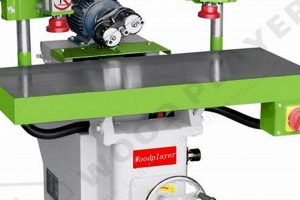
A stationary woodworking tool designed to flatten, reduce the thickness of, and impart a smooth surface to pieces of wood. This device operates by feeding material through a rotating cutterhead, which precisely shaves off a layer of the wood’s surface. An example of its application is achieving uniform thickness across multiple boards for constructing a cabinet door.
The value of this tool lies in its ability to prepare stock for joinery, ensuring consistent dimensions and eliminating imperfections. Its historical significance is rooted in enabling mass production of standardized wooden components, contributing significantly to advancements in furniture making and construction. The accuracy it provides reduces waste and improves the overall quality of finished products.
Subsequent sections will delve into the diverse types of these machines, detailing their specific functionalities, operational considerations, maintenance requirements, and factors to consider when selecting a suitable model for a given application. Emphasis will be placed on safety protocols and best practices for optimal utilization.
Operational Tips for Thickness Planers
Effective and safe utilization of a thickness planer requires adherence to specific guidelines. These tips aim to optimize performance and prolong the life of the equipment.
Tip 1: Material Inspection. Prior to feeding stock, thoroughly inspect the workpiece for any foreign objects, such as nails or staples. These can severely damage the cutterhead and pose a safety hazard.
Tip 2: Grain Direction. Feed the wood into the machine with the grain. Planing against the grain can result in tear-out, producing a rough and uneven surface.
Tip 3: Incremental Depth of Cut. Avoid removing excessive material in a single pass. Employ multiple shallow cuts to minimize stress on the machine and produce a smoother finish. A maximum depth of 1/16 inch per pass is generally recommended for hardwoods.
Tip 4: Proper Support. Ensure adequate infeed and outfeed support for long workpieces. Rollers or extension tables can prevent snipe, the unwanted reduction in thickness at the beginning and end of the board.
Tip 5: Dust Collection. Implement a robust dust collection system. Wood shavings and dust generated during the process can be a health hazard and impede the machines performance. Connect the machine to a dust collector with sufficient CFM (cubic feet per minute) rating.
Tip 6: Blade Maintenance. Regularly inspect and maintain the blades. Sharp blades are essential for efficient cutting and reducing stress on the motor. Dull blades should be sharpened or replaced promptly.
Tip 7: Machine Lubrication. Adhere to the manufacturer’s recommended lubrication schedule. Proper lubrication of moving parts ensures smooth operation and extends the lifespan of the planer.
Tip 8: Secure Placement. Ensure the planer is securely mounted to a stable surface. Vibration during operation can compromise accuracy and potentially cause the machine to shift.
By implementing these practices, operators can maximize the effectiveness of the planer, produce consistently high-quality results, and mitigate potential risks.
The concluding section will provide a summary of key considerations for selecting the most appropriate planer based on individual needs and project requirements.
1. Surface Quality

Surface quality, in the context of machining lumber, defines the smoothness and uniformity of a planed board. It is a primary determinant of the final aesthetic and functional characteristics of woodworking projects. The capabilities of the woodworking machine planer directly influence the attainable surface quality.
- Cutterhead Configuration
The design of the cutterhead, including the number of knives and their arrangement, significantly impacts the resulting surface finish. Planers with helical cutterheads, featuring numerous small, angled cutters, typically produce a smoother surface compared to those with traditional straight knives. The helical design reduces tear-out by presenting the cutting edge at a shear angle to the wood grain.
- Blade Sharpness and Alignment
The sharpness of the planer blades is critical. Dull blades cause tearing and result in a rough, uneven surface. Regular sharpening or replacement of blades is essential for maintaining optimal surface quality. Moreover, precise alignment of the blades within the cutterhead ensures uniform cutting depth across the width of the workpiece, preventing ridges or inconsistencies.
- Feed Rate and Depth of Cut
The rate at which the wood is fed through the planer and the depth of each cut directly influence the surface finish. Slower feed rates and shallower cuts generally yield a smoother surface by reducing the load on the cutterhead and minimizing the risk of tear-out. Conversely, excessive feed rates or deep cuts can result in a rough or scalloped surface.
- Wood Species and Grain Orientation
The type of wood being planed and its grain orientation affect the achievable surface quality. Denser hardwoods tend to plane more smoothly than softwoods. Furthermore, planing with the grain minimizes tear-out and produces a cleaner surface compared to planing against the grain. Careful consideration of wood properties is crucial for optimizing surface quality.
The interaction of these factors dictates the ultimate surface quality attainable with a woodworking machine planer. Controlling these parameterscutterhead configuration, blade maintenance, feed rate, depth of cut, and wood propertiesallows for achieving the desired level of smoothness and uniformity in woodworking projects.
2. Dimensional Accuracy

Dimensional accuracy, referring to the precision with which a woodworking machine planer maintains the specified dimensions of a workpiece, is fundamental to quality woodworking. Its importance stems from the need for parts to fit together seamlessly in joinery and construction.
- Cutterhead Stability and Rigidity
The stability and rigidity of the cutterhead assembly are paramount for achieving consistent thickness across the entire width of the board. Any play or vibration in the cutterhead directly translates to variations in the final dimensions. Machines with robust cutterhead designs and effective vibration dampening mechanisms exhibit superior dimensional accuracy. An example is a planer with a cast-iron frame and heavy-duty bearings, minimizing deflection during operation.
- Infeed and Outfeed Table Alignment
Proper alignment of the infeed and outfeed tables is crucial for preventing snipe, the undesirable reduction in thickness at the beginning and end of a board. Misalignment causes the workpiece to tilt as it enters or exits the cutterhead, resulting in uneven material removal. Periodic checks and adjustments of table alignment are essential for maintaining dimensional accuracy. The use of precision shims and levels ensures correct table positioning.
- Depth Stop Mechanism Precision
The accuracy of the depth stop mechanism directly determines the precision with which the planer removes material in each pass. A poorly calibrated or inconsistent depth stop leads to variations in the final thickness of the workpiece. Planers with fine-threaded adjustment mechanisms and clear, easily readable scales provide greater control over the depth of cut, enhancing dimensional accuracy. Digital readouts offer the highest level of precision.
- Feed Roller Pressure Control
Consistent feed roller pressure is necessary for maintaining a uniform feed rate and preventing slippage during planing. Uneven pressure can cause the workpiece to hesitate or stall, leading to variations in thickness. Adjustable feed roller pressure allows the operator to optimize the feed rate for different wood species and thicknesses, improving dimensional accuracy. Machines with independently adjustable rollers provide the greatest control.
The interplay of these factors directly impacts the dimensional accuracy achievable with a woodworking machine planer. Addressing each element is essential for producing parts with consistent and precise dimensions, which are necessary for high-quality woodworking projects.
3. Material Removal
The capacity for material removal is a key performance indicator of a woodworking machine planer. It defines the volume of wood that can be efficiently processed within a given timeframe and directly influences the machine’s suitability for various woodworking applications.
- Cutterhead Speed and Power
The rotational speed of the cutterhead, measured in revolutions per minute (RPM), and the motor’s horsepower are directly proportional to the machine’s material removal rate. Higher speeds and greater power allow for more aggressive cutting and the efficient processing of dense hardwoods. Example: A planer with a 5-horsepower motor can typically remove material faster than one with a 3-horsepower motor when planing hardwoods like maple or oak.
- Feed Rate Adjustment
The ability to adjust the feed rate, which dictates how quickly the workpiece passes through the machine, is crucial for optimizing material removal. A slower feed rate allows for deeper cuts and more efficient removal of material, while a faster feed rate is suitable for finishing passes. Example: For rough-sawn lumber, a slower feed rate is recommended to remove significant material and flatten the surface. For final passes, a faster feed rate can be used to achieve a smooth finish.
- Cutting Depth Capacity
The maximum depth of cut that the planer can achieve in a single pass determines its ability to quickly reduce the thickness of a board. A greater cutting depth capacity translates to faster material removal. However, exceeding the recommended cutting depth can strain the machine and compromise the quality of the finished surface. Example: A planer with a maximum cutting depth of 1/8 inch can remove material more quickly than one with a maximum depth of 1/16 inch, but it may also increase the risk of tear-out if used aggressively.
- Chip Extraction Efficiency
Efficient chip extraction is essential for maintaining consistent material removal and preventing clogging of the cutterhead. A well-designed dust collection system effectively removes wood shavings, allowing the blades to cut cleanly and preventing the accumulation of debris that can impede performance. Example: A planer connected to a dust collector with sufficient CFM (cubic feet per minute) will experience less clogging and maintain a more consistent material removal rate compared to a planer without adequate dust extraction.
These interdependent factors collectively define the material removal capabilities of a woodworking machine planer. Careful consideration of these attributes is crucial when selecting a planer for specific woodworking tasks, ensuring that the machine can efficiently and effectively process the required volume of material.
4. Power Requirement

The power requirement of a woodworking machine planer is a critical specification dictating its operational capabilities and suitability for various tasks. Adequate power ensures consistent performance, prevents motor overload, and contributes to the machine’s longevity. Understanding the power demands is essential for proper electrical circuit planning and safe operation.
- Motor Horsepower and Voltage
Motor horsepower (HP) is the primary indicator of a planer’s cutting capacity. Higher HP ratings enable the machine to handle denser hardwoods and larger stock dimensions without stalling. Voltage, typically 120V or 240V, must match the available electrical supply. A mismatch can result in damage to the motor or inadequate performance. Example: Planing thick maple requires a higher HP motor and appropriate voltage compared to planing thin pine.
- Amperage Draw and Circuit Capacity
Amperage draw represents the amount of electrical current the planer consumes during operation. This value is critical for determining the required circuit breaker size and wire gauge. Overloading a circuit can cause breakers to trip, creating interruptions and potential safety hazards. Example: A planer drawing 15 amps requires a dedicated 20-amp circuit with appropriate wiring.
- Phase (Single vs. Three-Phase)
Larger, industrial-grade planers often utilize three-phase power, which offers greater efficiency and power delivery compared to single-phase. However, three-phase power requires a specialized electrical system. Most residential workshops are equipped with single-phase power, limiting the selection of suitable planers. Example: A large-scale lumber mill typically employs three-phase planers for high-volume production.
- Starting Current (Inrush Current)
Planers, especially those with induction motors, exhibit a high starting current, also known as inrush current, when initially powered on. This surge of current can temporarily exceed the normal operating amperage. Electrical circuits must be capable of handling this inrush current to prevent breaker tripping. Example: A planer with a 15-amp running current may draw 45 amps or more during startup, necessitating a larger breaker.
The power requirement directly impacts the performance and operational safety of a woodworking machine planer. Matching the machine’s electrical demands with the available power supply is essential for reliable operation and preventing electrical hazards. Selection of a planer must consider the available electrical infrastructure and the intended scope of woodworking activities.
5. Machine Stability
Machine stability, in the context of a woodworking machine planer, is a paramount attribute directly influencing the precision, safety, and longevity of the equipment. Instability in a planer manifests as vibrations, movement during operation, or a lack of rigidity in the frame. These factors negatively impact the quality of the finished workpiece and increase the risk of operational hazards. A direct consequence of instability is dimensional inaccuracy; if the machine vibrates or shifts during planing, the resultant board will exhibit inconsistent thickness across its surface. For example, a wobbly planer might produce cabinet doors with uneven edges, rendering them unusable without further corrective action.
The inherent design and construction materials significantly contribute to a planer’s stability. A heavy, cast-iron frame absorbs vibrations more effectively than a lightweight, stamped-steel frame. Similarly, a planer securely bolted to a solid foundation exhibits greater stability than one simply resting on the floor. Practical examples include industrial-grade planers, which are often anchored to concrete floors to minimize movement during high-volume operations. Furthermore, the internal components, such as the cutterhead and feed rollers, must be precisely balanced and aligned to reduce vibration. Regular maintenance, including tightening bolts and lubricating moving parts, is essential for preserving stability over time.
In summation, machine stability is an indispensable element of a woodworking machine planer. Its absence leads to diminished precision, compromised safety, and reduced equipment lifespan. Prioritizing stability through robust design, proper installation, and diligent maintenance is vital for achieving consistently high-quality results and ensuring a safe working environment. Ignoring this aspect introduces challenges ranging from material waste to potential operator injury, underscoring the practical significance of understanding and addressing machine stability in woodworking operations.
6. Operational Safety

The safe operation of a woodworking machine planer is a paramount concern, requiring strict adherence to established safety protocols and a thorough understanding of potential hazards. The inherently dangerous nature of rotating cutterheads and high-speed material feed necessitates proactive measures to mitigate risks and prevent injuries.
- Personal Protective Equipment (PPE)
The consistent use of appropriate PPE is essential when operating a planer. Safety glasses or a face shield protect against flying debris, while hearing protection minimizes the risk of auditory damage from prolonged exposure to noise. Dust masks or respirators prevent the inhalation of fine wood particles, reducing the potential for respiratory illnesses. Failure to utilize PPE can lead to severe and preventable injuries. An example is eye injuries from wood chips ejected during planing.
- Machine Guarding and Safety Devices
Properly functioning machine guards are critical for preventing accidental contact with the rotating cutterhead. These guards should be in place and properly adjusted before commencing any planing operation. Anti-kickback pawls and push sticks provide additional safety by preventing the workpiece from being ejected backward and maintaining a safe distance between the operator’s hands and the cutterhead. Tampering with or disabling safety devices compromises operator safety and increases the likelihood of accidents.
- Safe Work Practices and Procedures
Adherence to established safe work practices is crucial for minimizing risks. This includes thoroughly inspecting the workpiece for foreign objects before planing, feeding the material with the grain direction, avoiding excessive depth of cut, and maintaining a stable stance. Never reach over or around the rotating cutterhead, and avoid distractions during operation. For example, attempting to remove a jammed workpiece without first disconnecting power can lead to serious injury.
- Emergency Procedures and Lockout/Tagout
Operators must be familiar with emergency stop procedures and the location of emergency shut-off switches. In the event of a malfunction or accident, the ability to quickly stop the machine is critical. The lockout/tagout procedure should be implemented during maintenance or repair to prevent accidental activation of the planer. This involves disconnecting the power source and applying a lock and tag to the disconnect switch, ensuring that the machine cannot be inadvertently started.
The integration of these safety measures is not merely a recommendation but a critical requirement for the responsible operation of a woodworking machine planer. A commitment to safety, coupled with proper training and diligent adherence to established protocols, minimizes the potential for accidents and promotes a safe working environment.
Frequently Asked Questions
This section addresses common inquiries regarding woodworking machine planers, aiming to provide clear and concise information for effective utilization and informed decision-making.
Question 1: What is the primary function of a woodworking machine planer?
The primary function is to reduce the thickness of a board to a precise dimension, ensuring a consistently flat and smooth surface. This preparation is crucial for joinery and achieving desired aesthetic qualities.
Question 2: What safety precautions are essential when operating a woodworking machine planer?
Essential safety precautions include wearing appropriate personal protective equipment (PPE) such as safety glasses and hearing protection, ensuring machine guards are in place and functional, thoroughly inspecting stock for foreign objects, and maintaining a safe distance from the cutterhead.
Question 3: How does cutterhead design affect the finish quality produced by a woodworking machine planer?
The cutterhead design directly influences the finish quality. Helical cutterheads with multiple small blades arranged in a spiral pattern generally produce a smoother, less tear-out prone surface compared to straight-knife cutterheads.
Question 4: What factors should be considered when selecting a woodworking machine planer for a specific application?
Factors to consider include the maximum board width and thickness capacity, motor horsepower, feed rate, cutterhead type, dust collection capabilities, and dimensional accuracy requirements. Evaluate these elements in relation to the intended woodworking tasks.
Question 5: How often should the blades of a woodworking machine planer be sharpened or replaced?
The frequency of blade sharpening or replacement depends on usage and the type of wood being planed. Dull blades increase the risk of tear-out and strain the motor. Inspect blades regularly and sharpen or replace them when performance degrades or damage is evident.
Question 6: What causes snipe, and how can it be prevented when using a woodworking machine planer?
Snipe is the undesirable reduction in thickness at the beginning and end of a board. It is primarily caused by inadequate support for the workpiece as it enters and exits the cutterhead. Prevent snipe by using infeed and outfeed tables or rollers to provide consistent support.
Understanding these aspects contributes to the safe and efficient utilization of the planer.
The subsequent section provides closing remarks, summarizing critical elements to consider.
Conclusion
The preceding exposition has detailed fundamental aspects of the woodworking machine planer. Key points addressed include operational tips, dimensional accuracy, power requirements, safety protocols, and the impact of machine stability on output quality. Effective utilization of this tool demands a comprehensive understanding of these factors.
Mastery of woodworking necessitates informed decision-making and rigorous adherence to safety standards. The information presented serves as a foundation for optimizing performance and minimizing risks associated with this indispensable tool. Continued diligence and commitment to best practices are essential for achieving consistent, high-quality results in woodworking endeavors.