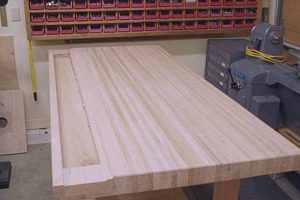
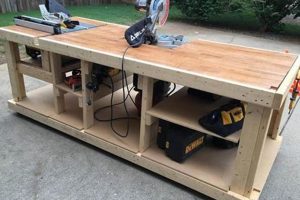
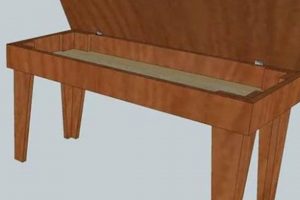
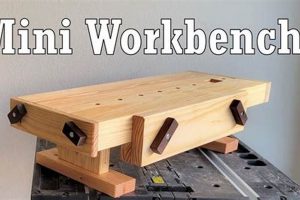
The dimensions of a workbench are a critical factor in its functionality for woodworking tasks. These measurements, encompassing length, width, and height, directly influence the work surface area and the user’s posture during operation. For instance, a longer surface facilitates the handling of larger projects, while the height must accommodate the user’s stature to promote ergonomic working conditions.
Optimal dimensions contribute significantly to efficiency and safety in a woodworking environment. A sufficiently sized surface allows for secure clamping and ample space for tool placement, minimizing the risk of accidents and improving workflow. Historically, benches were often built to reflect the specific needs and average height of artisans in particular regions, demonstrating an understanding of the direct impact of dimensions on practical application.
Therefore, a careful assessment of individual project requirements, available workspace, and user ergonomics should guide the selection process. Factors to consider include the type of woodworking projects undertaken, the available space in the workshop, and the individual’s height and reach, all of which directly inform the appropriate choice of bench dimensions for optimal performance.
Dimension Optimization for Woodworking Benches
The following recommendations address the crucial aspect of workbench dimensions in enhancing woodworking precision and comfort.
Tip 1: Length Considerations: For handling sizable projects, a length exceeding six feet is advisable. This provides ample support and working area for larger components, minimizing instability.
Tip 2: Width for Stability: A width between 24 and 36 inches provides sufficient stability and surface area. This allows for secure clamping and prevents the bench from tipping during rigorous work.
Tip 3: Height and Ergonomics: The bench height should correspond to the user’s elbow height when standing. This promotes proper posture and reduces strain during prolonged use. Adjustments, such as leg extensions, may be necessary.
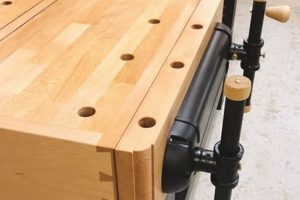
Tip 4: Vise Placement and Dimensions: Incorporate the dimensions of the vise into the overall bench design. Ensure sufficient clearance and stability around the vise mounting area for effective clamping.
Tip 5: Incorporate Storage Considerations: Plan for integrated storage solutions within the bench design. This should consider the dimensions and weight of commonly used tools, ensuring accessibility and organization.
Tip 6: Material Selection Impact: Material selection directly impacts the overall dimensions and structural integrity. Hardwoods are preferable, but their thickness must be considered in relation to the desired workbench dimensions and load-bearing capacity.
Tip 7: Tail Vise Dimensions: If a tail vise is included, its length should complement the overall bench length. A longer tail vise allows for securing longer pieces of wood during edge jointing or similar operations.
Adhering to these dimensional guidelines can significantly improve the effectiveness and comfort of woodworking tasks. Prioritizing optimal measurements translates to improved efficiency and reduced physical strain.
The subsequent sections will explore specific design considerations and construction techniques related to these dimensional guidelines.
1. Overall Length

Overall length, a primary component of workbench dimensions, directly influences the type and scale of projects that can be accommodated. A workbench possessing insufficient length restricts the ability to efficiently work with larger boards or assemblies, leading to instability and potential inaccuracies. The length determines the capacity for supporting long workpieces, such as table legs or cabinet sides, during operations like planing, jointing, or assembly. A longer workbench provides increased stability, reducing vibration and improving precision.
For instance, a luthier crafting a guitar will require a shorter workbench compared to a cabinetmaker constructing a dining table. The cabinetmaker’s workbench will invariably necessitate greater length to support the extended dimensions of cabinet components during assembly. Similarly, a woodworker focused on smaller, detail-oriented projects might find a shorter bench more practical, as it requires less space and can be more easily maneuvered within a smaller workshop. Therefore, the overall length should align with the typical size and nature of anticipated projects.
In conclusion, the workbench’s length is not merely a dimensional characteristic but a crucial determinant of its practical utility. A well-considered overall length, based on the intended woodworking applications, is essential for ensuring stability, accuracy, and efficiency in the workshop. Ignoring this element of workbench design can lead to limitations in project scope and compromised workflow.
2. Surface Width

Surface width represents a critical dimensional aspect, directly influencing the utility of a workbench. It dictates the available space for tool placement, workholding, and project manipulation. A carefully considered width enhances workflow and contributes to improved safety.
- Tool Accessibility and Organization
The surface width determines the proximity of tools to the work area. A greater width enables the organized placement of tools within easy reach, reducing the need to constantly shift position or interrupt the workflow. Insufficient width can lead to cluttered work surfaces and increased risk of accidents. For example, a woodworker engaged in dovetailing benefits from a wider surface that accommodates chisels, saws, and measuring tools, all within immediate access.
- Workholding Capacity and Flexibility
The capacity to effectively secure workpieces relies significantly on surface width. A broader surface allows for the strategic placement of vises, clamps, and other workholding devices. This increased flexibility is particularly important for projects involving irregular shapes or complex joinery. For instance, securing a large panel for planing requires ample surface width to accommodate multiple clamping points and prevent warping or movement during the process.
- Project Scale and Complexity
Surface width impacts the size and complexity of projects that can be comfortably undertaken. A wider surface provides greater support for larger components and assemblies, reducing the risk of instability and facilitating more intricate woodworking techniques. Consider a woodworker assembling a cabinet carcass; a wider bench surface ensures that the various panels can be laid out and joined accurately without overhanging the edge of the bench.
- Ergonomic Considerations
Although less direct than height, surface width contributes to overall ergonomics. A width that is too narrow can force the user to adopt awkward postures to reach certain areas of the workpiece, increasing strain and fatigue. Conversely, an excessively wide surface can impede reach and accessibility. Optimal surface width allows for comfortable and efficient movement around the workbench, minimizing the risk of repetitive strain injuries.
The aforementioned factors underscore the importance of carefully selecting surface width based on individual needs and project requirements. Optimizing this dimension ensures improved tool accessibility, enhanced workholding capacity, support for larger projects, and better ergonomic comfort, ultimately contributing to a more productive and safer woodworking environment.
3. Working Height

Working height, a critical dimension in workbench design, directly affects user ergonomics and consequently, efficiency and safety. As an integral component of the overall “woodworking bench size,” it influences posture, reach, and the amount of force required for various woodworking tasks. An incorrectly sized workbench, particularly regarding height, can lead to musculoskeletal strain, reduced precision, and increased risk of injury. For example, a bench that is too low compels the user to stoop, resulting in back pain and limited leverage. Conversely, a bench that is too high necessitates elevated shoulders and arms, leading to fatigue and reduced control over hand tools.
The ideal working height is typically determined by the user’s stature and the type of woodworking operations performed. A common guideline suggests that the benchtop should be approximately at wrist height when standing with relaxed shoulders. However, specific tasks may warrant adjustments. For fine detail work, a slightly higher bench may improve visibility and control. For tasks involving heavy pounding or planing, a slightly lower bench may provide greater stability and leverage. Furthermore, the integration of adjustable legs or risers allows for customization to accommodate multiple users or varying project requirements, underscoring the adaptability required within “woodworking bench size” considerations.
In conclusion, the optimal working height is not merely a matter of comfort but a fundamental element of workbench design that directly impacts physical well-being and work quality. A proper understanding of its relationship to other workbench dimensions and the specific needs of the woodworker is essential for creating a safe, efficient, and ergonomically sound workspace. Ignoring the significance of this dimension within the broader “woodworking bench size” framework can lead to long-term health problems and diminished productivity.
4. Apron Thickness

Apron thickness, as a dimension within the framework of “woodworking bench size,” significantly contributes to the overall structural rigidity and stability of the workbench. The apron, typically constructed of solid wood, functions as a critical connecting element between the benchtop and legs, resisting racking forces and preventing deformation under load. Insufficient apron thickness compromises the bench’s ability to withstand the stresses imposed during vigorous woodworking operations, potentially leading to premature wear and tear or catastrophic failure. For example, a bench with a thin apron may exhibit excessive flex when subjected to heavy planing, negatively impacting precision and potentially damaging the workpiece. The dimensions of the apron must therefore be carefully calibrated to the overall dimensions and anticipated workload of the workbench.
The influence of apron thickness extends beyond mere structural integrity. It also affects the usability of the bench for certain workholding techniques. A thicker apron provides a more substantial surface for attaching vises, holdfasts, and other clamping devices. These devices rely on the apron’s ability to resist deformation under clamping pressure to effectively secure the workpiece. A thin or weak apron may distort under load, rendering the workholding ineffective. Furthermore, the apron can serve as a mounting point for drawers or shelves, providing valuable storage space within the bench. The aprons dimensions must therefore consider the intended integration of these auxiliary features. A cabinetmaker, for example, may require a particularly robust apron to support the weight of a heavy shoulder vise and the stresses imposed during hand-cut joinery.
In summary, apron thickness is not simply a peripheral detail but a fundamental determinant of a workbench’s durability, stability, and workholding capacity. Optimal apron thickness is contingent on the bench’s overall dimensions and the anticipated demands of the woodworking tasks it will support. Compromising on this aspect can lead to diminished performance, compromised safety, and a reduced lifespan for the workbench. Consequently, a comprehensive understanding of the relationship between apron thickness and “woodworking bench size” is essential for constructing a reliable and effective woodworking tool.
5. Leg spacing
Leg spacing, a constituent element of “woodworking bench size,” profoundly affects the overall stability and load-bearing capacity of the structure. This dimensional aspect governs the distribution of weight across the workbench, directly influencing its resistance to tipping, racking, and vibration. Inadequate leg spacing, relative to the dimensions of the benchtop, creates a heightened risk of instability, particularly when working with heavy workpieces or applying substantial force. For example, a wide workbench with narrowly spaced legs is prone to tipping when pressure is applied to its edges. Consequently, meticulous consideration of leg spacing is paramount in ensuring a safe and efficient woodworking environment.
The relationship between leg spacing and workbench dimensions is not linear; it is governed by principles of structural mechanics. A broader leg stance provides a wider base of support, increasing the bench’s resistance to lateral forces. The positioning of the legs relative to the benchtop’s edges and the weight distribution also plays a crucial role. Legs positioned closer to the corners offer superior stability compared to those placed centrally. Furthermore, the integration of stretchers and aprons, which connect the legs and benchtop, significantly enhances the overall rigidity of the framework. Consider a large workbench designed for assembling heavy furniture; the leg spacing must be proportionately increased, and reinforced with robust stretchers, to prevent deflection and maintain a level working surface.
In summation, leg spacing is an indispensable component of “woodworking bench size,” intricately linked to the workbench’s stability and load-bearing capabilities. Optimal leg spacing, commensurate with the benchtop dimensions and anticipated workload, is essential for ensuring a safe, reliable, and productive woodworking workspace. Neglecting this dimensional aspect can lead to compromised stability, increased risk of accidents, and reduced work quality. The careful calibration of leg spacing, in conjunction with other dimensional parameters, is therefore a cornerstone of sound workbench design and construction.
Frequently Asked Questions
This section addresses common inquiries regarding the dimensions of woodworking benches, providing concise and informative answers to assist in informed decision-making.
Question 1: How does the overall length impact the type of projects suitable for a workbench?
A greater overall length accommodates larger workpieces, facilitating operations such as planing long boards or assembling substantial furniture components. Limited length restricts the ability to handle expansive projects, potentially compromising stability and accuracy.
Question 2: What is the recommended surface width for a woodworking bench, and why?
A width between 24 and 36 inches is generally recommended. This range provides ample space for tool placement, workholding, and maneuverability without sacrificing accessibility. Wider benches may be cumbersome in smaller spaces.
Question 3: How should workbench height be determined to ensure ergonomic comfort?
The optimal height corresponds to the user’s wrist height when standing with relaxed shoulders. This promotes proper posture and minimizes strain during prolonged use. Adjustments may be necessary based on individual preferences and specific tasks.
Question 4: Why is apron thickness a critical dimensional consideration?
Apron thickness directly contributes to the workbench’s structural rigidity and ability to resist racking forces. A thicker apron provides a more stable platform for workholding and prevents deformation under load, ensuring greater accuracy and longevity.
Question 5: How does leg spacing affect the overall stability of the woodworking bench?
Wider leg spacing provides a broader base of support, increasing the workbench’s resistance to tipping and vibration. Strategic leg placement near the corners further enhances stability, particularly when working with heavy or irregularly shaped objects.
Question 6: What role does material selection play in determining appropriate workbench dimensions?
The chosen material influences the required dimensions for achieving adequate strength and stability. Hardwoods are generally preferred, and their thickness must be considered in relation to the intended workload and overall dimensions of the workbench. Softer woods may necessitate larger dimensions to achieve comparable strength.
The aforementioned inquiries highlight the interconnectedness of dimensional aspects in workbench design. A comprehensive understanding of these factors ensures a functional, safe, and ergonomically sound woodworking workspace.
The following section will address design considerations related to the different types of woodworking benches.
Conclusion
The preceding exploration has illuminated the critical importance of workbench dimensions in establishing an effective woodworking environment. Factors such as overall length, surface width, working height, apron thickness, and leg spacing directly impact user ergonomics, structural integrity, and project feasibility. A failure to adequately consider these dimensional aspects can result in compromised performance, increased risk of injury, and reduced lifespan for the woodworking bench.
Therefore, a meticulous evaluation of individual woodworking needs, available workspace, and material selection is essential for informed decision-making regarding “woodworking bench size.” A properly dimensioned workbench represents a significant investment in efficiency, safety, and the long-term quality of woodworking endeavors, underscoring its vital role as a foundational element within any workshop.