The optimal vertical dimension of a woodworking surface, tailored to the individual user, significantly impacts both efficiency and comfort during project execution. This dimension, when appropriately configured, promotes ergonomic posture and reduces strain on the back, shoulders, and wrists. For instance, a surface too low necessitates excessive bending, while one too high can lead to elevated shoulders and fatigue.
Proper surface elevation enhances precision and control over tools and materials. It allows for better leverage during sawing, chiseling, and other operations. Historically, woodworkers often relied on custom-built benches designed to match their body size and working style. The benefits of a correctly sized work surface extend to increased productivity, reduced risk of injury, and improved overall enjoyment of the craft.
Determining the appropriate measurement involves considering individual physical characteristics and common tasks performed at the bench. Several established methods exist for calculating a comfortable and effective dimension, encompassing approaches based on arm length, height, and specific project requirements. Detailed examination of these methods is crucial for establishing a personalized woodworking workspace.
Considerations for Optimal Woodworking Surface Elevation
Achieving a suitable elevation for a woodworking bench is paramount for maximizing efficiency and minimizing physical strain. Implementing the following guidelines will aid in establishing an ergonomically sound and productive workspace.
Tip 1: Measure Arm Height: A common starting point involves measuring the distance from the floor to the user’s wrist while standing upright with the arm hanging relaxed. This measurement serves as a preliminary benchmark for determining an appropriate surface level.
Tip 2: Adjust for Common Tasks: Consider the types of woodworking operations frequently performed. If detailed work, such as carving or inlay, is prevalent, a slightly higher surface may be beneficial. Conversely, for tasks requiring significant downward force, a lower surface may offer improved leverage.
Tip 3: Account for Vise Height: The height of the vise should be integrated into the overall calculation. Ensure that the top of the vise aligns with the primary work surface when closed, maintaining a consistent plane for operations involving clamping and securing materials.
Tip 4: Build a Mock-Up: Prior to constructing a permanent bench, create a temporary structure using adjustable supports. Experiment with various heights to identify the most comfortable and efficient level for different tasks. This iterative process allows for fine-tuning before committing to a final design.
Tip 5: Prioritize Posture: Evaluate posture while performing common woodworking tasks. The objective is to maintain a neutral spine position, avoiding excessive bending or reaching. Adjust the surface height until a comfortable and balanced posture is achieved.
Tip 6: Factor in Footwear: Always consider the type of footwear typically worn in the workshop when determining measurements. Variations in sole thickness can subtly alter the effective height and impact ergonomic comfort.
Tip 7: Accommodate Varying Stock Thickness: Account for the thickness of commonly used lumber. A slightly lower surface may be advantageous when working with thicker materials, ensuring adequate leverage and control.
Adhering to these recommendations promotes a workspace conducive to both productivity and physical well-being. Through careful consideration of individual needs and project requirements, an optimized woodworking surface can be realized.
The following sections will explore the implications of surface material selection on overall bench performance.
1. User's Stature

The physical dimensions of the individual woodworker represent a primary determinant in establishing an appropriate workbench height. Disregarding the user’s stature can lead to ergonomic inefficiencies and potential physical strain.
- Arm Length and Reach
Arm length directly influences the comfortable reach across the workbench surface. A shorter arm length necessitates a lower bench height to avoid excessive reaching and shoulder strain, while a longer arm length may accommodate a taller bench. Optimal reach minimizes the need to lean forward excessively, promoting a more upright and sustainable posture. Example: A woodworker with shorter arms would find a standard-height bench (36 inches) difficult to use for tasks in the center of the bench, leading to shoulder discomfort.
- Torso Height and Posture
Torso height affects the angle at which the woodworker interacts with the work surface. A taller torso can accommodate a higher bench without requiring excessive bending, while a shorter torso necessitates a lower bench to maintain a neutral spine position. Proper torso alignment reduces strain on the lower back and promotes long-term musculoskeletal health. Example: A taller individual using a bench designed for someone of average height may experience chronic lower back pain due to constant bending.
- Leg Length and Standing Comfort
Leg length influences the user’s ability to comfortably stand at the bench for extended periods. Insufficient leg room below the bench can lead to awkward postures and knee strain. A bench height that allows for comfortable leg positioning promotes better circulation and reduces fatigue. Example: A shorter woodworker using a bench with a solid base and limited legroom may experience discomfort and restricted movement due to the lack of space for their legs and feet.
- Overall Height and Bench Relationship
Overall height integrates all body dimensions to establish a holistic relationship with the bench. A comprehensive assessment of the user’s total height, combined with arm length, torso height, and leg length, provides the most accurate basis for determining an optimal bench height. This integrated approach ensures a personalized fit that minimizes strain and maximizes efficiency. Example: A woodworker who is significantly taller or shorter than average will likely require a custom-built bench to accommodate their unique physical needs, preventing potential ergonomic issues associated with standard-sized benches.
The facets of user’s stature underscore the necessity for personalized bench construction or adjustment. Considering arm length, torso height, leg length, and overall height allows for a workbench configuration tailored to individual needs, promoting ergonomic well-being and maximizing woodworking productivity. Ignoring these factors can result in discomfort, reduced efficiency, and potential long-term health issues.
2. Task Specificity

The specific operations undertaken at a woodworking bench significantly influence the determination of an optimal height. Different tasks necessitate varying degrees of leverage, precision, and visual acuity, thereby requiring adjustments to the work surface elevation.
- Detailed Carving and Fine Assembly
Tasks such as intricate carving, delicate joinery, and precise assembly often benefit from a slightly elevated work surface. This higher position allows for closer visual inspection and finer motor control, reducing strain on the neck and back. For example, a luthier assembling a guitar may require a bench height that facilitates focused observation and precise placement of small components, demanding a higher elevation than general woodworking tasks.
- Heavy Stock Removal and Shaping
Operations involving substantial material removal, such as planing, sawing thick stock, or rough shaping, typically require a lower bench height to maximize leverage and stability. This lower stance allows the woodworker to apply greater downward force with less exertion, improving efficiency and reducing fatigue. A shipwright shaping a large timber, for example, would benefit from a lower bench to facilitate powerful and controlled movements.
- Vise Work and Clamping Operations
The type and frequency of vise work influence the ideal bench height. Tasks involving extensive clamping, such as edge joining boards or securing components for shaping, necessitate a height that aligns the vise jaw with the user’s comfortable working plane. This alignment prevents awkward postures and ensures optimal clamping pressure. A furniture maker using a leg vise to tenon a table leg, for instance, needs a bench height that minimizes strain during repetitive clamping and adjustment.
- Finishing and Application of Coatings
The application of finishes, stains, and coatings requires a height that allows for even distribution and thorough visual inspection. A bench height that facilitates unobstructed viewing of the surface and comfortable arm movement promotes consistent application and minimizes defects. A cabinet maker applying lacquer to a cabinet door, for example, would benefit from a bench height that allows for a clear view of the finish and easy maneuverability with a spray gun.
Ultimately, task specificity necessitates a flexible approach to bench height determination. While a single height may suffice for general woodworking, optimizing for particular tasks often requires adjustable benches or dedicated work surfaces tailored to specific operations. Prioritizing task-specific ergonomics enhances efficiency, reduces physical strain, and improves the quality of finished products.
3. Vise Integration

The integration of a vise into a woodworking bench is intrinsically linked to establishing its optimal height. The vise’s primary function of securing workpieces for various operations makes its positioning critical to user comfort and efficiency. A poorly integrated vise, regardless of the bench’s overall height, can negate ergonomic benefits and impede workflow.
- Jaw Height Alignment
The height of the vise jaws relative to the bench surface directly impacts the user’s posture and leverage. If the jaws are positioned too low, the woodworker must bend excessively, leading to back strain. Conversely, if the jaws are too high, the user’s shoulders may become elevated, causing discomfort and reduced control. The ideal alignment places the top of the vise jaws flush with the bench surface, or slightly above, allowing for a neutral wrist position and optimal downward force application. For example, when planing a board held in a face vise, the woodworker should be able to exert pressure directly over the board without hunching or reaching.
- Vise Type and Function
The type of vise employed influences the ideal height adjustment. Face vises, leg vises, and shoulder vises each present unique considerations. A leg vise, for instance, typically necessitates a lower bench height to maximize leverage when clamping larger workpieces. A shoulder vise, designed for edge work, may require a slightly higher position to provide adequate clearance and accessibility. The specific tasks performed with each vise type should inform the bench height determination. For example, a bench primarily used for hand-cut joinery utilizing a shoulder vise might be slightly taller than a bench dedicated to general woodworking with a face vise.
- Crank and Handle Clearance
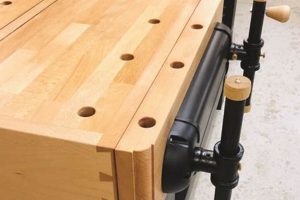
The clearance required for the vise crank or handle must be factored into the overall bench design. Insufficient clearance can restrict movement and impede the clamping process. The height of the bench apron, coupled with the vise placement, must allow for unobstructed rotation of the crank. Consider the vise mechanics to ensure ergonomic operation. For instance, the clearance for the handle of a quick-release vise must be sufficient to allow the hand to rotate freely without contacting the bench.
- Workpiece Stability and Support
The vise’s effectiveness in securing a workpiece directly affects the stability and control available to the woodworker. A correctly positioned vise, integrated with an appropriately sized bench, minimizes vibration and movement during operations such as sawing, chiseling, and planing. Proper bench height coupled with a stable vise contributes to precise and efficient execution. A low height with limited legroom can affect bench stability, as the user’s legs may contact the vise.
In conclusion, vise integration is not merely an attachment but a fundamental aspect of workbench design. The optimal bench height is inseparable from the vise’s position, function, and clearance requirements. Careful consideration of these factors results in a cohesive and ergonomic workspace that promotes both productivity and comfort. The subsequent analysis will explore the impact of material thickness on the determination of ideal workbench elevation.
4. Material Thickness

Material thickness directly influences the effective height of a woodworking setup, and consequently, the ideal workbench height. The vertical dimension of the material being worked upon occupies space above the bench surface, thereby reducing the available space for comfortable tool manipulation and visual access. Ignoring this factor can lead to awkward postures and diminished control. For example, when hand-planing a thick board, a workbench that is already at the upper end of the acceptable height range becomes excessively high, forcing the woodworker to elevate their shoulders and compromise their planing stroke.
Adjustments to accommodate material thickness are often necessary to maintain ergonomic principles. One approach involves lowering the workbench height to compensate for the added elevation provided by the workpiece. This can be achieved through the use of adjustable-height benches or supplementary work surfaces. Alternatively, strategically placed risers can elevate the worker, effectively lowering the relative height of the workbench. Consider a scenario where a woodworker frequently laminates multiple layers of material; the cumulative thickness of the lamination necessitates a lower bench height to avoid working above a comfortable plane.
The interplay between material thickness and workbench height requires careful consideration to prevent physical strain and ensure precise execution. Failing to account for this relationship can result in compromised leverage, reduced visibility, and ultimately, a diminished quality of work. Therefore, understanding this connection is essential for designing and utilizing a woodworking bench that is both ergonomically sound and functionally effective. The subsequent section addresses the significance of posture alignment in determining the appropriate bench height.
5. Posture Alignment

Maintaining proper posture is integral to efficient and safe woodworking practices. The relationship between the human body and the workbench must facilitate a natural spinal alignment to minimize strain and prevent long-term musculoskeletal issues. The optimal height of a woodworking bench is, therefore, inextricably linked to the user’s ability to maintain correct posture while performing various tasks.
- Neutral Spine Position
A neutral spine position, characterized by the natural curves of the back, is the foundation of good posture. A woodworking bench that is too low forces the user to bend excessively at the waist, disrupting this neutral alignment and placing undue stress on the lower back. Conversely, a bench that is too high causes the user to elevate their shoulders, leading to neck and shoulder pain. The ideal bench height allows for a comfortable stance with a straight back and relaxed shoulders. Example: A bench set at the correct height will enable a woodworker to plane a board without hunching or reaching, maintaining the natural curvature of the spine.
- Shoulder and Elbow Angles
The angles of the shoulders and elbows are critical indicators of proper bench height. The optimal position allows for the elbows to be bent at approximately 90 degrees while the hands are engaged in typical woodworking tasks. This angle minimizes strain on the arm and shoulder muscles. A bench that is too low will force the elbows to extend, while a bench that is too high will cause the shoulders to lift. Example: When chiseling, a woodworker should be able to hold the chisel comfortably with their elbows bent at a right angle, allowing for precise and controlled movements.
- Wrist and Hand Positioning
Maintaining a neutral wrist position is essential for preventing repetitive strain injuries such as carpal tunnel syndrome. The ideal bench height allows for the wrists to be straight and relaxed, without excessive bending or extension. Awkward wrist angles can result from a bench that is either too high or too low, forcing the user to compensate with unnatural hand movements. Example: When using a hand plane, the woodworker’s wrists should be straight and in line with their forearms, allowing for a smooth and consistent stroke.
- Visual Acuity and Neck Strain
The height of the workbench affects the angle at which the woodworker views the workpiece. An incorrectly positioned bench can necessitate excessive neck flexion or extension, leading to neck pain and eye strain. The ideal height promotes a comfortable viewing angle that minimizes neck movement. Example: While performing detailed carving, a woodworker should be able to see the workpiece clearly without straining their neck, ensuring accurate and precise cuts.
In summary, posture alignment is not merely a matter of comfort, but a critical factor in preventing long-term health issues associated with woodworking. The optimal bench height is the one that facilitates a neutral spine, comfortable shoulder and elbow angles, relaxed wrist positioning, and a clear visual field, thereby minimizing strain and maximizing efficiency. The subsequent section will delve into the importance of bench stability for achieving optimal woodworking outcomes.
6. Bench Stability
The stability of a woodworking bench directly influences the effectiveness of any chosen height. A bench that shifts or vibrates during use compromises precision, increases the risk of errors, and elevates the potential for injury, irrespective of whether the height is ergonomically sound. Therefore, stability must be a paramount consideration when determining the ideal vertical dimension of a woodworking surface.
- Mass and Rigidity
The overall mass and rigidity of the bench construction contribute significantly to stability. A heavier bench, constructed from dense materials and robust joinery, inherently resists movement and vibration more effectively than a lightweight or flimsy structure. For instance, a bench built from thick hardwood timbers, joined with mortise and tenon joints, will provide a more stable platform than a bench constructed from softwood and secured with screws. Increased stability allows the woodworker to exert greater force with hand tools without the bench shifting, enhancing precision and control at the chosen height.
- Footprint and Support Structure
The size and design of the bench’s footprint and support structure influence its resistance to tipping and racking. A wider footprint, with legs that are splayed outwards, provides greater lateral stability. Additionally, connecting stretchers between the legs enhance rigidity and prevent the bench from twisting or flexing. A bench with a small footprint and inadequate bracing is more susceptible to movement, compromising accuracy, particularly when planing long boards. Optimal support structure maintains bench integrity at the “ideal height”.
- Floor Contact and Leveling
The manner in which the bench makes contact with the floor is critical for stability. An uneven floor can cause the bench to rock or wobble, even if the structure itself is rigid. Adjustable feet or shims can be used to level the bench, ensuring that all four legs make solid contact with the floor. Securing the bench to the floor, while sometimes impractical, provides the ultimate level of stability. Poor floor contact will cause bench movement even at the “ideal height”.
- Vise Integration and Workholding
The way a vise is integrated into the bench and the effectiveness of the workholding system impact overall stability. A poorly mounted vise can vibrate or flex under pressure, transmitting movement to the workpiece. The vise and any integrated clamping systems must be rigidly attached to the bench to provide secure and stable workholding. The stability of the vise amplifies with the use of the correct “ideal height”.
In essence, bench stability acts as a critical foundation upon which all woodworking operations are performed. Without it, the benefits of an ergonomically sound bench height are significantly diminished. A stable bench, achieved through adequate mass, a robust support structure, proper floor contact, and secure vise integration, ensures precision, safety, and efficiency, regardless of the chosen vertical dimension.
Frequently Asked Questions
This section addresses common inquiries regarding the determination and implementation of a suitable height for a woodworking bench, emphasizing ergonomic principles and practical considerations.
Question 1: Why is bench height a critical factor in woodworking?
Bench height directly influences posture, leverage, and visual access during woodworking operations. An improperly sized bench can lead to physical strain, reduced efficiency, and potential long-term health issues.
Question 2: How does an individual’s height influence the ideal bench height?
An individual’s stature, encompassing arm length, torso height, and leg length, significantly impacts the appropriate bench height. These dimensions dictate the comfortable reach, spinal alignment, and legroom necessary for sustained woodworking activities.
Question 3: How do specific woodworking tasks affect the ideal bench height?
Tasks such as detailed carving, heavy stock removal, and vise work necessitate varying bench heights to optimize leverage, precision, and visual clarity. A bench designed for general woodworking may require adjustments for specialized operations.
Question 4: What role does the vise play in determining the optimal bench height?
The vise’s position, function, and clearance requirements are integral to bench height determination. The vise jaws should align with the user’s comfortable working plane to prevent awkward postures and ensure efficient clamping.
Question 5: How does material thickness affect the ideal bench height?
Material thickness occupies space above the bench surface, effectively reducing the available workspace. The bench height must be adjusted to compensate for the added elevation of the workpiece, ensuring comfortable tool manipulation and visual access.
Question 6: How does one assess and adjust bench height for proper posture?
<>
Proper posture is characterized by a neutral spine, relaxed shoulders, and comfortable elbow and wrist angles. The bench height should be adjusted until these conditions are met, minimizing strain and promoting long-term musculoskeletal health.
Determining the appropriate bench height requires a multifaceted approach, encompassing individual physical characteristics, specific task requirements, and ergonomic considerations. Prioritizing these factors ensures a workspace conducive to both productivity and well-being.
The following sections will explore considerations for bench construction materials.
The Significance of Ergonomic Bench Height
This exploration has underscored the multifaceted nature of determining the ideal height for woodworking bench. It is not a static measurement but a dynamic adaptation, influenced by individual physique, task specificity, vise integration, material considerations, posture alignment, and the foundational requirement of bench stability. Successfully navigating these parameters results in a workspace optimized for both efficiency and long-term physical well-being.
The pursuit of a properly dimensioned woodworking surface remains a critical endeavor for serious practitioners. Careful attention to these principles will enhance the craftsperson’s ability to create with precision and comfort, thereby elevating the quality and enjoyment of the woodworking experience. Further research into customized bench designs and adjustable height mechanisms is encouraged for those seeking ultimate ergonomic refinement.
![Build A Roman Woodworking Bench [DIY Guide] | Step-by-Step Guides, Tools & Inspiration to Build Beautiful Wooden Decor on a Budget](https://woodfromhome.com/wp-content/uploads/2026/05/th-207-300x200.jpg "Build A Roman Woodworking Bench [DIY Guide] Step-by-Step Guides, Tools & Inspiration to Build Beautiful Wooden Decor on a Budget")