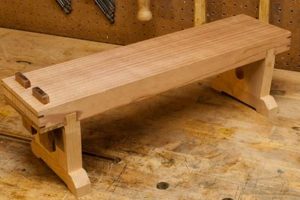
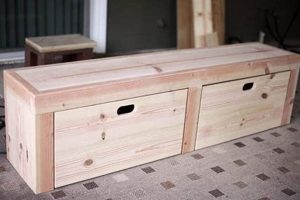
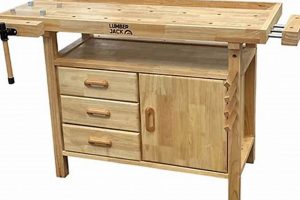
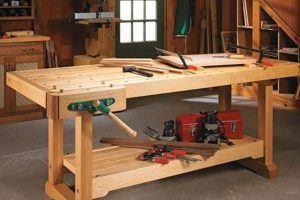
A work surface, tailored to the specific needs of a woodworker, offers dimensional flexibility and feature adaptability beyond that of mass-produced alternatives. These specialized platforms can integrate vises, dog holes, and storage solutions precisely configured for the user’s typical projects and physical dimensions. This contrasts with standardized offerings, which may necessitate compromise in functionality or ergonomics.
The significance of a personalized workstation lies in its ability to enhance efficiency, precision, and comfort during woodworking tasks. Historically, craftsmen built their own workbenches, reflecting an understanding that an optimized workspace contributes directly to the quality and speed of output. The enhanced ergonomics reduce strain, while strategically placed tools and storage minimize workflow interruptions, leading to more accurate and enjoyable work.
The following discussion will delve into the key considerations for designing and selecting a suitable workstation, including factors such as material choice, size and configuration, integrated features, and the alignment with individual woodworking styles and project requirements. This exploration aims to provide a framework for informed decision-making in creating or acquiring a workspace that genuinely supports and enhances the craft.
Essential Considerations for Optimized Woodworking Stations
The selection or construction of a dedicated woodworking area requires careful planning to maximize efficiency and ensure suitability for the intended tasks. The following tips provide critical guidance.
Tip 1: Material Selection: The primary material should prioritize stability and durability. Hardwoods such as maple, beech, or birch are recommended for their resistance to warping and ability to withstand heavy use. Avoid softwoods, as they are prone to damage and instability.
Tip 2: Dimensional Considerations: The overall size must align with the typical project scope. A surface that is too small restricts movement, while an excessively large surface can lead to inefficiencies. Measure the available workspace and anticipate future needs.
Tip 3: Vise Integration: The type and placement of vises are crucial. Consider a combination of face and tail vises for versatile clamping options. Ensure the vises are robustly mounted and capable of exerting significant pressure without damaging the underlying structure.
Tip 4: Dog Hole Configuration: Strategically placed dog holes, compatible with holdfasts and bench dogs, significantly expand clamping capabilities. Maintain consistent spacing and alignment for optimal functionality.
Tip 5: Surface Flatness: Absolute flatness is paramount for precision woodworking. Employ accurate leveling techniques during construction and regularly inspect the surface for deviations. Minor imperfections can be addressed with hand-planing.
Tip 6: Integrated Storage: Incorporate drawers, shelves, or cabinets to store frequently used tools and materials. This promotes organization and reduces workflow interruptions. Prioritize accessibility and consider the weight capacity of the storage solutions.
Tip 7: Ergonomic Height: The height should be tailored to the user’s stature to minimize strain. The ideal height typically allows for comfortable planing without excessive bending or reaching. Adjustable-height designs offer the greatest flexibility.
These considerations ensure a workstation that fosters efficiency, accuracy, and longevity within the woodworking practice. Adhering to these guidelines will result in a far more functional and valuable workspace.
This concludes the section on workstation design and implementation. The subsequent discussion will address maintenance and long-term care.
1. Stability

Stability is paramount in a woodworking platform. It directly influences the precision and safety of woodworking tasks. A stable bench resists movement, absorbs vibrations, and provides a consistent reference surface, critical for accurate cuts, joinery, and assembly.
- Mass and Rigidity
The weight and stiffness of the bench are primary contributors to its stability. Increased mass resists movement from applied forces during sawing, planing, or hammering. Rigidity prevents flexing or warping, maintaining a consistent working plane. For example, a bench constructed from thick, dense hardwood like maple will exhibit greater stability than one made from lightweight pine. Insufficient mass can lead to inaccurate cuts, while excessive flexing compromises joint integrity.
- Leg Design and Joinery
The leg structure and joinery methods employed significantly impact overall stability. Widely spaced legs, securely joined to the bench top and aprons using robust joinery techniques such as mortise and tenon or dovetails, enhance resistance to racking and twisting forces. A weak leg structure will transmit vibrations and allow for undesirable movement, undermining the precision of the work. Conversely, a well-engineered leg system provides a solid foundation.
- Foot Contact and Leveling
Uniform contact between the bench feet and the floor is essential for distributing weight and preventing rocking. Uneven floors can introduce instability, even in a well-constructed bench. Adjustable feet or shims can compensate for floor irregularities, ensuring a level and stable platform. Failure to address uneven floor contact will result in inconsistent performance and potential safety hazards.
- Internal Bracing and Reinforcement
Internal bracing, such as stretchers or diagonal supports, further enhances stability by distributing stress and preventing deformation. These reinforcements are particularly important in larger benches or those subjected to heavy use. Strategically placed bracing minimizes the risk of racking or sagging, ensuring long-term structural integrity and consistent performance. Omission of bracing can lead to premature wear and reduced precision.
These facets highlight the interconnected nature of stability within the framework of a well-crafted woodworking surface. Neglecting any of these elements compromises the overall effectiveness, impacting both the quality of the work and the safety of the user. A solid, stable bench is not merely a place to work but a fundamental tool for precision and craftsmanship.
2. Workholding

The efficacy of a woodworking surface hinges significantly on its workholding capabilities. The bench serves as a stable platform; however, secure and versatile workholding transforms it into a precise tool. Insufficient workholding leads to material movement during shaping, jointing, or finishing, resulting in inaccuracies, damaged workpieces, and potential hazards. The specific workholding options integrated into a bench directly determine the types of projects that can be undertaken and the efficiency with which they can be completed. The presence of robust vises, strategically placed dog holes, and appropriate clamping accessories enables the woodworker to fixate components reliably in any orientation. A well-equipped bench supports a variety of techniques, from delicate carving to forceful planing. Consider a scenario involving dovetail joinery: precise alignment and fixation are critical. A bench with inadequate clamping solutions would necessitate makeshift methods, increasing the likelihood of errors and prolonging the task. This highlights that the bench is not merely a surface, but a dynamic system where stability complements versatile gripping.
Workholding solutions can be categorized into several fundamental approaches, each with its advantages. Vises provide powerful clamping force for securing edges or faces. Bench dogs, used in conjunction with dog holes, offer flexible positioning and support for larger panels. Specialized clamps, such as holdfasts, apply downward pressure without obstructing the working surface. The integration of these solutions into a tailored bench allows for customization based on typical project needs. For example, a furniture maker may prioritize a large tail vise for managing long boards, whereas a luthier might favor a smaller face vise for intricate carving. The customized workholding aligns directly with the specific workflow, maximizing efficiency and minimizing time wasted on improvised clamping methods.
A comprehensive understanding of workholding principles and options is essential for maximizing the utility of any woodworking surface. The presence of reliable and flexible clamping mechanisms transforms the workbench from a mere table into a precision tool, allowing the craftsman to execute complex tasks with accuracy and control. The interplay between the surface’s stability and gripping strength defines the degree to which the user can accurately shape, assemble, and finish workpieces. Therefore, the selection and implementation of appropriate workholding solutions constitute a core consideration in the design and utilization of any dedicated woodworking station, greatly enhancing the effectiveness of each woodworking project.
3. Surface Flatness

The flatness of a woodworking platform directly influences the precision and accuracy of woodworking operations. A non-planar surface introduces errors in referencing, joinery, and assembly processes. When constructing or acquiring a tailored woodworking station, achieving and maintaining surface trueness is paramount. Variations in height across the surface manifest as inconsistencies in cut depths, misaligned joints, and skewed assemblies. For example, if a benchtop is not flat, planing a board to a consistent thickness becomes problematic, as the plane will follow the contours of the bench, resulting in an uneven workpiece. Similarly, when assembling a frame on an unlevel surface, the resulting structure may be distorted and lack squareness.
Customization offers the opportunity to optimize flatness from the outset. Selecting stable materials, such as kiln-dried hardwoods, and employing robust construction techniques minimizes the risk of warping or cupping. Furthermore, the customized approach allows for the incorporation of features that facilitate ongoing maintenance of surface trueness. These features might include adjustable feet to compensate for uneven floors or a replaceable surface that can be easily planed or resurfaced when necessary. The ability to tailor the bench to the specific environment and usage patterns increases the likelihood of sustained surface accuracy. Real-world examples demonstrate the impact: a luthier crafting instruments requires a meticulously flat surface for precise neck carving and fretboard leveling, while a cabinet maker relies on a trued surface for assembling casework components accurately. In both instances, the customized workstation, with its focus on flatness, directly supports the quality of the finished product.
In summary, the connection between a tailored woodworking station and surface trueness is causal: the degree of flatness determines the achievable accuracy in woodworking tasks. Addressing this aspect from the initial design stage, through material selection and construction methods, and by enabling ongoing maintenance is crucial. The challenge lies in selecting materials and techniques appropriate to the intended use and environmental conditions. By prioritizing this relationship, craftsmen can create a workstation that genuinely enhances the precision and efficiency of their work. This understanding ultimately links to the broader theme of optimizing tools and workspaces for superior craftsmanship.
4. Material Durability

Material durability is a primary factor influencing the long-term utility and performance of a woodworking station. The selected materials must withstand the rigors of daily use, resist wear and tear, and maintain structural integrity over extended periods. A substandard material choice compromises the stability, accuracy, and overall lifespan of the bench.
- Hardwood Selection and Wear Resistance
The selection of dense hardwoods, such as maple, beech, or oak, directly correlates with the bench’s ability to resist denting, scratching, and abrasion. These woods possess a high degree of hardness, minimizing the impact of heavy tools, dropped objects, and repetitive use. A bench constructed from a softwood, conversely, will exhibit accelerated wear and tear, requiring more frequent repairs or replacement.
- Joint Integrity and Structural Longevity
Durable materials are essential for maintaining the integrity of joinery over time. Mortise-and-tenon joints, dovetails, and other traditional woodworking joints rely on the strength and stability of the surrounding material. Inferior materials may weaken or deform under stress, leading to joint failure and compromised structural stability. The selection of high-quality hardwoods ensures these joints remain secure and functional for decades.
- Surface Treatment and Protection
The application of appropriate surface treatments, such as oil finishes, varnishes, or lacquers, enhances the material’s resistance to moisture, chemicals, and abrasion. These coatings create a protective barrier that prevents the wood from absorbing liquids, staining, or deteriorating. A durable finish extends the lifespan of the bench and preserves its aesthetic appeal. Conversely, neglecting surface protection leaves the material vulnerable to damage.
- Resistance to Environmental Factors
The chosen material should exhibit resistance to environmental factors, such as humidity fluctuations and temperature variations. Wood is a hygroscopic material, meaning it absorbs and releases moisture from the surrounding air. This can cause swelling, shrinkage, and warping, potentially affecting the bench’s flatness and stability. Selecting wood that has been properly kiln-dried and acclimated to the workshop environment minimizes these effects, ensuring long-term dimensional stability.
In summary, material durability is an indispensable consideration in the design and construction of a tailored woodworking station. The selection of dense hardwoods, robust joinery techniques, protective surface treatments, and environmentally stable materials ensures the bench will provide decades of reliable service. These factors collectively contribute to a workstation that not only enhances woodworking efficiency but also represents a lasting investment in the craft.
5. Ergonomic height

Ergonomic height is a critical consideration in the design and utilization of a woodworking station. An appropriately sized bench minimizes physical strain, enhances efficiency, and promotes a more sustainable woodworking practice. A bench that is too low compels the user to stoop, leading to back pain and reduced precision. Conversely, a bench that is too high forces the user to raise their shoulders and arms, causing fatigue and discomfort.
- Posture and Spinal Alignment
The primary goal of ergonomic design is to maintain a neutral spinal posture during woodworking tasks. The height of the bench should allow the user to stand upright with a slight bend in the elbows when performing activities such as planing or sawing. This posture minimizes stress on the back, neck, and shoulders. An improperly sized bench forces the user to compensate with awkward movements, increasing the risk of musculoskeletal disorders.
- Reach and Accessibility
Ergonomic height also influences the user’s reach and accessibility to tools and materials. A bench that is too low may require excessive bending to retrieve items from lower shelves or drawers, while a bench that is too high may make it difficult to reach objects on the surface. The height should be optimized to allow for comfortable and efficient access to all necessary tools and materials.
- Workpiece Manipulation
The ability to manipulate workpieces comfortably and efficiently is directly affected by the bench height. When performing tasks that require precise control, such as carving or joinery, the user needs to be able to position the workpiece at an optimal height and angle. A bench that is too high or too low restricts the user’s range of motion and reduces their ability to achieve accurate results.
- Adjustability and Customization
Given the variability in human body dimensions, adjustability is a valuable feature in a woodworking station. Adjustable-height benches allow the user to fine-tune the working surface to their individual needs and preferences. This customization promotes optimal posture, reduces strain, and enhances overall comfort. If adjustability is not feasible, careful measurement and planning are essential to determine the ideal fixed height.
Customization of the woodworking station offers the opportunity to prioritize ergonomic height, resulting in a more comfortable, efficient, and sustainable woodworking practice. By optimizing the bench height, users can minimize physical strain, enhance precision, and reduce the risk of musculoskeletal disorders. The selection of an appropriate height tailored to the user’s dimensions and work style, significantly improves the overall woodworking experience.
6. Integrated storage
Integrated storage, as a design element, is directly consequential to the functionality and efficiency of a woodworking surface. The integration, often tailored within a custom design, allows for the immediate accessibility of essential tools and materials. Proximity reduces wasted time, minimizes unnecessary movement, and organizes a workspace. For example, drawers beneath the bench top can house frequently used hand tools, while larger cabinets can accommodate power tools or stock materials. Without incorporated storage, the worker is forced to seek implements elsewhere, disrupting the workflow and potentially compromising accuracy.
The benefits extend beyond mere convenience. Strategically placed storage solutions enhance safety. By providing designated spaces for tools, clutter is reduced, minimizing the risk of tripping hazards or accidental damage to equipment. A clear and organized workspace also supports focused attention, reducing the potential for errors. Consider the process of cutting dovetails: immediate access to chisels, saws, and marking gauges, all stored within the bench itself, allows for a smooth, uninterrupted sequence of operations. This level of integration is challenging to achieve with prefabricated or generic benches, which often lack customizable storage options. A custom bench, therefore, allows for a work environment specifically tailored to the individual worker’s methods, maximizing productivity.
The challenges associated with integrated storage involve careful planning and execution. The design must account for the size and weight of stored items, ensuring that drawers and cabinets are robust enough to withstand regular use. Weight distribution must be considered to maintain bench stability. Despite these challenges, the benefits of incorporated storage far outweigh the difficulties, transforming it from an add-on feature to a necessary component of any truly effective work station. This realization is pivotal for woodworkers seeking to optimize both their craft and workspace.
7. Customization options

The intrinsic value of a tailored woodworking surface derives, in substantial measure, from the customization options available during its design and construction. These options directly dictate the degree to which the completed unit aligns with the user’s specific needs, workflow, and physical dimensions. The ability to modify dimensions, incorporate specialized workholding mechanisms, and integrate storage solutions constitutes a primary differentiator between a mass-produced workbench and one that is truly optimized for individual woodworking activities. For instance, a luthier requires a smaller, more specialized surface with integrated jigs for instrument making, while a furniture maker benefits from a larger, more robust bench equipped with heavy-duty vises. The absence of customization necessitates compromise, forcing the woodworker to adapt to the limitations of the equipment rather than having the equipment adapt to the workflow.
Customization options manifest in several key areas. Dimensional adjustments are crucial for ergonomic reasons, ensuring the bench height and depth align with the user’s stature and reach. Workholding customization involves the selection and placement of vises, dog holes, and clamping systems tailored to specific tasks. Storage customization allows for the integration of drawers, cabinets, and shelves sized and configured to accommodate the user’s tool collection and material inventory. Material selection also constitutes a customization option, with the choice of hardwood species and finish influencing the bench’s durability and aesthetic qualities. Practically, this means that a woodworker can select a benchtop thickness optimized for damping vibration, or specify a particular vise that matches their preferred clamping style. The accumulative effect of these individually customized features results in a woodworking environment optimized to increase productivity and minimize physical strain.
In conclusion, the available customization options exert a profound influence on the functionality and utility of a tailored woodworking surface. The ability to modify dimensions, incorporate specialized workholding, integrate storage solutions, and select appropriate materials directly determines the degree to which the bench supports the user’s specific needs and workflow. While challenges may exist in the planning and execution of these custom features, the benefits derived from a truly optimized workspace significantly outweigh the difficulties, transforming the bench from a mere surface into an essential tool for precision and efficiency in woodworking. The recognition of this connection is fundamental for woodworkers seeking to elevate their craft and maximize their potential.
Frequently Asked Questions
The following questions address common concerns and misconceptions regarding the construction and acquisition of specialized woodworking surfaces. These answers aim to provide clarity and informed guidance.
Question 1: What distinguishes a tailored woodworking platform from a commercially available workbench?
A tailored woodworking platform is specifically designed and constructed to meet the individual needs of the woodworker, incorporating dimensions, workholding solutions, and storage options optimized for their particular projects and working style. Commercially available workbenches are mass-produced with standardized features, often necessitating compromises in functionality or ergonomics.
Question 2: What are the primary material considerations for the top surface of a tailored woodworking platform?
Hardwoods, such as maple, beech, or birch, are generally preferred due to their density, stability, and resistance to wear. Softwoods are less suitable due to their susceptibility to denting and deformation under heavy use. Kiln-dried lumber is essential to minimize warping and movement.
Question 3: How does the height of a tailored woodworking platform impact its usability?
The height should be ergonomically optimized to minimize strain on the back, shoulders, and arms. The ideal height typically allows for comfortable planing without excessive bending or reaching. Adjustable-height designs offer the greatest flexibility, accommodating various tasks and user preferences.
Question 4: What are the key workholding options to consider when designing a tailored woodworking platform?
Vises (face and tail), dog holes, and specialized clamping accessories are essential. The selection and placement of these options should align with the type of projects typically undertaken. Robust mounting and construction are critical to ensure secure workpiece fixation during operations.
Question 5: How important is surface flatness in a tailored woodworking platform, and how is it achieved?
Surface flatness is paramount for accurate referencing, joinery, and assembly. It is achieved through careful material selection, precise construction techniques, and ongoing maintenance. Regular inspection and correction with hand planes may be required to address minor deviations.
Question 6: What is the typical lifespan of a well-constructed tailored woodworking platform?
With proper care and maintenance, a well-constructed tailored woodworking platform can provide decades of reliable service. The longevity depends on the quality of materials, construction methods, and the frequency and intensity of use.
These FAQs provide an overview of important considerations. Detailed planning and design are recommended to realize the full potential of a customized woodworking surface.
The following section discusses the long-term maintenance of the custom woodworking platforms.
Conclusion
The preceding exploration has detailed the significance of the custom woodworking bench as a cornerstone of the efficient and precise woodworking practice. From material selection and dimensional considerations to the integration of workholding solutions and ergonomic designs, each element contributes directly to the bench’s overall utility and the quality of the finished product. The ability to tailor a workstation to individual needs distinguishes it from mass-produced alternatives, promoting a workflow optimized for accuracy, comfort, and longevity.
The decision to invest in a custom woodworking bench represents a commitment to the craft and a recognition of the essential role a well-designed workspace plays in achieving superior results. Continued research and careful consideration of the principles outlined herein are encouraged to ensure that any woodworking surface genuinely supports the woodworker’s goals. The impact is clear: a thoughtfully designed bench significantly elevates both the woodworking process and the quality of the output.