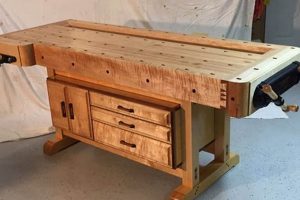
The most appropriate dimensions for a workbench intended for woodworking significantly influence its utility and effectiveness. These dimensions, encompassing length, width, and height, determine the surface area available for project assembly, the stability during demanding tasks, and the ergonomic comfort of the user, respectively. A bench that is too small may restrict larger projects, while an excessively large one could consume valuable workspace. Similarly, improper height can lead to discomfort and reduced efficiency.
Selecting suitable measurements impacts project quality, user safety, and overall workflow. A stable and adequately sized work surface allows for precise cuts, secure clamping, and efficient material handling. Historically, workbench dimensions were dictated by the typical projects of the era and the physical stature of the craftsperson. Modern woodworking often involves a broader range of project sizes and necessitates careful consideration of the workbench’s overall footprint and ergonomic design.
The subsequent sections will delve into specific dimensional recommendations, considering various woodworking styles, typical project scales, and adjustable height options. This will provide a detailed understanding of how to determine optimal dimensions for individual woodworking needs.
Determining Optimal Workbench Dimensions
Effective woodworking necessitates a workbench that appropriately accommodates the scale and nature of typical projects. The following recommendations serve as guidelines for establishing suitable dimensions.
Tip 1: Length Consideration: A length of 60 to 72 inches provides adequate space for most common woodworking tasks. Longer benches are advantageous for larger projects, but must be balanced against available workshop area.
Tip 2: Width Evaluation: A width between 24 and 36 inches offers sufficient surface area without being excessively deep. This range allows for convenient access to tools and materials positioned at the back of the bench.
Tip 3: Height Calculation: Workbench height is crucial for ergonomic comfort and efficiency. A generally accepted guideline is to position the workbench height such that, when standing, the user’s bent elbow is approximately 2 to 4 inches above the work surface.
Tip 4: Project-Specific Adjustment: Individuals primarily engaged in smaller projects may find a smaller bench adequate. Conversely, those working on large furniture pieces should consider a longer and wider surface.
Tip 5: Vise Integration: The location and type of vise influence the required bench dimensions. Consider the vise’s size and clamping capacity when determining overall workbench length and width.
Tip 6: Stance and Reach: Account for personal reach and typical working stance. Ensuring comfortable access to all areas of the workbench reduces strain and enhances productivity.
Tip 7: Mobility Considerations: If workbench mobility is required, smaller dimensions and the addition of casters are recommended. However, mobility should not compromise stability.
Selecting the correct dimensions facilitates efficient workflow, promotes user comfort, and enhances the quality of finished woodworking projects. Prioritizing individual needs and workshop constraints is essential when establishing optimal workbench dimensions.
The subsequent section will address the influence of different woodworking styles on ideal workbench parameters.
1. Length

The length of a woodworking bench exerts a direct influence on its capacity to accommodate projects of varying scales. Insufficient length restricts the ability to effectively maneuver large workpieces during assembly, cutting, and finishing operations. For instance, constructing a dining table, which often exceeds six feet, necessitates a bench of commensurate length to provide adequate support and stability. Conversely, an excessively long bench in a limited workspace impedes movement and reduces overall shop efficiency. A common cause is underestimating typical project size during bench construction, resulting in subsequent limitations. The optimal length must, therefore, be determined by the anticipated size of projects.
Consider the construction of cabinetry as another example. A bench with a length of approximately 72 inches enables the assembly of standard base cabinets without requiring the workpiece to overhang the edges. This prevents potential damage or instability during glue-ups and joinery. Woodworkers who frequently build larger casework units, such as wardrobes or bookcases, may necessitate a length of 84 inches or more. Thus, selecting the appropriate length directly correlates with the types of projects that can be undertaken safely and efficiently.
In summary, length is a critical parameter in defining the suitability of a woodworking bench. Its impact extends beyond mere physical accommodation, affecting workflow, precision, and safety. Selecting a bench length that aligns with typical project dimensions is a fundamental step in establishing an effective and productive woodworking environment. The challenge lies in predicting future project needs and balancing space constraints with desired capabilities.
2. Width

The width dimension of a woodworking bench significantly influences the accessibility of tools and the ability to manipulate materials effectively. Insufficient width restricts the user’s reach and maneuvering space, directly affecting the feasibility of certain woodworking tasks. For instance, attempting to clamp a wide panel for gluing on a bench with limited width can lead to instability and imprecise alignment. The choice of width, therefore, has a cause-and-effect relationship with the quality and efficiency of woodworking processes. As a component of the ideal dimensions, width critically determines the overall usability of a workbench.
Consider the assembly of a drawer unit within a larger cabinet. A workbench width of approximately 24 to 30 inches allows convenient access to all drawer components without requiring excessive reaching or repositioning. Conversely, a width exceeding 36 inches might necessitate awkward postures and reduced control over smaller pieces. This illustrates the practical application of understanding how width impacts the workflow. Likewise, when using hand planes, sufficient width provides space to securely clamp the workpiece and execute planing strokes without obstruction. These examples emphasize the need to align the workbench’s width with the typical project scope.
In conclusion, the selection of appropriate bench width is a critical element in optimizing the woodworking process. Insufficient width creates limitations in material handling and tool accessibility, directly affecting project quality. Therefore, carefully considering the intended scale of woodworking endeavors and the user’s physical reach is essential when determining workbench dimensions. The challenge lies in achieving a balance between providing ample workspace and maintaining ergonomic comfort, ensuring the bench serves as an effective tool for various woodworking tasks.
3. Height

Workbench height is a critical dimension that significantly impacts user comfort, efficiency, and safety. It is not simply an arbitrary measurement but a carefully considered factor directly influencing the ergonomic interaction between the woodworker and the bench. An improperly sized bench height can lead to musculoskeletal strain, reduced precision, and overall fatigue, ultimately diminishing the quality of work produced.
- Ergonomic Considerations
Workbench height should align with the user’s physiology to minimize strain and maximize comfort. A bench that is too low necessitates excessive bending, contributing to back pain. Conversely, a bench that is too high can cause shoulder and neck discomfort. The ideal height allows the user to work with a neutral spine and relaxed shoulders. A common guideline suggests the workbench surface should be approximately elbow height, but individual variations exist, requiring personalized adjustments.
- Work Style Adaptation
Different woodworking tasks necessitate varying heights. Precision work, such as carving or fine joinery, often benefits from a slightly higher bench, allowing for closer visual inspection and control. Conversely, tasks requiring significant force, such as planing or chopping mortises, may be more effectively performed on a slightly lower bench, enabling the user to utilize body weight and leverage more effectively. Some woodworkers employ multiple benches of varying heights or adjustable height benches to accommodate these diverse needs.
- Vise Placement and Usage
The height of the workbench also dictates the optimal placement of vises. A correctly positioned vise should allow the user to apply clamping pressure without undue strain. When using a face vise for edge planing, for instance, the top of the workpiece should be at a comfortable working height. Similarly, the height of a leg vise is critical for securely holding long boards for edge jointing. An improperly positioned vise can compromise stability and reduce the effectiveness of clamping operations.
- Impact on Tool Usage
Proper workbench height facilitates the efficient and safe use of various woodworking tools. For example, when using hand planes, a well-proportioned bench height allows for a smooth, controlled stroke without excessive reaching or bending. When using chisels, the user can apply downward force effectively and maintain precise control. Conversely, an inappropriate bench height can lead to awkward angles and increased risk of injury. The interplay between bench height and tool usage underscores the importance of careful dimension selection.
In conclusion, workbench height is not a fixed value but a dynamic parameter that should be tailored to individual ergonomic needs, work style preferences, and the intended use of the bench. Selecting the appropriate height is crucial for maximizing comfort, efficiency, and safety in the woodworking process. Understanding these facets is vital for determining the most suitable dimensions, thereby optimizing the woodworking environment.
4. Thickness

The thickness of a woodworking benchtop is a critical determinant of its stability, rigidity, and long-term durability. Insufficient thickness compromises the bench’s ability to resist deflection under load, leading to inaccurate work and potential joint failure. For instance, a thin benchtop subjected to heavy clamping forces during glue-up operations may flex, resulting in uneven surfaces and weakened bonds. A proper thickness, therefore, directly contributes to the overall effectiveness and longevity of the workbench.
A benchtop thickness of 3 to 4 inches is generally considered optimal for most woodworking applications. This dimension provides adequate mass to absorb vibrations from hand tools and prevents excessive movement during demanding tasks such as planing or chopping mortises. For specialized applications, such as those involving heavy timbers or frequent use of power tools, a greater thickness may be warranted. For example, a blacksmithing or timber framing bench often requires a top thickness of 6 inches or more to withstand the impact forces and weight associated with these activities. Proper thickness is crucial in creating a robust and reliable working platform.
In summary, the thickness of a woodworking benchtop is not merely a matter of aesthetics but a fundamental factor impacting performance and durability. Choosing an adequate thickness is essential for ensuring stability, minimizing vibration, and resisting deflection under load. Balancing material cost with the desired level of rigidity is a key consideration when determining the ideal thickness. The investment in a thicker benchtop translates directly into increased accuracy, reduced fatigue, and a longer lifespan for the workbench, thereby contributing to a more productive and enjoyable woodworking experience.
5. Apron Depth
Apron depth directly influences the structural rigidity of a woodworking bench and, consequently, is a significant component of its optimal dimensions. Aprons, which are the vertical boards attached beneath the benchtop, provide critical resistance to racking and twisting forces. Insufficient apron depth compromises the bench’s stability, particularly when subjected to uneven loads or heavy hand tool usage. This, in turn, negatively impacts precision and control during woodworking tasks. As an example, attempting to hand-plane a long board on a bench with shallow aprons can result in noticeable bench movement, compromising the flatness of the planed surface.
The ideal apron depth is contingent upon the overall size of the bench and the anticipated workload. A deeper apron provides increased resistance to deformation but can also restrict legroom and accessibility beneath the bench. A common range for apron depth is between 4 and 6 inches. Benches intended for heavy-duty applications, such as timber framing or blacksmithing, may necessitate aprons of greater depth to adequately withstand the imposed stresses. The selection of appropriate apron depth must consider the cause-and-effect relationship between structural support and ergonomic usability, ensuring that the bench provides a stable and comfortable working platform.
In summary, apron depth plays a vital role in determining the overall effectiveness and suitability of a woodworking bench. Its impact extends beyond mere structural reinforcement, influencing the precision, stability, and user comfort associated with woodworking activities. Balancing the need for robust support with ergonomic considerations is crucial when establishing optimal dimensions. The careful selection of apron depth directly contributes to a more productive and enjoyable woodworking experience, underscoring its importance as a component of the overall bench design.
6. Leg Spacing

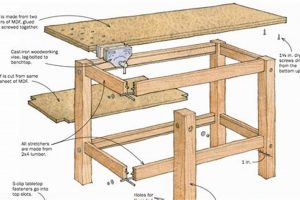
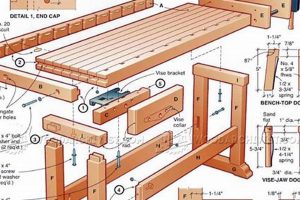
Leg spacing, a crucial element of the bench’s structural integrity, bears a significant relationship to the dimensions defining a woodworking bench. The distance between the legs directly affects the distribution of weight and resistance to racking forces across the entire structure. Insufficient leg spacing, relative to the benchtop’s length and width, can lead to instability, particularly when heavy objects are placed on the bench or during forceful operations like hand planing. An inadequately supported benchtop may flex or vibrate, compromising the accuracy of joinery and potentially causing premature wear on the bench itself. The determination of leg spacing therefore has a direct cause-and-effect relationship with the overall performance and longevity of the workbench.
Consider a bench designed for constructing large furniture pieces. If the leg spacing is excessively wide, the unsupported span of the benchtop becomes prone to sagging under the weight of lumber and partially assembled components. This sagging not only creates an uneven work surface but also weakens the joints connecting the legs to the benchtop, potentially leading to structural failure over time. Conversely, excessive leg spacing in a shorter bench may limit maneuverability around the bench and prevent comfortable access to tools stored beneath the top. Optimal leg spacing strikes a balance between providing adequate support and preserving usability. The precise measurement is often informed by the benchtop’s material, thickness, and the anticipated maximum load. For example, a benchtop constructed from solid hardwood will generally require less frequent leg support than one made from a less dense or thinner material.
In summary, the relationship between leg spacing and workbench dimensions is fundamental to the bench’s structural integrity and usability. Appropriate leg spacing ensures stability, minimizes vibration, and maximizes the lifespan of the workbench. Addressing the challenge of finding the ideal balance between support and accessibility requires careful consideration of material properties, anticipated workload, and ergonomic factors. A well-engineered leg spacing scheme is an essential component of any woodworking bench, contributing to a safer, more efficient, and ultimately more enjoyable woodworking experience.
Frequently Asked Questions
The following addresses common inquiries related to establishing suitable dimensions for a woodworking bench, focusing on factors influencing its functionality and usability.
Question 1: What are the primary dimensions to consider when designing a woodworking bench?
The primary dimensions include length, width, and height. Length dictates the maximum workpiece size, width influences accessibility, and height impacts ergonomics. Top thickness, apron depth, and leg spacing contribute to overall stability.
Question 2: Is there a universally recommended size for all woodworking benches?
No, a universally recommended size does not exist. Optimal dimensions depend on individual needs, typical project scale, available workspace, and ergonomic preferences. Adaptations are necessary to accommodate specific requirements.
Question 3: How does the intended type of woodworking influence bench dimensions?
Fine woodworking may benefit from a smaller, more maneuverable bench. Cabinetmaking often requires a longer bench for assembling larger casework. Timber framing necessitates a robust bench capable of supporting heavy loads.
Question 4: What is the optimal bench height for ergonomic comfort?
A common guideline suggests that the benchtop should be approximately elbow height. However, adjustments are necessary to account for individual stature and work style. The goal is to minimize bending and strain.
Question 5: How does benchtop thickness contribute to overall stability?
Greater thickness provides increased mass and resistance to deflection. A thicker benchtop minimizes vibration, absorbs impact forces, and ensures a more stable working surface, particularly during demanding tasks.
Question 6: What is the purpose of aprons on a woodworking bench?
Aprons are vertical boards attached beneath the benchtop that provide structural rigidity. Deeper aprons offer increased resistance to racking and twisting forces, contributing to the overall stability of the bench.
Properly dimensioned woodworking benches enhance efficiency, promote safety, and improve the quality of finished projects. Careful consideration of individual requirements and woodworking style is essential when selecting bench dimensions.
The subsequent section will delve into various construction techniques for building a woodworking bench.
Conclusion
The exploration of the most appropriate dimensions for a woodworking bench reveals a nuanced interplay of factors. Length, width, height, thickness, apron depth, and leg spacing each contribute to the bench’s utility and suitability for diverse woodworking tasks. An adequately dimensioned bench enhances workflow, minimizes physical strain, and elevates the precision of finished products. It also prevents the unnecessary cost incurred by using excessive materials.
In conclusion, the pursuit of the “best size for woodworking bench” is a critical endeavor for any serious woodworker. The ideal dimensions are a function of individual needs, typical project scales, and available workspace, coupled with a thorough understanding of ergonomic principles and structural requirements. Continual evaluation and adjustment of the bench’s dimensions, as woodworking practices evolve, will ensure lasting value and productivity. The bench and the woodworker work in symbiosis.