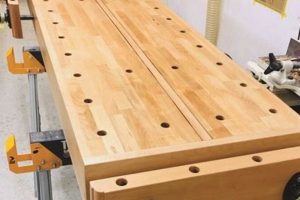
Work surfaces specifically designed for woodworking tasks, often offered through retail channels, represent a crucial element in both amateur and professional woodworking environments. These specialized platforms provide a stable and secure area for cutting, shaping, and assembling wooden components. They are typically constructed from durable materials such as hardwood or engineered wood products, and may feature built-in vises, dog holes, and other accessories that facilitate various woodworking operations.
The availability of these specialized platforms offers significant advantages. A dedicated, robust surface enhances precision, safety, and efficiency in woodworking projects. Historically, woodworking relied on adaptable surfaces, but the introduction of purpose-built stations streamlined workflows. The use of such stations contributes to higher quality finished products and a more organized workspace.
The following discussion will delve into the diverse range of available options, factors to consider when acquiring one, and the ways these items contribute to a more effective and enjoyable woodworking experience.
Considerations When Acquiring a Woodworking Surface
Proper evaluation is crucial when selecting a woodworking surface. Multiple factors influence the suitability of a particular model for specific applications.
Tip 1: Assess Workspace Dimensions: Before purchase, meticulously measure the available space. Larger surfaces offer increased versatility but require a correspondingly larger footprint. Ensure adequate clearance for movement around the platform during use.
Tip 2: Evaluate Material Durability: Hardwood surfaces, such as maple or beech, offer superior resistance to wear and tear. Consider the expected frequency and intensity of use when evaluating material options. Engineered wood provides a cost-effective alternative, but may exhibit lower durability under heavy loads.
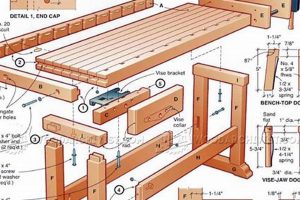
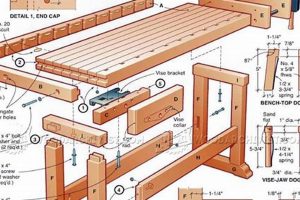
Tip 3: Analyze Vise Configuration: Vises are essential for securing workpieces. Different vise types, including face, leg, and end vises, offer varying clamping capabilities. Determine the required clamping force and range based on typical project dimensions.
Tip 4: Examine Dog Hole Placement: Dog holes, in conjunction with bench dogs, provide flexible work-holding solutions. Evaluate the pattern and spacing of dog holes to ensure compatibility with intended clamping strategies. Consider the availability of compatible bench dog accessories.
Tip 5: Consider Integrated Storage: Some models incorporate drawers or shelves for tool storage. Evaluate storage capacity and accessibility to optimize workflow and minimize clutter. Integrated storage can streamline the woodworking process and improve overall organization.
Tip 6: Evaluate Surface Flatness: A truly flat surface is critical for accurate woodworking. Investigate the manufacturing tolerances and consider using a straightedge to verify flatness before finalizing a purchase. A perfectly flat surface is a cornerstone for woodworking precision.
Careful consideration of these aspects ensures the selected platform aligns with specific woodworking needs, promoting efficiency and accuracy.
This detailed evaluation will lead to a more informed purchasing decision, contributing to a more productive and satisfying woodworking experience.
1. Benchtop Material

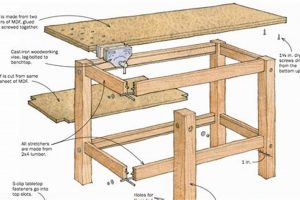
The material comprising the surface of a woodworking station directly impacts its functionality, durability, and overall suitability for various tasks. The selection of benchtop material is a primary consideration when evaluating available woodworking benches and directly influences the cost and lifespan of the product.
- Hardwood Composition
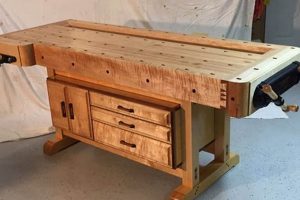
Hardwood, such as maple, beech, or birch, provides a dense and durable work surface capable of withstanding heavy use. Benches with solid hardwood tops offer excellent resistance to impacts, abrasion, and warping. Professional-grade stations frequently feature hardwood construction due to its longevity and stability. The cost of these benches is generally higher, reflecting the quality and durability of the material. Example: A professional cabinet maker might select a maple top bench for daily, intensive use.
- Engineered Wood Alternatives
Engineered wood products, including plywood or MDF (Medium-Density Fiberboard), present a more cost-effective alternative to solid hardwood. These materials offer a stable and uniform surface, although they may be more susceptible to damage from impacts or moisture. Benches with engineered wood tops are often suitable for hobbyist or light-duty applications. Example: A beginner woodworker might choose a bench with an MDF top to minimize initial investment.
- Surface Treatment and Finish
The finish applied to the benchtop material significantly affects its resistance to spills, stains, and wear. A durable finish, such as polyurethane or varnish, protects the wood from moisture and enhances its longevity. Regular maintenance and reapplication of the finish are necessary to preserve the integrity of the work surface. Example: A polyurethane finish on a workbench helps to prevent glue or other woodworking adhesives from bonding with the surface.
- Material Thickness and Stability
The thickness of the benchtop material directly correlates with its stability and resistance to deflection under load. Thicker benchtops provide a more solid and vibration-dampening surface, which is crucial for precision woodworking tasks. A stable benchtop minimizes movement and ensures accurate cuts and assemblies. Example: A bench with a thicker maple top will vibrate less when planing a board, leading to a smoother finish.
The choice of benchtop material is a trade-off between cost, durability, and intended use. Solid hardwood offers superior performance and longevity but carries a higher price tag. Engineered wood provides a more economical option suitable for less demanding applications. A discerning buyer must carefully consider these factors to select a woodworking bench that meets their specific needs and budget.
2. Vise Mechanisms

The presence and type of vise mechanisms significantly impact the utility and value of woodworking benches offered for purchase. Vises are integral for securing workpieces during a multitude of woodworking operations, including sawing, planing, and joining. The absence of a suitable vise fundamentally limits the tasks a bench can effectively facilitate. Consequently, the specification of vise mechanisms is a critical factor in assessing the suitability of a woodworking bench for specific applications.
Various vise designs cater to differing needs. Face vises, often mounted on the front of the bench, are versatile for general-purpose clamping. Leg vises, engaging the entire leg of the bench, offer superior holding power for larger pieces. End vises, positioned at the end of the bench, are particularly useful for dovetailing and other joinery tasks. The choice of vise mechanism dictates the range of projects that can be undertaken and the efficiency with which they can be completed. For example, a cabinet maker constructing a large table will require a bench equipped with robust leg vises capable of securely holding the frame components during assembly.
In summary, vise mechanisms are not merely accessories; they are essential components that determine the functionality and value of woodworking benches. Understanding the capabilities and limitations of different vise types is paramount for selecting a bench that aligns with intended woodworking activities. The suitability of a vise for a specific task directly affects the precision, safety, and overall efficiency of the woodworking process, making it a decisive consideration in any purchase decision.
3. Frame Construction

The structural integrity of woodworking benches is fundamentally determined by frame construction. A robust frame is essential for providing a stable and durable work surface, capable of withstanding the forces exerted during various woodworking operations. Consequently, the quality of frame construction significantly impacts the overall value and suitability of woodworking benches available for purchase. Deficiencies in frame design or material selection can lead to instability, racking, and premature failure, rendering the bench ineffective and potentially hazardous.
Frame construction encompasses several critical aspects, including material selection, joinery methods, and overall design. Woodworking benches are often constructed from hardwoods such as maple or oak, known for their strength and resistance to deformation. Metal frames, typically steel, offer a high degree of rigidity and load-bearing capacity. The choice of material influences the bench’s weight, cost, and aesthetic appeal. Furthermore, the joinery techniques employed in assembling the frame are paramount. Mortise-and-tenon joints, dovetail joints, and bolted connections provide varying degrees of strength and stability. The overall frame design, including the dimensions and configuration of the legs, stretchers, and aprons, determines the bench’s resistance to racking and deflection. A well-designed frame distributes weight evenly and minimizes stress concentrations, ensuring long-term stability.
In summation, frame construction is a critical determinant of the performance and longevity of woodworking benches. The choice of materials, joinery methods, and overall design significantly impacts the bench’s stability, load-bearing capacity, and resistance to deformation. Purchasers should carefully evaluate these aspects to ensure the selected bench provides a solid and reliable foundation for woodworking projects. Understanding the principles of frame construction empowers buyers to make informed decisions, selecting benches that offer lasting value and enhance the efficiency and safety of their woodworking endeavors.
4. Storage Solutions

The integration of storage solutions in woodworking benches represents a significant consideration for efficiency and organization within a workspace. This element directly influences accessibility to tools and materials, ultimately impacting workflow and productivity.
- Integrated Drawers and Cabinets
Woodworking benches for sale frequently incorporate drawers and cabinets as integral storage components. These built-in units provide dedicated space for hand tools, measuring devices, and smaller hardware items. The placement and configuration of drawers and cabinets should be carefully considered to ensure ergonomic access and efficient utilization of space. An example is a bench with shallow drawers directly beneath the work surface for quick access to frequently used tools like chisels and marking gauges.
- Open Shelving and Racking Systems
Open shelving and racking systems offer alternative storage solutions, providing easily accessible space for larger tools, lumber, and project components. These systems may be integrated into the bench design or added as supplementary storage units. The open nature of shelving allows for quick visual assessment of inventory and facilitates efficient retrieval of materials. For instance, a woodworking bench might include a lower shelf for storing partially completed projects or larger power tools.
- Tool Wells and Trays
Some woodworking benches incorporate tool wells or trays directly into the work surface. These features provide a convenient location for temporarily storing tools during a project. Tool wells and trays help to prevent tools from rolling off the bench and keep them readily accessible. An example would be a shallow tray integrated into the edge of the bench to hold screws, nails, or other small hardware items.
- Pegboard and Hanging Systems
Pegboard and hanging systems offer flexible storage solutions that can be easily customized to accommodate a variety of tools and accessories. These systems typically involve attaching pegboard panels to the bench frame or surrounding walls. Tools are then hung from hooks or brackets attached to the pegboard. Pegboard systems provide a highly adaptable storage solution, allowing for easy rearrangement and organization. For example, a pegboard mounted above a woodworking bench could be used to store saws, planes, and other frequently used tools.
The inclusion of effective storage solutions in woodworking benches contributes to a more organized, efficient, and productive workspace. The choice of storage solutions should be carefully considered based on the specific needs and preferences of the user, as well as the available space and budget. The goal is to create a functional and well-organized environment that supports the successful completion of woodworking projects.
5. Size Constraints

The physical dimensions of available woodworking benches represent a critical constraint in purchasing decisions. The size of a bench directly dictates its suitability for a given workspace and the types of projects it can accommodate. Evaluating size limitations is therefore essential when considering woodworking benches for sale.
- Workspace Footprint
The available floor space dictates the maximum permissible size of a woodworking bench. Overly large benches can obstruct movement and limit access to other tools and equipment. Smaller workshops necessitate compact benches that maximize work surface area while minimizing the overall footprint. An example would be a small apartment workshop requiring a folding or mobile bench to conserve space when not in use.
- Work Surface Area
The dimensions of the work surface determine the size and complexity of projects that can be undertaken. Larger projects, such as assembling furniture components, require a substantial work surface. Conversely, smaller tasks, such as carving or detail work, can be accomplished on a more compact bench. The anticipated project scope should guide the selection of an appropriately sized work surface. For instance, a hobbyist building small wooden toys may find a smaller bench adequate, while a professional cabinet maker requires a significantly larger surface area.
- Height Considerations
The height of a woodworking bench is a critical ergonomic factor. A bench that is too high or too low can lead to discomfort and strain during prolonged use. The ideal bench height is typically determined by the user’s stature and the type of tasks being performed. Adjustable-height benches offer increased versatility and can accommodate multiple users or different working styles. For example, a taller individual may require a higher bench to maintain a comfortable working posture, while a lower bench may be preferred for detailed carving work.
- Portability and Mobility
The weight and dimensions of a woodworking bench influence its portability and mobility. Stationary benches are typically larger and heavier, offering greater stability and work surface area. Mobile benches, equipped with casters or wheels, provide increased flexibility and can be easily moved around the workshop. Folding benches offer the ultimate in portability, allowing for compact storage when not in use. The need for mobility should be considered when selecting a bench, particularly in smaller or multi-purpose workshops. For example, a mobile bench can be easily moved to different areas of a workshop to accommodate various tasks, while a folding bench can be stored away when space is limited.
These interconnected aspects of size limitations directly impact the selection of woodworking benches. Buyers must consider available space, project scope, ergonomic factors, and mobility requirements to select a bench that optimally meets their specific needs. Ignoring these size constraints can result in a bench that is either impractical for the available workspace or unsuitable for the intended woodworking tasks. Therefore, a thorough assessment of size limitations is essential for making an informed purchasing decision.
6. Weight Capacity
Weight capacity, in the context of woodworking benches, signifies the maximum load the structure can safely bear without compromising its structural integrity or stability. This specification is of paramount importance when evaluating woodworking benches for acquisition, directly influencing the range and scope of feasible projects.
- Material Composition and Load Bearing
The selection of materialshardwood species, engineered wood, or metaldirectly determines a bench’s inherent load-bearing capabilities. Hardwoods generally offer higher weight capacities than softer woods or engineered alternatives, while metal frames often provide the most robust support. A bench constructed from maple or steel is likely to withstand heavier loads than one made from pine or MDF. The rated weight capacity should align with the anticipated weight of workpieces and tools placed on the bench.
- Frame Design and Structural Integrity
Frame design profoundly impacts a bench’s ability to distribute and withstand weight. Robust joinery, such as mortise-and-tenon or bolted connections, enhances structural integrity. Benches with well-braced frames and sturdy legs are better equipped to handle heavy loads without deflection or instability. A poorly designed frame can compromise the bench’s weight capacity, even if constructed from durable materials. For example, a bench with slender, unsupported legs may buckle under a heavy load, regardless of the tabletop material.
- Vise Mechanisms and Clamping Forces
Vise mechanisms exert significant clamping forces on workpieces, placing additional stress on the bench structure. A bench’s weight capacity must account for these forces to prevent deformation or failure. Heavy-duty vises, particularly those used for metalworking or holding large workpieces, require a bench with a high weight capacity to ensure stability and prevent damage. The vise’s clamping force, combined with the weight of the workpiece, should remain within the bench’s specified weight limit.
- Project Scope and Workpiece Dimensions
The types of projects undertaken dictate the required weight capacity of a woodworking bench. Larger and heavier workpieces, such as solid wood slabs or assembled furniture components, necessitate a bench with a correspondingly high weight capacity. Smaller projects, such as carving or model making, may be accommodated by benches with lower weight ratings. Assessing the typical dimensions and weight of intended workpieces is crucial for selecting a bench with adequate load-bearing capabilities. For example, a woodworker who primarily builds small boxes may not require a bench with as high a weight capacity as one who frequently works with large timber beams.
Understanding the interplay between material composition, frame design, vise mechanisms, and project scope is vital for making informed decisions when procuring woodworking benches. A bench’s weight capacity must align with the anticipated demands of woodworking activities to ensure safety, stability, and long-term durability.
7. Price Ranges
The spectrum of available woodworking benches is intrinsically linked to their corresponding price ranges. This financial aspect constitutes a primary determinant in the acquisition process, directly influencing the features, materials, and overall quality of the selected station. Understanding the factors that contribute to price variations is essential for informed decision-making.
- Entry-Level Options
Woodworking benches at the lower end of the price spectrum typically feature simpler designs, less robust materials (such as softwood or engineered wood), and fewer integrated features. These options are generally suitable for hobbyists or beginners with limited budgets and less demanding woodworking tasks. Example: A basic workbench constructed from pine with a single vise might fall into this category. The compromise is often durability and long-term performance.
- Mid-Range Selections
Benches within the mid-range price category offer a balance between affordability and quality. These models often incorporate more durable materials (such as hardwood or steel frames), improved vise mechanisms, and basic storage solutions. They are well-suited for serious hobbyists or semi-professional woodworkers who require a reliable and versatile workstation. Example: A bench with a hardwood top, metal legs, and integrated drawers would likely fall into this price range. This range provides a solid compromise between budget and quality.
- Professional-Grade Investments
Woodworking benches at the upper end of the price range represent a significant investment. These models feature premium materials (such as high-density hardwood or heavy-gauge steel), precision-engineered components, and a comprehensive array of features, including advanced vise systems, extensive storage, and adjustable height mechanisms. They are designed for professional woodworkers who demand the highest levels of performance, durability, and precision. Example: A bench with a thick maple top, multiple vises, and a built-in tool cabinet would fall into this high-end category. These are built for daily, rigorous use.
- Influence of Brand and Origin
The brand reputation and manufacturing origin can also significantly impact price. Established brands with a proven track record of quality often command higher prices. Benches manufactured in countries with higher labor costs or stricter quality control standards may also be more expensive. Conversely, lesser-known brands or benches manufactured in countries with lower production costs may offer more affordable alternatives. Consumers should weigh the perceived value of brand reputation and origin against the actual features and specifications of the bench. Brand recognition often, but not always, equates to higher quality.
Ultimately, the ideal woodworking bench represents a balance between budgetary constraints and the specific demands of intended woodworking activities. A careful assessment of price ranges, coupled with a thorough evaluation of features, materials, and quality, will facilitate informed purchasing decisions and ensure that the selected station provides optimal value and performance. It is important to consider both short-term costs and long-term value when evaluating woodworking benches for sale.
Frequently Asked Questions
The following addresses common inquiries regarding the acquisition and selection of woodworking benches. These questions aim to provide clarity and assist in making informed purchasing decisions.
Question 1: What constitutes a suitable material for a woodworking benchtop?
Ideal benchtop materials include hardwoods like maple or beech, known for their durability and resistance to wear. Engineered wood products offer a more cost-effective alternative, although they may exhibit reduced longevity under heavy use.
Question 2: How does frame construction influence the stability of a woodworking bench?
Robust frame construction, utilizing durable materials such as hardwoods or steel, is essential for stability. Well-executed joinery techniques, like mortise-and-tenon joints, enhance the frame’s ability to withstand stress and prevent racking.
Question 3: What factors should be considered when assessing vise mechanisms on woodworking benches?
Vise mechanisms should be evaluated based on their clamping force, jaw width, and ease of adjustment. Different vise types, such as face, leg, and end vises, cater to varying workholding needs.
Question 4: How does integrated storage contribute to the efficiency of a woodworking workspace?
Integrated storage solutions, such as drawers, cabinets, and shelves, promote organization and accessibility. Dedicated storage space for tools and materials streamlines workflow and minimizes clutter.
Question 5: What are the key considerations when evaluating the size constraints of a woodworking bench?
Size constraints should be assessed in relation to the available workspace, the intended project scope, and ergonomic requirements. Bench height, work surface area, and overall dimensions must align with the user’s needs and the workshop environment.
Question 6: How does weight capacity impact the suitability of a woodworking bench for specific tasks?
Weight capacity determines the maximum load a bench can safely bear without compromising its structural integrity. Heavier projects require benches with correspondingly higher weight ratings to ensure stability and prevent damage.
In summary, careful consideration of materials, construction, features, dimensions, and weight capacity will facilitate the selection of a woodworking bench that meets specific needs and enhances the woodworking experience.
The subsequent section will address maintenance procedures to extend the lifespan of purchased woodworking benches.
Conclusion
The preceding analysis has elucidated crucial aspects pertaining to the acquisition of woodworking benches. Key considerations encompass material selection, structural integrity, vise mechanisms, storage solutions, size constraints, and weight capacity. A comprehensive understanding of these elements is paramount for making informed purchasing decisions tailored to specific woodworking requirements.
The availability of woodworking benches on the market presents a spectrum of choices, demanding careful evaluation to ensure optimal value and performance. Prudent consideration of discussed factors will contribute to a functional and enduring woodworking environment, fostering both efficiency and precision. The long-term benefits of a well-selected station justify a thorough and diligent approach to procurement.