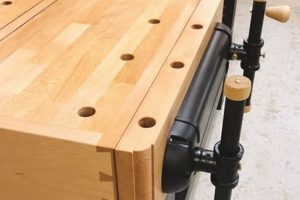
The creation of work-holding accessories, specifically those designed for insertion into a workbench surface, enables secure material positioning during woodworking operations. These accessories, typically cylindrical or rectangular in shape, fit into pre-drilled holes in the workbench, allowing for the clamping or bracing of wood stock. For instance, a woodworker might employ these devices to hold a board firmly in place while planing or routing.
The implementation of these work-holding elements is fundamental to efficient and precise woodworking. They provide a stable platform, minimizing material movement and enhancing safety during tasks such as sawing, chiseling, and sanding. Historically, variations of these aids have been employed for centuries, demonstrating their enduring utility in woodworking practices as they enhance accuracy and repeatability.
The following discussion will elaborate on the materials, techniques, and considerations involved in the fabrication of effective work-holding accessories, outlining best practices for their design and utilization to maximize their functionality within the woodworking shop.
Fabrication Guidance
The following outlines key considerations for producing effective work-holding accessories, ensuring optimal performance and longevity.
Tip 1: Material Selection: Choose hardwoods, such as maple or beech, for their durability and resistance to deformation under clamping pressure. Avoid softer woods that may compress or splinter.
Tip 2: Dimensional Accuracy: Precise diameter or width measurements are critical for a secure fit within the workbench holes. Employ calipers to ensure dimensions match the hole size, accounting for slight tolerances.
Tip 3: Chamfered Edges: Chamfering the top edge eases insertion and reduces the risk of damaging the workbench surface or the accessory itself. A small, consistent chamfer is sufficient.
Tip 4: Angle Considerations: When designing angled work-holding pieces, verify that the angle complements the intended task. Incorrect angles can compromise holding power and accuracy.
Tip 5: Surface Finish: A smooth, even finish minimizes friction during insertion and removal, preventing binding or jamming. Sanding to a fine grit is recommended.
Tip 6: Length Optimization: Select a length that provides adequate grip while minimizing obstruction. Overly long accessories can interfere with workpiece manipulation.
Tip 7: Consistent Testing: Regularly test the accessories for fit and holding strength. Replace or repair any that exhibit signs of wear or damage to maintain optimal performance.
Adhering to these guidelines will result in the creation of reliable and effective work-holding accessories, enhancing the precision and safety of woodworking activities.
This foundational information enables a deeper understanding of advanced applications and customization options related to work-holding systems.
1. Material Selection

Material selection is a critical determinant in the performance and lifespan of work-holding accessories within woodworking operations. The chosen material directly influences the accessory’s ability to withstand clamping forces, resist deformation, and maintain dimensional stability over extended use. The characteristics of the selected wood species significantly impact the overall effectiveness.
- Hardness and Density
The hardness and density of the wood are paramount in resisting compression and wear. Hardwoods like maple, beech, and oak are typically preferred due to their superior resistance to indentation and abrasion compared to softwoods such as pine or fir. The denser the wood, the greater its ability to withstand repeated clamping without significant deformation, preserving the accessory’s fit and holding power.
- Grain Orientation
The orientation of the wood grain influences the accessory’s resistance to splitting or cracking under stress. Aligning the grain parallel to the direction of force application maximizes strength and minimizes the risk of failure. End grain, which is more susceptible to splitting, should be avoided in areas subject to high clamping pressure.
- Moisture Content
The moisture content of the wood must be controlled to prevent dimensional changes that can affect the fit and function of the accessory. Excessive moisture can cause swelling, while dryness can lead to shrinkage and cracking. Kiln-dried lumber with a stable moisture content is essential for ensuring long-term dimensional stability.
- Resistance to Wear
The long-term durability and performance is resistance to wear. Harder woods exhibit lower rates of wear. Consider this when selecting wood.
The selection of appropriate materials directly correlates with the reliability and longevity of work-holding accessories. A careful evaluation of wood species characteristics ensures optimal performance and contributes to the overall safety and efficiency of woodworking tasks. Failure to address these material considerations can result in premature failure, compromising work quality and potentially creating hazardous conditions.
2. Dimensional Accuracy

Dimensional accuracy is paramount in the fabrication of work-holding accessories for woodworking. Precise adherence to specified measurements is crucial for ensuring proper fit, functionality, and secure workpiece retention. Deviations from intended dimensions can compromise the effectiveness of the entire work-holding system.
- Diameter Consistency
The diameter of cylindrical work-holding accessories must be uniform along their entire length. Inconsistencies in diameter can lead to binding in some areas and looseness in others, preventing secure engagement with the workbench. This may lead to workpiece movement, affecting the precision of woodworking operations. Calipers and precise measuring tools are essential during fabrication.
- Squareness of Shoulders
Where applicable, the shoulders or edges of the accessory must be square to the axis of the cylinder or the faces of a rectangular component. Lack of squareness can induce tilting or misalignment of the workpiece, affecting the accuracy of cuts and joints. The use of precision squares and accurate machining techniques are required.
- Parallelism of Faces
For rectangular work-holding accessories, the faces must be parallel to each other. Non-parallel faces can create uneven pressure distribution, reducing holding power and potentially damaging the workpiece. Accurate milling or planing techniques are necessary to achieve parallelism within acceptable tolerances.
- Tolerance Matching
The dimensions of the accessory must be carefully matched to the size of the corresponding holes in the workbench. The tolerances must be tight enough to prevent excessive play but loose enough to allow for easy insertion and removal. This requires accurate measurement of both the accessory and the workbench holes.
Achieving dimensional accuracy is not merely a matter of aesthetic concern; it directly influences the performance and reliability of the work-holding system. Variations in dimensions lead to inconsistent holding power and compromised workpiece stability. Rigorous attention to precise measurements and tolerances during fabrication is essential for maximizing the utility and safety of work-holding accessories in woodworking applications.
3. Holding Power

Holding power, the capacity to resist movement of a workpiece under applied force, is a foundational element in woodworking activities. When fabricating work-holding devices, the effectiveness of these accessories is intrinsically linked to their ability to maintain a secure grip on the material, directly impacting the precision and safety of subsequent operations.
- Material Friction and Compression
The friction coefficient between the device and the workpiece, coupled with the compressive force exerted, determines the initial resistance to slippage. Harder materials, combined with optimized surface finishes, enhance frictional forces. A bench dog made from hardwood will offer better hold than one from softwood. Insufficient friction or compression results in potential movement during sawing or routing, leading to inaccuracies or damage.
- Geometric Design and Contact Area
The shape and size of the contact area between the device and the workpiece influence the distribution of force. A larger contact area generally translates to greater holding power, minimizing localized stress. The design may involve a angled surface to increase friction and reduce slippage. Incorrect geometry or insufficient contact weakens the hold, making the operation unsafe.
- Clamping Mechanism and Force Application
The method by which force is applied significantly impacts the holding power. Devices that employ wedging action or cam mechanisms can amplify the applied force, providing a more secure hold. Clamping mechanisms must be properly adjusted to ensure consistent and adequate force application. Improper mechanism or insufficient clamping force leads to compromised stability and precision.
- Fit and Tolerance within Bench Apertures
The fit within the bench aperture and the workpiece will play a major role. if the fit is to loose then the hold power will be minimal. Tolerances within measurements will need to be calculated to optimize holding power.
These factorsmaterial characteristics, geometric design, and the clamping mechanismcollectively determine the holding power of work-holding devices. An understanding of these principles is essential for the design and fabrication of accessories that provide secure and reliable workpiece retention, enabling efficient and accurate woodworking.
4. Surface Finish

The surface finish of work-holding accessories influences their functionality and lifespan. A properly prepared surface optimizes friction, reduces wear, and prevents damage to both the accessory and the workpiece. Irregularities or imperfections can compromise holding power and contribute to premature failure.
For instance, a rough surface may increase friction initially, but can also leave marks on softer woods. Conversely, an overly smooth surface, lacking sufficient texture, may result in inadequate grip, allowing the workpiece to slip under load. Therefore, a balanced approach is necessary. This typically involves sanding to a specific grit, often followed by the application of a non-film-forming finish that enhances friction without creating a hard, inflexible layer. An example of practical application is when securing delicate carvings; a smooth, waxed finish will minimize the risk of marring the surface, while still providing sufficient hold. The surface roughness average (Ra) should therefore be considered, often measured using profilometers.
In summary, the surface finish is a key component of effective work-holding. While seemingly a minor detail, it plays a significant role in determining the security and stability of the workpiece. Maintaining a suitable surface finish is a practical consideration, helping woodworkers to achieve precision and accuracy in their projects while preserving the quality of their materials and tools. Any imperfections can also result in injury during operation.
5. Angled Adaptations

Angled adaptations, in the context of work-holding, represent a specialization within accessory fabrication, offering solutions for securing non-orthogonal workpieces or facilitating angled operations. These adaptations expand the functionality of standard bench setups, allowing for more versatile and precise material manipulation.
- Dovetail Fixtures
Angled devices can be incorporated to hold dovetail joints securely during glue-up. Such fixtures, with precisely angled faces, ensure proper alignment and clamping pressure, leading to stronger and more accurate joints. The degree of the angle must match the dovetail geometry.
- Wedge-shaped Elements
Wedges, often employed in conjunction with traditional work-holding, provide a means to apply pressure at a specific angle. These are useful for securing tapered pieces or applying force against a specific point. The taper angle dictates the applied force distribution.
- Angled Bench Dog Faces
Modifying the faces of standard bench elements with an angle allows for the clamping of pieces that are not square to the workbench surface. This is particularly useful when working with complex shapes or when performing angled joinery. Angle choice depends on the application.
- Mitered Corner Clamps
Angled work-holding can be applied to clamp mitered corners during the assembly and gluing process. By applying force parallel to the plane. It provides great results for many projects.
The integration of angled adaptations into work-holding strategies enhances the precision and adaptability of woodworking operations. The design and implementation of these adaptations require careful consideration of the specific angles involved and the forces being applied. Properly executed, these solutions offer increased flexibility and accuracy in a wide range of woodworking projects.
Frequently Asked Questions
The following addresses common inquiries regarding the fabrication and utilization of work-holding accessories within woodworking, providing clarification on best practices and potential challenges.
Question 1: What hardwood species are best suited for fabricating durable work-holding devices?
Dense hardwoods such as maple, beech, and oak are preferred due to their resistance to compression and wear under clamping pressure. These species exhibit superior dimensional stability and can withstand repeated use without significant deformation.
Question 2: How does the grain orientation affect the strength and longevity of these accessories?
Aligning the grain parallel to the primary direction of force application maximizes strength and minimizes the risk of splitting or cracking. End grain orientation should be avoided in areas subject to high clamping stress.
Question 3: What is the optimal surface finish for ensuring secure workpiece retention?
A smooth, even finish, typically achieved through sanding to a fine grit, minimizes friction during insertion and removal while providing sufficient grip to prevent slippage. A non-film-forming finish can further enhance frictional properties.
Question 4: How important is dimensional accuracy in the creation of these accessories?
Dimensional accuracy is critical for ensuring proper fit within the workbench holes and for maintaining consistent holding power. Precise measurements and adherence to specified tolerances are essential for reliable performance.
Question 5: What are some common mistakes to avoid during the construction of these devices?
Common errors include selecting unsuitable materials, neglecting grain orientation, failing to achieve accurate dimensions, and overlooking the importance of surface finish. Addressing these factors is crucial for producing functional and durable accessories.
Question 6: Is it always necessary to use hardwoods for this fabrication?
The use of hardwoods is highly recommended for general applications. However, certain specialized applications may benefit from the unique properties of specific softwoods, such as flexibility or shock absorption. Consider the specific requirements of the task before selecting a material.
Understanding these key aspects is essential for maximizing the effectiveness and longevity of work-holding accessories. Consistent application of these principles will contribute to improved precision and safety in woodworking practices.
The subsequent section explores advanced design considerations and customization options for work-holding systems, building upon the foundational knowledge presented thus far.
Conclusion
The preceding discourse has outlined essential considerations for crafting effective work-holding accessories. Key aspects such as material selection, dimensional accuracy, holding power optimization, surface finish preparation, and the incorporation of angled adaptations have been addressed. Mastering these principles is fundamental to enhancing the precision, safety, and efficiency of woodworking endeavors.
Continued refinement of fabrication techniques and a commitment to understanding the interplay between material properties and design principles will yield superior work-holding solutions. Woodworkers are encouraged to apply these insights to their practice, contributing to improved craftsmanship and innovation within the field. The pursuit of optimized work-holding strategies remains a cornerstone of quality woodworking.