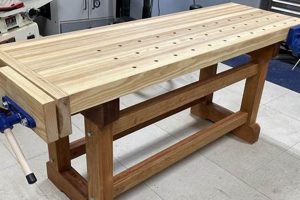
The distinctive workstation employed in traditional Japanese woodworking is characterized by its unique design features, most notably its relatively low working height and specialized clamping systems. These features facilitate specific techniques and postures common in Japanese joinery. A typical example incorporates a flat, rectangular surface supported by legs, often incorporating mortise and tenon joinery for stability and longevity. The design emphasizes efficient material handling and precise execution of intricate cuts.
This type of workbench offers several advantages. The lower height promotes stability and allows the woodworker to utilize their body weight more effectively when executing demanding cuts with hand tools. Specialized clamping systems, such as holdfasts and dogs, provide secure and versatile means of securing workpieces without obstructing the work surface. Historically, this design evolved in conjunction with the development of specific Japanese woodworking tools and techniques, emphasizing precision, efficiency, and a deep connection to the materials.
The subsequent sections will delve into specific aspects of this work surface, including the materials used in its construction, the variations in design based on specific woodworking tasks, and the methods employed to properly maintain and utilize this essential tool. Furthermore, the discussion will encompass the adaptability of this traditional design to modern woodworking practices.
Tips for Optimizing a Japanese Woodworking Bench
Effective utilization of a Japanese woodworking bench requires adherence to specific practices to maximize its inherent advantages. These tips aim to provide guidance on optimizing this specialized workstation.
Tip 1: Height Adjustment for Ergonomics: A properly adjusted height is paramount. The ideal height allows the woodworker to exert force downward, utilizing body weight effectively. Fine-tune leg length or add risers to achieve a comfortable working posture, minimizing strain and maximizing control.
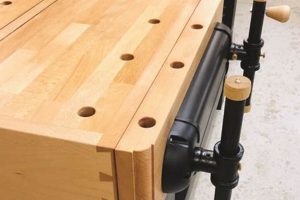
Tip 2: Strategic Holdfast Placement: Holdfasts are crucial for securing workpieces. Experiment with different hole placements on the work surface to accommodate various shapes and sizes. Consider the direction of force applied during cutting or planing to ensure the workpiece remains stable.
Tip 3: Regular Surface Maintenance: A flat, clean work surface is essential for accurate work. Periodically flatten the top of the Japanese woodworking bench using hand planes to remove any irregularities. Apply a light coat of oil or wax to prevent moisture absorption and maintain a smooth surface.
Tip 4: Optimize Tool Placement: Arrange tools within easy reach to minimize movement and maintain focus. Consider a tool rack or tray adjacent to the workstation to keep frequently used tools readily accessible.
Tip 5: Utilize Wedges and Shims: Employ wedges and shims to precisely adjust the angle and position of workpieces. These small adjustments can significantly improve accuracy when cutting intricate joinery.
Tip 6: Proper Leg Securing: Ensure legs are secured tightly. Loose legs detract from stability and safety, re-tighten or refit the joinery accordingly.
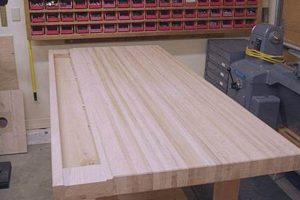
Tip 7: Consider a Mizo-ita: Consider adding a mizo-ita to the Japanese woodworking bench. The mizo-ita will let you clamp thing sheets easily to work on it.
Adhering to these tips enhances the functionality and efficiency of the Japanese woodworking bench, promoting precision, comfort, and optimal results in woodworking projects.
The following sections will elaborate on specific design variations and techniques associated with this type of workbench, providing a deeper understanding of its versatility and adaptability.
1. Low Working Height

The defining characteristic of the Japanese woodworking bench, relative to Western counterparts, is its lower working height. This seemingly simple design choice has profound implications for technique, posture, and overall efficiency in traditional Japanese woodworking.
- Enhanced Stability and Leverage
The lower center of gravity afforded by the reduced height significantly enhances the stability of the woodworker’s stance. This allows for greater leverage and control when using hand tools such as saws and planes, particularly during demanding operations like shaping large timbers or cutting intricate joinery. Examples include applying consistent pressure during long planing strokes or maintaining accuracy when pulling a saw through hardwood. The improved stability translates to reduced fatigue and increased precision.
- Optimized Body Mechanics and Posture
A lower bench promotes a more natural and balanced posture. It facilitates the use of the entire body weight for applying force, rather than relying solely on arm strength. The woodworker can adopt a stance with bent knees and a straight back, reducing strain on the lower back and shoulders. This is in contrast to the more upright posture often associated with taller Western benches. The result is improved comfort and reduced risk of long-term musculoskeletal issues.
- Direct Visual Access to the Workpiece
The reduced height provides a more direct and unobstructed visual access to the workpiece. The woodworker can more easily observe the grain direction, cut lines, and overall shape of the material. This enhanced visual acuity is particularly critical when executing precise cuts and fitting complex joinery. It minimizes the need for excessive bending or straining to see the work, improving accuracy and reducing errors. For example, seeing the precise cut line is improved when doing dovetails.
- Integration with Traditional Tool Design
The lower working height is intimately linked to the design and usage of traditional Japanese woodworking tools. Pull saws (nokogiri), for example, are designed to be used with a pulling motion, which is more efficiently executed when the body weight can be effectively applied. Similarly, Japanese planes (kanna) are often used with a pushing motion that benefits from the stability provided by the lower stance. This symbiotic relationship between bench height and tool design highlights the holistic approach to woodworking prevalent in Japanese tradition.
In essence, the low working height of the Japanese woodworking bench is not merely an aesthetic preference but a fundamental design element that profoundly impacts technique, posture, and tool usage. It reflects a deliberate effort to optimize the woodworking process for efficiency, precision, and long-term physical well-being, and it enhances the effectiveness of the Japanese bench.
2. Specialized Clamping Systems

Specialized clamping systems are integral to the functionality of the Japanese woodworking bench, serving as the primary means of securing workpieces for precise execution. Unlike many Western benches that rely heavily on vises, the Japanese bench often utilizes a combination of holdfasts, bench dogs, and occasionally, simple rope or wedge-based mechanisms. This emphasis on versatile and readily adjustable clamping reflects the dynamic nature of Japanese joinery, which frequently involves non-orthogonal angles and complex shapes. The cause and effect relationship is evident: intricate joinery demands adaptable clamping, leading to the evolution of these specialized systems. A typical example involves using holdfasts to secure a board for planing; the holdfast’s flexibility allows the woodworker to reposition the board quickly without the need for elaborate adjustments. The importance of these systems lies in their ability to provide secure and unobstructed access to the workpiece, enabling efficient and accurate hand tool work. Without them, the effectiveness of the bench is severely compromised.
The practical significance of understanding these systems extends beyond simply replicating the design. It involves appreciating the underlying principles of force distribution and workpiece stability. For instance, a woodworker employing a Japanese bench might use a combination of bench dogs and a planing stop to prevent a board from sliding during planing, effectively distributing the cutting force across multiple points. Similarly, when cutting dovetails, holdfasts can be strategically positioned to provide unobstructed access to the end grain while maintaining a firm grip on the workpiece. These examples highlight the adaptive nature of the clamping systems, allowing the woodworker to tailor the setup to the specific demands of each task.
In summary, specialized clamping systems are not merely accessories to the Japanese woodworking bench but rather essential components that enable its unique functionality. The challenges in replicating these systems lie in understanding the nuanced interplay between tool design, technique, and the specific properties of the materials being worked. A comprehensive understanding of these clamping methods is vital for woodworkers seeking to fully leverage the capabilities of the Japanese woodworking bench and achieve the precision and efficiency associated with traditional Japanese woodworking.
3. Mortise and Tenon Joinery

Mortise and tenon joinery, a fundamental technique in woodworking, assumes a position of critical importance when considered in relation to the Japanese woodworking bench. The bench itself serves as the stable platform upon which the precise execution of these joints occurs. Its design and features directly influence the efficiency and accuracy with which mortise and tenon joints can be crafted.
- Stability During Joint Creation
The low profile and robust construction of the Japanese woodworking bench provide unparalleled stability during the physically demanding process of creating mortise and tenon joints. Chopping mortises and fitting tenons often require significant force; a stable bench prevents movement and ensures accuracy. An example is the use of a heavy mallet to chop a deep mortise; the bench must absorb the impact without shifting, allowing the woodworker to maintain precise control of the chisel.
- Workpiece Positioning and Clamping
The specialized clamping systems inherent in the Japanese woodworking bench, such as holdfasts and bench dogs, are essential for securing workpieces in optimal positions for mortise and tenon creation. These systems allow for unobstructed access to the joint area, facilitating precise chisel work and accurate fitting. A practical example is the use of holdfasts to secure a leg while its mortise is being chopped, ensuring the leg remains rigidly in place throughout the process.
- Tool Accessibility and Organization
The design of the Japanese woodworking bench often incorporates features that promote tool accessibility and organization, crucial for the efficient execution of mortise and tenon joinery. Having the appropriate chisels, saws, and measuring tools readily at hand minimizes interruptions and maintains workflow. A specific instance is a tool rack positioned near the bench, allowing the woodworker to quickly select the correct chisel for each stage of the mortise-cutting process.
- Emphasis on Precision and Accuracy
The integration of mortise and tenon joinery with the Japanese woodworking bench underscores the emphasis on precision and accuracy inherent in Japanese woodworking traditions. The bench’s stability, coupled with its specialized clamping systems, allows for the creation of tight-fitting and aesthetically pleasing joints that are both structurally sound and visually refined. An illustration is the meticulous fitting of a tenon into its mortise, requiring careful paring and adjustment to achieve a seamless and almost invisible joint line.
In conclusion, the connection between mortise and tenon joinery and the Japanese woodworking bench is one of synergy and mutual reinforcement. The bench provides the stable and adaptable platform required for the precise execution of these joints, while the emphasis on mortise and tenon joinery shapes the design and features of the bench itself. This relationship exemplifies the holistic approach to woodworking characteristic of Japanese tradition.
4. Surface Flatness

Surface flatness is a paramount attribute of a functional Japanese woodworking bench. The bench serves as a reference plane for a multitude of tasks, ranging from precise joinery preparation to accurate stock dimensioning. Deviations from flatness, however minute, can introduce cumulative errors in workpiece geometry, undermining the accuracy of subsequent operations. A warped or uneven surface creates inconsistencies when referencing with hand planes or marking gauges, leading to misaligned cuts and poorly fitted joints. For example, attempting to flatten a board on a non-planar bench top will result in a board that mirrors the inaccuracies of the bench, negating the purpose of the flattening process. Surface flatness, therefore, is not merely a desirable feature but a foundational requirement for achieving the precision associated with traditional Japanese woodworking.
The attainment and maintenance of surface flatness on a Japanese woodworking bench often involves a multi-stage process. Initial flattening typically employs a combination of hand planes, specifically designed for this purpose. Subsequent maintenance requires periodic checks with straightedges and corrective planing to address any seasonal warping or wear. The choice of wood species for the bench top also plays a significant role. Hardwoods with stable grain patterns are preferred to minimize the likelihood of distortion. Moreover, the method of construction, including the type of joinery used to connect the top planks, influences long-term stability. A poorly constructed bench top is more susceptible to warping, necessitating more frequent maintenance and potentially compromising accuracy. A warped bench can cause major issues.
In summary, surface flatness is inextricably linked to the functionality and utility of a Japanese woodworking bench. Its importance extends beyond mere aesthetics, impacting the accuracy and efficiency of virtually every woodworking task performed on the bench. The challenges in achieving and maintaining a perfectly flat surface necessitate careful material selection, meticulous construction techniques, and a commitment to ongoing maintenance. The Japanese woodworking bench serves as a critical component of fine woodworking.
5. Tool Accessibility

Efficient workflow in traditional Japanese woodworking is significantly influenced by the accessibility of tools at the workstation. The design of a Japanese woodworking bench often incorporates features specifically aimed at optimizing tool retrieval and storage. This is not merely a matter of convenience; readily available tools reduce interruptions, maintain focus, and ultimately enhance the precision and quality of the work. A direct cause and effect relationship exists: limited tool accessibility leads to decreased efficiency, while optimized accessibility promotes seamless execution. For instance, a woodworker pausing frequently to locate a specific chisel disrupts the flow of work and can increase the likelihood of errors. The importance of tool accessibility as a component of the Japanese woodworking bench is therefore paramount; it is an integral factor contributing to the overall productivity and accuracy of the woodworking process.
Practical examples of tool accessibility integration within a Japanese woodworking bench design include dedicated tool racks positioned within arm’s reach, strategically placed drawers for frequently used items, and even simple solutions like ledges or recesses along the bench’s perimeter to hold small tools and measuring devices. These features are not arbitrary additions but rather carefully considered elements designed to streamline workflow. The arrangement often reflects the specific tasks performed on the bench and the tools most commonly employed. A woodworker primarily focused on joinery might prioritize accessibility to chisels, saws, and marking gauges, while one engaged in surface preparation might emphasize planes and sharpening stones. The understanding that tool accessibility is a crucial factor enables woodworkers to optimize their bench setup for maximum efficiency, customizing the arrangement to suit their individual needs and preferences.
In summary, tool accessibility is not an isolated consideration but a key element in the overall design and functionality of the Japanese woodworking bench. Its importance lies in its direct impact on efficiency, accuracy, and the overall quality of the woodworking process. The challenge for woodworkers is to thoughtfully integrate tool storage and retrieval solutions that are both convenient and tailored to their specific needs. By prioritizing tool accessibility, woodworkers can fully leverage the potential of the Japanese woodworking bench and achieve the precision and finesse characteristic of traditional Japanese woodworking.
6. Material Stability
Material stability, concerning a Japanese woodworking bench, defines the capacity of the bench’s constituent materials to resist deformation, movement, or degradation over time and under varying environmental conditions. This stability is crucial for maintaining the accuracy and reliability of the bench as a platform for precision woodworking.
- Wood Species Selection
The choice of wood species profoundly impacts the bench’s overall stability. Hardwoods known for their dimensional stability, such as beech, oak, or maple, are favored over softer, less dense woods. These hardwoods exhibit minimal expansion and contraction in response to changes in humidity, preserving the bench’s flatness and structural integrity. This stability ensures that joinery remains tight and that the bench surface remains a reliable reference plane.
- Joinery Techniques
The joinery methods used in constructing the bench contribute significantly to its material stability. Traditional Japanese woodworking emphasizes robust joinery techniques, such as mortise and tenon joints, which create strong, interlocking connections between the bench’s components. These joints resist racking and prevent individual parts from shifting or separating over time, maintaining the bench’s structural integrity and dimensional accuracy. An unstable mortise and tenon joints may cause the bench surface to become non-planer.
- Environmental Considerations
Environmental factors, particularly humidity and temperature fluctuations, exert considerable influence on the material stability of a wooden workbench. Fluctuations in humidity can cause wood to expand and contract, leading to warping, cracking, or loosening of joints. Protecting the bench from extreme environmental variations through climate control or appropriate finishes is essential for preserving its stability and extending its lifespan. Also location in which the bench is stored should be a flat surface.
- Finishing and Sealing
The application of appropriate finishes and sealants plays a critical role in enhancing the material stability of the Japanese woodworking bench. These coatings create a barrier that protects the wood from moisture absorption, minimizing expansion and contraction. Additionally, certain finishes can provide resistance against UV damage, preventing discoloration and degradation of the wood surface over time. However, it’s vital to select finishes that don’t negatively affect the ability to easily flatten the surface when required.
The facets of material stability, ranging from wood species selection to environmental considerations, directly influence the long-term performance and reliability of the Japanese woodworking bench. A bench constructed with stable materials and robust joinery, and properly maintained, provides a consistent and accurate platform for generations of woodworking.
7. Ergonomic Efficiency

Ergonomic efficiency, concerning the Japanese woodworking bench, refers to optimizing the workstation to minimize physical strain and maximize the woodworker’s productivity and comfort. This optimization stems from a deliberate design approach that considers posture, reach, and the repetitive motions inherent in traditional woodworking techniques. The relevance of ergonomic efficiency is underscored by its direct impact on the woodworker’s long-term physical well-being and the quality of the finished product.
- Reduced Working Height and Posture
The lower working height of the Japanese woodworking bench promotes a more natural posture, reducing strain on the back and shoulders. This design allows the woodworker to utilize their body weight effectively when using hand tools, minimizing the need for excessive reaching or bending. An example is planing a long board; the woodworker can maintain a stable stance and apply consistent pressure without undue strain, which leads to improved accuracy and reduced fatigue over extended periods.
- Optimized Tool Placement and Accessibility
Strategic placement of tools and materials within easy reach is crucial for ergonomic efficiency. A well-organized workbench minimizes unnecessary movements and interruptions, allowing the woodworker to maintain focus and rhythm. For example, keeping frequently used chisels and saws within arm’s reach reduces the need to constantly shift position, saving time and energy. A tool rack or designated areas for specific tasks contributes to a streamlined workflow.
- Versatile Clamping Systems and Workpiece Positioning
The specialized clamping systems used on the Japanese woodworking bench, such as holdfasts and bench dogs, enable secure and versatile workpiece positioning. These systems allow the woodworker to orient the workpiece in the most ergonomic position for specific tasks, reducing awkward angles and minimizing strain. An example involves securing a leg for mortising; the holdfasts can be adjusted to provide optimal access to the mortise location while maintaining a comfortable working posture.
- Consideration of Body Mechanics and Movement
Ergonomic efficiency extends beyond the physical dimensions of the bench to encompass the woodworker’s body mechanics and movement patterns. The design of the bench encourages fluid and efficient motions, minimizing unnecessary exertion and maximizing control. For example, the low stance often associated with using the Japanese woodworking bench facilitates the use of leg muscles for stability and power, rather than relying solely on arm strength. This holistic approach reduces fatigue and improves overall efficiency.
In summary, the ergonomic efficiency of the Japanese woodworking bench is a product of deliberate design choices that prioritize the woodworker’s physical well-being and optimize workflow. The reduced working height, strategic tool placement, versatile clamping systems, and consideration of body mechanics all contribute to a more comfortable, efficient, and sustainable woodworking practice. These facets reinforce the notion that the bench is not merely a static platform but an active partner in the creation of fine woodworking.
Frequently Asked Questions About the Japanese Woodworking Bench
This section addresses common inquiries concerning the design, application, and maintenance of the Japanese woodworking bench. The aim is to provide concise and authoritative answers based on established woodworking principles.
Question 1: What distinguishes a Japanese woodworking bench from a Western-style bench?
The primary distinction lies in the working height. Japanese benches are typically lower, promoting stability and efficient use of body weight. Specialized clamping systems, such as holdfasts and bench dogs, are also more prevalent than traditional vises.
Question 2: Why is the working height of this type of bench lower than other benches?
The lower height promotes a more stable stance, allowing the woodworker to exert force downward, utilizing body weight for increased leverage. This reduces strain and increases control, particularly when using hand tools.
Question 3: What are the typical materials used in the construction of a traditional example of this type of bench?
Hardwoods known for dimensional stability, such as beech, oak, and maple, are commonly employed. These materials resist warping and maintain surface flatness over time.
Question 4: How is surface flatness maintained on a Japanese woodworking bench?
Periodic flattening with hand planes is essential. A straightedge is used to identify irregularities, which are then corrected through careful planing. Regular maintenance is crucial for accuracy.
Question 5: What are the advantages of the clamping systems unique to these types of benches?
Holdfasts and bench dogs offer versatile workpiece positioning without obstructing the work surface. They allow for secure clamping of various shapes and sizes, adapting to the demands of intricate joinery.
Question 6: Can this workbench be adapted for use with power tools?
While primarily designed for hand tool work, the bench can be adapted with modifications. However, its inherent design emphasizes the precision and control associated with traditional methods. Power tools can be used, but careful consideration must be given to stability and clamping to ensure safety and accuracy.
These answers provide a foundational understanding of this woodworking platform. Further exploration of specific techniques and design variations is recommended for those seeking to fully leverage its potential.
The next section will present practical projects and design plans to help illustrate how to apply the discussed principles in constructing or adapting this type of workbench for individual needs.
Conclusion
The preceding exploration has detailed the defining characteristics, operational principles, and underlying philosophy of the Japanese woodworking bench. From its deliberate low profile to its reliance on versatile clamping systems and its emphasis on material stability and ergonomic efficiency, the Japanese woodworking bench represents a comprehensive approach to facilitating precision hand tool work. The effectiveness of this design stems from its integration with traditional Japanese woodworking techniques, particularly those related to intricate joinery and surface preparation.
The information provided should serve as a foundation for understanding the potential of this specialized workstation. Woodworkers are encouraged to further investigate the specific design variations and construction methods to adapt the principles of the Japanese woodworking bench to their own practices. A commitment to understanding these nuances is essential for appreciating its full functionality. A stable foundation will always improves any future projects.

![Top-Rated Best Portable Woodworking Bench [2024 Guide] | Step-by-Step Guides, Tools & Inspiration to Build Beautiful Wooden Decor on a Budget](https://woodfromhome.com/wp-content/uploads/2026/05/th-181-300x200.jpg "Top-Rated Best Portable Woodworking Bench [2024 Guide] Step-by-Step Guides, Tools & Inspiration to Build Beautiful Wooden Decor on a Budget")