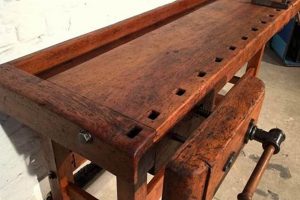
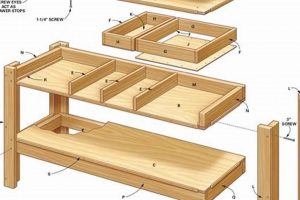
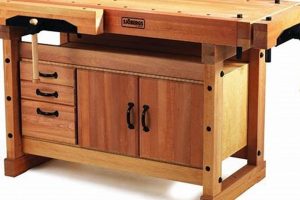
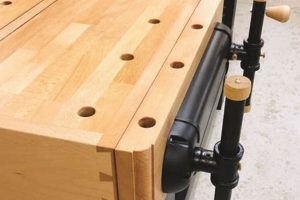
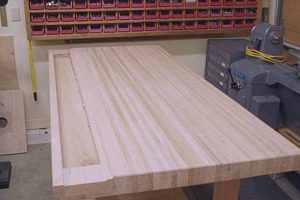
A specialized workbench utilizes a grid of holes across its surface to accommodate pegs or bench dogs. These pegs serve as adjustable stops, clamping aids, and supports for securing workpieces of various shapes and sizes during woodworking tasks. This design allows for flexible and adaptable fixturing, enabling precise and efficient execution of joinery and other woodworking operations. For example, a woodworker might use the pegs to hold a board in place while planing its edge, or to support a component during glue-up.
The versatility offered by this approach enhances workflow and precision in the workshop. The system allows for rapid repositioning and securing of materials, minimizing setup time and maximizing productivity. Historically, similar concepts have been employed in woodworking for centuries, evolving from simple holdfasts to more sophisticated peg and dog systems. This adaptability makes it suitable for both intricate detail work and larger-scale projects, making it a valuable asset for both amateur and professional woodworkers.
With a foundational understanding of its definition and advantages established, subsequent sections will explore the different types available, construction considerations, optimal peg placement strategies, and maintenance best practices to ensure long-term utility.
Essential Usage Strategies
The effective utilization of a specialized workbench enhances woodworking precision and efficiency. These tips outline key strategies for maximizing its potential.
Tip 1: Optimize Peg Placement: Arrange the pegs strategically to accommodate the specific workpiece. Consider the grain direction, desired clamping force, and stability requirements when positioning the support elements.
Tip 2: Utilize Bench Dogs in Conjunction with Clamps: Bench dogs can be paired with various clamping mechanisms, such as bar clamps or holdfasts, to provide secure and even pressure distribution across the workpiece surface. This minimizes the risk of movement during critical operations.
Tip 3: Create Custom Fixtures: The peg system facilitates the construction of custom jigs and fixtures. Design specialized supports for repetitive tasks or intricate shapes, improving accuracy and repeatability.
Tip 4: Employ a Variety of Peg Shapes and Sizes: Maintain an assortment of pegs with varying diameters, lengths, and head designs. This allows for greater flexibility in adapting to diverse workpiece geometries and clamping needs.
Tip 5: Regularly Inspect and Maintain Pegs: Examine pegs for wear, damage, or looseness. Replace or repair any compromised components to ensure optimal performance and prevent potential safety hazards.
Tip 6: Protect the Bench Surface: When using aggressive clamping force, place sacrificial material between the workpiece and the bench surface to prevent damage. This prolongs the lifespan of the workbench and maintains its structural integrity.
Tip 7: Consider Angled Peg Placement: Employ angled pegs to provide support for tapered workpieces or to create specialized clamping configurations. This technique expands the bench’s adaptability and capabilities.
Adhering to these recommendations will allow woodworkers to leverage the specialized workbench effectively, resulting in increased accuracy, improved workflow, and higher-quality finished products.
The following section will discuss the different types of specialized workbenches, and how they can be adapted for various woodworking tasks.
1. Peg Hole Diameter

Peg hole diameter represents a critical specification in the design and functionality of a specialized woodworking bench. Its precise dimension directly impacts the effectiveness of the bench dog system, influencing workholding capabilities and overall user experience.
- Bench Dog Compatibility
The diameter of the holes must precisely match the diameter of the bench dogs intended for use. Oversized holes render the dogs ineffective, as they will not provide sufficient resistance against lateral forces. Conversely, undersized holes prevent the dogs from being inserted, negating their utility. A tight, but not force-fit, tolerance is essential for optimal performance. For example, a 3/4″ hole is designed for a 3/4″ bench dog, allowing for minimal play while maintaining ease of insertion and removal.
- Material Considerations
The material of the bench top influences the longevity and stability of the peg holes. Hardwoods, such as maple or beech, are preferred due to their resistance to wear and deformation. Softwoods, while easier to drill, are more prone to enlargement over time, compromising the integrity of the system. Reinforcement with metal inserts or bushings can mitigate this issue, particularly in frequently used locations. The diameter must account for any bushings used.
- Drilling Precision
Achieving consistent and accurate hole diameters is paramount. Variations in size, even fractions of a millimeter, can affect the stability and security of the workpieces. Specialized drilling techniques, such as using a Forstner bit or a drill press with a depth stop, are recommended to ensure uniformity. Irregularities in hole diameter create inconsistencies in clamping pressure and compromise the overall functionality of the bench.
- Impact on Clamping Force
The relationship between the peg hole diameter and the bench dog directly affects the maximum clamping force achievable. Excessive play between the dog and the hole allows the dog to tilt or shift under pressure, reducing the effective clamping force. This can lead to workpiece movement during critical operations, such as planing or routing. A snug fit maximizes the surface contact between the dog and the hole, distributing the clamping force evenly and preventing slippage.
In conclusion, peg hole diameter is not merely a dimensional specification but a key determinant of a specialized woodworking bench’s performance. Careful consideration of bench dog compatibility, material selection, drilling precision, and its impact on clamping force is essential for creating a robust and reliable workholding system.
2. Bench Dog Material

The selection of appropriate bench dog material is paramount for the effective utilization of a peg woodworking bench. Material properties directly influence the bench dog’s durability, work-holding capacity, and overall lifespan, thus impacting the workbench’s performance. Consideration of material characteristics is essential for achieving secure and stable workpiece fixturing.
- Hardwood Durability
Hardwoods such as maple, beech, and oak are frequently employed for bench dog construction due to their inherent strength and resistance to wear. These materials withstand repeated clamping forces and resist deformation over time, ensuring consistent performance. For example, a maple bench dog can endure the rigors of heavy planing without significant degradation, maintaining a secure grip on the workpiece.
- Metal Rigidity and Precision
Metal bench dogs, typically steel or brass, offer superior rigidity and dimensional stability. They resist bending or compression under high clamping pressures, providing a secure and unwavering hold. Metal bench dogs are particularly suitable for tasks requiring extreme precision, such as joinery, where minimal workpiece movement is crucial. Brass, while softer than steel, offers resistance to corrosion and reduces the risk of marring delicate surfaces.
- Polymer Versatility and Protection
Polymer-based bench dogs, such as those made from high-density polyethylene (HDPE) or nylon, provide a balance of durability and surface protection. These materials are less likely to damage or scratch delicate workpieces, making them suitable for finishing or assembly tasks. Polymer bench dogs also exhibit resistance to moisture and chemical exposure, extending their lifespan in demanding workshop environments. They are often used when clamping softer materials.
- Composite Material Innovation
Composite materials, such as fiber-reinforced polymers, offer a customizable combination of strength, rigidity, and weight. These materials can be engineered to meet specific performance requirements, providing tailored solutions for specialized woodworking applications. For example, a carbon fiber bench dog could offer exceptional strength-to-weight ratio, reducing overall bench weight without compromising work-holding capacity.
Ultimately, the optimal choice of bench dog material depends on the specific woodworking tasks to be performed and the characteristics of the workpieces being secured. Evaluating the trade-offs between durability, rigidity, surface protection, and cost is essential for maximizing the effectiveness of a peg woodworking bench and ensuring long-term user satisfaction. Each material serves as a crucial element for supporting woodworking practices.
3. Surface Flatness

Surface flatness is a critical attribute of a specialized woodworking bench, directly influencing the precision and accuracy of various woodworking operations. Deviations from a true plane can introduce errors in joinery, assembly, and finishing, ultimately compromising the quality of the final product.
- Precision Joinery
Accurate joinery relies on consistent contact between mating surfaces. If the bench surface is not flat, workpieces may rock or shift during layout and cutting, resulting in gaps or misalignments in the finished joint. For example, when cutting dovetails, a warped bench surface can cause the saw to wander, leading to ill-fitting joints that require extensive correction. A flat surface ensures that hand tools, such as planes and chisels, register correctly, enabling precise shaping and fitting of components.
- Stable Assembly
During glue-up and assembly, a flat bench surface provides a stable and level platform for clamping and securing workpieces. Uneven surfaces can introduce stress and distortion into the assembly, potentially compromising its structural integrity. For instance, if a table leg is glued to a top on an unlevel surface, the leg may be permanently stressed, leading to instability or eventual failure. A flat surface ensures that all components are properly aligned and supported during the curing process, resulting in a stronger and more durable assembly.
- Accurate Reference Plane
A flat bench surface serves as a reliable reference plane for measuring and marking. Woodworkers frequently use the bench surface as a zero point for transferring dimensions, checking for squareness, and establishing reference lines. If the bench surface is not flat, measurements will be inaccurate, leading to errors in the layout and cutting of components. A true and level reference plane is essential for achieving precise and consistent results. For instance, using a winding stick on a non-flat bench can lead to inaccurate readings and skewed results.
- Tool Performance and Calibration
The flatness of the bench surface also impacts the performance and calibration of woodworking tools. Hand planes, for example, are designed to operate on a flat surface, and their cutting action can be negatively affected by an uneven bench. Similarly, machines like routers or sanders that rest on the bench’s surface can produce uneven results if the surface is not perfectly flat. A consistently flat surface allows tools to perform at their optimal level and facilitates accurate calibration, leading to improved efficiency and quality.
In summary, surface flatness is an indispensable characteristic of a specialized woodworking bench. Its absence can significantly impede woodworking processes, leading to inaccurate results and compromised final products. Prioritizing a flat and stable surface is essential for achieving precision, stability, and reliable performance in any woodworking project.
4. Clamping Options
Clamping options, when considered in the context of a specialized woodworking bench, represent a critical determinant of its functionality and adaptability. The ability to securely hold workpieces in place during various operations hinges directly on the availability and effectiveness of suitable clamping methods.
- Bench Dog and Peg Combinations
The integration of bench dogs and pegs provides a versatile system for securing workpieces of varying shapes and sizes. Bench dogs, inserted into the bench’s grid of holes, act as stops against which the workpiece is clamped. Pegs can be used to support overhanging edges or create custom jigs for specific tasks. This combination allows for rapid setup and adjustments, accommodating a wide range of woodworking projects. For instance, a board can be held securely for edge planing by clamping it between two bench dogs and a holdfast.
- Holdfast Integration
Holdfasts, traditional clamping devices that exert downward pressure through friction, are often used in conjunction with specialized woodworking benches. The bench’s peg system provides an anchor point for holdfasts, allowing them to exert significant clamping force without damaging the workpiece. This is particularly useful for securing large or awkwardly shaped items that cannot be easily clamped with conventional methods. A holdfast can secure a wide board while using a hand plane.
- Face Clamping Accessories
Beyond traditional bench dogs and holdfasts, numerous face clamping accessories can be integrated with a specialized woodworking bench. These include specialized clamps that attach directly to the bench’s surface, providing secure and even pressure distribution. Face clamps are particularly useful for joining panels or assembling complex structures, ensuring that all components are tightly aligned during glue-up. Adjustable face clamps will firmly hold a mitered corner together while glue dries.
- Custom Jigs and Fixtures
The peg system facilitates the creation of custom jigs and fixtures for specialized woodworking tasks. By utilizing pegs and dogs as anchoring points, woodworkers can construct temporary clamping systems tailored to the specific geometry of a workpiece. This approach allows for precise and repeatable clamping, improving accuracy and efficiency in repetitive operations. A custom jig could enable accurate and safe routing on small components.
The diversity of clamping options available for specialized woodworking benches underscores their adaptability and suitability for a wide range of woodworking applications. From traditional bench dogs and holdfasts to modern face clamping accessories and custom jigs, the ability to securely hold workpieces is essential for achieving accurate and high-quality results.
5. Grid Spacing

Grid spacing, in the context of specialized woodworking benches utilizing a peg system, dictates the versatility and precision achievable during workholding. This parameter defines the distance between the centers of adjacent peg holes, directly influencing the granularity with which workpieces can be secured and supported. A finer grid spacing allows for more precise positioning of bench dogs and other clamping accessories, accommodating smaller or more complex workpiece geometries. Conversely, wider grid spacing limits the adjustability and may necessitate alternative clamping strategies for certain projects. The choice of grid spacing represents a fundamental design consideration, impacting both the bench’s adaptability and the efficiency of woodworking operations.
The impact of grid spacing becomes evident when considering specific woodworking tasks. For instance, fine joinery, such as creating dovetail joints on small boxes, demands precise workpiece positioning. A bench with a closely spaced grid allows for the placement of bench dogs directly adjacent to the joint, providing maximum support and minimizing vibration during cutting. In contrast, when working on larger panels or assemblies, wider grid spacing may be sufficient, as the overall stability of the workpiece is less dependent on precise positioning of individual dogs. Furthermore, the grid spacing affects the types of clamping accessories that can be effectively used. Some specialized clamps require specific hole patterns to function correctly, limiting the compatibility of the bench if the grid spacing is not appropriately designed. Real-life examples of varying grid spacing can be observed in commercially available benches, ranging from closely spaced grids optimized for detail work to wider grids designed for general purpose use.
In conclusion, grid spacing is a critical design parameter that dictates the versatility and precision of a specialized woodworking bench. The selection of an appropriate grid spacing involves a trade-off between adjustability, compatibility with clamping accessories, and the types of woodworking tasks anticipated. Understanding the implications of grid spacing is essential for woodworkers seeking to optimize their bench for specific applications and maximize the efficiency of their workflow. Challenges often arise when attempting to modify an existing bench’s grid pattern, highlighting the importance of careful consideration during the initial purchase or construction phase.
6. Bench Height

Bench height, an often-overlooked aspect of workbench design, profoundly impacts the ergonomic efficiency and physical well-being of woodworkers utilizing a specialized workbench. When integrated with a peg system, the bench height dictates the optimal reach and posture required to manipulate workpieces and employ tools effectively. A bench that is too low induces back strain from excessive bending, while a bench that is too high forces shoulder and arm muscles to compensate, leading to fatigue and potential injury. The integration of a peg system for workholding amplifies this effect; incorrect bench height necessitates awkward angles for clamping and securing materials, reducing precision and increasing the risk of errors. The effectiveness of a peg system is thus inextricably linked to the ergonomic correctness of the bench height.
Consider the practical application of planing a board. With a workbench of appropriate height, a woodworker can apply consistent force using their body weight, achieving smooth and even strokes. However, if the bench is too low, the woodworker must bend at the waist, compromising their leverage and increasing the likelihood of muscle strain. Conversely, if the bench is too high, the woodworker struggles to exert downward pressure effectively, resulting in choppy and uneven planing. The peg system, designed to hold the board securely, cannot compensate for these postural deficiencies. Similarly, when executing precision joinery, such as dovetailing, an incorrect bench height forces the woodworker to contort their body, reducing visibility and control over the chisel or saw. Examples abound of woodworkers modifying their benches, adding risers or adjusting leg lengths, to achieve an optimal working height, underscoring the practical significance of this element.
In summary, bench height is not merely a static dimension but a critical factor influencing both the effectiveness of a peg woodworking bench and the physical health of the woodworker. Optimizing bench height to match the individual’s stature and working style is paramount for maximizing efficiency, minimizing fatigue, and promoting long-term well-being in the workshop. Recognizing the interplay between bench height and the functionality of the peg system is essential for achieving superior woodworking results and a healthier working environment. Future developments could focus on benches with easily adjustable height mechanisms, enhancing adaptability across a broader range of users.
7. Work Holding

Work holding, a fundamental aspect of woodworking, assumes critical importance when utilizing a specialized bench incorporating a peg system. The effectiveness of joinery, shaping, and finishing processes is directly contingent upon the stability and secure positioning of the workpiece. A peg woodworking bench inherently provides a framework for adaptable and robust work holding solutions, enabling precise and efficient execution of diverse woodworking tasks.
- Peg and Dog Systems
The primary work holding mechanism on such a bench involves the strategic placement of pegs and bench dogs within the array of holes. These elements act as adjustable stops and supports, accommodating workpieces of varying shapes and sizes. For example, a board can be secured for edge planing by positioning bench dogs to resist lateral movement and support the overhanging edge. The peg and dog system’s adjustability offers a significant advantage over fixed clamping methods.
- Custom Fixture Integration
A peg woodworking bench facilitates the construction and integration of custom fixtures tailored to specific woodworking operations. By utilizing the peg holes as anchoring points, woodworkers can create specialized jigs for tasks such as routing, carving, or repetitive joinery. For instance, a custom jig can be designed to hold a workpiece at a precise angle for cutting dovetails, enhancing accuracy and repeatability. The bench’s grid pattern enables secure and stable mounting of these fixtures.
- Clamping Accessory Compatibility
The peg system enhances the compatibility of the workbench with a wide array of clamping accessories. Traditional clamps, such as bar clamps or pipe clamps, can be used in conjunction with bench dogs to apply controlled pressure to the workpiece. Specialized clamps designed to interface with the peg holes offer even greater versatility. For example, a holdfast can be inserted into a peg hole to provide downward pressure, securing a workpiece for carving or other hand tool operations. The bench effectively becomes a universal clamping platform.
- Vise Integration and Support
While the peg system provides primary work holding, integration with a traditional vise can further expand the bench’s capabilities. The vise secures workpieces for operations requiring significant clamping force or precise manipulation, such as mortising or carving. The peg system complements the vise by providing additional support for larger or awkwardly shaped workpieces. For example, a long board can be held in the vise while supported by pegs positioned along its length, preventing sagging or vibration.
The facets discussed illustrate the multifaceted role of work holding within the context of a peg woodworking bench. These benches offer an adaptable framework for securing workpieces, enabling efficient and precise execution of diverse woodworking operations. The peg system enhances compatibility with various clamping accessories and custom fixtures, providing a comprehensive solution for addressing the unique work holding challenges presented by different projects. Effective implementation of work-holding techniques on a peg woodworking bench ultimately contribute to the quality and efficiency of woodworking processes.
Frequently Asked Questions about Peg Woodworking Benches
This section addresses common inquiries regarding specialized woodworking benches utilizing a peg system, providing factual and concise answers to facilitate informed decision-making.
Question 1: What peg hole diameter is optimal for a peg woodworking bench?
The optimal peg hole diameter is contingent upon the size of bench dogs to be employed. A 3/4-inch diameter hole is a common standard, accommodating readily available 3/4-inch bench dogs. Precise drilling is paramount; deviations can compromise workholding efficacy.
Question 2: What materials are best suited for constructing bench dogs?
Hardwoods, such as maple or beech, are frequently employed for bench dog construction due to their durability and resistance to wear. Metal and high-density polymers also offer viable alternatives, depending on the specific application and desired level of rigidity.
Question 3: How critical is surface flatness for a peg woodworking bench?
Surface flatness is paramount for achieving accurate joinery and stable assembly. Deviations from a true plane can introduce errors in workpiece alignment and tool registration, thereby compromising the quality of woodworking operations.
Question 4: What clamping options are compatible with a peg woodworking bench?
A peg woodworking bench accommodates diverse clamping options, including bench dogs, holdfasts, face clamps, and custom-designed jigs. The peg system facilitates secure and adaptable workholding for various workpiece geometries.
Question 5: How does grid spacing affect the functionality of a peg woodworking bench?
Grid spacing, the distance between peg holes, influences the precision and adjustability of workholding. Finer grid spacing allows for more precise positioning of bench dogs, accommodating smaller or more complex workpieces. Wider grid spacing may suffice for larger projects.
Question 6: What is the recommended bench height for a peg woodworking bench?
The recommended bench height is contingent upon the woodworker’s stature. A general guideline suggests a height that allows the woodworker to perform tasks comfortably without excessive bending or reaching. Ergonomic considerations are essential for preventing fatigue and promoting long-term well-being.
These responses provide a foundational understanding of key considerations related to specialized woodworking benches utilizing a peg system. Further research and experimentation may be necessary to optimize performance based on individual preferences and specific woodworking needs.
The subsequent section will provide insight into maintenance.
Conclusion
The preceding exploration has elucidated the multifaceted nature of the peg woodworking bench. The peg system’s adaptability provides a foundational framework for diverse workholding strategies, influencing the precision and efficiency of woodworking operations. The interplay between peg hole diameter, bench dog material, surface flatness, clamping options, grid spacing, and bench height defines the utility and ergonomic considerations inherent in these specialized work surfaces. These elements, when properly understood and addressed, contribute directly to the realization of quality craftsmanship.
Ultimately, the informed application of the principles and considerations outlined serves as a cornerstone for maximizing the potential of the peg woodworking bench. Consistent maintenance and thoughtful adaptation of techniques will extend its lifespan, enhancing woodworking outcomes for years to come. Further investigation and practical experimentation are encouraged to refine and personalize the utilization of this indispensable woodworking tool.