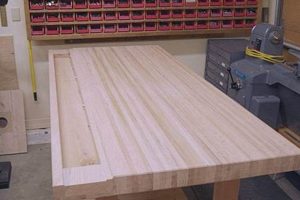
The practice of crafting and shaping wood objects in the absence of a traditional woodworking support structure represents an alternative approach to the craft. For instance, carving small wooden figures on a tabletop or assembling prefabricated components on the floor exemplifies this method.
This approach broadens accessibility to woodworking, removing the barrier of needing a dedicated and often substantial workbench. It allows individuals with limited space, resources, or mobility to participate in the craft. Historically, many woodworking tasks, particularly in itinerant or resource-scarce settings, were performed without specialized work surfaces.
The subsequent sections will explore various techniques, tools, and considerations pertinent to executing woodworking projects effectively under these conditions. Attention will be given to work holding solutions, surface protection strategies, and tool adaptations that facilitate precision and safety in the absence of a conventional workbench.
Essential Strategies for Woodworking Without a Traditional Bench
Effective project execution demands careful consideration of alternative methods and adapted techniques. The following provides practical guidance for engaging in woodworking activities in the absence of a dedicated bench.
Tip 1: Prioritize Secure Work Holding: Employ clamps, vises (attached to a stable surface), or non-slip mats to firmly secure the workpiece. A stable workpiece is paramount for precision and safety.
Tip 2: Utilize Portable Work Surfaces: Consider using sawhorses with a plywood top, folding tables, or even a sturdy section of flooring covered with protective material. These provide a stable and elevated platform.
Tip 3: Adapt Tool Selection: Opt for hand tools and smaller power tools designed for maneuverability and control. Japanese pull saws, block planes, and cordless drills are examples of appropriate choices.
Tip 4: Protect Existing Surfaces: Use drop cloths, thick cardboard, or workbench mats to shield floors, tables, and other surfaces from scratches, dents, and spills. Prevention minimizes cleanup and potential damage.
Tip 5: Maintain a Clean and Organized Workspace: Regularly clear away sawdust, shavings, and tool clutter. A tidy workspace enhances safety and efficiency.
Tip 6: Focus on Smaller Projects: Initially, concentrate on projects with manageable dimensions and fewer intricate cuts. This facilitates control and reduces the risk of errors.
Tip 7: Practice Proper Body Mechanics: Maintain good posture and avoid straining. Take frequent breaks to prevent fatigue and potential injuries. Ergonomics are crucial for prolonged work.
These guidelines enable individuals to overcome the limitations imposed by the absence of a traditional workbench. By implementing these strategies, woodworking projects can be completed with precision, safety, and a minimum of disruption to the surrounding environment.
The next section will address specific project ideas suitable for these modified woodworking approaches.
1. Secure Workholding

Secure workholding constitutes a foundational element for woodworking activities conducted in the absence of a dedicated workbench. The absence of a robust and stable bench necessitates alternative strategies for immobilizing the workpiece. Without a secure means of restraint, precision and safety are compromised, potentially leading to inaccurate cuts, material damage, or personal injury. For example, attempting to hand-saw a small piece of wood resting solely on a tabletop, without any form of clamping, invariably results in instability and inaccurate cuts.
The implementation of effective workholding techniques directly impacts the quality and efficiency of the woodworking process. Clamps, vises attached to stable surfaces (such as tables or countertops), non-slip mats, and strategically placed weights are all viable methods for achieving secure immobilization. Consider the task of routing a decorative edge on a wooden plaque. Without clamps firmly securing the plaque to a surface, the router can easily slip, marring the wood and posing a safety hazard to the operator. Similarly, when assembling a small wooden box, using corner clamps to hold the pieces together during glue-up ensures proper alignment and a strong, square joint.
In conclusion, secure workholding is not merely a supplementary consideration but rather an indispensable requirement for woodworking without a traditional bench. It compensates for the inherent lack of stability, enabling precision, ensuring safety, and ultimately determining the success of the project. Understanding and implementing appropriate workholding techniques is therefore crucial for anyone engaging in woodworking activities under these circumstances. The challenges associated with limited space or resources can be effectively mitigated by prioritizing and mastering this essential skill.
2. Surface Protection

Surface protection assumes heightened importance when woodworking is performed without a dedicated bench. The absence of a durable, often sacrificial, bench surface necessitates proactive measures to safeguard underlying floors, tables, or other surfaces from damage. Woodworking inherently involves activities that can cause scratches, dents, staining, and general wear. Sawing, chiseling, sanding, and the application of finishes all present potential risks to unprotected surfaces. The ramifications of neglecting surface protection can range from minor cosmetic damage to significant structural impairment, leading to costly repairs or replacements. For example, varnish spills directly onto a hardwood floor without protective covering can result in irreversible staining and finish damage, requiring professional restoration.
Effective surface protection strategies encompass a range of materials and techniques tailored to the specific woodworking tasks being undertaken. Drop cloths made of canvas or plastic sheeting provide a general barrier against spills and debris. Workbench mats constructed from rubber or felt offer cushioning to prevent dents and scratches. Thicker materials, such as plywood or hardboard, can be used as sacrificial surfaces for operations involving sharp tools or abrasive materials. Implementing these measures requires foresight and diligent application. Before commencing any woodworking activity, the surfaces in the immediate vicinity must be adequately covered and secured. The choice of protective material should correspond to the potential risks involved; finer finishes necessitate more robust protection, while rougher work may only require basic coverage.
In summary, surface protection is an indispensable element of woodworking conducted without a traditional bench. It is not merely a cosmetic consideration but a pragmatic necessity for preserving the integrity of surrounding environments. By implementing appropriate protective measures, woodworkers can mitigate the risks associated with their craft, ensuring that their projects are completed without causing unintended damage to the spaces they inhabit. The proactive application of surface protection techniques contributes to a sustainable and responsible approach to woodworking, promoting both craftsmanship and environmental stewardship.
3. Portable Alternatives

The concept of portable alternatives directly addresses the limitations imposed by the absence of a fixed woodworking bench. These solutions provide a substitute work surface and support system, enabling woodworking activities in diverse locations and under varying spatial constraints.
- Sawhorses with Plywood Topping
Sawhorses, when paired with a sheet of plywood or a similar flat material, create a customizable and easily transportable work platform. The height can be adjusted by selecting different sawhorses, and the surface area is scalable based on the dimensions of the plywood sheet. This setup is suitable for a range of tasks, from cutting lumber to assembling smaller projects. The portability allows the workspace to be easily relocated as needed.
- Folding Work Tables
Folding work tables offer a compact and readily deployable work surface. These tables typically feature a durable top and folding legs for ease of storage and transport. While often smaller than a traditional workbench, they provide a stable platform for various woodworking tasks, particularly those requiring precision and control. The inherent portability makes them well-suited for individuals with limited space or those who need to work in multiple locations.
- Clamping Workstations
Clamping workstations, often incorporating features like dog holes and integrated clamping mechanisms, provide a versatile solution for securing workpieces. These workstations can be placed on any stable surface, effectively transforming it into a temporary workbench. They are particularly useful for tasks requiring precise positioning and secure holding of materials, such as joinery or carving. The integrated clamping system enhances efficiency and accuracy.
- Tailgate or Truck Bed Setup
For woodworkers operating in outdoor environments or at job sites, the tailgate of a truck or the bed of a pickup can serve as an impromptu work surface. By using clamps, non-slip mats, or portable vises, this space can be adapted for cutting, shaping, and assembling materials. This arrangement is particularly useful for construction-related tasks or projects involving larger pieces of lumber. The mobility of the vehicle further enhances the portability of the workspace.
The selection of a portable alternative depends on the specific requirements of the project, the available space, and the desired level of stability and functionality. These solutions offer a flexible and adaptable approach to woodworking, allowing individuals to engage in the craft without the need for a dedicated and permanent workbench.
4. Adapted Toolset
The concept of an adapted toolset is intrinsically linked to woodworking conducted without a traditional bench. The constraints imposed by the absence of a stable, dedicated work surface necessitate careful consideration of tool selection to maintain precision, safety, and efficiency. The appropriate toolset becomes a compensatory mechanism, enabling the woodworker to overcome the limitations of the environment.
- Hand Tools Emphasized
In the absence of a bench, hand tools gain prominence. They provide a level of control and maneuverability often lacking in larger power tools. Hand saws, chisels, planes, and marking gauges become essential for tasks requiring precision and accuracy. For example, fitting a mortise and tenon joint without the stability of a bench relies heavily on the skill and control afforded by hand tools.
- Smaller Power Tools Preferred
When power tools are necessary, smaller, more portable models are preferred. Compact drills, circular saws, and sanders offer a balance between power and maneuverability. These tools are easier to control and position, reducing the risk of errors or accidents. Cordless tools further enhance portability and eliminate the encumbrance of power cords.
- Specialized Workholding Accessories
An adapted toolset also includes workholding accessories designed for use without a bench. Clamps, vises, and non-slip mats are essential for securing workpieces in place. These accessories allow the woodworker to create temporary work surfaces and maintain stability during operations such as sawing, routing, or sanding. The selection of appropriate workholding accessories is crucial for safety and precision.
- Sharpening Equipment Paramount
Maintaining sharp tools is paramount, particularly when relying on hand tools. A well-honed blade reduces the force required to make a cut, improving control and accuracy. Sharpening equipment, such as sharpening stones, strops, and honing guides, becomes an integral part of the adapted toolset. Regular sharpening ensures that tools perform optimally, minimizing the risk of errors and maximizing efficiency.
The selection of an adapted toolset for woodworking without a bench is not merely a matter of convenience but a strategic response to the challenges posed by the absence of a dedicated work surface. By prioritizing hand tools, smaller power tools, specialized workholding accessories, and sharpening equipment, woodworkers can effectively mitigate these challenges and achieve high-quality results in diverse environments.
5. Ergonomic Practices

Ergonomic practices are fundamentally important when engaging in woodworking without a traditional bench. The absence of a properly configured workbench often necessitates unconventional postures and movements, increasing the risk of musculoskeletal disorders. Integrating ergonomic principles becomes essential to mitigate these risks and promote long-term physical well-being.
- Optimized Work Height
Maintaining an appropriate work height is crucial. Without a bench, the default surface is often too low, leading to excessive bending and strain on the lower back. Utilizing portable work surfaces, such as sawhorses or adjustable tables, allows for customization of the work height. The ideal height minimizes reaching and bending, keeping the spine in a neutral position. For example, raising the work surface to approximately elbow height can significantly reduce back strain during prolonged tasks like sanding or carving.
- Proper Posture and Body Mechanics
Conscious attention to posture and body mechanics is essential. Maintaining a straight back, avoiding twisting motions, and keeping the workpiece close to the body reduces strain on joints and muscles. Utilizing proper lifting techniques when moving materials and tools is also important. Frequent breaks to stretch and change position further mitigate the risk of fatigue and injury. For example, when sawing, ensuring that the stance is stable and the movement originates from the legs rather than the back minimizes strain.
- Appropriate Tool Selection and Usage
The selection and usage of tools directly impact ergonomic factors. Choosing tools with ergonomic handles that fit comfortably in the hand reduces strain on the wrists and hands. Using sharp tools minimizes the force required to perform a task, reducing the risk of repetitive stress injuries. For example, using a well-sharpened hand plane requires less force than a dull one, reducing strain on the arms and shoulders.
- Workspace Organization and Accessibility
A well-organized and accessible workspace promotes efficiency and reduces unnecessary movements. Keeping tools and materials within easy reach eliminates the need for excessive reaching or bending. Good lighting further enhances visibility and reduces eye strain. For example, having a small rolling cart to hold commonly used tools and materials keeps them readily available and minimizes the need to walk back and forth across the workspace.
The integration of these ergonomic practices is not merely a supplementary consideration but a fundamental necessity for sustainable woodworking in the absence of a traditional bench. By prioritizing proper work height, posture, tool selection, and workspace organization, woodworkers can significantly reduce the risk of injury and promote long-term physical well-being, allowing them to pursue their craft with greater comfort and safety.
Frequently Asked Questions
The following addresses common inquiries regarding the practice of woodworking in the absence of a traditional workbench, providing concise and informative responses.
Question 1: What are the primary safety concerns associated with woodworking without a dedicated bench?
Main concerns include unstable workpieces, compromised posture leading to back strain, and increased risk of slips and falls due to a less organized workspace. Mitigation involves secure workholding, ergonomic practices, and meticulous housekeeping.
Question 2: How does the absence of a bench affect the precision of woodworking tasks?
Reduced stability can compromise precision. Compensatory measures include utilizing high-quality hand tools, implementing effective workholding techniques, and carefully planning each step of the process.
Question 3: What types of projects are best suited for woodworking without a bench?
Smaller projects involving intricate joinery or delicate carving may be more challenging. Simpler projects, such as small boxes, picture frames, or decorative items, are generally more manageable.
Question 4: What are the most essential tools for woodworking without a bench?
Essential tools include hand saws, chisels, planes, marking gauges, clamps, non-slip mats, and a reliable sharpening system. Smaller power tools, such as cordless drills and sanders, can also be beneficial.
Question 5: How can a stable work surface be created in the absence of a traditional bench?
Stable work surfaces can be created using sawhorses with a plywood top, folding work tables, or clamping workstations. Existing surfaces can be adapted with protective coverings and workholding accessories.
Question 6: Is woodworking without a bench a viable option for beginners?
While a traditional bench offers advantages, woodworking without one is indeed viable for beginners. Starting with smaller projects, focusing on essential skills, and emphasizing safety precautions are crucial for a positive learning experience.
Woodworking in the absence of a bench demands adaptability, resourcefulness, and a strong emphasis on safety. By addressing these key considerations, individuals can successfully engage in the craft regardless of spatial limitations.
The subsequent section will provide project tutorials suitable for the discussed techniques.
Conclusion
The preceding discourse has systematically explored woodworking without a bench, delineating the challenges, strategies, and essential considerations involved in executing woodworking tasks in the absence of a dedicated workbench. The exploration encompassed workholding techniques, surface protection measures, portable alternatives, adapted toolsets, and ergonomic practices. Furthermore, common inquiries regarding this approach were addressed, providing clarity on safety concerns, precision limitations, and suitable project types.
While the absence of a traditional workbench presents inherent challenges, it does not preclude the possibility of engaging in meaningful and productive woodworking. The diligent application of the principles outlined herein allows individuals to overcome spatial limitations and achieve satisfactory results. Continued innovation in portable work surfaces, adaptable tools, and ergonomic accessories will further enhance the accessibility and viability of woodworking without a bench, potentially broadening its appeal to a wider audience. The future of the craft likely entails a greater emphasis on adaptable and space-efficient solutions, making woodworking a more inclusive and accessible pursuit.