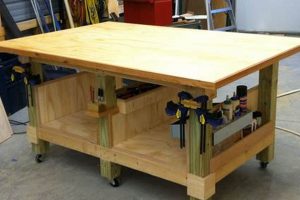
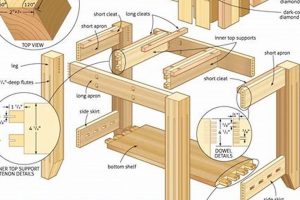
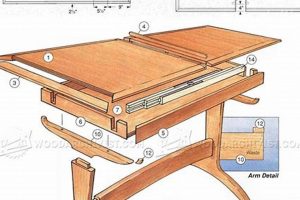
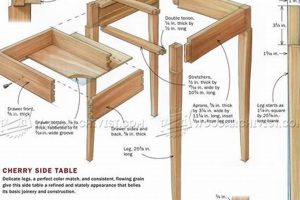
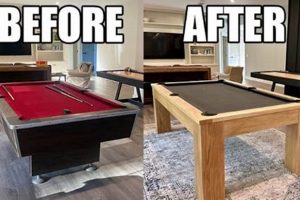
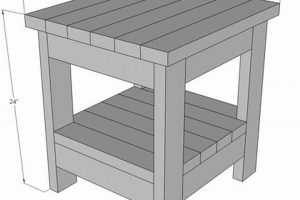
Detailed schematics that provide step-by-step guidance for constructing outdoor tables from wood. These instructions typically include material lists, cutting diagrams, assembly procedures, and finishing techniques. They offer a visual and textual roadmap for woodworkers to create functional and aesthetically pleasing tables suitable for patios and other outdoor spaces. For example, a plan might specify the dimensions and joinery methods for building a rectangular table with a slatted top.
The availability of structured guidance offers several advantages. Using comprehensive guides reduces material waste by providing precise cutting instructions and minimizing errors. This method promotes woodworking projects, enabling both amateur and experienced individuals to craft durable and attractive outdoor furniture, increasing the enjoyment of outdoor living spaces. Historically, such formalized instruction moved woodworking from a trade practiced only by skilled artisans to a hobby accessible to a broader population.
The following sections will explore considerations for selecting appropriate documents, the various styles and designs commonly available, and the factors that influence the final product’s durability and aesthetic appeal.
Essential Considerations for Outdoor Table Construction
Effective utilization of woodworking documents demands careful planning and execution. The following recommendations will improve the process and resulting table.
Tip 1: Material Selection: Choose wood species appropriate for outdoor use. Teak, cedar, and redwood exhibit natural resistance to moisture, insects, and decay. Pressure-treated lumber provides another viable option, but requires adherence to safety precautions during cutting and handling. Incorrect selection could lead to premature deterioration.
Tip 2: Accurate Measurements: Verify all measurements outlined. Discrepancies, even minor ones, can compromise the structural integrity and aesthetic appeal of the finished product. Use a reliable measuring tool and double-check dimensions before cutting.
Tip 3: Joinery Techniques: Employ robust joinery methods suitable for outdoor furniture. Mortise-and-tenon, dovetail, or biscuit joints provide superior strength compared to simple butt joints. Consider the expansion and contraction of wood due to temperature and humidity changes.
Tip 4: Hardware Selection: Use corrosion-resistant hardware, such as stainless steel or brass screws and bolts. Galvanized hardware provides a cost-effective alternative, but its lifespan may be shorter in harsh environments. Avoid using dissimilar metals, as they can cause galvanic corrosion.
Tip 5: Finishing Application: Apply a high-quality exterior finish to protect the wood from the elements. Options include marine-grade varnish, spar urethane, or penetrating oil finishes. Follow the manufacturer’s instructions carefully and apply multiple coats for optimal protection. Regular maintenance, such as re-application of finish, will prolong the table’s lifespan.
Tip 6: Plan Customization: Adapt documented instructions to suit specific needs and aesthetic preferences. Modifications might involve altering dimensions, incorporating unique design elements, or selecting different wood species. Ensure any modifications maintain structural integrity.
Adherence to these guidelines facilitates the creation of durable, aesthetically pleasing, and functional outdoor tables. Diligence in material selection, accurate execution, and appropriate finishing techniques are paramount.
The subsequent section will examine common design variations and stylistic considerations associated with constructing these tables.
1. Material Selection

Material selection is a foundational element in the successful execution of outdoor table construction, directly influencing the final product’s durability, aesthetics, and overall longevity. Specific choices dictate the table’s resistance to weather, insects, and general wear and tear, making it a critical consideration within the overall document.
- Wood Species and Environmental Factors
The selected wood species must withstand the specific environmental conditions of its intended location. Exposure to moisture, sunlight, and temperature fluctuations necessitates the use of durable, rot-resistant woods such as teak, cedar, or redwood. Using an inappropriate species, such as pine without proper treatment, will lead to premature decay and structural failure. Comprehensive plans must specify species appropriate for the climate.
- Material Cost and Availability
Different wood species vary significantly in cost and regional availability. Exotic hardwoods like teak are often more expensive and less accessible than domestically sourced softwoods. Construction documents should consider these factors and offer alternative material suggestions to accommodate varying budgets and resource constraints. The plan might suggest using pressure-treated lumber as a cost-effective alternative to naturally resistant species.
- Structural Integrity and Load-Bearing Capacity
The chosen material must possess sufficient structural integrity to support the intended load. Tables designed to accommodate heavy objects or frequent use require stronger, denser woods. The structural plans within the guide should calculate the necessary material dimensions based on the wood’s specific strength characteristics to ensure stability and prevent collapse. For instance, a thicker tabletop might be required if using a less dense wood.
- Finishing and Aesthetic Considerations
The selected material significantly influences the final aesthetic appearance and its compatibility with different finishes. Some wood species accept stains and paints readily, while others exhibit natural grain patterns that are best highlighted with clear sealants. Detail drawings should specify appropriate finishing techniques and product recommendations tailored to the chosen wood species to achieve the desired look and provide adequate protection. Consideration of grain orientation can enhance both the visual appeal and structural integrity.
In summary, material selection is not merely a cosmetic consideration but a critical engineering decision that directly impacts the structural integrity, longevity, and aesthetic quality of the resulting outdoor table. Proper construction guides provide detailed material specifications, alternative options, and appropriate finishing recommendations to enable woodworkers to make informed choices that optimize the project’s success.
2. Joint Strength

The robustness of any outdoor table relies heavily on the integrity of its joinery. Within the context of detailed construction schematics, the specifications for secure connections are paramount for withstanding environmental stressors and maintaining structural stability over time.
- Mortise and Tenon Joint Design
Mortise and tenon joints represent a traditional yet highly effective method for joining wooden components. Construction guides outline precise dimensions and tolerances for the mortise (hole) and tenon (protruding element), ensuring a snug fit that maximizes surface area for adhesive bonding and mechanical interlocking. For example, plans might specify a tapered tenon for increased resistance to pull-out forces, crucial for table legs that experience lateral loads. Detailed specifications regarding mortise depth and tenon shoulder width directly influence the joint’s overall load-bearing capacity.
- Dovetail Joint Application
Dovetail joints, characterized by their interlocking wedge shape, provide exceptional resistance to tensile forces. They are frequently employed in drawer construction and can be adapted for table aprons or decorative elements. The accuracy with which the dovetails are cut and fitted is paramount; construction drawings stipulate precise angle measurements and spacing requirements to ensure a tight, gap-free joint. Properly executed dovetails contribute significantly to the table’s overall rigidity and resistance to racking forces. This information can provide a table that is both durable and aesthetically pleasing.
- Screw and Bolt Fastener Specifications
While adhesives play a crucial role in joint strength, mechanical fasteners such as screws and bolts provide supplemental reinforcement. Construction guides meticulously specify fastener type, size, and spacing based on the wood species and anticipated load. For instance, outdoor tables require corrosion-resistant stainless steel or brass fasteners to prevent degradation from moisture exposure. Diagrams illustrate precise pilot hole drilling techniques to prevent wood splitting and ensure optimal fastener engagement. Torque specifications are often provided to avoid over-tightening, which can compromise the wood’s structural integrity.
- Adhesive Selection and Application Techniques
The selection of an appropriate adhesive is critical for achieving long-lasting joint strength in outdoor environments. Construction schematics prescribe waterproof or water-resistant adhesives, such as polyurethane or epoxy-based formulations, that maintain their bond strength even under prolonged exposure to moisture. Plans detail surface preparation techniques, such as sanding or degreasing, to ensure optimal adhesive adhesion. Clamping pressure and curing time recommendations are also included to maximize the adhesive’s effectiveness. An improperly applied adhesive can lead to joint failure and premature deterioration of the table.
Ultimately, the detailed guidance provided regarding joint construction within outdoor table blueprints serves to ensure the creation of robust, weather-resistant furniture capable of withstanding the rigors of outdoor use. Precise specifications for joinery methods, fastener selection, and adhesive application directly contribute to the table’s structural integrity and longevity. These details are the cornerstone of a well-crafted and enduring outdoor table.
3. Dimensional Accuracy

Dimensional accuracy constitutes a cornerstone of successful patio table construction. Blueprints serve as the definitive guide for achieving precise measurements and adherence to specified dimensions. Deviations from these critical values compromise the structural integrity, aesthetic appeal, and overall functionality of the finished table.
- Component Interoperability and Assembly
Precise dimensions ensure that individual components fit together seamlessly during assembly. For instance, if the legs of a table are not cut to the exact specified length, the tabletop will not sit level, leading to instability. Plans typically include detailed cutting lists and diagrams that highlight critical measurements, emphasizing the importance of accurate execution. Consistent interoperability facilitates a smoother assembly process and minimizes the need for on-the-fly adjustments.
- Structural Load Distribution and Stability
Accurate dimensions are essential for proper load distribution. A table designed with incorrect dimensions may concentrate stress on specific joints or members, leading to premature failure. Blueprints incorporate engineering principles that dictate precise member sizes to withstand anticipated loads. For example, the thickness of a tabletop must be accurately determined to prevent sagging or warping under the weight of objects placed upon it. Dimensional precision directly translates to enhanced structural stability and a prolonged service life.
- Aesthetic Symmetry and Visual Harmony
Dimensional accuracy plays a significant role in achieving aesthetic symmetry and visual harmony. Even minor discrepancies in component dimensions can be readily apparent, detracting from the overall appearance of the table. Schematics provide detailed specifications for component alignment and spacing, ensuring a balanced and visually pleasing design. Consistent dimensions in repeating elements, such as table legs or slats, contribute to a sense of order and refinement.
- Material Efficiency and Waste Reduction
Adhering to precise dimensions minimizes material waste. Accurate cutting lists enable efficient utilization of lumber, reducing the likelihood of costly errors and offcuts. Construction documents often include optimized cutting layouts that maximize the number of components that can be extracted from a given piece of stock. By promoting material efficiency, dimensional precision contributes to cost savings and environmentally responsible woodworking practices.
The principles of dimensional accuracy permeate every stage of outdoor table construction, from initial material preparation to final assembly. Detailed blueprints provide the framework for achieving precise measurements, ensuring structural integrity, aesthetic appeal, and material efficiency. By adhering to these established guidelines, woodworkers can create durable, functional, and visually pleasing outdoor tables that withstand the test of time.
4. Finish Durability

The longevity and aesthetic appeal of any outdoor table, crafted according to woodworking documents, is intrinsically linked to the durability of its protective finish. The finish acts as a barrier against environmental stressors, safeguarding the underlying wood from damage and decay. The appropriate selection and application of the finish are therefore crucial components detailed in these plans.
- Weather Resistance
Exterior finishes formulated for weather resistance shield the wood from moisture, ultraviolet radiation, and temperature fluctuations. These coatings prevent water penetration, which can lead to rot, warping, and cracking. UV inhibitors within the finish mitigate the damaging effects of sunlight, preserving the wood’s color and preventing surface degradation. Woodworking documents specify finish types and application techniques that maximize weather resistance for the intended climate. For example, a plan for a table in a coastal environment might recommend a marine-grade varnish with multiple coats.
- Abrasion and Impact Resistance
Outdoor tables are subject to abrasion from regular use and potential impacts from dropped objects or accidental collisions. Durable finishes provide a protective layer that resists scratches, scuffs, and dents. Harder finishes, such as polyurethane, offer greater abrasion resistance compared to softer finishes like oil-based sealants. Construction documents detail the finish’s hardness properties and its suitability for the anticipated level of wear and tear. They will also describe recommended surface preparation for maximizing the bond of a hard-wearing coating.
- Maintenance Requirements
The long-term durability of a finish depends on proper maintenance. Woodworking documentation specifies maintenance schedules and procedures to preserve the finish’s integrity. This might include regular cleaning, periodic reapplication of finish coats, or the use of specialized cleaning products. Plans also caution against harsh chemicals or abrasive cleaners that can damage the finish. Clear guidelines on maintenance ensure that the table remains protected and aesthetically pleasing over its lifespan. Failure to adhere to these guidelines could result in premature finish failure, exposing the wood to environmental damage.
- Chemical Resistance
Outdoor tables are frequently exposed to a variety of chemicals, including cleaning solutions, spilled beverages, and garden chemicals. Durable finishes offer resistance to these substances, preventing staining, discoloration, and damage to the underlying wood. Construction documents specify finish types that exhibit chemical resistance and provide recommendations for cleaning up spills promptly to prevent permanent damage. They may also advise against using certain types of cleaners or chemicals that can degrade the finish over time.
The specification of a durable finish within woodworking documents is not merely an aesthetic consideration; it is an essential component of ensuring the long-term performance and structural integrity of the patio table. The selection of an appropriate finish, coupled with proper application and maintenance, contributes significantly to the table’s resistance to environmental factors, abrasion, and chemical exposure, thereby maximizing its service life and preserving its visual appeal.
5. Structural Integrity

The inherent ability of a patio table to withstand applied forces and environmental stressors without deformation or failure constitutes its structural integrity. This characteristic is of paramount importance in the context of crafting woodworking documents that guide construction, ensuring a safe, durable, and long-lasting product.
- Material Selection and Load Capacity
The choice of materials directly influences the load-bearing capacity of the finished table. Wood species such as teak, cedar, and redwood offer inherent resistance to decay and insects, contributing to long-term structural stability. Woodworking blueprints must specify appropriate wood types and dimensions based on anticipated loads, ensuring the table can support intended weights without compromising its integrity. An example is specifying thicker lumber for the tabletop if it is expected to bear heavy items, or selecting a wood species known for its high bending strength for the legs.
- Joinery Techniques and Connection Strength
The manner in which individual components are joined significantly impacts the overall strength and stability of the table. Robust joinery techniques, such as mortise and tenon, dovetail, or properly executed screw and bolt connections, provide superior resistance to racking and shear forces compared to simpler butt joints. Construction documents detail precise joinery methods, fastener specifications, and adhesive recommendations to maximize connection strength and prevent joint failure. An example involves using mortise and tenon joints for attaching the legs to the tabletop frame, providing a strong and stable connection that resists lateral forces.
- Design Considerations and Stability Analysis
The table’s overall design influences its inherent stability. Factors such as leg placement, tabletop overhang, and the presence of cross bracing affect its resistance to tipping and wobbling. Well-crafted woodworking documents incorporate design principles that optimize stability, such as a wide base for the legs and a balanced distribution of weight. Some documents may include rudimentary stability analysis, illustrating how the design resists potential tipping forces. Example, include cross braces between the legs of the table to improve its stability by adding horizontal rigidity, preventing the legs from splaying outwards.
- Environmental Factors and Material Degradation
Exposure to environmental elements such as moisture, sunlight, and temperature fluctuations can degrade wood and compromise structural integrity. Woodworking blueprints should specify protective finishes and construction techniques that mitigate these effects. For example, utilizing stainless steel hardware prevents corrosion, while applying a UV-resistant sealant protects the wood from sun damage. Documents might emphasize the importance of proper drainage and ventilation to prevent moisture accumulation, reducing the risk of rot and decay. An example might involve including drainage holes in the tabletop design to prevent water from pooling and causing warping.
Ultimately, the construction documents should meticulously address each of these facets, allowing the creation of a patio table that not only meets aesthetic requirements but also offers lasting structural integrity, ensuring its safe and reliable use for years to come.
6. Design Style

Design style functions as a critical component within woodworking documents, directly influencing the aesthetic appeal and functional characteristics of a completed patio table. These documents provide a blueprint for translating design concepts into tangible structures. The selected design dictates the materials used, the joinery techniques employed, and the overall aesthetic presentation. For example, a modern design, characterized by clean lines and minimalist features, necessitates precise cuts and concealed joinery to achieve a seamless appearance. Conversely, a rustic style, often emphasizing natural textures and visible joinery, might call for rough-hewn lumber and exposed fasteners. This connection between design choice and construction process underscores the style’s importance in predetermining the execution outlined in project guidelines.
The implementation of specific design styles in woodworking directly impacts material costs, construction time, and required skill levels. Elaborate designs with intricate details typically demand more expensive materials and advanced woodworking techniques, increasing both the project’s overall cost and the skill level needed for successful completion. A complex design might involve curved components, requiring specialized tools and expertise. Conversely, a simpler design featuring straight lines and basic joinery can be executed with readily available materials and standard woodworking tools, making it accessible to beginner woodworkers. An understanding of the interplay between design and construction enables individuals to make informed decisions based on their skills, resources, and aesthetic preferences.
Ultimately, the selection of a design style, as represented in project woodworking instructions, determines the table’s suitability for its intended environment and use. A formal design may befit a manicured garden, while a more relaxed style could complement a casual patio setting. The chosen design should align with the homeowner’s aesthetic preferences and lifestyle. By carefully considering the design style and its implications for material selection, construction techniques, and functional suitability, individuals can create a patio table that not only meets their practical needs but also enhances their outdoor living space. Failure to appreciate this connection may result in a finished product that is structurally sound but aesthetically displeasing or functionally inappropriate.
7. Weather Resistance

Weather resistance is a fundamental attribute dictating the suitability and longevity of any outdoor furniture, and its consideration is inextricably linked to detailed construction guides for patio tables. The primary function of such documents lies in providing precise instructions that result in a product capable of withstanding environmental stressors. Failure to adequately address weather resistance within these instructions leads to premature degradation of the table, rendering it functionally obsolete. For example, an amateur woodworker constructing a table based on incomplete instructions, neglecting proper wood selection or finish application, may find the table succumbing to rot within a single season.
Construction documents explicitly incorporate weather resistance through several key elements. Firstly, there is material selection. High-quality instructions invariably specify wood species inherently resistant to moisture, decay, and insect infestation, such as teak, cedar, or redwood. Alternative treatments, such as pressure-treating lumber, are also detailed, along with associated safety precautions. Secondly, detailed instructions will outline the application of protective finishes. These finishes act as a barrier against water penetration, ultraviolet radiation, and temperature fluctuations. The type of finish, its method of application, and the number of coats are meticulously defined to achieve optimal protection. Furthermore, design features that promote water runoff and prevent moisture accumulation, such as slatted tabletops or drainage holes, may be incorporated to enhance resistance. A table constructed using plans emphasizing these elements is far more likely to endure prolonged exposure to the elements without significant deterioration.
In summary, weather resistance constitutes a critical design parameter embedded within the very structure of patio table creation guides. The absence of this consideration renders such documents incomplete and ultimately detrimental. The practical significance of understanding the inextricable link between weather resistance and effective documents for construction is clear: it directly translates to the creation of durable, functional, and aesthetically pleasing outdoor furniture capable of withstanding environmental challenges and providing lasting service. The careful integration of appropriate materials, finishes, and design features, as dictated by comprehensive guides, provides assurance the final product will withstand the elements.
Frequently Asked Questions
This section addresses common inquiries regarding documents used for constructing outdoor tables from wood. It aims to clarify misconceptions and provide essential information for woodworkers.
Question 1: What are the key components typically found in documents used for creating outdoor tables from wood?
Comprehensive documents usually encompass a detailed material list, precise cutting diagrams, step-by-step assembly instructions, and finishing recommendations. These elements guide the woodworker through the entire construction process.
Question 2: What level of woodworking skill is required to effectively use documented guides for outdoor table construction?
Skill requirements vary depending on the complexity of the project. Simpler designs can be suitable for beginners with basic knowledge, while more intricate designs require advanced woodworking skills, tool proficiency, and experience with complex joinery techniques.
Question 3: How important is it to follow material recommendations included in detailed schematics?
Adhering to specified material recommendations is crucial for ensuring the table’s durability and weather resistance. Substituting materials without understanding their properties can compromise the structural integrity and longevity of the finished product.
Question 4: What are the potential consequences of disregarding dimensional accuracy outlined in schematics for making tables?
Ignoring dimensional accuracy can result in components that do not fit together correctly, leading to instability, structural weaknesses, and an aesthetically displeasing finished product. Precise measurements are essential for successful assembly and overall table quality.
Question 5: How can documented guides assist in selecting appropriate joinery techniques for outdoor furniture construction?
Detailed documentation often includes information on various joint types, such as mortise and tenon or dovetail joints, along with instructions on how to execute them effectively. Proper joint selection and execution are critical for ensuring the table’s structural strength and resistance to stress.
Question 6: Is it necessary to apply a protective finish to outdoor tables constructed from lumber?
Applying a protective finish is highly recommended to shield the wood from moisture, ultraviolet radiation, and temperature fluctuations. A suitable finish enhances weather resistance, prevents decay, and prolongs the table’s lifespan.
In conclusion, utilizing thorough, accurate schematics significantly increases the likelihood of successfully building a durable and aesthetically pleasing outdoor table. Understanding the importance of material selection, dimensional accuracy, joinery techniques, and finishing applications is paramount.
The next section will address advanced techniques and customization options for individuals seeking to further refine their outdoor table woodworking skills.
Conclusion
The preceding discussion has explored facets critical to constructing outdoor tables. Emphasis has been placed on material selection, joinery techniques, dimensional accuracy, finish durability, structural integrity, design style, and weather resistance, offering a comprehensive overview of fundamental considerations. The importance of documented guides for effective execution of such projects is evident, ensuring both structural soundness and aesthetic satisfaction.
As woodworkers engage with formalized instructions, it is imperative to recognize the lasting value of meticulous planning and execution. Prioritizing these considerations will yield enduring pieces that enhance outdoor environments for years to come, showcasing the marriage of craftsmanship and practical design. The creation process requires a commitment to quality and precision, fostering a legacy of functional artistry.