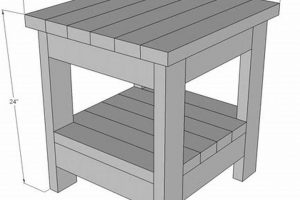
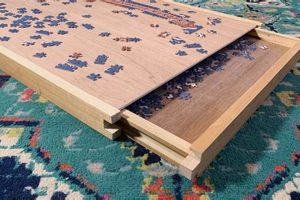
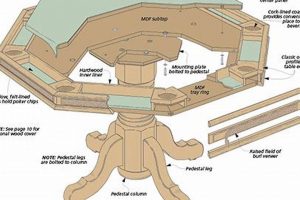
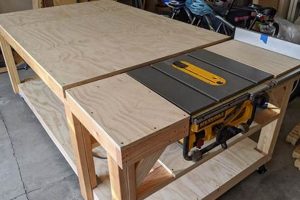
Instructions detailing the process of constructing a basic table using wood are readily available. These instructions typically outline fundamental joinery techniques and material requirements for creating a functional piece of furniture. For instance, a plan might specify using pine lumber, screw joinery, and a basic rectangular design to produce a small side table.
The value of accessible construction guides lies in their ability to empower individuals with woodworking skills, foster creativity, and provide a cost-effective alternative to purchasing pre-made furniture. Historically, such guides have played a significant role in promoting self-sufficiency and the dissemination of practical skills within communities. They offer a tangible entry point into the craft of woodworking.
The following sections will elaborate on selecting appropriate materials, understanding essential woodworking tools, mastering fundamental joinery methods, and applying finishing techniques to complete a woodworking table project successfully.
Essential Guidance for Basic Wood Table Assembly
The subsequent recommendations are designed to optimize the execution of introductory woodworking table projects. These insights aim to mitigate potential errors and enhance the overall quality of the finished product.
Tip 1: Material Selection: Prioritize using softwood lumber, such as pine or fir, for ease of workability. Ensure the lumber is straight, free of knots, and properly kiln-dried to minimize warping or cracking post-construction.
Tip 2: Accurate Measurement: Adherence to precise measurements is paramount. Employ a high-quality measuring tape and a sharp pencil for marking. Double-check all measurements before commencing cuts to avoid cumulative errors.
Tip 3: Safe Tool Operation: Familiarize oneself with the safe operation of all power tools. Utilize appropriate safety equipment, including eye protection and hearing protection. Secure the workpiece properly before initiating any cutting or drilling operations.
Tip 4: Joinery Technique: Start with simple screw joinery or pocket-hole joinery. These methods are forgiving and require minimal specialized tools. Ensure screws are properly countersunk to avoid protruding heads.
Tip 5: Sanding and Finishing: Thoroughly sand all surfaces with progressively finer grits of sandpaper, starting with 120 grit and progressing to 220 grit. This creates a smooth surface for finishing. Apply a consistent finish, such as polyurethane or varnish, in thin coats to prevent drips and ensure proper curing.
Tip 6: Workspace Preparation: Establish a clean and well-lit workspace. Adequate space allows for safe tool maneuvering and workpiece manipulation. Proper lighting improves visibility and reduces the risk of errors.
Tip 7: Pre-Drilling: When using screws, pre-drill pilot holes to prevent the wood from splitting, especially when working near the edges of the board. This is crucial for a clean and structurally sound joint.
Adhering to these guidelines will increase the likelihood of a successful outcome when undertaking basic wood table construction. These recommendations promote precision, safety, and the attainment of a durable and aesthetically pleasing finished product.
The subsequent section will discuss common challenges encountered during woodworking projects and strategies for effective problem-solving.
1. Clear Material List

A clear material list is a cornerstone of any effective simple table woodworking plan. It itemizes the specific types and quantities of wood, fasteners, adhesives, and finishing products required for the project. This list directly impacts the project’s feasibility and outcome. Omission or ambiguity within the material list can lead to material shortages, the use of inappropriate substitutes, or incorrect project costing. For example, a plan might specify “4 – 2×4 lumber, 8 feet long.” Failing to provide this detail necessitates guesswork, potentially leading to the purchase of insufficient materials or wood of the wrong dimensions, rendering the plan unusable without modification.
The absence of a clear material list can increase the time and expense involved in the woodworking project. The woodworker must then estimate quantities, research appropriate material grades, and potentially make multiple trips to the lumber yard. In contrast, a comprehensive list, including dimensions, species, and grade, allows for efficient material acquisition and promotes accurate cost estimation. Furthermore, a detailed material list may include specific hardware requirements, such as “1 1/4-inch wood screws,” ensuring that the correct fasteners are used, which contributes to the structural integrity of the finished table.
In summary, a clear material list is indispensable for simple table woodworking projects. Its accuracy and completeness directly contribute to the efficiency, cost-effectiveness, and ultimately, the success of the undertaking. The presence of a well-defined material list minimizes errors, reduces waste, and empowers the woodworker to focus on the construction process itself. Its importance should not be underestimated, particularly for individuals new to woodworking. In general, for the woodworking hobbyist, a solid understand of materials needed is a must.
2. Accurate Dimensions

The integrity of any simple table woodworking plan hinges on the accuracy of its dimensional specifications. Precise measurements are not merely suggestions but foundational elements that dictate the structural soundness and aesthetic appeal of the completed table. Erroneous dimensions propagate through the construction process, leading to misaligned joints, unstable structures, and a finished product that deviates significantly from the intended design. Consider a simple table plan where the leg length is specified incorrectly. If the legs are too short, the table will be functionally useless; if they are too long, the tabletop height will be impractical and aesthetically jarring. The consequences extend beyond visual flaws, potentially compromising the table’s stability and load-bearing capacity.
The importance of accurate dimensions extends to all components of the plan, from the tabletop’s length and width to the precise angles of any angled cuts. Each dimension interacts with others; therefore, even minor inaccuracies can compound and create substantial discrepancies in the final assembly. For instance, if the plan for a rectangular table specifies a tabletop dimension that is off by even a quarter of an inch, the resulting table may appear skewed or asymmetrical. Mitigating these issues necessitates the use of reliable measuring tools, a meticulous approach to marking and cutting, and a thorough verification process to confirm that all dimensions align with the plan’s specifications. The use of digital calipers and precision squares during the dimensioning process, while seemingly meticulous, is a common and effective practice in ensuring accuracy.
In summary, the accurate dimensioning of all components constitutes a critical dependency for any simple table woodworking plan. Errors in dimensional specifications have cascading effects that compromise both the functionality and visual appeal of the finished piece. Adherence to precise measurements, combined with the use of reliable tools and a meticulous approach, is paramount to realizing the intended outcome of the woodworking project. Accurate dimensions are not simply a detail; they are the bedrock upon which the success of the woodworking endeavor rests, so you should always double check your plans to make sure you are meeting your goals.
3. Simplified Joinery

The successful execution of uncomplicated table projects relies heavily on the strategic implementation of simplified joinery techniques. These techniques, by design, reduce complexity and skill requirements, rendering the project accessible to individuals with limited woodworking experience. The selection of appropriate joinery methods directly impacts the structural integrity, assembly ease, and overall aesthetic of the table. Consequently, the specific joinery chosen serves as a critical determinant in achieving a satisfying result with minimal difficulty. For example, a basic side table plan that employs screw joinery or pocket-hole joinery simplifies the connection of table legs to the tabletop, eliminating the need for intricate mortise and tenon or dovetail joints. This conscious simplification lowers the barrier to entry for novice woodworkers.
The application of streamlined joinery is evident in various aspects of basic woodworking. Butt joints, reinforced with screws or dowels, offer a straightforward means of assembling frame components. Similarly, pocket-hole joinery provides a hidden and relatively strong method for attaching aprons to tabletops, minimizing the visual complexity of the joint. Furthermore, the strategic use of construction adhesive in conjunction with mechanical fasteners enhances joint strength and reduces the need for perfectly tight-fitting joints. In practical application, the simplified joinery can be seen in readily available furniture kits where pre-drilled holes and easily alignable components greatly reduce the complexity of assembly. Another way it is applied in everyday life is a simple desk where the legs are attached by screws.
In conclusion, the correlation between simplified joinery and accessible woodworking projects is undeniable. The intentional selection of user-friendly joinery methods is crucial for maximizing the project’s feasibility, ensuring the table’s structural integrity, and fostering a positive experience for the woodworker. While intricate joinery techniques undeniably hold merit, the focus on simplification is paramount in empowering individuals to successfully complete basic table construction projects. Prioritizing this simplicity can result in attractive, stable tables without requiring extensive skills. Ultimately, the simplified joinery results in a finished project that requires less work while still maintaining its functionality.
4. Step-by-Step Instructions

The effectiveness of simple table woodworking plans is inextricably linked to the presence of clear, well-defined, step-by-step instructions. These instructions serve as a roadmap, guiding the woodworker through the construction process in a logical and sequential manner. The absence of such instructions, or the presence of ambiguous or incomplete instructions, can lead to confusion, errors, and ultimately, project failure. A well-crafted set of step-by-step instructions breaks down the construction process into manageable tasks, minimizing the potential for overwhelm and maximizing the likelihood of successful completion. Consider a simple table plan that requires attaching legs to a tabletop. A clear instruction might state: “Step 1: Position the table legs 2 inches from each corner of the tabletop. Step 2: Secure each leg using four 1 1/4-inch wood screws.” These explicit instructions provide concrete guidance, reducing the possibility of misinterpretation and ensuring accurate assembly. Conversely, vague instructions such as “Attach the legs to the tabletop” leave room for ambiguity and error, particularly for novice woodworkers.
The practical significance of step-by-step instructions extends beyond mere guidance; they also foster confidence and competence. As the woodworker progresses through each step, successfully completing each task, a sense of accomplishment builds. This positive reinforcement encourages further engagement with the project and the development of woodworking skills. Moreover, detailed instructions can incorporate visual aids, such as diagrams or photographs, further clarifying the process and reducing the potential for misinterpretation. For example, a step demonstrating the application of wood glue might include a photo illustrating the correct amount of glue to apply and the proper technique for spreading it evenly. The availability of these visual aids enhances comprehension and facilitates accurate execution. Also, step-by-step instructions are also essential for safety. If a table saw is used to cut the table legs, the step-by-step will include instructions on the proper method to use the saw to avoid accidents.
In summary, step-by-step instructions are a critical component of simple table woodworking plans, without which the project becomes significantly more challenging and prone to failure. Clear, concise, and well-illustrated instructions provide a roadmap for successful construction, foster confidence and competence, and ultimately contribute to a positive woodworking experience. The inclusion of these instructions transforms a complex process into a series of manageable tasks, making woodworking accessible to a wider audience and ensuring that even novice woodworkers can create functional and aesthetically pleasing tables. Thus, the effectiveness of “simple table woodworking plans” heavily relies on the clarity and precision of the step-by-step guidance provided, acting as a cornerstone for successful execution and satisfying outcomes. If the table woodworking plans do not have step-by-step instructions, that should be seen as a red flag and the woodworker should search for better plans, or construct a plan by themselves.
5. Finishing Guidance

Effective finishing guidance constitutes an indispensable element within simple table woodworking plans. Its presence directly impacts the durability, aesthetics, and longevity of the constructed table. Without clear instructions on proper finishing techniques, a well-built table may be susceptible to environmental damage, exhibit an unappealing appearance, or degrade prematurely. For instance, consider a table constructed from softwood, such as pine. Without proper sealing and finishing, the porous nature of the wood renders it vulnerable to moisture absorption, staining, and surface abrasion. Specific finish application instructions serve to mitigate these risks by outlining the correct products, application methods, and drying times. Effective woodworking plans provide the details required for completing the process.
The correlation between finishing guidance and a successful woodworking outcome extends beyond mere protection. The choice of finish, whether it be paint, stain, varnish, or oil, directly influences the table’s aesthetic. Guidance related to proper sanding, priming, and application techniques ensures a smooth, uniform finish that enhances the wood’s natural grain or achieves the desired color and sheen. For example, plans for a rustic-style table might recommend a staining technique that accentuates the wood’s imperfections, followed by a matte varnish for protection. Conversely, plans for a contemporary table might suggest a high-gloss lacquer finish for a sleek, modern look. Proper finishing will result in a more visually appealing piece. Furthermore, the plan should provide guidance for how to apply each coat, or what grit sandpaper to use in between coats.
In conclusion, finishing guidance is integral to simple table woodworking plans, acting as a critical bridge between construction and long-term functionality and visual appeal. Its inclusion provides the necessary information for protecting the table from damage, enhancing its aesthetic qualities, and ensuring its longevity. The absence of such guidance diminishes the value of the plan, leaving the woodworker without the necessary knowledge to complete the project successfully. Therefore, a comprehensive woodworking plan should provide clear and detailed finishing instructions, enabling the creation of a durable and aesthetically pleasing finished product. Moreover, understanding finishes and how to apply them can be used to create other pieces in the woodworker’s arsenal.
Frequently Asked Questions
The following addresses common inquiries regarding the utilization and interpretation of basic woodworking plans for constructing tables.
Question 1: What tools are essential for executing woodworking plans effectively?
Essential tools typically include a measuring tape, a saw (hand saw or circular saw), a drill, a screwdriver, sandpaper, and clamps. Specific tool requirements vary based on the plan’s complexity and joinery methods.
Question 2: How does one determine the appropriate type of wood for a table project?
Wood selection depends on factors such as budget, desired appearance, and required durability. Softwoods like pine are cost-effective and easy to work with, while hardwoods like oak provide greater strength and aesthetic appeal.
Question 3: What safety precautions should be observed when working with woodworking tools?
Safety precautions necessitate the use of eye protection, hearing protection, and appropriate dust masks. Power tools demand focused attention and adherence to manufacturer guidelines. Securing the workpiece properly is crucial for safe cutting and drilling operations.
Question 4: How can one ensure accuracy when following dimensional specifications within a plan?
Accuracy is achieved through the use of precision measuring tools and meticulous attention to detail. Double-checking all measurements before commencing cuts minimizes the risk of cumulative errors.
Question 5: What are common challenges encountered during table construction, and how can these be addressed?
Common challenges encompass wood splitting, misaligned joints, and uneven finishes. These issues can be mitigated by pre-drilling pilot holes, employing clamps for secure joinery, and applying finish coats in thin, even layers.
Question 6: What resources are available for learning more about woodworking techniques and plan interpretation?
Resources include woodworking books, online tutorials, and local woodworking classes. These resources offer valuable insights into tool usage, joinery methods, and finishing techniques.
Adherence to these principles promotes successful table construction and minimizes potential complications. Understanding these queries supports the interpretation of simple table woodworking plans.
The subsequent section will cover resources for finding woodworking plans and inspiration for table designs.
Concluding Observations Regarding Basic Table Construction Guides
This examination of simple table woodworking plans underscores the crucial role of detailed instruction, accurate measurements, simplified joinery, and finishing guidance in facilitating successful project outcomes. These guides offer a pathway for individuals to engage in woodworking, fostering skill development and providing cost-effective furniture solutions.
The adherence to well-structured plans enables the construction of functional and aesthetically pleasing tables. Continued exploration and application of these resources contribute to the preservation and advancement of woodworking as a valuable craft. Proper planning is an investment that yields tangible and lasting rewards.