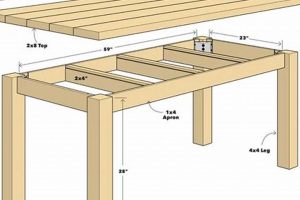
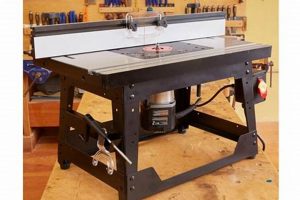
A circular structure crafted from wood and intended for use as a tabletop surface represents a common project undertaken in the craft of shaping wood. Such projects often involve employing various techniques like joinery, shaping, and finishing to achieve a functional and aesthetically pleasing result. An example would be a solid piece used for dining, games, or display, demonstrating both practical application and artistry.
The significance of building a circular wooden surface lies in its versatility and ability to foster social interaction. The form encourages equal participation and unobstructed conversation among those gathered around it. Historically, these structures have been symbols of unity and equality, evident in legendary stories and traditional meeting places. Furthermore, creating such a structure hones skills in precision, design, and material selection.
The following sections will delve into aspects pertaining to the design, construction techniques, appropriate wood choices, and essential finishing processes involved. Considerations for achieving structural integrity, aesthetic appeal, and long-term durability will also be discussed.
Woodworking Round Table
The creation of a circular wooden tabletop presents unique challenges and requires careful attention to detail. The following considerations aim to guide the woodworker through the process, ensuring a structurally sound and aesthetically pleasing outcome.
Tip 1: Material Selection is Paramount: The type of wood chosen significantly impacts the final product’s stability and appearance. Hardwoods, such as maple or oak, provide durability and resistance to warping, crucial for a large, unsupported surface. Consider grain patterns to enhance the table’s visual appeal.
Tip 2: Employ Precise Cutting Techniques: Accurate cuts are essential for achieving a true circle. The use of a trammel or compass, combined with a bandsaw or jigsaw, allows for precise shaping. Successive, shallow cuts are preferable to force, which can lead to splintering.
Tip 3: Strategic Joinery Strengthens the Structure: When constructing a tabletop from multiple boards, employ robust joinery techniques. Options include tongue-and-groove, dowel joints, or biscuits, all of which provide increased surface area for glue adhesion and enhance the overall strength.
Tip 4: Grain Orientation Mitigates Warping: Pay attention to the orientation of the wood grain in relation to the table’s center. Alternating the direction of the grain in adjacent boards can help counteract the natural tendency of wood to warp or cup due to changes in humidity.
Tip 5: Sanding and Smoothing Create a Flawless Surface: Proper surface preparation is crucial for an even finish. Begin with coarse-grit sandpaper and gradually progress to finer grits. Thorough sanding eliminates imperfections and ensures optimal adhesion of the chosen finish.
Tip 6: Consider a Breadboard End (for large diameters): For large-diameter tables, a breadboard end can help to prevent warping and cupping. This involves attaching a perpendicular board to the edges of the tabletop, allowing for expansion and contraction across the width of the table without causing structural stress.
Tip 7: Apply a Durable Finish for Protection: Select a finish appropriate for the table’s intended use. Options include polyurethane, varnish, or oil-based finishes, each offering varying degrees of protection against moisture, scratches, and UV damage. Apply multiple thin coats for optimal durability.
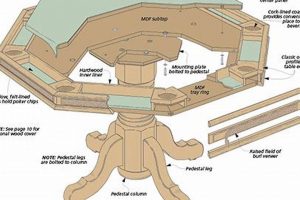
Tip 8: Ensure Stability with a Properly Designed Base: The table’s base must be designed to adequately support the weight of the tabletop. Consider the size and shape of the base in relation to the tabletop’s dimensions to prevent tipping or instability. A well-designed base is both functional and aesthetically pleasing.
By adhering to these considerations, the woodworker can significantly increase the likelihood of creating a structurally sound, visually appealing, and long-lasting piece. Attention to detail and a thorough understanding of woodworking principles are key to success.
The following sections will explore common pitfalls in construction and provide solutions to ensure a successful outcome. Careful planning and execution remain paramount throughout the entire process.
1. Diameter

The diameter of a wooden circular tabletop directly impacts its structural requirements and intended functionality. A larger diameter necessitates enhanced support mechanisms to counteract potential sagging or instability. The distance across the circular surface dictates the span of unsupported wood, influencing the selection of wood species, joinery techniques, and base design. A small surface, such as a side stand, may require minimal reinforcement, while a large dining table demands a robust foundation and potentially a breadboard end construction to mitigate warping across the grain.
The correlation between the measure across a circular piece and its purpose is demonstrably clear. A small diameter is suitable for intimate settings or serving specific functions, while a large diameter is more appropriate for communal gatherings. Designing a round tabletop for dining requires calculating a diameter that accommodates a specific number of place settings, ensuring adequate space for each individual. An insufficient diameter results in overcrowding, hindering its intended use, whereas an excessive diameter may become unwieldy and dominate the space.
In summary, understanding the relationship between circular wooden structure diameter and its structural integrity, functional usage, and aesthetic integration is crucial to ensure long-term success and user satisfaction. Accurately determining the optimal distance from edge to edge of a particular woodworking project requires careful consideration of wood characteristics, base support, and intended applications. Failure to adequately address these factors could result in either a structurally unsound or an aesthetically disproportionate piece of furniture.
2. Wood Species

The selection of a suitable wood species is fundamental to the design and construction of a circular wooden tabletop. The material’s properties directly influence the final product’s structural integrity, aesthetic appeal, and long-term durability. This section will explore crucial facets of wood species selection in the context of creating a circular wooden work.
- Hardness and Durability
Hardwoods, such as maple, oak, and cherry, generally offer superior resistance to dents, scratches, and wear compared to softwoods like pine or fir. The intended use significantly informs this decision; a dining or gaming surface subjected to frequent use necessitates a more durable wood species. For instance, a red oak surface is highly resistant to daily wear, while a pine surface is more prone to damage.
- Stability and Moisture Resistance
Wood’s response to moisture fluctuation is a critical consideration. Species with low shrinkage coefficients, like mahogany or walnut, are less susceptible to warping or cracking due to changes in humidity. A stable wood species maintains the structural integrity of the circular plane, particularly in environments with varying humidity levels. A less stable choice would require specific construction techniques, like breadboard ends.
- Grain Pattern and Aesthetics
The visual characteristics of wood grain contribute significantly to the aesthetic of the finished circular piece. Species such as walnut, with its rich, dark color and complex grain patterns, can create a visually striking surface. Conversely, maple offers a lighter, more uniform appearance. The woodworker selects based on the desired aesthetic, considering factors like stain compatibility and overall design style. The choice could complement the base structure.
- Workability and Cost
The ease with which a wood species can be workedcut, shaped, and finishedis a practical factor. Some species, like poplar, are relatively soft and easy to machine, making them suitable for intricate details. However, workability often correlates with cost, influencing the selection based on budget constraints and skill level. A more costly option, while offering superior qualities, may not be feasible for all projects.
In conclusion, the careful consideration of these facetshardness, stability, grain pattern, workability, and costis essential for selecting the optimal wood species for circular wooden constructions. The appropriate choice ensures a balance between functionality, aesthetics, and longevity, resulting in a durable and visually appealing piece.
3. Joint Strength

The structural integrity of any wooden construction relies significantly on the strength of its joints; this principle is especially critical in the context of a circular wooden tabletop. The absence of corners in a circular design distributes stress differently than in rectangular structures, placing unique demands on the joints connecting individual wooden components. Inadequate joint strength can lead to premature failure, warping, or complete structural collapse.
- Surface Area of Glue Adhesion
Joints possessing a larger surface area for glue adhesion provide superior resistance to tensile and shear forces. Techniques like tongue-and-groove or mortise-and-tenon, which maximize the contact surface between wooden elements, are preferred for circular wooden constructions, particularly for larger diameters. A butt joint, with its minimal surface area, is generally insufficient for withstanding the stresses inherent in a large circular work.
- Mechanical Fasteners
The incorporation of mechanical fasteners, such as screws or dowels, enhances joint strength beyond reliance on adhesive alone. These fasteners provide a physical interlock between wooden elements, resisting separation under load. The selection of appropriate fasteners, including screw type and spacing, is crucial for achieving optimal joint performance in round tabletop applications. Dowels strategically placed reinforce the structure where significant stress is expected.
- Wood Grain Orientation
Aligning the wood grain strategically at the joint interface can significantly impact its strength. End-grain gluing, where the end grain of one piece is glued to the side grain of another, is generally weaker than side-grain gluing. Mitigating end-grain exposure and maximizing side-grain contact within the joint enhances its overall resistance to separation. Optimal grain alignment is key for the durability of a round table.
- Type of Adhesive
The type of adhesive employed directly influences the joint’s ability to withstand stress and environmental factors. Polyurethane or epoxy adhesives offer superior strength and moisture resistance compared to traditional wood glues, making them suitable for circular wooden works exposed to varying humidity levels or significant loads. Selecting the appropriate adhesive ensures a durable and stable connection.
In summary, achieving adequate joint strength in a circular wooden surface necessitates careful consideration of glue surface area, mechanical fasteners, grain orientation, and adhesive type. The integration of these factors results in a robust and stable structure, capable of withstanding the unique stresses inherent in the design. A well-executed joint not only enhances the table’s overall durability but also contributes to its longevity and aesthetic appeal.
4. Surface Finish

The application of a surface finish to a circular wooden tabletop significantly impacts its long-term durability, aesthetic qualities, and resistance to environmental factors. A properly selected and applied finish acts as a protective barrier against moisture, scratches, and UV degradation, thereby extending the service life of the piece. The cause-and-effect relationship is direct: inadequate or inappropriate finishing results in accelerated wear and tear, compromising the structural integrity and visual appeal of the wooden work.
The finish is a critical component of the overall design. For example, a natural oil finish enhances the inherent grain patterns of the wood, providing a subtle, tactile surface that is well-suited for dining furniture. Conversely, a high-gloss polyurethane finish offers greater protection against spills and stains, making it ideal for surfaces subject to heavy use. In situations requiring increased protection, several layers may be required. The practical significance of understanding the characteristics of different finishes lies in the ability to select the optimal treatment to meet specific performance and aesthetic goals. A lack of protection results in a damaged appearance which is undesirable.
Selecting the optimal finish involves consideration of the wood species, the intended use of the table, and the desired aesthetic. Challenges may arise in achieving an even, flawless finish, particularly with porous wood species. The application of a sanding sealer prior to the finish coat can help to mitigate this issue. In conclusion, a well-executed surface finish is essential for the preservation and enhancement of a circular wooden tabletop, safeguarding its structural integrity, visual appeal, and overall value. The appropriate finish selection ensures that the table withstands the test of time, delivering both functionality and aesthetic satisfaction.
5. Base Stability

The stability of the supporting structure is paramount to the functionality and safety of any circular wooden table. The circular tabletop design, lacking the inherent support provided by corners in rectangular or square tables, places unique demands on the base to prevent tipping, wobbling, or structural failure. Therefore, a carefully considered base design is crucial for ensuring a stable and secure circular wooden surface.
- Footprint and Center of Gravity
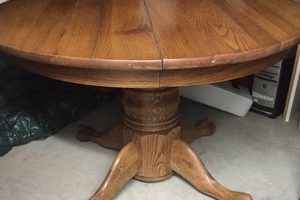
The size and shape of the base’s footprint directly influence stability. A wider base footprint provides a lower center of gravity and a greater resistance to tipping. For a circular tabletop, a base with a splayed leg design or a large central pedestal distributes weight effectively and prevents lateral instability. For instance, a small, narrow base supporting a large diameter table is inherently unstable, prone to tipping with minimal force applied to the tabletop’s edge. Careful calculations of the table’s weight distribution are essential in determining the appropriate footprint.
- Material Strength and Rigidity
The materials used in the base construction must possess sufficient strength and rigidity to support the weight of the tabletop and any anticipated loads. Solid wood, metal, or engineered materials are common choices, each offering varying degrees of structural integrity. For a large diameter, a hardwood base with robust joinery provides optimal stability. A base constructed from flimsy or inadequate materials is likely to flex or deform under load, compromising the overall stability of the circular wooden construction.
- Joint Integrity and Connection Methods
The method of connecting the base to the tabletop significantly impacts stability. Secure and robust joinery techniques, such as mortise-and-tenon joints, bolted connections, or integrated support structures, ensure a strong and stable connection. Loose or poorly constructed joints introduce instability, leading to wobbling or even separation of the base from the tabletop. For example, a simple screw attachment without proper reinforcement is inadequate for supporting a heavy tabletop.
- Weight Distribution and Load Capacity
Even weight distribution across the base is crucial for maintaining stability. An uneven weight distribution creates imbalances, increasing the risk of tipping or structural failure. The base must be designed to accommodate the anticipated load capacity of the circular surface, accounting for the weight of objects placed on it. Reinforcements may be needed in areas subject to concentrated stress to prevent deformation or collapse.
In conclusion, achieving optimal base stability is paramount to the successful construction of any circular wooden table. Proper consideration of footprint, material strength, joint integrity, and weight distribution is essential for creating a safe, functional, and aesthetically pleasing piece. An unstable base undermines the purpose of the whole design, making those above considerations a central point of the woodworking project.
6. Edge Profile
The contour of a circular wooden surfaces perimeter, referred to as the edge profile, significantly influences the aesthetic character, tactile experience, and functional safety of the woodworking round table. The edge is not merely a boundary; it’s a critical design element impacting both the visual appeal and the usability of the piece.
- Aesthetic Definition
The edge profile dictates the tables overall style. A simple, square edge projects a modern, minimalist aesthetic, whereas a rounded or beveled edge conveys a softer, more traditional feel. Ogee or Roman ogee profiles, characterized by complex curves, introduce an element of classical elegance. The selected profile must harmonize with the tables overall design, the wood species, and the intended setting. For example, a rustic table might feature a live edge, showcasing the natural shape of the wood.
- Tactile Comfort and Safety
The edge profile determines the tactile experience of the table. A sharp edge presents a potential hazard, especially for children or in high-traffic areas. Rounding or softening the edge enhances safety and improves comfort for users who frequently lean on the table. A bullnose edge, with its fully rounded profile, minimizes the risk of injury. A chamfered edge removes sharpness while maintaining a more modern aesthetic. The profile contributes significantly to the user experience.
- Durability and Resistance to Damage
The edge profile can affect the tabletops resistance to chipping and wear. A sharp, square edge is more susceptible to damage from impacts than a rounded or beveled edge. A more gradual curve or bevel distributes impact forces, reducing the likelihood of chipping or splintering. A properly shaped edge thus contributes to the longevity of the furniture piece.
- Finish Application and Consistency
The edge profile presents unique challenges for finish application. Complex profiles with intricate curves require careful sanding and precise application techniques to ensure a consistent and even finish. Sharp corners and edges tend to accumulate finish unevenly, leading to drips or pooling. Simpler profiles, such as a straight bevel or a rounded edge, are generally easier to finish evenly. The profile must be taken into account when selecting the type of finish and the method of application.
Therefore, selecting the appropriate contour for the rim is crucial for ensuring the visual appeal, user safety, and long-term durability of woodworking round table. The chosen shape should seamlessly integrate form, function, and the constraints of the material, enhancing the overall value and user satisfaction with the finished product.
7. Grain Direction
The orientation of wood grain within a circular wooden tabletop has a profound effect on its structural stability and long-term resistance to warping or cracking. Wood inherently expands and contracts across its grain with changes in humidity. In a circular configuration, this movement, if unmanaged, can induce significant stresses, leading to deformation or failure. Properly accounting for grain direction is thus a critical element in the design and construction of a durable woodworking round table. For example, consider a table constructed from multiple boards where all grains run in the same direction. Seasonal humidity changes would cause these boards to expand and contract unevenly, potentially leading to cupping or bowing of the surface. This demonstrates the direct correlation between this element of material selection and the longevity of the finished piece.
Practical applications of this understanding manifest in various construction techniques. One strategy involves alternating the grain direction of adjacent boards during lamination, effectively counteracting the effects of expansion and contraction. Another, more advanced approach includes incorporating a breadboard end, a perpendicular piece attached to the table’s circumference. The breadboard end allows the main tabletop to expand and contract within its frame, minimizing stress and preventing warping. Furthermore, understanding grain direction informs the selection of appropriate jointing methods. Mitered joints, for instance, are often reinforced with splines or biscuits to prevent movement along the grain, which can compromise the joint’s integrity. Failure to account for grain direction can result in joints that separate over time, diminishing the overall structural soundness of the round wooden creation. Careful management is always required.
In summary, grain direction is a critical consideration in circular wooden projects, influencing both design choices and construction methods. The consequences of neglecting it range from minor aesthetic imperfections to significant structural failures. Implementing strategies to mitigate the effects of wood movement across the grain is essential for producing a stable and long-lasting circular wooden construction. The enduring success of any woodworking round table project depends on a comprehensive understanding of grain direction and its impact on wood behavior. Ignoring this fundamental principle jeopardizes the structural stability, aesthetic quality, and long-term viability of the finished piece.
Frequently Asked Questions
The following questions address common inquiries and concerns related to designing, constructing, and maintaining circular wooden tabletops.
Question 1: What are the key considerations when selecting wood for a circular tabletop?
Key considerations include wood hardness, stability, grain pattern, and cost. Hardwoods generally offer greater durability, while species with low shrinkage coefficients resist warping. Grain patterns contribute to the aesthetic appeal, and cost influences material selection based on budget constraints. This should all inform wood selection.
Question 2: What jointing techniques are most appropriate for a round table?
Robust joinery is crucial. Techniques such as tongue-and-groove, mortise-and-tenon, or dowel joints maximize surface area for glue adhesion and enhance structural strength. The selection of a particular joint should align with anticipated stress loads and the material characteristics.
Question 3: How does grain direction affect the stability of a circular wooden creation?
Wood expands and contracts across the grain with changes in humidity. Alternating grain direction in adjacent boards or incorporating breadboard ends helps counteract these effects, preventing warping or cracking. Correct alignment is essential.
Question 4: What type of base provides the best support for a circular tabletop?
A wider base footprint, with a lower center of gravity, enhances stability. Splayed legs or a large central pedestal effectively distribute weight and prevent tipping. The base material must also possess sufficient strength to support the tabletop and any anticipated loads.
Question 5: How should one address the edge profile of a circular wooden creation?
The edge profile influences both aesthetics and safety. Rounded or beveled edges improve tactile comfort and reduce the risk of injury, while also enhancing resistance to chipping and wear. The profile should harmonize with the tabletops overall design and the intended use.
Question 6: Which surface finishes are best for protection and longevity?
Polyurethane or epoxy finishes offer superior protection against moisture, scratches, and UV degradation. Multiple thin coats of the selected finish enhance durability. Consider the intended use and the level of protection required when selecting the optimal finish.
These FAQs underscore the multifaceted nature of this woodworking project and reinforce the necessity of integrating design expertise and wood material competence. Accurate execution and attention to detail are essential for creating long-lasting pieces with an emphasis on usability, longevity, and design features.
The following section transitions into a conclusion which will recap important points covered throughout the article and will highlight the significance of this woodworking project.
Conclusion
The preceding discussion has explored various facets inherent in the design and construction of a woodworking round table. Critical aspects such as material selection, joinery techniques, base stability, surface finishing, and grain direction management have been addressed. The impact of each facet on the structural integrity, aesthetic qualities, and long-term durability of the finished piece has been analyzed, emphasizing the necessity of a holistic approach to the project.
Creating a woodworking round table transcends mere woodworking; it represents an exercise in careful design, precise execution, and an understanding of material properties. Mastery of these principles enables the creation of functional objects that can serve as enduring assets. Further research into advanced techniques and innovative materials remains crucial for further refining the craft. The circular form, in particular, is a challenge that offers many unique opportunities for woodworkers.