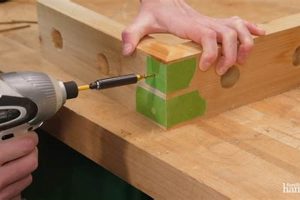
A crucial power tool in woodworking, a router enables the shaping of wood to create diverse profiles, joinery, and decorative elements. It employs a rapidly spinning bit to remove material, allowing for precise cuts. Examples include creating decorative edges on table tops, cutting grooves for cabinet door panels, or carving intricate designs into wooden surfaces.
Its importance stems from its versatility and ability to execute tasks that would be difficult or impossible with hand tools alone. The tool enhances efficiency, precision, and repeatability in woodworking. Historically, the capabilities it offers were achieved through laborious manual processes, showcasing its transformative impact on the craft. Its use promotes both creative expression and structural integrity in projects.
Understanding the different types of these tools, selecting the appropriate bits, and mastering safe operating techniques are essential for successfully integrating this versatile tool into various woodworking endeavors. The following sections will explore these aspects in detail, providing a foundation for achieving professional-quality results.
Tips
The following tips offer guidance for maximizing precision and safety when integrating the specified woodworking technique into projects.
Tip 1: Secure Workpiece Clamping: Prior to operation, ensure the workpiece is firmly secured to the work surface. Unsecured materials can shift during cutting, leading to inaccurate results and potential hazards.
Tip 2: Select Appropriate Bit Geometry: Choose bits designed specifically for the intended cut and material. Using an incorrect bit can result in tear-out, burning, or damage to the tool.
Tip 3: Maintain a Consistent Feed Rate: A consistent feed rate is essential for achieving a smooth and even cut. Avoid rushing the process, as this can lead to uneven surfaces and increased risk of kickback.
Tip 4: Use Multiple Passes for Deep Cuts: When making deep cuts, remove material in multiple passes rather than attempting to remove it all at once. This reduces strain on the tool and bit, resulting in cleaner cuts and prolonging bit life.
Tip 5: Rout Against the Grain Judiciously: Recognize the direction of the wood grain and, when possible, rout with the grain. Cutting against the grain can lead to tear-out; if unavoidable, take shallow passes and use a sharp bit.
Tip 6: Regularly Inspect and Maintain Bits: Dull or damaged bits can compromise cut quality and increase the risk of accidents. Regularly inspect bits for sharpness and integrity, and replace them as needed.
Tip 7: Employ Dust Collection Systems: Woodworking processes generate considerable amounts of dust. Utilize a dust collection system to maintain a clean and safe work environment and to improve visibility.
Adhering to these recommendations will improve project outcomes and promote a safer work environment.
The following section will address common challenges and troubleshooting techniques associated with employing this important woodworking process.
1. Edge profiling

Edge profiling, a prominent application, significantly enhances both the aesthetic appeal and functional safety of woodworking projects. Utilizing a router, woodworkers can create a variety of edge details, such as roundovers, chamfers, and ogees. The connection between edge profiling and this tool is direct: the tool provides the means to execute these profiles with precision and repeatability that would be difficult, if not impossible, to achieve manually. A roundover bit, for example, softens sharp edges on furniture, mitigating potential injuries. Similarly, a decorative ogee profile can elevate the visual impact of a tabletop or cabinet door.
The selection of an appropriate router bit is crucial for achieving the desired profile. Factors such as bit material (e.g., high-speed steel vs. carbide-tipped), cutting geometry, and bearing type influence the outcome. Furthermore, control over the tool’s speed and feed rate directly affects the smoothness of the cut and minimizes the risk of tear-out, especially when working with hardwoods. Edge profiling is also used practically to create appealing handholds and ergonomic designs.
Mastery of this process requires understanding of bit selection, feed rate control, and safe operating procedures. Addressing the challenges of tear-out and uneven cuts demands a keen eye and a willingness to experiment with different techniques. Ultimately, the ability to effectively shape edges elevates the quality and value of woodworking projects, demonstrating the importance of this tool as an important component.
2. Joinery creation
A fundamental aspect of woodworking, joinery creation involves assembling individual wood components to construct a cohesive and durable structure. The router significantly expands the range and precision of joinery techniques achievable. While traditional hand tools can create joinery, routers offer increased efficiency and accuracy, particularly when producing complex or repetitive joints. The use of a router allows for the creation of strong and aesthetically pleasing connections, directly impacting the structural integrity and visual appeal of the completed piece. For example, mortise-and-tenon joints, essential for robust frame construction, can be efficiently and precisely cut with a router and mortising jig. Similarly, dovetail joints, prized for their strength and visual appeal in drawer construction, benefit from the accuracy afforded by a router and dovetail jig.
The selection of the appropriate bit is paramount in joinery creation. Straight bits, rabbeting bits, dovetail bits, and mortising bits each serve specific purposes. The accuracy of the router setup, including fence alignment and bit depth, is critical for ensuring tight-fitting joints. Mismatched or poorly executed joints can compromise the structural integrity of the project, leading to instability and premature failure. The router also facilitates the creation of more intricate joinery details, such as inlays and decorative accents, that would be exceedingly difficult to execute by hand. Cabinet doors, for example, often utilize cope-and-stick joinery, which is efficiently produced with a router and dedicated bit set.
In summary, the router provides an efficient and accurate means for creating a wide variety of joinery types, which are important building blocks in woodworking projects. This, in turn, provides stability and attractiveness, with the quality of joinery affecting the longevity of projects. The key to successful integration lies in proper bit selection, precise setup, and a thorough understanding of the principles of joinery design. The appropriate routing of joinery is the basis of building stable wooden products.
3. Surface shaping
Surface shaping, a pivotal facet of woodworking, encompasses altering the planar characteristics of wood to achieve functional or aesthetic goals. The router serves as a primary tool for executing these shaping operations, providing controlled material removal and the capacity to create complex contours. The tool’s ability to accept diverse bit profiles allows for a wide spectrum of shaping possibilities, directly impacting the final form and visual appeal of woodworking projects. Consider, for example, creating a dished-out seat for a wooden stool, a sculpted detail on a cabinet door, or the carved surface of a decorative bowl. These shaping operations are greatly facilitated by the precision and control offered by a router and appropriate shaping jigs. Without such tools, these details require significant manual labor and expertise.
The practical application of surface shaping extends beyond mere aesthetics. It contributes to ergonomics, structural integrity, and functionality. A smoothly contoured handrail, for instance, enhances user comfort and safety. Similarly, shaping the interior of a drawer to accommodate specific items improves organization and accessibility. The selection of router bits, cutting speed, and feed rate directly influence the quality of the shaped surface. Inappropriate settings can lead to tear-out, burning, or uneven results. Techniques such as climb cutting and the use of templates often mitigate these challenges. CNC routers automate surface shaping based on CAD models, enabling the production of complex 3D forms with high precision and repeatability.
In conclusion, surface shaping is integral to achieving desired outcomes, with the router being a powerful tool for shaping projects. The device facilitates the creation of a wide range of surface features. A deep understanding of tool operation, bit selection, and material properties is essential for successful implementation. The relationship between the tool and surface shaping exemplifies the synergy between technology and craftsmanship in modern woodworking, enabling both artistic expression and functional design.
4. Template routing

Template routing, a specialized technique within woodworking, leverages the capabilities of a router to replicate precise shapes and patterns consistently. This method significantly enhances efficiency and accuracy, particularly when producing multiple identical parts. It finds extensive application in furniture making, cabinetry, and other woodworking endeavors requiring repeatable forms.
- Creating Consistent Shapes
The primary role of template routing lies in generating uniformity. A template, typically constructed from MDF, plywood, or acrylic, guides the router bit, ensuring that each workpiece assumes the exact shape of the template. This is particularly useful for creating curved components or intricate designs that would be difficult to reproduce accurately freehand. Examples include replicating chair legs, cabinet door panels, or decorative moldings.
- Material Selection and Template Construction
The selection of appropriate template material is crucial for successful routing. The material must be dimensionally stable, durable enough to withstand repeated use, and easily machinable to create precise shapes. Template construction techniques vary depending on the complexity of the design. Simple templates can be cut with a bandsaw and refined with sanding, while more intricate templates may require CNC machining for optimal accuracy. The correct selection and construction affects the tool performance and the quality of the woodworking project.
- Router Bit Selection and Setup
Selecting the appropriate router bit is essential for template routing. Flush trim bits, which feature a bearing that rides along the edge of the template, are commonly used. The bearing ensures that the cutting edge follows the template’s contours precisely. Accurate bit height adjustment and proper router speed are critical for achieving clean cuts and preventing tear-out, contributing to the efficiency of the project and tool.
- Safety Considerations
Template routing, like all woodworking operations involving power tools, requires adherence to strict safety protocols. Securely clamping the template and workpiece together is essential to prevent movement during routing. Eye and ear protection should always be worn. It is also important to be mindful of the router’s direction of rotation to avoid kickback and maintain control of the tool. Avoiding kickback events reduces risk and increases productivity in woodworking projects.
The technique effectively scales projects and increases product consistency. A router’s versatility, combined with the precision offered by templates, makes this approach indispensable for woodworkers seeking efficiency and accuracy in their projects. Proper usage of routers can reduce physical exertion in projects.
5. Bit selection
The successful execution of any woodworking project utilizing a router is fundamentally dependent on appropriate bit selection. The router itself provides the power and control, but the bit dictates the shape, precision, and quality of the cut. Choosing the correct bit for the material, the desired profile, and the specific task is therefore paramount.
- Profile Determination
Router bits are manufactured in a vast array of profiles, each designed to create a specific edge detail, groove, or decorative element. Roundover bits, chamfer bits, ogee bits, and cove bits are just a few examples. The selection of a particular profile bit directly determines the final appearance of the project. For example, a roundover bit softens edges for safety and comfort, while an ogee bit adds an elegant decorative touch. The profile selection aligns functionality with aesthetics in woodworking projects.
- Material Compatibility
Router bits are constructed from various materials, each suited for different wood types and applications. High-speed steel (HSS) bits are suitable for softer woods and general-purpose use, while carbide-tipped bits offer superior durability and are recommended for hardwoods, abrasive materials, and demanding tasks. Employing an inappropriate bit material can lead to premature wear, reduced cutting efficiency, and compromised cut quality. The material choice impacts longevity and the project result.
- Cutting Geometry and Size
The geometry and size of the cutting edges influence the efficiency and smoothness of the cut. Bits with multiple cutting edges generally produce smoother results but may require more power. The diameter of the bit affects the amount of material removed in a single pass and the minimum radius of curves that can be cut. Smaller diameter bits are often preferred for intricate work, while larger diameter bits are more suitable for heavy-duty material removal. Cutting geometry and size define cutting parameters, such as material removal rate.
- Shank Size and Router Compatibility
Router bits are available with different shank sizes, typically 1/4 inch or 1/2 inch. The shank size must be compatible with the router’s collet. While 1/4-inch shank bits are suitable for lighter-duty tasks, 1/2-inch shank bits offer greater stability and are recommended for larger bits and more demanding applications. Using an incorrectly sized shank can lead to bit slippage, vibration, and potential damage to the router. Compatibility ensures efficient power transfer for the tool.
In conclusion, the selection of appropriate bits is a critical aspect of woodworking. The proper use provides high-quality woodwork and efficient power use. A deep understanding of bit profiles, material compatibility, cutting geometry, and shank size requirements is essential for maximizing the router’s potential and achieving professional-quality results in woodworking projects. Ultimately, informed bit selection contributes to both the functional and aesthetic success of the finished piece.
Frequently Asked Questions
This section addresses common inquiries regarding the application of routers in woodworking projects, providing clarity and guidance on their effective and safe utilization.
Question 1: What factors determine the most suitable router for a given woodworking project?
The selection depends on the scope and complexity of the project. Plunge routers are versatile for intricate cuts and controlled depth, while fixed-base routers excel in edge profiling and straight cuts. Horsepower should align with the material’s density; hardwoods require more power than softwoods. Variable speed control is advantageous for managing different bit sizes and wood types.
Question 2: How can tear-out be minimized when routing against the grain?
Tear-out occurs when wood fibers are lifted and torn during cutting. Mitigating this involves taking shallow passes, using sharp bits, and employing a backer board to support the wood fibers at the exit point of the cut. Climb cutting, a technique where the router moves in the opposite direction of the bit’s rotation, can be used judiciously but requires a firm grip and utmost caution.
Question 3: What safety precautions are essential when operating a woodworking projects router?
Safety protocols are paramount. Eye and ear protection are mandatory. The workpiece must be securely clamped to prevent movement. Hands should be kept a safe distance from the bit. Power tools must only be operated by those with adequate training. A dust collection system is recommended to maintain a clean and healthy work environment. These steps can greatly help reduce the risk of bodily harm.
Question 4: How does one select the appropriate router bit for a specific woodworking task?
Bit selection hinges on the desired profile and the material being cut. Carbide-tipped bits are preferred for hardwoods due to their durability. The bit’s profile should match the intended design, whether it be a roundover, chamfer, or groove. Shank size must be compatible with the router’s collet. Considerations of router bit quality determine performance and longevity.
Question 5: What is the purpose of a router table, and how does it enhance woodworking projects?
A router table inverts the router, providing a stable and level surface for workpiece manipulation. This facilitates accurate edge profiling, jointing, and shaping. The table’s fence guides the workpiece, ensuring consistent cuts. Router tables are beneficial for producing multiple identical parts and handling small or irregularly shaped pieces, promoting efficiency and precision.
Question 6: How should router bits be maintained to ensure optimal performance and longevity?
Regular cleaning and sharpening are essential. Resin buildup can be removed with a solvent and a stiff brush. Bits should be sharpened periodically by a qualified professional to maintain their cutting edge. Damaged bits should be replaced immediately to prevent accidents and ensure clean cuts. Router bits will last longer if cared for and cleaned regularly.
Adherence to these guidelines will enhance the safety, precision, and overall success of woodworking projects.
The following section will explore advanced techniques and specialized applications.
Conclusion
The preceding sections have explored various facets of woodworking, emphasizing the critical role of the router. Key aspects, including edge profiling, joinery creation, surface shaping, template routing, and bit selection, have been examined to elucidate the tool’s versatility and its capacity to enhance both the functionality and aesthetic appeal of woodworking projects. Understanding these components is essential for achieving optimal results.
Mastering this technique requires a commitment to safety, precision, and continuous learning. By diligently applying the principles and techniques outlined, woodworkers can elevate the quality and sophistication of their creations, contributing to the enduring legacy of this craft. Further exploration and experimentation are encouraged to fully realize the tool’s potential.