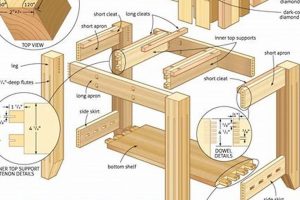
Beginning-level carpentry endeavors represent a practical introduction to the craft, emphasizing simplicity in design and execution. Examples include items such as basic birdhouses, small shelves, or simple picture frames, all typically requiring minimal tools and fundamental techniques.
The significance of these introductory builds lies in their capacity to foster skill development and confidence. Successful completion of such tasks provides a tangible sense of accomplishment, encourages further exploration of woodworking techniques, and offers a foundation for more complex future projects. Historically, learning basic carpentry skills has been a valuable asset for practical home maintenance and creative expression.
The subsequent sections will outline specific examples, tool recommendations, and step-by-step guidance for engaging in readily achievable woodworking activities, enabling individuals to develop foundational skills in a safe and effective manner.
Guidance for Simple Carpentry Tasks
The following recommendations are intended to facilitate success in early-stage woodworking. Attention to these details can enhance the quality and safety of initial projects.
Tip 1: Material Selection: Opt for softwoods like pine or fir for their ease of workability. These species are readily available and accept finishes well.
Tip 2: Tool Acquisition: Invest in a limited set of essential hand tools initially. A hand saw, measuring tape, combination square, and sandpaper are sufficient for basic tasks.
Tip 3: Precise Measurement: Accurate dimensions are critical. Double-check all measurements before cutting to minimize errors and material waste.
Tip 4: Secure Workholding: Employ clamps or a vise to secure workpieces during sawing and sanding operations. This enhances stability and reduces the risk of injury.
Tip 5: Sanding Technique: Sand with the grain of the wood using progressively finer grits of sandpaper. This produces a smooth surface for finishing.
Tip 6: Finish Application: Apply finishes in thin, even coats, allowing adequate drying time between applications. This ensures a durable and aesthetically pleasing result.
Tip 7: Prioritize Safety: Always wear appropriate safety glasses and dust mask when working. Familiarize oneself with safe operating procedures for all tools.
Adhering to these guidelines contributes to a more positive and productive learning experience. Focus on precision and safety to achieve satisfying results.
The subsequent discussion will address the application of these principles in the context of specific project designs.
1. Simple Designs

The characteristic of simple designs is fundamental to the accessibility of introductory carpentry tasks. The complexity of a design directly impacts the skill level, tooling requirements, and time investment necessary for completion. Consequently, selecting uncomplicated designs is crucial for those beginning to learn woodworking.
- Reduced Tooling Needs
Simplified projects typically necessitate fewer specialized tools. A project requiring complex joinery, such as dovetails, demands specific saws and chisels. Conversely, a basic box can be constructed with only a saw, hammer, and fasteners. This reduction in tooling costs and learning curves makes simple designs more approachable.
- Basic Joinery Techniques
Simple designs often rely on fundamental joinery methods, such as butt joints, lap joints, or rabbet joints. These techniques are easier to master than more intricate joinery and require less precision. Proficiency in these basic joints provides a solid foundation for tackling more complex projects in the future.
- Minimized Material Waste
Straightforward designs tend to utilize materials more efficiently. Complex curves or angles often result in significant material waste. Simple, geometric shapes allow for optimized material usage and reduced costs, which is particularly important for beginners who may make errors during the learning process.
- Increased Project Completion Rate
Due to their reduced complexity and shorter completion times, simple designs are more likely to be successfully finished. This sense of accomplishment is a critical motivator for beginners and encourages continued engagement with woodworking. Conversely, tackling overly ambitious projects early on can lead to frustration and discouragement.
The correlation between uncomplicated designs and the successful execution of early-stage carpentry tasks underscores the importance of starting with simple projects. By focusing on fundamental techniques and minimizing complexity, beginners can build confidence and acquire the skills necessary for more advanced woodworking endeavors.
2. Minimal Tools

The selection of a limited toolset is intrinsic to the feasibility of basic carpentry tasks. Project complexity is often dictated by the variety and sophistication of tools required. Reduced tooling requirements directly contribute to the accessibility of introductory woodworking projects.
- Reduced Initial Investment
Acquiring an extensive collection of specialized woodworking tools can represent a significant financial barrier. Projects designed for minimal tooling mitigate this obstacle. A basic set consisting of a hand saw, measuring tape, combination square, sandpaper, and a few essential fasteners allows individuals to begin working without substantial upfront costs. This lowers the barrier to entry for beginners and makes woodworking more accessible.
- Simplified Skill Acquisition
Each woodworking tool requires specific skills and techniques for safe and effective operation. Limiting the number of tools simplifies the learning process. Beginners can focus on mastering a few fundamental tools, such as sawing straight lines or driving screws accurately, before progressing to more complex equipment. This phased approach to skill development fosters confidence and reduces the potential for errors.
- Increased Portability and Workspace Flexibility
A limited toolset enhances the portability of woodworking projects. Individuals can work in smaller spaces or transport their tools to different locations more easily. This flexibility is particularly beneficial for those with limited workshop space or who wish to engage in woodworking activities outside of a traditional workshop setting.
- Focus on Fundamental Techniques
Working with minimal tools necessitates a greater emphasis on fundamental woodworking techniques. When lacking specialized equipment, individuals are compelled to develop skills in hand-tool use, precise measurement, and efficient material utilization. This focus on core skills provides a strong foundation for future woodworking endeavors and promotes resourcefulness.
The correlation between reduced tooling requirements and the successful execution of introductory carpentry tasks underscores the importance of project selection. By prioritizing projects that can be accomplished with a limited set of essential tools, beginners can gain valuable experience, develop fundamental skills, and minimize financial investment, ultimately fostering a more rewarding introduction to the craft.
3. Softwood Preferred

The preference for softwood in introductory carpentry is fundamentally linked to the ease with which it can be manipulated. Softer wood species, such as pine, fir, and cedar, possess a lower density compared to hardwoods like oak or maple. This reduced density translates to less resistance during cutting, shaping, and fastening operations. The consequence is that less force is required to work with these materials, making them suitable for individuals with limited experience or those using basic hand tools. A simple example is constructing a birdhouse; pine boards can be easily cut and assembled with minimal effort, whereas hardwoods would present a significantly greater challenge. This ease of use directly contributes to the successful completion of introductory projects.
Beyond workability, softwoods typically exhibit a more uniform grain structure. This characteristic minimizes the risk of splintering or tearing during cutting, a common occurrence when working with hardwoods possessing interlocked or irregular grain patterns. Additionally, softwoods generally accept finishes, such as paint or stain, more readily than certain dense hardwoods. This facilitates a more predictable and aesthetically pleasing final product. The selection of softwood is therefore not merely a matter of convenience but a critical factor influencing the overall success and enjoyment of early-stage carpentry endeavors. The ease of using this material supports skill development while reducing the likelihood of frustration.
In summary, the choice of softwood is a key component in simplified woodworking projects. Its workability, uniform grain, and receptive finishing qualities directly contribute to a more manageable and rewarding learning experience. While hardwoods offer distinct advantages in terms of durability and aesthetics for advanced projects, the selection of softwood enables beginners to develop foundational skills and build confidence in their abilities, facilitating a positive progression within the craft.
4. Precise Measurement

Accurate dimensions are fundamental to the success of even the simplest carpentry tasks. Deviations from planned measurements, regardless of scale, accumulate and compromise the structural integrity and aesthetic appeal of any project. In the context of introductory woodworking, precision is paramount due to the limited margin for error afforded by basic joinery techniques and the use of readily available, often less-forgiving, materials.
- Minimizing Material Waste
Accurate measurements significantly reduce material waste. When dimensions are consistently precise, the likelihood of miscuts and unusable offcuts decreases. This is particularly important for beginners who may be working with limited budgets or who are seeking to minimize their environmental impact. For instance, consistently measuring and marking lumber to the correct length before cutting reduces waste. Inaccurate measuring can lead to needing to re-cut pieces which leads to using new boards.
- Ensuring Proper Fit
Precise measurements are critical for ensuring components fit together correctly. Simple projects, such as boxes or shelves, rely on accurate dimensions for stable and aesthetically pleasing construction. If the sides of a box are not measured and cut accurately, the resulting assembly may be warped, uneven, or structurally unsound. Ensuring the components meet in an orderly manner is key to keeping the structure standing.
- Facilitating Square and Level Assemblies
Accurate measurement is necessary for achieving square and level assemblies, which are essential for both functionality and visual appeal. An improperly measured frame, for example, will not be square, making it difficult to hang or use effectively. The use of squares and levels in conjunction with precise measurement techniques is crucial for achieving professional-looking results.
- Promoting Safe Construction
Inaccurate measurements can lead to unsafe construction practices. If components are not properly sized and fitted, the resulting structure may be unstable and prone to collapse. This is especially important when constructing items that will bear weight or be used in potentially hazardous environments. For example, a shelf that is too short will not hold its components securely.
The emphasis on precise measurement in introductory carpentry is not merely about achieving aesthetic perfection; it is about fostering good working habits, promoting efficient material usage, ensuring structural integrity, and facilitating safe construction practices. Mastering accurate measurement techniques is a fundamental skill that will serve woodworkers well as they progress to more complex and challenging projects. Without precise measurement, a woodworker will fail to make simple projects.
5. Secure Clamping

Secure clamping is a critical component of elementary carpentry endeavors, influencing the quality and safety of project outcomes. The application of clamping mechanisms ensures workpieces remain stationary during various operations, such as cutting, drilling, gluing, and fastening. This stability directly affects the precision of cuts and the strength of joints, both vital aspects of even the most straightforward projects. An example is the assembly of a basic picture frame; without clamps holding the corners securely, the glued joints may shift during the drying process, resulting in a misaligned or weakened frame. In this and similar scenarios, proper clamping is indispensable.
Furthermore, secure clamping significantly enhances user safety. By immobilizing the workpiece, the risk of slippage and subsequent injury is minimized. When sawing a small board, for example, a clamp prevents the board from moving unexpectedly, which could lead to the saw blade binding or the user losing control. Moreover, effective clamping contributes to cleaner and more precise cuts, which is particularly important when working with hand tools, where accuracy is more reliant on user technique. Clamps support accuracy and prevent slippage.
In summary, the practice of secure clamping is not merely a supplementary step but an essential element for successful beginner woodworking. It directly impacts the accuracy of cuts, the strength of joints, and the safety of the user. While advanced techniques may employ more sophisticated clamping systems, the fundamental principle remains the same: secure stabilization of workpieces is paramount for achieving high-quality results, even in the simplest of carpentry projects. Without it, the project can fall apart.
6. Safe Practices
The integration of safe practices is paramount in introductory woodworking activities. The pursuit of simplicity in design and technique does not negate the inherent risks associated with tool use and material handling. Neglecting safety protocols, even in apparently benign tasks, can result in injuries ranging from minor cuts and abrasions to more severe lacerations or even accidents involving power tools if they are prematurely introduced into the learning process. For instance, failure to wear safety glasses while sanding can result in eye irritation or injury from airborne particles. Similarly, the absence of a dust mask can lead to respiratory issues from prolonged exposure to sawdust. Therefore, adherence to safety guidelines is not merely a recommendation, but an integral component of successful and responsible engagement with woodworking.
Safe practices in fundamental carpentry include, but are not limited to, the consistent use of personal protective equipment (PPE) such as safety glasses, hearing protection, and dust masks. They also encompass the proper handling and storage of tools, ensuring that sharp edges are protected and power tools are disconnected when not in use. Furthermore, maintaining a clean and organized workspace minimizes the risk of trips and falls. It is the responsibility of individuals engaging in woodworking to familiarize themselves with and consistently implement these safety measures. A practical example is ensuring that all tools are correctly sharpened and maintained; dull tools require more force to operate, increasing the likelihood of slippage and potential injury. Another is ensuring the workspace is well-lit, which minimizes errors during measurement and cutting.
In conclusion, the correlation between safe practices and introductory woodworking transcends mere risk mitigation; it establishes a foundation for responsible and sustainable engagement with the craft. By prioritizing safety from the outset, individuals not only minimize the potential for injury but also cultivate a culture of diligence and attention to detail. This, in turn, promotes greater confidence and proficiency in woodworking skills, ultimately fostering a more rewarding and fulfilling experience. The integration of safe practices is not an optional consideration, but a prerequisite for successful and enjoyable exploration of the craft.
Frequently Asked Questions
The following addresses prevalent inquiries regarding early-stage woodworking, emphasizing factual clarity and practical guidance.
Question 1: What constitutes the most suitable wood species for beginners?
Softwoods such as pine, fir, or cedar are generally recommended due to their workability and lower density, facilitating easier cutting and fastening.
Question 2: What fundamental tools are essential for initiating basic woodworking projects?
A basic toolset should include a hand saw, measuring tape, combination square, sandpaper, and a selection of fasteners, such as nails or screws.
Question 3: How critical is precision in measurement for introductory woodworking?
Accurate dimensions are of paramount importance, as even slight deviations can compromise the structural integrity and aesthetic appeal of simple projects.
Question 4: What is the purpose of clamping in basic carpentry tasks?
Clamping serves to secure workpieces during cutting, drilling, gluing, and fastening, ensuring stability and enhancing the precision of cuts and the strength of joints.
Question 5: Why is adherence to safety practices emphasized in introductory woodworking?
Prioritizing safety minimizes the risk of injuries associated with tool use and material handling, establishing a foundation for responsible engagement with the craft.
Question 6: What strategies can be employed to minimize material waste in woodworking projects?
Accurate measurement, careful layout, and the efficient use of offcuts can significantly reduce material waste, promoting cost-effectiveness and environmental responsibility.
The answers provided underscore the importance of material selection, precise execution, safety awareness, and resourcefulness in elementary carpentry.
The discussion will now transition to the application of these principles in specific project examples, providing practical guidance for beginners.
Conclusion
The preceding examination has elucidated the core tenets of easiest woodworking projects. Emphasis was placed on simplicity in design, minimal tooling requirements, the strategic use of softwoods, the criticality of precise measurement and secure clamping techniques, and the overarching importance of prioritizing safe work practices. Understanding and implementing these principles provides a solid foundation for individuals initiating their engagement with the craft.
Mastery of fundamental skills through these accessible projects serves as a gateway to more complex woodworking endeavors. The pursuit of practical craftsmanship fosters not only tangible skills but also an appreciation for precision, problem-solving, and the enduring value of creating functional and aesthetically pleasing objects. Continued dedication to these foundational concepts will inevitably yield increasingly sophisticated results.