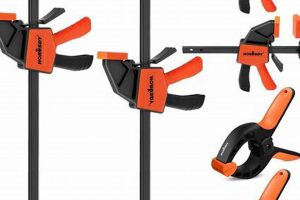
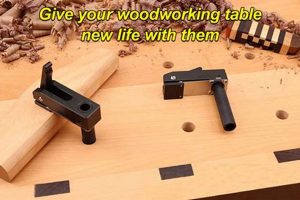
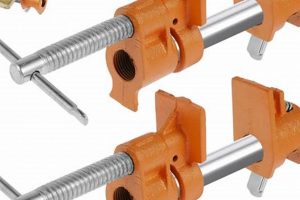
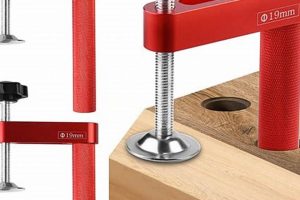
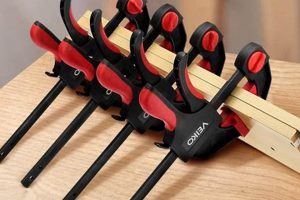
A fastening device utilized in carpentry and related fields allows for swift application and removal of pressure to secure workpieces. These devices, characterized by a mechanism enabling rapid adjustment and disengagement, are commonly employed to hold materials together during gluing, assembly, or other processes requiring temporary fixation. An example would be using such a tool to hold two pieces of wood together while adhesive dries, ensuring a strong bond.
The utility of these tools lies in their efficiency and ease of use. They reduce setup time, increase productivity, and offer a convenient alternative to traditional clamping methods requiring more intricate adjustments. Their development reflects a broader trend toward optimizing workflow in woodworking and related trades. The speed and simplicity of operation contribute significantly to project completion efficiency.
The subsequent sections will detail the various types available, discuss their ideal applications, explore proper usage techniques, and outline essential safety considerations. This information will provide a comprehensive understanding of these important workshop tools.
Essential Guidelines for Utilizing Fast-Acting Woodworking Clamps
This section provides practical guidance to maximize the effectiveness and longevity of these tools. Adhering to these recommendations promotes both project quality and user safety.
Tip 1: Select the Appropriate Style. Different designs serve distinct purposes. Bar styles are suitable for wide stock, while spring styles offer quick, light-duty holding. Consider the material thickness and required pressure when choosing.
Tip 2: Protect Workpiece Surfaces. Direct contact can mar soft woods. Use protective pads or cauls made from scrap wood between the clamp jaws and the workpiece to prevent indentation and staining.
Tip 3: Distribute Pressure Evenly. Avoid over-tightening, which can warp or damage materials. Employ multiple clamps spaced appropriately to distribute force uniformly across the joint or assembly. This is particularly critical when gluing large surfaces.
Tip 4: Maintain Cleanliness. Glue and debris accumulation can impede smooth operation. Regularly clean threads, jaws, and release mechanisms to ensure optimal performance and prevent corrosion. Use a wire brush and solvent, as needed.
Tip 5: Inspect for Damage. Prior to each use, examine for cracks, bends, or worn parts. Damaged components can compromise clamping force and pose a safety hazard. Replace defective units immediately.
Tip 6: Utilize Proper Alignment. Before tightening, ensure the clamp jaws are parallel and aligned with the joint. Misalignment can induce stress and compromise joint integrity. Adjustable clamps are beneficial in these situations.
Adhering to these guidelines will extend the lifespan of the clamping tools and enhance the quality of woodworking projects by ensuring secure, uniform holding power. Prioritizing these steps minimizes the risk of material damage and promotes user safety.
The following section will delve into advanced techniques for specialized woodworking tasks involving these versatile tools.
1. Speed of Adjustment

The rapidity with which a clamping device can be adjusted directly influences productivity in woodworking. “quick release clamp woodworking” derives a significant portion of its utility from the efficiency afforded by rapid adjustment mechanisms. This characteristic reduces non-productive time spent securing and releasing workpieces.
- Thread Pitch and Mechanism Efficiency
The design of the clamp’s adjustment mechanism, particularly the thread pitch in screw-operated models, dictates how quickly the clamp can be tightened or loosened. A coarser thread pitch allows for faster linear movement per revolution, but may require more force. The efficiency of the mechanism in transferring force from the user’s hand to the clamping jaws impacts the overall adjustment speed. “quick release clamp woodworking” designs often incorporate levers or ratchets to amplify force and accelerate adjustment.
- One-Handed Operation
Many modern designs prioritize one-handed operation to further enhance adjustment speed. This allows the user to hold the workpiece in position with one hand while simultaneously tightening or releasing the clamp with the other. One-handed clamps are particularly valuable in situations where precise positioning is critical or when working in confined spaces. This feature is central to the functionality that makes “quick release clamp woodworking” desirable.
- Quick-Release Mechanisms
Beyond simple thread adjustments, true “quick release clamp woodworking” incorporates dedicated mechanisms for instantaneous release. These mechanisms, often involving levers or spring-loaded triggers, allow the user to disengage the clamp completely with a single motion. The design and reliability of these mechanisms are paramount; a smooth, consistent release is essential for preventing damage to the workpiece or injury to the user. The functionality is the core definition of a “quick release clamp woodworking”.
- Incremental Adjustment Capability
While speed is paramount, the ability to make fine, incremental adjustments is also important. Some designs incorporate a combination of quick-release features and precise adjustment mechanisms. This allows the user to rapidly secure the workpiece and then fine-tune the clamping pressure to avoid over-tightening or distortion. The level of granular control is the quality of the “quick release clamp woodworking”.
The relationship between adjustment speed and overall workflow efficiency is undeniable. “quick release clamp woodworking” prioritizes minimizing downtime associated with securing and releasing workpieces. This design focus results in increased productivity and reduced physical strain on the user. The optimization of adjustment mechanisms, combined with ergonomic considerations, represents a significant advancement in woodworking tool design.
2. Holding Strength

Holding strength, the capacity of a clamping device to resist separation of joined materials under load, is a critical performance parameter. In the context of “quick release clamp woodworking”, this attribute directly impacts the integrity of the bond or assembly being created. Achieving adequate holding strength ensures dimensional stability and prevents component slippage during adhesive curing or mechanical fastening.
- Clamping Force Generation
The mechanical design of the clamp dictates the magnitude of force it can exert. Screw-type mechanisms, lever-action systems, and cam-over designs each possess inherent limitations in force generation. The material properties of the clamp’s components, such as the tensile strength of the threaded rod or the rigidity of the frame, define the maximum permissible force before failure. For “quick release clamp woodworking”, design compromises that prioritize speed of engagement must not sacrifice adequate clamping force. This necessitates robust materials and efficient force transmission.
- Jaw Surface Area and Friction
The area of contact between the clamp jaws and the workpiece influences the distribution of clamping force. Larger surface areas reduce stress concentrations and minimize the risk of material indentation. The coefficient of friction between the jaw surface and the workpiece material also contributes to holding strength. Serrated jaws or the application of friction-enhancing pads can improve grip, particularly on smooth or slippery surfaces. “quick release clamp woodworking” designs frequently incorporate features that enhance jaw grip without damaging the workpiece.
- Clamp Frame Rigidity
Deformation of the clamp frame under load reduces the effective clamping force applied to the workpiece. A rigid frame minimizes deflection and ensures that the generated force is transmitted efficiently to the joint. Frame rigidity is particularly important in “quick release clamp woodworking”, where rapid engagement mechanisms may introduce stress points. Material selection, frame geometry, and the presence of reinforcing elements contribute to overall frame rigidity. Insufficient rigidity leads to loss of clamping force and potential joint failure.
- Locking Mechanism Security
The integrity of the clamp’s locking mechanism is paramount in maintaining holding strength over time. Mechanisms that rely on friction alone may be susceptible to slippage, particularly under vibration or sustained load. Positive locking mechanisms, such as those incorporating ratchets or detents, provide greater security and prevent unintentional release. In “quick release clamp woodworking”, the locking mechanism must balance ease of operation with reliable holding power. The design must prevent accidental release while allowing for rapid disengagement when desired.
The interplay between these factors defines the effective holding strength of “quick release clamp woodworking”. A comprehensive understanding of these principles is essential for selecting the appropriate clamp for a given application and ensuring the structural integrity of the resulting assembly. Tradeoffs between speed, clamping force, and workpiece protection must be carefully considered to achieve optimal results.
3. Workpiece Protection

The safeguarding of material surfaces from damage during clamping is a paramount consideration in woodworking. The efficient application and removal of pressure, characteristic of “quick release clamp woodworking,” necessitate careful attention to preventing marring, indentation, and other forms of surface degradation.
- Pressure Distribution and Surface Contact
The concentration of clamping force on small areas can lead to localized indentation, particularly in softwoods. Utilizing clamp jaws with broad, flat surfaces distributes pressure more evenly, reducing the risk of damage. Protective pads constructed from compressible materials, such as cork or leather, provide a cushioning effect, further minimizing surface stress. These considerations are crucial in “quick release clamp woodworking” where rapid application of force might exacerbate potential damage. Example scenario, using a quick release clamp on softwood trim without protective pads will leave indentation marks.
- Material Compatibility and Chemical Reactivity
Certain clamping materials can chemically react with finishes or wood species, resulting in discoloration or staining. Direct contact between steel clamp jaws and tannin-rich woods, such as oak, can produce unsightly stains. Similarly, some adhesives may interact negatively with clamp materials. Barrier films or coatings can mitigate these risks. For “quick release clamp woodworking”, choosing clamps with non-reactive jaw surfaces or applying protective barriers prevents adverse chemical interactions. Example would be using non-reactive pad while gluing acidic material onto a base material to prevent stain
- Clamping Force Control and Overtightening
Excessive clamping force can warp or crush delicate workpieces. Adjustable clamps allow for precise control over applied pressure, minimizing the risk of damage. Techniques such as using stop blocks or shims to limit the degree of compression provide additional safeguards. For “quick release clamp woodworking,” the ability to quickly adjust clamping force is advantageous, but operators must exercise caution to avoid overtightening. Over-tightening may leads to distortion or breakage of material.
- Jaw Alignment and Lateral Stress
Misaligned clamp jaws can induce lateral stress, potentially causing slippage, distortion, or even fracture of the workpiece. Ensuring that the jaws are parallel and properly aligned with the joint line minimizes these risks. Adjustable clamps with pivoting jaws provide greater flexibility in accommodating variations in workpiece geometry. In “quick release clamp woodworking,” attention to jaw alignment is essential for achieving secure and damage-free clamping. Poor alignment results to stress concentration.
Effective workpiece protection hinges on a holistic approach that encompasses clamp selection, pressure control, material compatibility, and alignment precision. These factors are particularly salient in the context of “quick release clamp woodworking”, where the speed and convenience of these tools must be balanced with the need to preserve the integrity of the materials being joined.
4. Clamp Versatility
The adaptability of a clamping device to diverse woodworking tasks is a key determinant of its overall value. “Quick release clamp woodworking” benefits significantly from versatility, as it expands the range of projects and applications for which the tool is suitable. The ability to clamp workpieces of varying shapes, sizes, and materials, as well as the capacity to perform different clamping functions, directly impacts the efficiency and effectiveness of woodworking processes. For instance, a versatile clamp might be used to secure mitered corners, laminate panels, or assemble complex joinery, highlighting its broad applicability.
The design of a “quick release clamp woodworking” tool often incorporates features that enhance its versatility. Adjustable jaws, swiveling heads, and extendable arms allow the clamp to adapt to irregular shapes and accommodate different workpiece thicknesses. Some models also include interchangeable pads or attachments that enable specialized clamping functions, such as edge clamping or flush trimming. These design elements contribute to the tool’s ability to perform a wider range of tasks, reducing the need for multiple specialized clamps. The utility of these types of clamps is often determined by the versatility it offers.
In summary, the versatility of a clamping device is an essential characteristic that significantly enhances its value in woodworking. “Quick release clamp woodworking” that exhibits high versatility offers increased functionality, improved efficiency, and greater overall utility. By understanding the relationship between these concepts, woodworkers can make informed decisions about clamp selection and optimize their workflows for a wide variety of projects.
5. Ergonomic Design
The integration of ergonomic design principles into “quick release clamp woodworking” is crucial for minimizing user fatigue and maximizing efficiency during prolonged use. The repetitive actions associated with clamping, tightening, and releasing mechanisms can lead to musculoskeletal strain if the tool’s design does not prioritize user comfort and ease of operation. Consequently, handles are shaped for optimal grip, force exertion is minimized through lever mechanisms, and overall weight is carefully managed to prevent undue stress on the user’s hands and arms. The cause of design innovation can be attributed to mitigating possible health challenges of professional woodworkers. For example, elongated, padded handles on a “quick release clamp woodworking” design allow for comfortable application of force without causing pressure points on the user’s hands. Ergonomic handles are the key components for a good clamp to ensure comfortability and reduce wrist strain.
The placement and orientation of release mechanisms are also critical ergonomic considerations. Levers and triggers should be positioned for easy access and require minimal force to actuate, reducing the risk of repetitive strain injuries. Moreover, the overall balance of the clamp influences its ease of handling and reduces the likelihood of accidental drops or misalignments. A well-balanced “quick release clamp woodworking” design allows for precise positioning and secure clamping with minimal effort. Consider a bar clamp with an offset handle designed for increased leverage and reduced wrist flexion during tightening. This allows user to use it with great ease and improve workability, allowing users to finish their project faster. It also minimizes possible workplace injuries.
In conclusion, the ergonomic design of “quick release clamp woodworking” is not merely an aesthetic consideration but a fundamental aspect of its functionality and safety. By prioritizing user comfort, reducing physical strain, and promoting ease of operation, ergonomic design enhances productivity, minimizes the risk of injury, and contributes to a more positive woodworking experience. Challenges remain in balancing ergonomic features with durability and clamping force, but ongoing innovation continues to refine the design of these essential tools.
6. Durability Factors

The longevity and consistent performance of “quick release clamp woodworking” are directly determined by its durability. Resistance to wear, deformation, and corrosion under repeated use is paramount. Design, material selection, and manufacturing processes collectively define the service life of these tools.
- Material Selection and Heat Treatment
The choice of steel alloys for load-bearing components dictates strength and resistance to deformation. Higher-grade alloys, coupled with appropriate heat treatment processes (e.g., hardening and tempering), enhance tensile strength, yield strength, and wear resistance. Improper heat treatment can lead to premature failure, even with high-quality alloys. Example: The threads on a clamp screw made from insufficiently hardened steel will strip under high clamping force, rendering the tool useless. A well-designed “quick release clamp woodworking” tool utilizes specific material grade and is heat treated for specific components.
- Corrosion Resistance and Surface Treatment
Exposure to moisture and atmospheric contaminants can induce corrosion, weakening structural integrity and impairing functionality. Protective coatings, such as zinc plating, powder coating, or black oxide finishes, provide a barrier against corrosive elements. Regular maintenance, including cleaning and lubrication, further extends service life. For instance, unplated steel components exposed to a humid workshop environment will corrode rapidly, leading to seizing of moving parts. Surface treatment or coating is vital to ensure “quick release clamp woodworking” is free from corrosion.
- Mechanism Design and Load Distribution
The design of the clamping mechanism influences how stress is distributed throughout the tool. Sharp corners and abrupt transitions create stress concentrations, increasing the likelihood of fatigue failure. Smooth, radiused transitions and optimized geometry distribute loads more evenly, enhancing durability. For example, a lever-action clamp with a poorly designed pivot point will experience concentrated stress at that point, leading to premature wear or breakage. Therefore, design consideration is critical to ensuring “quick release clamp woodworking” is safe to use.
- Manufacturing Precision and Assembly Quality
Tight tolerances and precise assembly minimize play and friction within the clamping mechanism, reducing wear and improving overall performance. Poorly manufactured or assembled clamps may exhibit excessive looseness, increasing the risk of slippage and reducing clamping force. Regular quality control during manufacturing ensures dimensional accuracy and proper functionality. Example: A “quick release clamp woodworking” tool with loosely fitted components will exhibit excessive vibration and reduced clamping force, indicating an inferior design. This translates to poor usability and possible safety concerns to the end-users.
These durability factors collectively determine the long-term value and reliability of “quick release clamp woodworking”. Investing in tools constructed from high-quality materials, featuring robust designs, and manufactured to exacting standards ensures consistent performance and extends service life, providing a superior return on investment.
7. Alignment Precision

Alignment precision is paramount to achieving strong, aesthetically pleasing joints in woodworking, and its effective implementation is closely linked to the proper use of “quick release clamp woodworking.” The primary function of these clamps is to apply force, but if the force is not applied in a manner that maintains accurate alignment, the resulting joint can be structurally compromised or visually flawed. Misalignment can lead to uneven stress distribution within the joint, weakening the adhesive bond or mechanical fastening. For instance, when gluing two boards edge-to-edge to create a wider panel, even a slight misalignment during clamping will result in a visible ridge or step, requiring additional sanding and potentially compromising the panel’s overall thickness. Therefore, “quick release clamp woodworking” is only as effective as its ability to maintain precise alignment.
Several factors contribute to achieving alignment precision with these clamping devices. The clamp jaws must be parallel and exert force evenly across the joint. Skewed or angled jaws can induce lateral forces, causing the workpieces to shift during tightening. The use of cauls, which are rigid boards or blocks placed between the clamp jaws and the workpiece, helps to distribute pressure evenly and maintain alignment. Furthermore, techniques such as using dowels or biscuits to pre-align the workpieces before clamping significantly enhance the accuracy of the final joint. “quick release clamp woodworking” becomes an enabler for achieving precise alignment when used in conjunction with these techniques and auxiliary aids. Another example is when attaching two pieces of a miter joint, using alignment jigs and clamping with quick release clamp will ensure correct precision.
In conclusion, alignment precision is not merely a desirable attribute but a fundamental requirement for successful woodworking projects. “Quick release clamp woodworking” facilitates the application of clamping force, but it is the user’s responsibility to ensure that this force is applied in a manner that maintains accurate alignment. Employing proper techniques, utilizing auxiliary aids, and carefully monitoring the clamping process are essential for achieving strong, visually appealing joints. The effective integration of these factors transforms “quick release clamp woodworking” from a simple fastening device into a tool that enables precision and quality in woodworking.
Frequently Asked Questions about Fast-Acting Clamping Tools
The following addresses commonly encountered inquiries regarding the selection, application, and maintenance of these fastening tools. Understanding these aspects is crucial for maximizing their effectiveness and ensuring project success.
Question 1: What distinguishes a standard woodworking clamp from a “quick release clamp woodworking” tool?
The primary distinction lies in the speed and ease of operation. Standard clamps typically require multiple turns of a screw or other manual adjustment to apply and release pressure. “Quick release clamp woodworking” tools, conversely, incorporate mechanisms that allow for rapid application and release with minimal effort, enhancing efficiency and reducing setup time.
Question 2: Are “quick release clamp woodworking” tools suitable for all types of woodworking projects?
While versatile, these tools may not be optimal for all applications. Projects requiring exceptionally high clamping force or those involving irregularly shaped workpieces may necessitate specialized clamps. Consider the specific requirements of each project when selecting clamping devices.
Question 3: How can the risk of workpiece damage when using “quick release clamp woodworking” tools be minimized?
Employing protective pads or cauls between the clamp jaws and the workpiece distributes pressure evenly and prevents indentation. Avoiding over-tightening and ensuring proper alignment of the jaws are also crucial for preventing damage.
Question 4: What are the key maintenance procedures for preserving the functionality of “quick release clamp woodworking” tools?
Regular cleaning to remove glue and debris, lubrication of moving parts, and inspection for damage are essential. Corrosion can be prevented by storing tools in a dry environment and applying protective coatings. Damaged components should be replaced promptly.
Question 5: Do “quick release clamp woodworking” tools offer sufficient clamping force compared to traditional clamps?
While some models may offer lower maximum clamping force than heavy-duty traditional clamps, many “quick release clamp woodworking” designs provide adequate force for the majority of woodworking tasks. The specific clamping force rating should be considered when selecting a tool for a particular application.
Question 6: What safety precautions should be observed when using “quick release clamp woodworking” tools?
Always wear appropriate eye protection. Ensure that the workpiece is stable and securely supported before applying clamping pressure. Avoid over-tightening, which can lead to clamp failure or workpiece damage. Inspect tools regularly for signs of wear or damage.
These answers provide a foundational understanding of these valuable woodworking tools. Proper selection, application, and maintenance ensure optimal performance and contribute to successful project outcomes.
The subsequent section delves into real-world applications and case studies demonstrating the versatility of these clamps.
Conclusion
The preceding discussion has illuminated various facets of “quick release clamp woodworking,” emphasizing critical considerations such as adjustment speed, holding strength, workpiece protection, versatility, ergonomic design, durability, and alignment precision. These factors collectively determine the suitability of specific clamps for diverse woodworking applications, influencing project quality and efficiency.
A thorough understanding of these principles empowers practitioners to make informed decisions, optimizing tool selection and utilization. Continued adherence to best practices in clamping techniques will undoubtedly contribute to the advancement of woodworking craftsmanship and the enduring quality of finished products. Further investigation and refinement of these tools hold potential for increased productivity and improved safety in the woodworking domain.
![Best Woodworking Clamps on Amazon: [Your Project] Ready! | Step-by-Step Guides, Tools & Inspiration to Build Beautiful Wooden Decor on a Budget](https://woodfromhome.com/wp-content/uploads/2026/04/th-87-300x200.jpg "Best Woodworking Clamps on Amazon: [Your Project] Ready! Step-by-Step Guides, Tools & Inspiration to Build Beautiful Wooden Decor on a Budget")