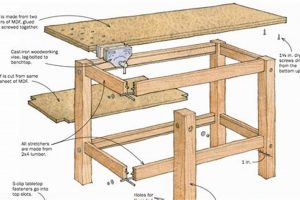
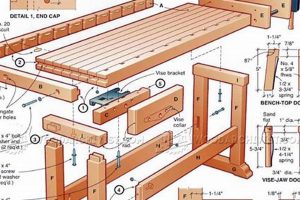
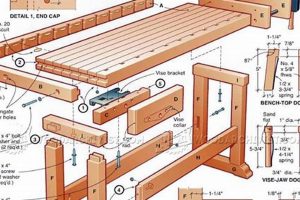
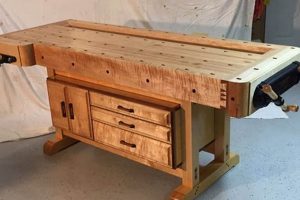
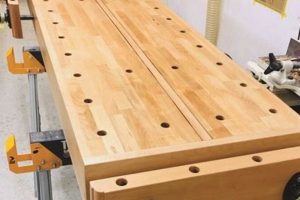
A mechanical apparatus affixed to a workbench, typically featuring two parallel jaws, provides a secure clamping force. This tool is essential for holding workpieces firmly in place during various woodworking operations. For example, it can stabilize a piece of lumber while it is being planed, sawed, or joined.
Its significance lies in enhancing precision, safety, and efficiency. By immobilizing the material, it allows for accurate cuts and joints, reducing the risk of slippage and potential injury. The evolution of these devices mirrors the advancements in woodworking techniques, from simple wooden clamps to modern, robust metal constructions, each contributing to improved craftsmanship and productivity.
The following sections will delve into the selection criteria, proper usage techniques, maintenance procedures, and diverse applications of this fundamental workshop component. Different types available will also be explored.
Essential Usage and Maintenance Tips
Maximizing the effectiveness and lifespan of the clamping mechanism requires adherence to specific guidelines regarding operation and upkeep. These principles enhance both the quality of work and the safety of the operator.
Tip 1: Proper Mounting is Critical. Securely fasten the device to a stable workbench. The mounting bolts must be of adequate size and tightened appropriately to prevent movement during use. Consider the thickness of the benchtop when selecting bolt length.
Tip 2: Utilize Jaw Liners. Employ soft jaw liners, such as wood or leather, to protect delicate workpieces from marring or indentation. These liners also enhance grip and prevent slippage.
Tip 3: Evenly Distribute Clamping Pressure. Ensure that the workpiece is in full contact with both jaws. Avoid over-tightening, as excessive force can damage either the workpiece or the apparatus itself. Gradual tightening yields more controlled and secure results.
Tip 4: Lubricate Moving Parts Regularly. Apply a light machine oil to the screw threads and other moving parts to maintain smooth operation and prevent corrosion. This lubrication should be performed periodically, depending on the frequency of use.
Tip 5: Clean After Each Use. Remove sawdust, shavings, and other debris from the apparatus after each use. A clean mechanism operates more effectively and prolongs its functional life.
Tip 6: Inspect for Damage Regularly. Periodically inspect the device for signs of wear, such as cracks in the metal or damaged threads. Address any issues promptly to prevent further damage or potential failure during operation.
Tip 7: Understand Material Compatibility. When working with certain woods that contain corrosive elements, such as oak, consider using corrosion-resistant hardware to prevent long-term damage to the tool.
Adherence to these tips ensures safe, precise, and prolonged utility of the mechanism, ultimately enhancing the quality and efficiency of woodworking endeavors.
The following sections will delve into various models and their respective application domains.
1. Clamping Force

Clamping force, a fundamental characteristic, dictates its capacity to securely hold a workpiece against applied forces during woodworking operations. The magnitude of this force, typically measured in pounds or kilograms, directly influences the stability of the material being worked on. Insufficient clamping force results in workpiece slippage, compromising accuracy and posing potential safety hazards. Excessive force, conversely, can damage delicate woods or the apparatus itself. Therefore, a balance is crucial.
The relationship between clamping force and the efficacy of the tool is readily apparent in various woodworking scenarios. Consider a craftsman using a hand plane to smooth a large board. Without sufficient clamping force, the board will shift under the pressure of the plane, resulting in uneven planing and potential damage to the wood. Conversely, when securing a small, intricately carved piece, a high clamping force could crush the delicate details. The selection is a determinant that reflects the properties of the material being worked on.Consider a metalsmith using a heavy-duty machine. This demands a high clamping force, to withstand the hammering, but it could damage the wood.
Understanding the concept ensures appropriate selection and application. The proper assessment of clamping force requirements, coupled with the selection of models capable of delivering that force without damaging the workpiece, is essential for achieving precise and safe woodworking results. Achieving optimal clamping force levels presents an ongoing challenge, requiring both experience and a keen awareness of the interplay between the workpiece material, the tool, and the specific woodworking operation being performed.
2. Jaw Width

Jaw width, a defining characteristic of a woodworking apparatus, directly dictates the maximum size of the workpiece that can be securely held. This dimension, measured as the distance between the internal faces of the jaws when fully closed, establishes a fundamental limitation on its applicability. A wider jaw accommodates larger boards or assemblies, while a narrower jaw is suited for smaller, more delicate projects. The choice of jaw width must align with the typical scale of work undertaken in a given woodworking setting; mismatching the jaw width to the workpiece size compromises stability and precision.
The impact of jaw width is evident in diverse woodworking scenarios. Consider a cabinetmaker constructing a large cabinet carcass: a apparatus with a narrow jaw is inadequate for clamping the assembled frame. This necessitates the use of a device with a wider jaw to ensure secure and stable alignment during glue-up. Conversely, a model maker working on intricate miniature components would find a wide-jaw cumbersome and unwieldy, favoring a smaller apparatus. Incorrectly selecting affects ease of use and precision.
Effective application demands a nuanced understanding of jaw width and its limitations. The woodworking professional must carefully assess the dimensions of typical projects and select an tool with a jaw width that accommodates those dimensions while maintaining a degree of precision. This selection process minimizes potential safety risks and maximizes the efficiency of woodworking operations, aligning with project demands and equipment suitability.
3. Material Strength
Material strength, referring to the capacity of a material to withstand applied stress without failure, is a critical consideration in the context of woodworking apparatus. The inherent strength of the construction material dictates the clamping force it can exert, its resistance to deformation under load, and its overall service life. An insufficient measure compromises performance and poses potential safety risks to the operator.
- Cast Iron Composition
Cast iron, a common material in traditional construction, offers a balance of strength and affordability. Specific grades dictate ultimate tensile strength, compressive strength, and ductility. Models constructed from higher-grade cast iron exhibit greater resistance to cracking or deformation under prolonged use. The selection directly influences the device’s ability to maintain clamping force consistently over time.
- Ductile Iron Properties
Ductile iron represents an improvement over standard cast iron, possessing enhanced tensile strength, yield strength, and impact resistance. Its increased ductility allows it to withstand higher stress levels without fracturing, making it suitable for heavy-duty applications. Models constructed using ductile iron are less susceptible to damage from accidental impacts or over-tightening.
- Steel Alloy Selection
Steel alloys, particularly those with high carbon content or specialized heat treatments, offer superior strength compared to cast or ductile iron. Alloys provide exceptional resistance to deformation, wear, and fatigue. Their utilization in critical components such as the screw and jaws enhances the tool’s ability to withstand sustained high clamping forces. This increases accuracy and reduces the likelihood of failure under demanding conditions.
- Hardness and Wear Resistance
Surface hardness, typically measured using Rockwell or Vickers scales, is a determinant. Hardened materials resist abrasion and wear from repeated use. Heat treating jaws or screw threads improves their wear resistance, extending service life. Models with hardened components maintain accuracy for longer, ensuring consistent clamping force and precision over extended periods of use.
These factors collectively define the robustness of an apparatus. Selecting a product constructed from materials with appropriate properties is essential for ensuring safe, efficient, and reliable performance in a woodworking environment. The investment in higher-strength materials translates into extended service life, reduced maintenance, and enhanced user safety.
4. Mounting Stability

Mounting stability is a paramount factor influencing the overall performance and usability of any apparatus attached to a workbench. This directly affects precision, safety, and the lifespan of both the tool and the workbench itself. Secure and rigid mounting prevents movement, vibration, and potential damage during woodworking operations.
- Base Plate Integrity
The base plate, serving as the primary interface between the apparatus and the workbench, must possess sufficient thickness and rigidity to withstand applied forces. Flexing or deformation of the base plate under load compromises clamping force and introduces inaccuracies. Proper base plate design incorporates reinforcement ribs and adequate material thickness to ensure structural integrity. An unyielding base is crucial for consistent and reliable performance.
- Fastener Selection and Placement
The choice and arrangement of fastenerstypically bolts, screws, or lag screwssignificantly impact mounting security. Fasteners must be of appropriate diameter, length, and material to resist shear and tensile forces. Placement of fasteners should be strategic, distributing load evenly across the base plate. Insufficient fastener quantity or inadequate placement compromises stability, leading to movement and potential failure. Utilizing appropriately sized and positioned fasteners is critical for safe and effective operation.
- Workbench Top Construction
The structural integrity of the workbench top directly influences the security of the apparatus mount. A thin or flimsy workbench top is prone to flexing or splitting under load, undermining the stability of the apparatus. A solid, well-constructed workbench top provides a rigid foundation for the apparatus, ensuring accurate and consistent performance. Reinforcements, such as aprons or stretchers, enhance workbench top rigidity, further improving mounting security.
- Interface Fit and Surface Contact
The quality of the contact surface between the apparatus base plate and the workbench top is a crucial determinant. An uneven or warped surface reduces contact area, concentrating stress and potentially leading to fastener failure or workbench top damage. Ensuring a flat, level surface through planing or shimming maximizes contact area, distributing load evenly and improving stability. A proper interface fit enhances mounting security and reduces the risk of vibration or movement during use.
These facets of mounting stability collectively determine the ability of an apparatus to function reliably and safely. Neglecting these considerations compromises precision, increases the risk of accidents, and reduces the service life of the tool. Prioritizing proper mounting techniques is essential for maximizing the benefits of apparatus in any woodworking environment.
5. Lead Screw Quality
The lead screw, a critical component within a apparatus, directly governs the precision and ease with which the jaws move, thus influencing the tool’s overall functionality. The screw’s quality, defined by factors such as material composition, thread accuracy, and surface finish, directly impacts clamping force consistency, thread wear, and the smoothness of operation. A lead screw manufactured from low-grade steel, with poorly formed threads, will exhibit premature wear, leading to inconsistent clamping and ultimately, failure. In contrast, a high-quality lead screw, crafted from hardened steel with precisely machined threads, delivers smooth, predictable jaw movement and sustained clamping force, ensuring reliable performance over an extended period.
The practical significance of screw quality becomes evident during demanding woodworking tasks. For example, when clamping a delicate workpiece, a screw with coarse or uneven threads may cause jerky movement, potentially damaging the material. Conversely, a screw offering fine, controlled movement enables precise adjustments, minimizing the risk of damage. Furthermore, when applying significant clamping pressure to a large workpiece, a robust, high-quality screw maintains consistent force, preventing slippage and ensuring accurate cuts. A lead screw with Acme threads (trapezoidal screw thread form) offers lower friction and higher load capacity compared to standard V-threads, exemplifying superior design principles.
In summary, the screw represents a key investment in the longevity and precision of any woodworking apparatus. Understanding the importance of screw characteristics allows for informed purchasing decisions, selecting models that deliver superior performance and durability. While often overlooked, the choice has profound implications for the quality of woodworking projects, user safety, and the long-term value of the tool itself.
6. Jaw Parallelism

Jaw parallelism, referring to the alignment of the clamping surfaces within a woodworking apparatus, is a critical factor influencing the accuracy and consistency of woodworking operations. Deviation from parallelism introduces uneven pressure distribution, compromising the security of the workpiece and potentially leading to damage or inaccuracies. This attribute serves as an indicator of manufacturing quality and contributes directly to the precision achievable with the tool.
- Even Pressure Distribution
Parallel jaws ensure that clamping force is distributed uniformly across the entire contact area of the workpiece. This uniform distribution prevents localized stress concentrations that can cause indentations, crushing, or distortion, particularly when working with delicate or soft materials. The ability to apply even pressure enhances grip and minimizes the risk of slippage, leading to more accurate cuts and joints.
- Accuracy in Jointing and Gluing
Maintaining ensures precise alignment of workpieces during jointing and gluing operations. Non-parallel jaws can cause misalignment, resulting in weak or inaccurate joints. Parallelism is especially critical when creating complex joints, such as dovetails or mortise and tenons, where even slight deviations can compromise the structural integrity and aesthetic appeal of the final product.
- Consistent Clamping Force
Parallel clamping surfaces contribute to consistent clamping force, regardless of the workpiece’s size or shape. This consistency is essential for achieving repeatable results, particularly in production environments where uniformity is paramount. A tool with parallel jaws provides a reliable and predictable clamping action, reducing the need for constant adjustments and minimizing variations in the finished product.
- Indicator of Manufacturing Quality
Jaw parallelism serves as an indicator of the overall manufacturing quality of the apparatus. Precisely machined and aligned jaws demonstrate attention to detail and adherence to stringent quality control standards. A tool exhibiting poor parallelism suggests potential deficiencies in other areas of its construction, indicating compromised performance and reduced service life. Assessing the serves as a benchmark for evaluating the worthiness of the entire apparatus.
These factors converge to emphasize the significant role plays in the context of the apparatus. Maintaining jaw parallelism enhances the precision, efficiency, and safety of woodworking operations. A tool with well-aligned jaws represents a valuable asset in any woodworking shop, contributing to higher quality craftsmanship and greater overall productivity.
Frequently Asked Questions
The following section addresses common inquiries and clarifies misunderstandings regarding the application, maintenance, and selection of woodworking devices used to secure workpieces.
Question 1: What constitutes an appropriate clamping force for securing hardwood during planing operations?
Clamping force must be sufficient to prevent workpiece slippage under the pressure of the planing tool. Over-tightening risks damaging the wood fibers, especially with softer hardwoods. Experimentation and observation are recommended to determine the optimal force level for specific wood species and tool pressure.
Question 2: How frequently should the lead screw be lubricated to maintain optimal performance?
Lubrication frequency depends on the intensity of use and the operating environment. A light application of machine oil every three months is generally sufficient for moderate use. More frequent lubrication is advisable in dusty environments or when the apparatus is subjected to heavy loads.
Question 3: What are the implications of using a apparatus with misaligned jaws?
Misaligned jaws result in uneven pressure distribution, potentially damaging the workpiece or compromising the accuracy of cuts and joints. This condition also increases the risk of slippage and can lead to accelerated wear on the tool itself. Addressing misalignment is essential for safe and effective use.
Question 4: Is there a specific type of mounting hardware recommended for attaching a heavy-duty apparatus to a workbench?
Heavy-duty models necessitate the use of high-strength bolts with a diameter appropriate for the mounting holes. Washers should be used to distribute the clamping force of the bolts and prevent damage to the workbench surface. Lag screws are generally not recommended for heavy-duty applications due to their lower shear strength.
Question 5: What are the potential consequences of exceeding the maximum jaw opening of a apparatus?
Exceeding the maximum jaw opening places undue stress on the screw mechanism and the jaw structure, potentially leading to deformation or failure. This practice also compromises the stability of the workpiece, increasing the risk of accidents. Adhering to the specified jaw opening limits is crucial for safe and reliable operation.
Question 6: How can surface marring of delicate workpieces be minimized during clamping?
Employing soft jaw liners, such as leather or wood, between the apparatus jaws and the workpiece is effective in preventing surface marring. These liners distribute clamping pressure more evenly, reducing the risk of indentation or scratching. Ensuring that the liners are clean and free of debris is also essential.
Proper utilization and maintenance, as emphasized in these answers, will contribute to both extended tool lifespan and project quality.
The following section will delve into the future innovations in these tools.
In Conclusion
This exploration has underscored the multifaceted nature of the “woodwork bench vice,” extending beyond its simplistic role as a mere clamping mechanism. Critical attributes such as clamping force, jaw width, material strength, mounting stability, lead screw quality, and jaw parallelism have been examined, revealing their profound impact on precision, safety, and the overall quality of woodworking endeavors. The proper selection, utilization, and maintenance of this tool, guided by a thorough understanding of these attributes, are essential for achieving optimal results.
Continued advancements in materials science and engineering promise further refinements to its design and functionality, enhancing its capabilities and extending its lifespan. As woodworking practices evolve, the enduring relevance of the “woodwork bench vice” remains steadfast. Its strategic application will empower generations of woodworkers to achieve craftsmanship of the highest caliber.