



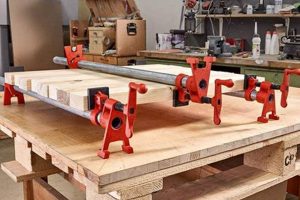
A fundamental technique in woodworking involves using specialized tools to securely hold components together during adhesive application and drying. These tools, typically featuring a long bar with adjustable clamping heads, apply even pressure across the joint, ensuring a strong and accurate bond. For instance, when constructing a table, these devices are essential for keeping the tabletop pieces aligned while the glue sets, preventing warping or misalignment.
This methodology is vital for achieving structural integrity and precise dimensions in various woodworking projects. The even pressure distribution prevents gaps and ensures a flush surface, which is critical for both the aesthetic appeal and the longevity of the finished product. Historically, woodworkers relied on simpler forms of these tools, but modern iterations offer increased clamping force, ease of use, and versatility, significantly improving efficiency and accuracy.
The subsequent sections will explore various types of these essential tools, examining their specific applications, advantages, and limitations. Furthermore, best practices for their effective utilization will be outlined, providing woodworkers of all skill levels with valuable insights for enhancing their craft.
Essential Tips for Effective Clamping
Employing proper techniques when utilizing bar clamps in woodworking is critical for achieving optimal results. The following tips provide guidance on maximizing the effectiveness and longevity of these tools.
Tip 1: Apply Even Pressure: Ensure equal distribution of force across the joint. Uneven pressure can lead to warping or misalignment of the wood pieces. Use multiple clamps spaced evenly along the joint.
Tip 2: Utilize Cauls: Employ cauls (sacrificial pieces of wood) between the clamp jaws and the workpiece. These distribute pressure more evenly and prevent indentations or damage to the wood surface.
Tip 3: Avoid Over-Tightening: Excessive clamping force can damage the wood fibers and compromise the joint. Apply sufficient pressure to close the joint firmly, but avoid overtightening the clamps.
Tip 4: Protect Surfaces: Use protective padding, such as cork or leather, between the clamp jaws and the wood surface to prevent marring or staining of the workpiece.
Tip 5: Maintain Cleanliness: Regularly clean the threads and moving parts of the clamps to ensure smooth operation and prevent corrosion. A wire brush and lubricating oil are useful for this purpose.
Tip 6: Choose the Right Clamp Length: Select clamps with adequate bar length to accommodate the width of the workpiece, allowing for sufficient clamping force without extending the clamp to its maximum capacity.
Tip 7: Stagger Clamp Placement: Alternate clamp placement above and below the workpiece when feasible. This technique can help to ensure even pressure and alignment, particularly with long or complex joints.
These tips highlight critical aspects of effective clamping. Proper technique not only enhances the strength and appearance of woodworking projects but also extends the lifespan of the clamping tools themselves.
The subsequent section will provide advice on selecting suitable bar clamps for specific woodworking tasks.
1. Even pressure application

Even pressure application is a cornerstone of successful woodworking, particularly when employing bar clamps. The uniformity of force exerted across a joint directly impacts the strength, aesthetics, and longevity of the finished piece. A lack of consistent pressure can lead to structural weaknesses and visible imperfections.
- Joint Integrity
Even pressure ensures a tight, gap-free joint. This is paramount for structural integrity, especially in load-bearing applications. For example, when assembling a table leg to the apron, uniform clamping prevents rocking and instability. Inadequate pressure can result in a weak joint that fails under stress, while excessive pressure can crush wood fibers.
- Adhesive Performance
Adhesives require consistent contact to bond effectively. Uneven clamping creates voids and inconsistent glue lines, compromising the bond’s strength. Consider a bookcase construction: If the shelves are not clamped with even pressure, the glue may not fully adhere, leading to sagging shelves over time. Proper technique ensures maximum surface contact for optimal adhesion.
- Surface Alignment
Precise alignment of components is crucial for aesthetic appeal. Even pressure prevents warping and ensures flush surfaces. Picture assembling a cabinet door: Uneven clamping can cause misaligned panels, resulting in an unprofessional appearance. Consistent pressure yields a smooth, seamless finish.
- Prevention of Stress Fractures
Applying uniform pressure minimizes the risk of stress fractures during the clamping process. Concentrated force in one area can weaken the wood, leading to cracks or breaks. When working with delicate wood species or intricate designs, even pressure distribution is essential to prevent damage and maintain the material’s structural integrity.
These facets underscore the critical relationship between even pressure application and achieving high-quality results in woodworking projects utilizing bar clamps. The pursuit of uniform clamping is not merely a matter of technique but a fundamental principle for creating durable, aesthetically pleasing, and structurally sound wooden objects. The benefits extend from increased joint strength to enhanced adhesive performance and overall project longevity.
2. Joint Alignment and Bar Clamp Woodworking
The accurate alignment of joints constitutes a foundational element of quality woodworking, and bar clamps serve as indispensable tools in achieving this precision. Joint alignment directly impacts the structural integrity, aesthetic appeal, and overall functionality of a woodworking project. When components are properly aligned during the assembly phase, the resultant structure exhibits increased stability and resistance to stress. Bar clamps facilitate this alignment by providing a controlled and consistent application of pressure, ensuring that the joined pieces remain in the desired configuration while adhesives cure. An example includes assembling a frame and panel door, where the stiles and rails must be perfectly aligned to accept the panel without gaps or stress. Misalignment in this context can lead to a door that is not square, potentially causing operational issues and diminishing the overall aesthetic.
Beyond structural considerations, joint alignment significantly influences the visual quality of woodworking. Flush surfaces and consistent seams are hallmarks of skilled craftsmanship. Bar clamps enable woodworkers to achieve these results by minimizing discrepancies between joined pieces. In constructing a tabletop, for instance, bar clamps ensure that individual boards are aligned along their edges, creating a smooth, seamless surface. Improper alignment would manifest as unevenness or noticeable gaps, detracting from the finished product’s appearance. The clamps’ ability to maintain pressure along the joint line throughout the adhesive curing period is vital in preventing slippage and maintaining the initially established alignment.
Therefore, the relationship between joint alignment and bar clamp woodworking is fundamentally causative; the correct use of bar clamps directly facilitates accurate joint alignment, yielding improvements in structural performance and visual aesthetics. Overcoming the challenges of wood movement, adhesive creep, and inherent material variations relies heavily on the controlled application of pressure afforded by these tools. Understanding this relationship is practically significant for any woodworker, from novice to experienced, as it underscores the importance of meticulous technique and tool selection in achieving consistent, high-quality outcomes in woodworking endeavors.
3. Prevent warping
The prevention of warping in woodworking is intrinsically linked to the proper application of bar clamps during the assembly and adhesive curing phases. Warping, defined as the distortion of wood from its intended shape, arises from uneven moisture content or internal stresses within the material. Bar clamps, when strategically employed, counteract these forces by maintaining uniform pressure across the workpiece, effectively restraining the wood as the adhesive sets and moisture equilibrium is achieved. For instance, in the construction of a solid wood table, bar clamps ensure that the tabletop planks remain flat and aligned, preventing them from cupping or twisting as they adjust to the ambient humidity levels. Failure to utilize adequate clamping pressure in this scenario can lead to a finished product that is structurally unsound and visually unappealing due to significant warping.
The specific techniques involved in using bar clamps to prevent warping include selecting the appropriate clamp length and spacing, employing cauls to distribute pressure evenly, and ensuring that the clamped assembly is supported on a flat, stable surface. Clamps should be positioned in a staggered pattern to avoid creating localized stress points that could exacerbate warping tendencies. Furthermore, the moisture content of the wood should be carefully monitored prior to assembly; ideally, it should be close to the equilibrium moisture content for the intended environment. Preparing wood improperly can result in catastrophic failures even with precise clamp application.
In summary, the effective prevention of warping in woodworking necessitates a comprehensive understanding of material properties, adhesive characteristics, and the proper application of bar clamps. By applying these tools diligently and adhering to best practices, woodworkers can significantly minimize the risk of warping and achieve high-quality, dimensionally stable finished products. Recognizing the interaction of these elements and their combined influence contributes directly to success in woodworking projects.
4. Adhesive Setting

Adhesive setting is a critical phase in woodworking where the adhesive material transitions from a liquid or semi-liquid state to a solid bond. In bar clamp woodworking, this process is intrinsically linked to the overall success of the project. Bar clamps provide the necessary sustained pressure to ensure intimate contact between the wooden surfaces during this transformation. This close contact is essential for the adhesive to properly wet the wood fibers, allowing for a strong mechanical and chemical bond to form. Without consistent pressure exerted by bar clamps, gaps or voids may occur within the joint, leading to a weakened bond and potential structural failure. For example, consider the assembly of a chair leg to the seat; inadequate clamping during the adhesive setting phase may result in a wobbly or unstable chair, compromising both its functionality and safety. The controlled pressure applied by bar clamps optimizes the adhesive’s capacity to achieve its maximum bonding strength.
The duration of the adhesive setting phase is highly dependent on the type of adhesive used, ambient temperature, and humidity levels. Bar clamps must maintain constant pressure throughout this period, which can range from several hours to a day or more for certain adhesives. Furthermore, the specific clamping pressure should be calibrated according to the properties of the wood and adhesive. Excessive pressure can crush the wood fibers, while insufficient pressure may not adequately close the joint. Proper selection and application of bar clamps, therefore, represent a core skill in woodworking, requiring an understanding of material compatibility and adhesive chemistry. Achieving optimal adhesive setting is not simply about applying force, but rather about strategically managing pressure and time to create a robust and durable bond.
In summary, adhesive setting is a vital component of bar clamp woodworking, where the sustained and uniform pressure from bar clamps promotes intimate contact between surfaces, facilitating a strong and lasting bond. Careful consideration of adhesive type, environmental conditions, and clamping pressure is essential to ensure optimal adhesive setting and the ultimate success and longevity of the woodworking project. Understanding the interplay of these factors is key to mastering the technique and achieving professional-grade results.
5. Material bonding

Material bonding represents a fundamental process in woodworking, signifying the creation of a robust and lasting connection between separate pieces of wood. Bar clamps serve as essential tools in this process, facilitating the close contact and sustained pressure necessary for adhesives to establish a strong bond. Understanding the nuances of material bonding within the context of bar clamp woodworking is crucial for producing durable and structurally sound finished products.
- Surface Contact and Adhesion
Effective material bonding necessitates intimate contact between the surfaces being joined. Bar clamps apply the force needed to eliminate gaps and ensure that the adhesive wets the wood fibers adequately. This wetting action is critical for creating a mechanical interlock and chemical bond between the adhesive and the wood. Without sufficient surface contact, the bond will be weak and prone to failure. For example, when edge-joining boards to create a tabletop, bar clamps guarantee uniform pressure along the entire length of the joint, promoting optimal adhesion.
- Pressure Distribution and Joint Strength
The distribution of pressure during material bonding significantly impacts the ultimate strength of the joint. Bar clamps, when properly positioned and tightened, distribute pressure evenly across the joint surface, preventing localized stress concentrations that could compromise the bond. Uneven pressure can lead to areas of inadequate adhesion and premature joint failure. In assembling a mortise and tenon joint, for instance, clamps ensure that the tenon is fully seated within the mortise, distributing pressure uniformly across the joint faces for maximum strength.
- Adhesive Curing and Bond Integrity
The adhesive curing process is essential to material bonding. Bar clamps maintain the necessary pressure during this critical period, preventing movement or separation of the joined pieces as the adhesive sets. This sustained pressure allows the adhesive to develop its full strength and ensures a permanent bond. The adhesive’s properties influence the curing time needed and are an important consideration when beginning bar clamp woodworking.
- Material Compatibility and Bond Durability
The compatibility between the adhesive and the wood species being bonded is another important consideration. Certain adhesives may not bond effectively with particular types of wood, resulting in a weak or unreliable joint. Similarly, environmental conditions such as temperature and humidity can affect the durability of the bond over time. Understanding these factors and selecting appropriate adhesives and techniques are essential for achieving long-lasting material bonding in bar clamp woodworking projects. The use of incorrect material and the right clamps together may result in material failures.
In conclusion, material bonding in bar clamp woodworking is a multifaceted process that requires careful attention to surface preparation, adhesive selection, pressure application, and environmental conditions. By understanding the factors that influence bond strength and durability, woodworkers can effectively utilize bar clamps to create joints that are both aesthetically pleasing and structurally sound. The consistent use of best practices will lead to both longevity and quality of construction.
6. Structural integrity
Structural integrity, the ability of a component or structure to withstand applied loads without failure, is paramount in woodworking. The proper utilization of bar clamps is a direct determinant of structural integrity in projects involving glued joints and assembled components. The following outlines key facets of how these tools contribute to achieving robust and durable wooden structures.
- Joint Strength and Load Bearing
Bar clamps ensure tight, gap-free joints, which are critical for distributing loads effectively across the connected pieces. A well-clamped joint maximizes the adhesive’s contact area, enabling it to bear the intended stress without fracturing. For example, in constructing a load-bearing frame, clamps maintain alignment and pressure as the adhesive sets, creating a joint capable of withstanding significant weight. A weak joint will compromise the frame’s overall structural integrity.
- Resistance to Shear and Tensile Forces
Proper clamping techniques enhance a joint’s resistance to both shear and tensile forces. Uniform pressure distribution prevents stress concentrations that could lead to joint failure under these types of loads. Consider a bookcase assembly: bar clamps secure the shelves to the sides, ensuring the joints can withstand the shear forces imposed by the weight of the books and the tensile forces when the bookcase is moved. Weak bonds could cause shelves to detach or the entire structure to collapse.
- Dimensional Stability and Warp Prevention
Bar clamps contribute to the dimensional stability of woodworking projects by preventing warping and distortion during the adhesive curing process. Consistent pressure maintains the intended shape and alignment of components, counteracting the effects of moisture absorption or internal stresses in the wood. As an example, assembling a wide tabletop requires bar clamps to keep the individual boards aligned as the glue dries, preventing cupping or twisting that would compromise the table’s flatness and structural integrity. Proper clamp application is essential in these cases to ensure the table remains flat and usable over time.
- Longevity and Resistance to Environmental Factors
The structural integrity achieved through proper bar clamp usage extends the longevity of woodworking projects by making them more resistant to environmental factors such as humidity and temperature changes. Well-bonded joints are less susceptible to moisture penetration and subsequent deterioration. For instance, when constructing outdoor furniture, clamps facilitate strong, weather-resistant joints that can withstand exposure to the elements without compromising the furniture’s structural integrity.
These factors demonstrate the crucial role of bar clamps in achieving structural integrity in woodworking. Their correct application ensures joint strength, resistance to forces, dimensional stability, and longevity, ultimately contributing to the creation of durable and reliable wooden structures. Recognizing and applying these principles elevates the quality and lifespan of woodworking projects.
Frequently Asked Questions
The following section addresses common inquiries regarding the effective utilization of bar clamps in woodworking, providing concise and informative responses.
Question 1: What is the optimal clamping pressure for most woodworking adhesives?
The ideal clamping pressure varies based on the specific adhesive and wood species. Generally, sufficient pressure should be applied to close the joint firmly and ensure intimate contact between the surfaces. Excessive pressure can crush wood fibers, while insufficient pressure may result in a weak bond. Consulting the adhesive manufacturer’s recommendations is advisable.
Question 2: How does one prevent marring of the wood surface when using bar clamps?
Employing cauls or protective padding between the clamp jaws and the workpiece is crucial. Cauls, typically made of wood, distribute pressure evenly and prevent indentations. Protective padding, such as cork or leather, provides a cushioning effect, minimizing the risk of surface damage.
Question 3: What is the recommended spacing between bar clamps when assembling large panels?
The optimal spacing depends on the thickness and stability of the material being clamped. As a general guideline, clamps should be spaced no more than 12 inches apart to ensure uniform pressure distribution and prevent warping. Closer spacing may be necessary for thin or flexible materials.
Question 4: How does temperature and humidity affect the adhesive setting process in bar clamp woodworking?
Elevated temperatures typically accelerate the adhesive setting process, while lower temperatures may retard it. High humidity levels can prolong the curing time for some adhesives. Maintaining a controlled environment within the recommended temperature and humidity range specified by the adhesive manufacturer is beneficial.
Question 5: Is it necessary to clean bar clamps after each use?
Regular cleaning is essential to maintain the smooth operation and longevity of bar clamps. Removing adhesive residue and debris from the threads and moving parts prevents corrosion and ensures consistent clamping force. A wire brush and lubricating oil are effective for this purpose.
Question 6: What are the primary advantages of using bar clamps over other types of woodworking clamps?
Bar clamps offer several advantages, including their ability to apply consistent pressure over a large surface area, their adjustable length to accommodate various workpiece sizes, and their relative ease of use. Their length allows for the construction of large panels or the clamping of assembled case goods in woodworking projects.
These FAQs address some of the most prevalent questions regarding bar clamp woodworking. Applying these guidelines increases the effectiveness and success of woodworking endeavors.
The subsequent section will delve into advanced techniques for utilizing bar clamps in complex woodworking projects.
Conclusion
This exploration of bar clamp woodworking has underscored its central role in achieving structural integrity, precise alignment, and enduring bonds within woodworking projects. The controlled application of pressure, combined with a thorough understanding of material properties and adhesive characteristics, represents the cornerstone of this technique. From preventing warping to optimizing adhesive setting, each facet of bar clamp woodworking contributes directly to the quality and longevity of finished pieces.
As woodworking continues to evolve, mastery of bar clamp methodology remains indispensable. Woodworkers are encouraged to integrate these principles into their practice, thereby upholding standards of craftsmanship and ensuring the sustained value of their creations. The continued refinement of these techniques promises advancements in both the durability and aesthetic excellence of woodworking endeavors.
![Top-Rated: Best Quick Clamps for Woodworking Projects [2024] | Step-by-Step Guides, Tools & Inspiration to Build Beautiful Wooden Decor on a Budget](https://woodfromhome.com/wp-content/uploads/2026/04/th-264-300x200.jpg "Top-Rated: Best Quick Clamps for Woodworking Projects [2024] Step-by-Step Guides, Tools & Inspiration to Build Beautiful Wooden Decor on a Budget")