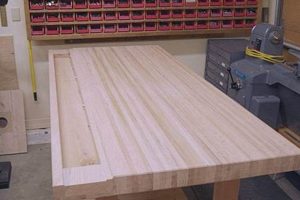
A dedicated workspace designed for crafting with wood, featuring a robust and stable construction. These surfaces typically incorporate vises, dog holes, and other features to securely hold materials during cutting, shaping, and assembly. These features provide enhanced accuracy and efficiency during woodworking tasks.
Such a platform offers numerous advantages to woodworking enthusiasts and professionals. It promotes precision, improves safety by providing a stable base, and increases productivity through its integrated tool-holding and workpiece-clamping capabilities. Historically, these were integral to workshops, reflecting evolving design and functionality to meet craftspeople’s changing demands.
The following sections will delve into aspects such as material selection, construction techniques, design considerations, essential features, and maintenance practices relevant to a quality, durable woodworking workspace. Understanding these elements is crucial for creating or selecting an optimal surface for woodworking endeavors.
Essential Workspace Guidance
The following recommendations outline best practices for maximizing the utility and lifespan of a purpose-built carpentry surface. Adhering to these principles ensures efficient workflow and consistent results.
Tip 1: Surface Protection: Employ a non-slip mat or workbench cover during heavy tasks to prevent scratches, dents, or staining. Implement regular cleaning to remove dust, wood shavings, and glue residue.
Tip 2: Vise Maintenance: Periodically lubricate the vise screws and moving parts with a suitable lubricant. Ensure the vise jaws align properly and apply even pressure to avoid workpiece slippage.
Tip 3: Dog Hole Utilization: Utilize dog holes strategically to secure workpieces of various shapes and sizes. Regularly inspect and clean dog holes to remove debris that might hinder proper dog placement.
Tip 4: Level Surface Verification: Routinely check the surface for levelness. Shim any uneven areas to ensure accurate cuts and assembly.
Tip 5: Tool Storage Optimization: Integrate tool storage solutions, such as drawers or shelving, within the design to keep essential tools readily accessible and organized. Minimize clutter on the primary work surface.
Tip 6: Finish Application Considerations: If applying finishes directly on the work surface, use a dedicated area or employ a protective barrier to prevent contamination of other workpieces.
Tip 7: Routine Inspection: Regularly inspect the entire structure for loose screws, damaged components, or signs of wear. Promptly address any issues to maintain structural integrity and prevent potential hazards.
By adhering to these recommendations, users can ensure the prolonged usability and optimal functionality of a dedicated carpentry structure. This leads to improved efficiency and safety in woodworking endeavors.
The subsequent sections will summarize the critical considerations discussed and offer concluding thoughts on creating or selecting an effective woodworking support.
1. Solid Wood Construction

Solid wood construction directly influences the durability and stability of a woodworking platform. The choice of solid wood, as opposed to engineered wood products, affects the bench’s ability to withstand the stresses inherent in woodworking tasks such as planing, sawing, and chiseling. Denser hardwoods like maple, beech, or oak are frequently selected for their resistance to wear and their capacity to maintain flatness over prolonged use. The selection of such materials directly contributes to the longevity of the structure.
A real-world example illustrates this point: A woodworking surface constructed from softwood may exhibit warping or deformation under consistent clamping pressure or exposure to moisture, resulting in inaccurate cuts and compromised joinery. Conversely, a bench made from kiln-dried hardwood is less susceptible to these issues. The enhanced mass and inherent rigidity of solid wood further dampen vibrations, providing a more stable platform for precision work. For example, when hand-planing a long board, a solid wood bench minimizes movement, contributing to a smoother, more consistent surface.
In summation, solid wood construction is not merely an aesthetic preference but a fundamental element contributing to a woodworking structure’s functionality and lifespan. The correct wood selection translates directly into improved work quality and reduces the likelihood of structural failure under demanding conditions. Understanding this connection is crucial for woodworkers seeking a reliable and enduring workspace.
2. Vise Placement & Function

Vise placement and function represent a critical determinant of an effective woodworking platform. The configuration, type, and operational characteristics of the vises directly impact the range of tasks a woodworker can perform and the efficiency with which those tasks can be executed. The strategic positioning of vises on the bench, coupled with their reliable clamping force, provides the necessary stability to secure workpieces during shaping, joining, and finishing operations. Improper vise placement or inadequate clamping power leads to workpiece slippage, inaccuracies, and potential safety hazards. Therefore, the vise setup is intrinsically linked to the overall utility of the workspace.
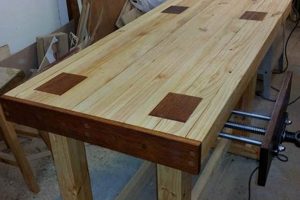
Several examples illustrate the practical significance of vise placement and function. A tail vise, typically positioned flush with one end of the bench, facilitates clamping long boards for edge jointing or planing. A face vise, mounted on the side of the bench, accommodates a range of workpiece thicknesses and orientations, often utilized for tasks such as dovetailing or mortising. The quality and responsiveness of the vises clamping mechanism further influences its effectiveness; a quick-release vise enables rapid adjustments, while a traditional screw vise provides superior clamping force. The interplay between these components determines the overall versatility of the workspace. A woodworker constructing a table, for instance, would rely on both the tail vise to secure long aprons during mortise and tenon joinery and the face vise to hold smaller components during shaping.
In conclusion, vise placement and function significantly influence the performance of a woodworking station. The proper selection and arrangement of vises, along with their reliable operation, enhance workholding capabilities, improve accuracy, and promote safety. Prioritizing these factors is essential for creating a woodworking surface that adapts to a diverse range of projects and delivers consistent results. Neglecting these details compromises the bench’s utility, restricts workflow, and ultimately impacts the quality of the finished product. Therefore, attention to vise-related aspects constitutes a fundamental element in constructing or selecting a worthwhile woodworking aid.
3. Dog Hole Configuration

Dog hole configuration is an integral aspect of a woodworking bench, directly influencing its versatility and workholding capacity. The arrangement, size, and precision of dog holes establish the foundation for securing workpieces during a multitude of woodworking operations. This configuration, therefore, significantly contributes to the overall functionality and efficiency of a dedicated woodworking surface.
- Pattern and Spacing
The pattern and spacing of dog holes across the benchtop dictates the types and sizes of workpieces that can be effectively clamped. A grid pattern with consistent intervals offers versatility for securing various projects. Closer spacing allows for finer adjustments, while wider spacing accommodates larger components. For instance, a bench intended for small-scale projects might benefit from a dense grid of dog holes, while a bench designed for large furniture construction might require a wider spacing pattern.
- Diameter and Depth
The diameter and depth of dog holes must be precisely dimensioned to accept standard-sized bench dogs and accessories. Too small of a diameter hinders the insertion of bench dogs, while too large a diameter results in excessive play and reduced clamping force. Insufficient depth compromises the stability of the bench dog, whereas excessive depth weakens the benchtop. A common standard is a 3/4-inch diameter, which accommodates widely available bench dogs. Consistent depth across all holes ensures uniform clamping pressure.
- Alignment and Perpendicularity
Proper alignment and perpendicularity of dog holes relative to the benchtop are crucial for accurate and reliable workholding. Misaligned dog holes can induce racking or twisting forces on the workpiece, leading to inaccuracies in cutting or joining operations. Dog holes that are not perpendicular to the surface can cause bench dogs to bind or slip under load. Precise drilling or boring techniques are required to ensure proper alignment and perpendicularity, contributing to a stable and predictable clamping system.
- Material and Reinforcement
The material surrounding the dog holes and any reinforcement measures taken directly impact their durability and resistance to wear. Dog holes drilled directly into softwoods are prone to wear and tear, potentially enlarging over time. Hardwood inserts or metal reinforcement rings around the dog holes enhance their longevity and prevent deformation under repeated use. Reinforcement is particularly important in areas subjected to high clamping forces, ensuring the long-term integrity of the benchtop.
The interplay of pattern, spacing, diameter, depth, alignment, and reinforcement dictates the overall effectiveness of the dog hole system. A well-executed dog hole configuration significantly enhances the workbench’s versatility, providing a stable and predictable platform for a wide range of woodworking tasks. Conversely, a poorly designed or executed dog hole system limits the bench’s functionality and compromises the accuracy and safety of woodworking operations, demonstrating the profound impact of dog hole configuration on the overall utility of a dedicated woodworking aid.
4. Surface Flatness

Surface flatness represents a paramount characteristic of any effective woodworking structure. Deviations from a true plane directly impede accurate stock preparation, joinery, and assembly processes. A non-planar surface introduces inconsistencies in measurements and can result in cumulative errors that compromise the integrity of the final woodworking piece. As such, the degree of surface flatness is a critical determinant of the quality and precision achievable on the dedicated structure.
The effect of surface flatness is particularly evident in tasks such as hand planing. A high degree of flatness allows a hand plane to make consistent contact with the workpiece, resulting in a uniformly smooth and level surface. Conversely, if the supporting structure exhibits dips or humps, the plane follows these irregularities, leading to uneven stock removal and a distorted final product. For example, when flattening a wide board for a tabletop, even a slight deviation from flatness on the support can translate into visible imperfections and difficulties in subsequent joining operations. Similarly, during the assembly of a cabinet, a non-planar surface can introduce racking and misalignment, compromising the structural integrity and aesthetic appeal of the finished piece. This underscores the necessity for a flat and stable work area.
Achieving and maintaining surface flatness presents ongoing challenges. Seasonal variations in humidity can induce warping or cupping in wooden tabletops. Regular maintenance, including periodic leveling and surface reconditioning, is essential for preserving the integrity of the structure. In summary, surface flatness is not merely a desirable attribute but a foundational requirement for precision woodworking. Its impact on accuracy, efficiency, and final product quality necessitates careful attention during design, construction, and long-term maintenance, reflecting its significance within the broader scope of quality woodworking practice.
5. Integrated tool storage

Integrated tool storage, as it relates to a woodworking structure, directly influences workflow efficiency and workspace organization. Thoughtful incorporation of storage solutions within the design of a carpentry work surface enhances accessibility to essential tools while minimizing clutter and maximizing usable workspace. This integration, therefore, represents a significant factor in optimizing the functionality of a dedicated woodworking environment.
- Accessibility and Efficiency
Integrated tool storage enables immediate access to commonly used tools. Drawers, shelves, and specialized racks, built directly into the framework, minimize the time spent searching for necessary implements. The strategic placement of these storage compartments near the primary work area streamlines workflow and reduces interruptions. A woodworker, for example, might store frequently used chisels and measuring tools in a drawer directly beneath the benchtop, eliminating the need to walk to a separate toolbox or storage cabinet.
- Space Optimization
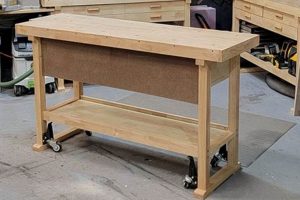
Incorporating tool storage into the bench design maximizes the use of available space, particularly in smaller workshops. Instead of relying on separate storage units that consume floor area, the bench itself becomes a self-contained workstation. Under-bench drawers, for example, utilize otherwise unused space, providing ample storage for hand tools, power tools, or hardware. This is especially beneficial in compact woodworking environments where every square foot of workspace is valuable.
- Organization and Safety
Integrated tool storage promotes a more organized and safer work environment. Designated compartments for specific tools reduce clutter, preventing tools from being misplaced or posing tripping hazards. A well-organized bench contributes to a more focused and efficient work process, while also minimizing the risk of accidents. For example, a chisel rack built into the side of the bench prevents chisels from rolling around and potentially causing injury.
- Customization and Adaptability
Integrated tool storage can be customized to accommodate specific tool collections and woodworking styles. Drawers can be fitted with custom dividers and organizers to accommodate specific hand tools. Shelves can be configured to hold power tools or lumber. A well-designed storage system adapts to the evolving needs of the woodworker, ensuring that the bench remains a functional and efficient workspace for years to come. For instance, a woodworker specializing in carving might incorporate a specialized storage system for carving tools and accessories.
These facets of integrated tool storage enhance productivity, promote safety, and optimize workspace utilization, demonstrating its importance to a well-designed surface for woodworking. The careful consideration and implementation of integrated storage solutions contribute significantly to creating an effective and enjoyable woodworking experience. Its benefits extend beyond mere convenience, impacting the overall quality and efficiency of woodworking endeavors.
6. Structural Stability
Structural stability is a paramount consideration in the design and construction of any woodworking bench. It directly affects the bench’s capacity to withstand forces generated during woodworking operations and its long-term resistance to deformation or failure. The structural integrity of a bench serves as the foundation for accurate and safe woodworking practices.
- Leg and Frame Joinery
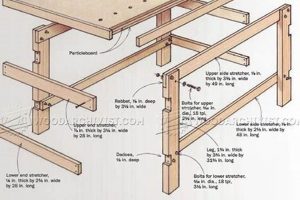
The joinery connecting the legs to the bench frame is critical for resisting racking and shear forces. Mortise and tenon joints, dovetail joints, or robust bolted connections provide the necessary strength and rigidity to maintain the bench’s rectangular form under stress. For example, a bench with poorly constructed leg joinery will exhibit excessive wobble, making it unsuitable for tasks requiring precision.
- Benchtop Thickness and Material
The thickness and material composition of the benchtop directly influence its resistance to bending and deflection. A thick, solid hardwood benchtop provides superior stiffness compared to a thin or composite top. This rigidity is essential for maintaining a flat and stable work surface under clamping pressure. Consider the scenario where a thin benchtop bows significantly under the force of a vise, rendering it difficult to achieve accurate cuts.
- Internal Bracing and Stiffeners
Internal bracing, stretchers, or aprons integrated into the bench frame enhance its overall stiffness and resistance to twisting. These structural elements distribute loads more evenly, preventing localized stress concentrations and minimizing deformation. A bench lacking adequate internal bracing may exhibit excessive vibrations during planing, making it difficult to achieve a smooth surface on the workpiece.
- Weight and Footprint
The overall weight and footprint of the bench contribute to its stability by resisting movement during woodworking operations. A heavier bench with a wider stance is less likely to shift or tip under load, providing a more secure and predictable work platform. A lightweight bench may tend to slide or rock during vigorous tasks such as chopping mortises, compromising safety and accuracy.
These facets of structural stability are interconnected in determining the longevity and performance of a woodworking bench. Robust joinery, a rigid benchtop, internal bracing, and adequate weight collectively ensure that the bench provides a solid and unwavering foundation for woodworking activities. The absence of any one of these elements compromises the overall stability of the structure, diminishing its utility and potentially posing safety risks. Therefore, attention to structural integrity is of utmost importance in the design and construction of a woodworking bench.
7. Finish Durability
The durability of the finish applied to a woodworking surface directly influences its longevity and resistance to damage from common workshop activities. A protective finish safeguards the wood from moisture, impacts, and abrasions, extending the lifespan and maintaining the aesthetic appeal of the structure. Consequently, the selection and application of a suitable finish are crucial considerations for any woodworking bench.
- Resistance to Moisture Intrusion
A durable finish acts as a barrier against moisture penetration, preventing warping, swelling, and the development of mold or mildew. Exposure to moisture can compromise the structural integrity of the wood and lead to premature failure. Finishes such as polyurethane or epoxy provide a robust moisture barrier, making them suitable choices for woodworking environments with fluctuating humidity levels. For instance, a bench subjected to frequent spills or located in a damp basement benefits significantly from a moisture-resistant finish.
- Protection Against Abrasions and Impacts
A durable finish protects the wood surface from scratches, dents, and other forms of physical damage caused by tools, workpieces, or accidental impacts. Finishes with high abrasion resistance, such as catalyzed varnishes or conversion coatings, withstand the rigors of daily use and maintain a smooth, consistent surface over time. A woodworking bench used for heavy tasks, such as hammering or chiseling, requires a finish that can withstand repeated impacts without chipping or scratching.
- Chemical Resistance
A durable finish provides resistance to chemicals commonly found in woodworking environments, such as solvents, glues, and finishing products. Exposure to these chemicals can stain, soften, or dissolve certain finishes, compromising their protective properties. Finishes with good chemical resistance, such as pre-catalyzed lacquers, are less susceptible to damage from accidental spills or contact with chemicals. A woodworking bench used for applying finishes or working with adhesives requires a chemically resistant finish to maintain its integrity.
- Maintenance and Repairability
A durable finish simplifies maintenance and repair, allowing for easy cleaning and touch-ups. Finishes that are easy to clean and resistant to staining help maintain the aesthetic appeal of the structure. Furthermore, finishes that can be readily repaired or recoated extend the lifespan of the bench by allowing for localized damage to be addressed without requiring a complete refinishing. For example, a bench with a durable polyurethane finish can be easily cleaned with soap and water and can be recoated to restore its protective properties after years of use.
The interplay of moisture resistance, abrasion resistance, chemical resistance, and ease of maintenance determines the overall durability of the finish on a woodworking structure. The selection of an appropriate finish should be based on the intended use of the bench, the environmental conditions of the workshop, and the desired level of protection. A well-chosen and properly applied finish not only enhances the aesthetic appeal of the woodworking bench but also significantly extends its lifespan and ensures its reliable performance for years to come.
Frequently Asked Questions
The following section addresses common inquiries concerning dedicated structures used in woodworking, clarifying prevailing misunderstandings and providing evidence-based guidance.
Question 1: What is the optimal material for constructing a woodworking surface?
Hardwoods, such as maple, beech, or oak, are generally preferred due to their density, resistance to wear, and ability to maintain flatness. Softwoods may be suitable for secondary components or less demanding applications. The specific choice should align with the intended use and budget considerations.
Question 2: How can one ensure surface flatness on a woodworking structure?
Initial construction using kiln-dried lumber, meticulous joinery, and periodic surface reconditioning are essential. Regularly checking the surface with a straightedge and addressing any deviations with hand planes or other appropriate tools is recommended.
Question 3: What are the key considerations for vise selection and placement?
Vise selection should reflect the types of projects undertaken. Face vises, tail vises, and leg vises serve different purposes. Placement should optimize workholding capacity and accessibility, ensuring the vise jaws align properly and apply even pressure to the workpiece.
Question 4: How should dog holes be configured for optimal workholding?
Dog holes should be precisely drilled with consistent diameter and spacing. The pattern should accommodate a range of workpiece sizes and shapes. Reinforcement around the dog holes may be necessary to prevent wear and maintain their structural integrity.
Question 5: What are the benefits of integrated tool storage in a woodworking structure?
Integrated tool storage enhances workflow efficiency by providing immediate access to frequently used tools. It maximizes workspace, promotes organization, and contributes to a safer work environment.
Question 6: What type of finish is recommended for a woodworking structure, and how should it be applied?
Durable finishes, such as polyurethane or epoxy, offer protection against moisture, abrasions, and chemical spills. Surface preparation is crucial for proper adhesion. Multiple thin coats, applied according to the manufacturer’s instructions, provide optimal protection.
These answers underscore the importance of informed decision-making in the selection, construction, and maintenance of a woodworking structure. Considering these factors contributes to a safer, more efficient, and more enjoyable woodworking experience.
The following section will delve into concluding remarks, synthesizing the key elements discussed throughout this exploration.
Conclusion
This exploration of the carpentry surface highlights the intertwined nature of material selection, design principles, and functional considerations. Factors such as robust construction, adaptable workholding capabilities, surface precision, integrated storage solutions, structural integrity, and finish durability collectively define the efficacy of a dedicated woodworking space. A holistic approach to design and construction, attentive to each of these elements, is paramount.
Therefore, diligent assessment of requirements, and adherence to established best practices remain crucial. Whether constructing a new support or evaluating an existing structure, these considerations directly influence the quality, efficiency, and safety of woodworking endeavors. Prioritizing these principles enables craftspeople to realize their creative visions with enhanced precision and enduring results.