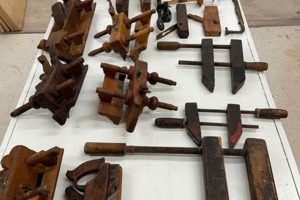
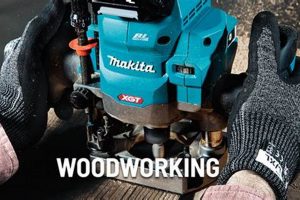
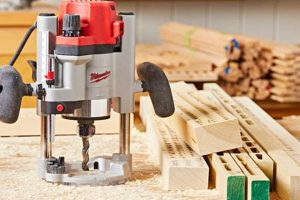
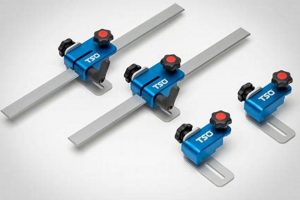
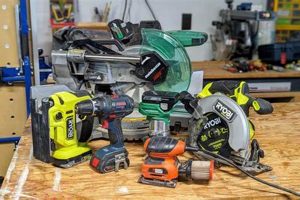
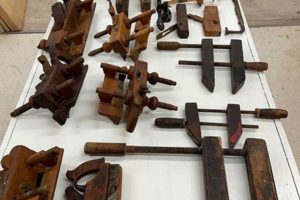
Implements utilized in shaping, cutting, joining, and finishing wood are essential for a broad range of construction and artistic endeavors. These instruments encompass a spectrum from manually operated devices such as hand saws and chisels, to power-driven machinery like table saws and routers, each designed for specific functions within woodworking projects. For example, a block plane refines surfaces, while a mortise machine creates precise joints.
The appropriate selection of implements is paramount to achieving precision, efficiency, and safety in woodworking projects. Understanding the function and application of each tool allows for the creation of durable and aesthetically pleasing items. Historically, the evolution of these instruments has significantly impacted the craft, enabling increasingly complex designs and refined finishes, contributing to both functional structures and artistic expressions.
The following discussion will examine a variety of categories based on their primary use, providing a deeper insight into their applications and operational characteristics. This categorization allows for a more structured understanding of the capabilities and limitations associated with specific instruments within this diverse craft.
Guidance on Selecting and Utilizing Woodworking Implements
This section provides focused advice to optimize the selection, maintenance, and application of instruments crucial for successful woodworking projects. Adherence to these guidelines enhances the quality, safety, and longevity of projects.
Tip 1: Prioritize Safety Equipment. Eye protection, hearing protection, and respiratory masks are essential when operating power tools or handling materials that produce dust or fumes. Consistent use minimizes potential hazards and promotes a safe working environment.
Tip 2: Maintain Sharp Cutting Edges. Dull blades and bits require more force, increasing the risk of accidents and producing inferior results. Regularly sharpen or replace cutting tools to ensure clean, efficient cuts.
Tip 3: Understand Grain Direction. Cutting against the grain can lead to splintering and tear-out. Analyze wood grain before each cut and adjust tool orientation accordingly for a smoother finish.
Tip 4: Secure Workpieces Firmly. Use clamps, vises, or other securing mechanisms to prevent movement during cutting, shaping, or joining. Stable workpieces enhance precision and reduce the risk of tool slippage.
Tip 5: Choose the Right Tool for the Task. Selecting the appropriate implement for a specific operation is critical for achieving desired results. Avoid using tools beyond their intended capabilities, as this can compromise safety and quality.
Tip 6: Calibrate Instruments Regularly. Ensure accurate measurements and cuts by frequently calibrating saws, squares, and other measuring devices. Regular calibration maintains precision and consistency throughout a project.
Tip 7: Store Implements Properly. Proper storage protects cutting edges, prevents rust, and maintains the integrity of tools. Organize implements in a dry, designated area to prolong their lifespan and ensure accessibility.
Implementing these guidelines contributes to enhanced safety, precision, and longevity in woodworking projects. A proactive approach to tool selection, maintenance, and operation yields superior results and minimizes potential risks.
The subsequent section will delve into specific applications and advanced techniques, building upon the foundational knowledge presented here.
1. Functionality

The functionality of implements utilized in woodworking dictates their suitability for specific tasks, thereby establishing a critical parameter in tool selection and utilization. Each instrument possesses inherent capabilities and limitations that directly impact project outcomes.
- Cutting Functionality
Cutting instruments serve the primary function of dividing wood stock into desired dimensions. Saws, including hand saws and power saws, exemplify this functionality. Hand saws, requiring manual force, offer control and precision for intricate cuts, while power saws, such as table saws, enable efficient and accurate cutting of larger stock. Choice depends on project scale and required precision.
- Shaping Functionality
Shaping instruments modify the form of wood through material removal. Planes, chisels, and rasps facilitate the creation of contours, curves, and decorative elements. Planes are employed to flatten surfaces, while chisels remove material for joinery or detailing. Rasps refine rough surfaces, each instrument providing nuanced shaping capabilities.
- Joinery Functionality
Instruments designed for joinery enable the connection of separate wood components. Mortise and tenon jigs, dovetail saws, and various clamping devices facilitate the creation of strong and aesthetically pleasing joints. The specific type of joint dictates the required instruments and techniques, impacting structural integrity and visual appeal.
- Finishing Functionality
Finishing instruments enhance the appearance and protect the surface of wood projects. Sandpaper, scrapers, and various application tools contribute to a smooth and durable finish. Sandpaper removes imperfections, while scrapers refine surfaces. Application tools facilitate the even distribution of paints, stains, and sealants, affecting the final aesthetic and protective qualities.
The diverse functionalities exhibited by implements employed in woodworking necessitate a thorough understanding of their individual capabilities. Matching the appropriate instrument to the task at hand optimizes efficiency, precision, and the overall quality of the finished product. A deliberate selection process, informed by a clear understanding of functional parameters, is paramount to successful woodworking outcomes.
2. Precision

Precision, in the context of implements utilized in woodworking, signifies the degree to which an instrument facilitates accurate and repeatable execution of specific tasks. This characteristic directly influences the quality, structural integrity, and aesthetic value of finished woodworking projects. The inherent design and manufacturing tolerances of each implement, coupled with the operator’s skill, determine the achievable level of precision. For instance, a well-calibrated digital caliper enables measurements to within fractions of a millimeter, crucial for creating tight-fitting joinery. Conversely, a poorly maintained hand saw may deviate from the intended cutting line, resulting in inaccurate dimensions and compromised structural strength. Therefore, precision is not merely a desirable attribute but a fundamental requirement for many woodworking operations.
The relationship between instrument precision and project success is exemplified in cabinetmaking. Constructing cabinets with precisely square corners and consistent dimensions demands the use of instruments such as precision squares, laser levels, and accurate measuring tapes. Deviation from these parameters leads to misaligned doors, uneven drawers, and a compromised overall appearance. Similarly, intricate carving projects necessitate implements with exceptional control and accuracy, such as specialized carving chisels and micro-motors. The selection of instruments is therefore dictated by the level of precision required for the specific task and the desired outcome.
In summary, precision is an indispensable component of woodworking implements, impacting the achievable quality and structural integrity of projects. The careful selection, proper maintenance, and skilled operation of these instruments are essential for realizing desired outcomes and minimizing errors. While advancements in technology continue to improve the precision of implements, the fundamental principle remains: achieving accuracy depends on a harmonious interplay between the instrument’s capabilities and the craftsman’s expertise.
3. Power Source
The operating mechanism, encompassing electrical, pneumatic, or manual actuation, fundamentally defines the capabilities and application parameters of woodworking instruments. The selected operating mechanism dictates the portability, power output, and operational complexity of the instrument. Electrical power, characterized by consistent delivery and high torque potential, enables instruments such as table saws and routers to perform demanding tasks with precision. Pneumatic power, relying on compressed air, offers a favorable power-to-weight ratio, commonly observed in nail guns and sanders, facilitating maneuverability. Manual operation, characteristic of hand saws and chisels, provides direct control but is constrained by physical exertion and time considerations. An understanding of these power source attributes is paramount to the appropriate selection of woodworking instruments aligned with project requirements and operational constraints.
The interplay between operating mechanism and instrument performance is exemplified by considering orbital sanders. Electrically powered orbital sanders offer variable speed settings and consistent power delivery, enabling efficient material removal across extensive surfaces. Pneumatic orbital sanders, lighter and more compact, are suitable for intricate detail work and applications requiring fine control. Manual sanding, while time-intensive, provides the highest level of tactile feedback, preferred for delicate finishes and specialized applications. The choice of operating mechanism directly affects material removal rate, surface finish quality, and operator fatigue levels, underscoring its significance in optimizing work processes.
In summary, the operating mechanism serves as a defining attribute of instruments utilized in woodworking, influencing performance characteristics, application suitability, and operational efficiency. A comprehensive understanding of the strengths and limitations associated with electrical, pneumatic, and manual operating mechanisms is essential for making informed decisions regarding tool selection and utilization. This knowledge facilitates the achievement of desired project outcomes while mitigating risks related to operational constraints and safety considerations. Further, the continued development of advanced operating mechanisms, such as battery-powered instruments with extended runtimes and improved power delivery, is poised to further enhance the capabilities and versatility of woodworking instruments in the future.
4. Material Compatibility

The term Material Compatibility, in the context of woodworking instruments, denotes the suitability of a particular tool for use with specific types of wood and related materials. This characteristic is paramount to achieving desired results, ensuring tool longevity, and maintaining operator safety. The intersection of instrument design and material properties determines the efficacy of a given tool-material pairing.
- Hardwood vs. Softwood Applications
Hardwoods, characterized by their density and complex grain patterns, necessitate instruments with hardened steel blades and robust construction. Tools intended for hardwoods, such as planes and chisels, typically undergo specialized heat treatments to withstand the increased resistance. Conversely, softer woods are more amenable to tools with less aggressive cutting edges, reducing the risk of tear-out and splintering. Mismatched pairings, such as using a softwood-optimized blade on a hardwood, result in premature dulling and compromised cut quality.
- Engineered Wood Products
Engineered wood products, encompassing plywood, MDF, and particleboard, present unique challenges due to the presence of adhesives and varying densities. Saw blades designed for these materials feature specialized tooth geometries and carbide tips to resist abrasion and deliver clean cuts. Standard woodworking blades may exhibit excessive splintering or rapid dulling when used on engineered wood products. Router bits intended for engineered materials are similarly constructed to maintain sharp cutting edges and minimize edge chipping.
- Exotic Wood Species
Exotic wood species often possess distinct properties, including high oil content, silica inclusions, or interlocked grain patterns. These characteristics necessitate the use of instruments with specific features, such as high-speed steel blades or specialized lubricants. Failure to account for these properties can lead to tool damage, reduced cutting efficiency, and unsatisfactory results. Some exotic woods may also elicit allergic reactions; therefore, appropriate personal protective equipment becomes essential.
- Metal Fasteners and Abrasives
The presence of metal fasteners, such as nails or screws, within a workpiece significantly impacts instrument selection. Specialized metal detectors assist in locating embedded fasteners prior to machining, preventing tool damage and potential injury. When abrasive materials, such as sandpaper, are employed, the grit selection must align with the wood species and desired finish. Aggressive grits can cause excessive scratching on softer woods, while finer grits may prove ineffective on denser species.
The preceding points highlight the critical importance of considering material compatibility when selecting instruments for woodworking projects. Informed decisions, based on a thorough understanding of material properties and tool characteristics, optimize performance, extend tool lifespan, and enhance project outcomes. Further, acknowledging the inherent limitations of tools relative to material properties contributes to a safer and more efficient working environment.
5. Maintenance

The sustained operational efficacy of instruments utilized in woodworking is intrinsically linked to consistent and appropriate maintenance procedures. Neglecting maintenance protocols invariably leads to diminished performance, accelerated wear, and compromised safety. The following sections delineate critical facets of instrument maintenance, elucidating their impact on woodworking outcomes.
- Sharpening Cutting Edges
Maintaining sharp cutting edges on implements, encompassing saws, chisels, and planes, is paramount to achieving clean, precise cuts. Dull edges necessitate increased force, elevating the risk of slippage and material damage. Regular sharpening, employing appropriate honing techniques and sharpening stones, ensures optimal cutting performance. The frequency of sharpening is contingent on tool usage and the hardness of the materials being worked.
- Cleaning and Lubrication
The accumulation of sawdust, resin, and debris on woodworking instruments impedes their functionality and accelerates corrosion. Regular cleaning, utilizing appropriate solvents and brushes, removes these contaminants. Lubrication of moving parts, such as gears and bearings, minimizes friction, prolongs component lifespan, and ensures smooth operation. The selection of lubricants must align with the instrument’s design and environmental conditions.
- Calibration and Adjustment
The accuracy of woodworking instruments, including saws, squares, and measuring devices, is essential for achieving dimensional precision. Regular calibration, employing recognized standards and precision instruments, corrects deviations and ensures consistent measurements. Adjustment of components, such as blade alignment and fence positioning, optimizes cutting accuracy and minimizes the risk of errors.
- Component Inspection and Replacement
Periodic inspection of woodworking instruments identifies worn or damaged components, such as belts, bearings, and electrical cords. Timely replacement of these components prevents catastrophic failures, minimizes downtime, and ensures operator safety. Adherence to manufacturer’s recommendations regarding component replacement intervals is critical for maintaining instrument reliability.
The preceding facets underscore the significance of integrating comprehensive maintenance protocols into woodworking practices. Proactive maintenance not only extends the lifespan of instruments but also enhances operational efficiency, minimizes safety risks, and ensures the consistent production of high-quality woodworking projects. Failing to prioritize maintenance invariably results in increased costs associated with repairs, replacements, and diminished productivity.
6. Safety Features
The integration of safety features into woodworking instruments directly mitigates potential hazards associated with their operation. These features, designed to prevent accidents and minimize injuries, are an indispensable component of each instrument. Their absence or malfunction can directly lead to severe consequences, including lacerations, amputations, eye injuries, and exposure to harmful dust or noise. For example, a table saw equipped with a blade guard, anti-kickback pawls, and a riving knife significantly reduces the risk of kickback, a dangerous event where the workpiece is violently thrown back toward the operator. The operational effectiveness of these features is directly proportional to the operator’s adherence to established safety protocols and the instrument’s proper maintenance.
Consider the practical application of dust collection systems in conjunction with sanding equipment. Sanding operations generate substantial quantities of fine particulate matter, posing respiratory health risks. The incorporation of a dust collection port and connection to a high-efficiency particulate air (HEPA) filter system effectively removes airborne particles, minimizing inhalation hazards. Similarly, the use of push sticks and push blocks when operating jointers or routers maintains a safe distance between the operator’s hands and the cutting edge, preventing accidental contact. Eye protection, specifically safety glasses or face shields, safeguards against flying debris and projectiles, preventing potential eye injuries. The proper selection and utilization of these safety features are crucial in fostering a secure working environment.
In summary, safety features are inextricably linked to the responsible and effective utilization of woodworking instruments. They serve as a primary line of defense against potential hazards, minimizing the risk of injury and promoting a safer working environment. While engineering controls, such as safety guards and dust collection systems, play a critical role, the operator’s knowledge, training, and adherence to established safety procedures are equally important. Prioritizing safety not only protects the individual but also contributes to a more productive and sustainable woodworking practice.
Frequently Asked Questions Regarding Woodworking Implements
This section addresses prevalent inquiries concerning the selection, application, and maintenance of instruments essential for woodworking activities.
Question 1: What is the fundamental distinction between a hand plane and a power planer?
Hand planes rely on manual force to shave thin layers of wood, offering precise control and a smooth finish. Power planers utilize a rotating cutterhead powered by an electric motor, enabling rapid material removal but potentially sacrificing finesse.
Question 2: Is it necessary to sharpen chisels, even when new?
Many chisels, even when acquired new, may not possess an optimal cutting edge. Honing on a sharpening stone is often required to achieve the desired level of sharpness for precise woodworking tasks.
Question 3: What are the primary considerations when selecting a saw blade for a table saw?
Tooth count, blade diameter, and kerf width are critical factors. Higher tooth counts yield smoother cuts but slower feed rates. Blade diameter must correspond to the table saw’s specifications. Kerf width impacts material removal and cut accuracy.
Question 4: How frequently should woodworking instruments undergo cleaning and lubrication?
Cleaning and lubrication frequency depends on usage intensity and environmental conditions. Instruments subjected to heavy use or exposed to humid environments necessitate more frequent maintenance.
Question 5: What safety precautions are imperative when operating a router?
Eye protection, hearing protection, and dust collection are essential. Securing the workpiece, using appropriate router bits, and maintaining a firm grip on the instrument are also critical safety measures.
Question 6: What constitutes proper storage for woodworking instruments?
Instruments should be stored in a dry, organized environment to prevent corrosion and damage. Cutting edges should be protected, and instruments should be readily accessible for efficient workflow.
Adhering to these principles enhances the longevity and performance of woodworking implements, contributing to successful project outcomes.
The subsequent section explores advanced techniques and specialized applications within the realm of woodworking.
Conclusion
The preceding discussion has elucidated the diverse array of implements utilized in woodworking, encompassing considerations of functionality, precision, power source, material compatibility, maintenance, and safety features. Each implement possesses inherent characteristics that dictate its suitability for specific tasks, thereby necessitating informed selection and utilization to ensure optimal project outcomes. A comprehensive understanding of these factors is critical for woodworkers of all skill levels.
The pursuit of proficiency in woodworking demands a continuous commitment to acquiring knowledge, refining skills, and adhering to rigorous safety protocols. By embracing these principles, woodworkers can unlock the potential to create enduring and aesthetically pleasing objects, while mitigating the inherent risks associated with the craft. The enduring legacy of woodworking lies in the ability to transform raw materials into functional and artistic expressions, a testament to human ingenuity and craftsmanship. Therefore, a deliberate approach to mastering tools and techniques will perpetuate this legacy for generations to come.