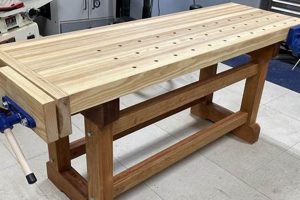
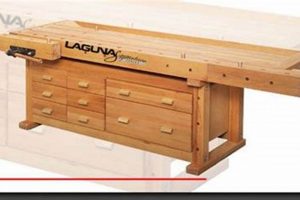
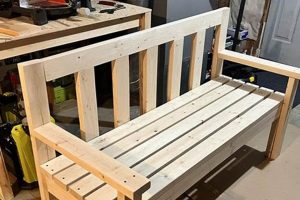
A sturdy, flat work surface designed specifically for woodworking tasks. It typically features a robust construction, often incorporating vises, dog holes, and other features to aid in securely holding and manipulating wood pieces. An example is a solid maple structure with a front vise and a tail vise, allowing the user to clamp workpieces of various sizes and orientations.
This essential piece of workshop equipment provides a stable and dedicated area for performing operations such as sawing, planing, joining, and assembly. Its robust design minimizes vibration and movement, contributing to accuracy and safety. Historically, it has been central to woodworking practices, evolving over centuries from simple tables to sophisticated workstations tailored to specific crafts. The presence of such a structure enhances workflow, reduces fatigue, and allows for a more efficient and precise execution of woodworking projects.
The following sections will delve into the key considerations for selecting appropriate materials, construction techniques, and optimal dimensions. A detailed discussion regarding the integration of work holding solutions and strategies for maintaining a safe and organized environment will also be presented.
Woodworking Shop Bench
Maximizing the utility and lifespan of a woodworking structure requires careful planning and consistent maintenance. Adherence to the following tips will contribute to a safe, efficient, and productive workspace.
Tip 1: Prioritize Stability. The primary function is to provide a stable surface. Ensure the legs are securely attached to the top and consider adding stretchers to minimize racking. A heavy construction, using dense hardwoods, also contributes significantly to stability.
Tip 2: Implement Effective Work Holding. A vise, or multiple vises, are essential. Choose vises appropriate for the type of woodworking performed. Consider quick-release mechanisms for efficient operation.
Tip 3: Incorporate Dog Holes. A grid of dog holes, compatible with bench dogs and other accessories, dramatically expands work-holding capabilities. Ensure the holes are precisely drilled and aligned for optimal performance.
Tip 4: Maintain a Flat Surface. A flat surface is critical for accurate woodworking. Periodically check the top for flatness using a straightedge and, if necessary, flatten it using hand planes or other appropriate methods.
Tip 5: Protect the Finish. Apply a durable finish, such as an oil-based varnish or polyurethane, to protect the wood from moisture and scratches. Regular cleaning and waxing will further preserve the finish.
Tip 6: Organize Tools and Accessories. Integrate storage solutions, such as drawers, shelves, or tool wells, to keep essential tools and accessories within easy reach. This reduces clutter and improves workflow.
Tip 7: Position for Optimal Lighting. Adequate lighting is crucial for safety and accuracy. Position the woodworking structure near a window or supplement with artificial lighting to ensure the work surface is well-illuminated.
Tip 8: Routinely Inspect and Maintain. Regularly inspect the structure for loose joints, damaged components, or other issues. Promptly address any problems to prevent further damage and maintain safety.
By focusing on stability, work-holding capabilities, surface flatness, and organization, the woodworking structure will serve as a reliable and productive workspace for years to come. Consistent maintenance ensures its longevity and optimal performance.
The concluding section will summarize the key considerations discussed throughout this article and provide guidance on customizing a design to suit individual needs.
1. Sturdy construction

Sturdy construction is paramount to the functionality and longevity of a woodworking structure. It directly impacts stability, safety, and the ability to perform precise woodworking tasks effectively. The following facets elaborate on the essential elements that contribute to a robust structure.
- Material Selection
The choice of materials significantly influences overall strength and durability. Dense hardwoods, such as maple, beech, or oak, are preferred for their resistance to wear, deformation, and impact. Softwoods, while more economical, may compromise long-term stability and are typically used for non-structural components. Proper material selection ensures the structure can withstand the forces exerted during woodworking operations.
- Joint Integrity
The methods used to join the various components are critical. Strong joinery techniques, such as mortise and tenon, dovetails, or robust bolted connections, are essential for resisting racking and shear forces. Weak or poorly executed joints can lead to instability, premature failure, and potential safety hazards. The integration of durable joinery contributes significantly to the overall solidity of the structure.
- Mass and Weight Distribution
The overall mass and how that mass is distributed impacts stability. A heavier structure resists movement and vibration more effectively than a lightweight one. Distributing the weight evenly across the base and through the legs ensures stability on uneven surfaces. A solid foundation provided by adequate mass and proper weight distribution is crucial for precision work.
- Reinforcement and Bracing
Strategic reinforcement and bracing enhance resistance to deformation and racking. Stretchers connecting the legs, aprons supporting the top, and diagonal bracing all contribute to structural integrity. These elements distribute stress and prevent the structure from twisting or collapsing under load. Implementing effective reinforcement strategies extends the service life and maintains the accuracy of the workstation.
The combination of appropriate material selection, robust joinery techniques, sufficient mass, and strategic reinforcement ensures the structure provides a stable and reliable platform for woodworking activities. These considerations are fundamental to the design and construction of any structure intended for demanding workshop environments.
2. Effective work holding

Effective work holding is integral to any woodworking structure. It refers to the methods and devices employed to secure a workpiece in place, allowing the woodworker to perform operations such as sawing, planing, routing, and joinery with precision and safety. The efficacy of the work-holding system directly impacts the quality of the finished product and the efficiency of the woodworking process.
- Vises
Vises are mechanical clamping devices attached directly to the structure’s top or sides. A front vise, typically mounted on the front apron, is used for general-purpose clamping. A tail vise, often integrated into the end of the structure, provides clamping force across the width of the surface, especially useful when combined with bench dogs. The clamping force and jaw width of a vise must be suitable for the typical workpieces encountered. Poorly sized or weak vises compromise the stability of the workpiece, leading to inaccuracies and potential safety hazards.
- Bench Dogs
Bench dogs are pegs or stops that fit into precisely drilled holes in the top, known as dog holes. They are used in conjunction with a vise or independently to secure workpieces. Bench dogs prevent workpieces from sliding or rotating during operations. Dog holes arranged in a grid pattern offer versatility in positioning the dogs for various workpiece sizes and shapes. Inconsistent dog hole spacing or poorly fitting dogs reduce their effectiveness.
- Clamping Accessories
Beyond vises and bench dogs, a variety of clamping accessories augment work-holding capabilities. These include holdfasts, which provide rapid clamping using friction, cam clamps, which offer adjustable clamping pressure, and specialized clamps designed for specific joinery tasks, such as dovetailing. The integration of appropriate clamping accessories expands the range of projects that can be effectively undertaken and enables more complex or intricate operations to be performed with greater accuracy.
- Surface Friction
While not a clamping mechanism in itself, the surface friction of the woodworking surface plays a role in work holding. A surface with a high coefficient of friction, achieved through the inherent properties of the wood or the application of a specialized coating, can help prevent workpieces from slipping during light operations. Surface friction works in concert with clamping mechanisms to maintain stability and control.
The combination of well-chosen and properly implemented work-holding methods transforms the basic structure into a versatile and highly functional tool. These methods enhance precision, improve safety, and expand the range of woodworking projects that can be successfully executed. A poorly conceived work-holding system compromises the utility of even the most robustly constructed structure.
3. Surface flatness

Surface flatness is a crucial attribute of any functional woodworking structure. Its deviation directly impacts the accuracy of joinery, the stability of workpieces, and the overall quality of finished projects. A structure that lacks a truly flat surface introduces errors, necessitating corrective measures that consume time and resources. The cause of an un-flat structure surface can range from initial construction flaws, settling, or environmental factors such as humidity fluctuations leading to warping. For example, attempting to assemble a flat-panel door on a surface with a noticeable crown will inevitably result in gaps or misalignments when the door is placed on a level plane. This underscores the importance of addressing surface deviations proactively.
The pursuit of surface flatness extends beyond initial construction. Regular maintenance, including planing or sanding to correct localized imperfections, is essential for long-term accuracy. Consider a cabinet maker needing to assemble a perfectly flush countertop. An uneven structure surface could cause the countertop sections to be misaligned, resulting in an aesthetically unappealing surface, and reducing structural integrity. Regular checks with a straightedge and appropriate corrective action are essential components of responsible woodworking practice. Furthermore, accessories such as winding sticks can be used to detect twist in the benchtop for more comprehensive assessment.
Achieving and maintaining surface flatness on a woodworking structure is a continuous process requiring precision, vigilance, and appropriate tools. Failure to prioritize this aspect introduces compounding errors throughout the workflow, negatively impacting the final product. Recognizing the intrinsic link between surface quality and project success enables woodworkers to maximize their efficiency and achieve consistently professional results. This attention to detail forms the foundation for high-quality craftsmanship.
4. Ergonomic height

The ergonomic height of a woodworking structure is a critical determinant of user comfort, efficiency, and long-term physical well-being. An inappropriately sized structure forces the woodworker to adopt awkward postures, leading to strain, fatigue, and potential musculoskeletal disorders. Conversely, a structure of suitable height promotes a natural and comfortable working position, enhancing productivity and minimizing the risk of injury. The impact of height is most pronounced during repetitive tasks such as planing or sanding, where prolonged bending or reaching can quickly exacerbate discomfort.
Determining the optimal height involves considering the woodworker’s stature, the type of tasks performed, and the typical use of hand tools. A taller individual requires a higher surface to avoid stooping, while tasks requiring downward pressure, such as chopping mortises, may benefit from a slightly lower height. The traditional elbow-height rule, where the structure is level with the woodworker’s elbow, serves as a general guideline, but individual preferences and task-specific adjustments are often necessary. Ignoring these personalized factors can result in decreased focus, compromised accuracy, and increased physical stress.
In conclusion, ergonomic height is not merely a matter of convenience but a fundamental element in creating a safe and productive woodworking environment. Proper height selection mitigates the risk of physical strain, fosters efficient workflow, and enhances the overall enjoyment of the craft. Customizing the height to match individual needs and working style is essential for maximizing the benefits of this foundational workshop component. The benefits can greatly increase user’s experience and outcome.
5. Integrated storage

Integrated storage within the woodworking structure addresses a fundamental need for organization and accessibility within the workshop. The presence, or absence, of such storage directly impacts workflow efficiency and safety. Disorganized tools and materials necessitate time-consuming searches, increasing the likelihood of accidents and hindering productivity. A well-designed storage system, conversely, provides designated locations for tools, fasteners, and project components, streamlining operations and minimizing wasted time. This effect is particularly noticeable during complex projects requiring a diverse array of tools and materials. For instance, a cabinet maker constructing a multi-drawer chest benefits significantly from having readily accessible hardware and measuring tools, avoiding interruptions to the assembly process.
The practical applications of integrated storage extend beyond mere convenience. Drawers, shelves, and compartments located within the woodworking structure footprint optimize space utilization, especially in smaller workshops where square footage is limited. Customized storage solutions tailored to specific tool types, such as dedicated chisel racks or saw till, further enhance organization and prevent damage to delicate tools. Consider a luthier crafting a guitar; having specialized storage for delicate carving tools and valuable tonewoods within arm’s reach minimizes the risk of damage and preserves the integrity of the materials. The integration of specific hardware, such as drawer slides or magnetic tool holders, can further improve access and functionality.
In summation, integrated storage is not merely an optional feature but a crucial element in maximizing the utility and efficiency of a woodworking structure. The design and implementation of effective storage solutions directly correlate with improved workflow, enhanced safety, and optimized space utilization. While challenges may arise in accommodating diverse tool collections or adapting to evolving project needs, the benefits of a well-organized workspace far outweigh the effort required to implement integrated storage effectively. By prioritizing organization, the woodworker can focus on craftsmanship rather than struggling with inefficient tool management.
Frequently Asked Questions
The following addresses common inquiries regarding the selection, use, and maintenance of the primary woodworking workstation. Clarification of these points promotes informed decision-making and effective workshop practice.
Question 1: What constitutes an ideal height for a woodworking station?
The determination of optimal height depends on individual stature and task preferences. A general guideline suggests aligning the top surface with the user’s elbow when standing. Precise adjustment may be necessary to accommodate specialized operations or personal ergonomic requirements.
Question 2: What are the key considerations in selecting wood for constructing a woodworking station?
Density, stability, and resistance to wear are paramount. Hardwoods such as maple, beech, or oak are frequently preferred for their robustness and durability. Softwoods may be appropriate for non-structural components, but the primary frame should employ hardwoods for maximum stability.
Question 3: How frequently should the top surface be flattened?
The frequency of flattening depends on usage and environmental conditions. Regular inspection with a straightedge is recommended. Corrections are typically required when deviations become noticeable or begin to affect the accuracy of woodworking operations.
Question 4: What are the essential work-holding accessories for a woodworking station?
Vises are considered essential, with the front vise and tail vise offering versatile clamping options. Bench dogs, holdfasts, and various specialized clamps complement the vise system, expanding the range of workpiece configurations that can be securely held.
Question 5: Is integrated storage a necessary feature?
While not strictly essential, integrated storage significantly enhances workshop efficiency and organization. Drawers, shelves, and compartments provide readily accessible locations for tools and materials, minimizing wasted time and promoting a safer work environment.
Question 6: How does one maintain a woodworking station to ensure longevity?
Regular cleaning, prompt repair of any damage, and periodic application of a protective finish are essential. Proper maintenance prevents deterioration of the wood, preserves surface flatness, and extends the service life of the structure.
Careful consideration of these frequently asked questions facilitates informed decisions regarding the selection, construction, and maintenance of this essential piece of workshop equipment.
The subsequent section will provide specific examples of woodworking structures from varying manufacturers or design configurations.
Conclusion
The preceding discussion has illuminated the multifaceted nature of the woodworking shop bench, underscoring its role as a critical element within the woodworking environment. The analysis encompassed considerations ranging from material selection and structural integrity to ergonomic design and integrated storage solutions. Each of these aspects contributes directly to the workstation’s functionality, safety, and overall impact on woodworking productivity.
The effective implementation of these principles necessitates a comprehensive understanding of individual woodworking practices and workshop constraints. It is incumbent upon the woodworker to carefully evaluate these factors and adapt their workstation accordingly. Investment in a well-designed and maintained woodworking shop bench is an investment in the craft itself, promoting accuracy, efficiency, and the realization of high-quality woodworking projects.

![Top-Rated Best Portable Woodworking Bench [2024 Guide] | Step-by-Step Guides, Tools & Inspiration to Build Beautiful Wooden Decor on a Budget](https://woodfromhome.com/wp-content/uploads/2026/05/th-181-300x200.jpg "Top-Rated Best Portable Woodworking Bench [2024 Guide] Step-by-Step Guides, Tools & Inspiration to Build Beautiful Wooden Decor on a Budget")