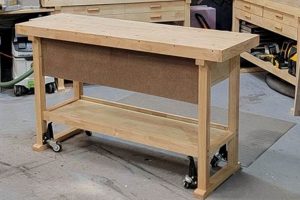
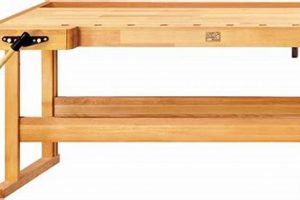
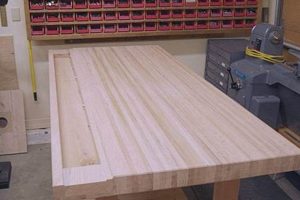
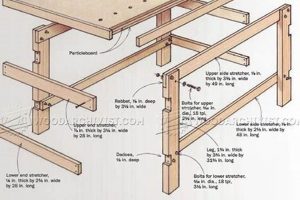
A fundamental piece of workshop equipment, a basic structure designed for supporting materials during fabrication processes, frequently arises in discussions pertaining to home-based construction endeavors. Such a platform, conceived for ease of assembly and intended for amateur craftspeople, offers a stable surface for executing a range of tasks. A common illustration includes a rectangular frame constructed from dimensional lumber, featuring a solid top and sturdy legs, readily buildable with minimal tools and expertise.
The inherent advantages of such a self-constructed support system lie in its affordability and customizability. It allows for precise adaptation to specific spatial constraints and project requirements. Historically, crafting these support structures has been a cornerstone of woodworking practices, offering a tangible entry point for beginners while providing experienced individuals with a dedicated area for intricate work. The creation of such a structure encourages resourcefulness and provides a cost-effective alternative to commercially manufactured options.
The subsequent sections will delve into the selection of suitable materials, the essential tools required for construction, and a step-by-step guide to assembling a robust and functional support platform. Furthermore, it will address common modifications and enhancements that can be implemented to personalize the equipment and optimize it for specific applications.
Essential Considerations for Workshop Foundation
Constructing a stable and functional work surface is paramount for successful woodworking. The following guidelines offer practical advice for creating a durable and efficient platform in a home workshop.
Tip 1: Material Selection is Crucial: Opt for sturdy, straight lumber, such as kiln-dried pine or fir. Avoid warped or knot-ridden boards, as these can compromise the structural integrity of the finished product. The thickness of the material should be commensurate with the anticipated load.
Tip 2: Prioritize Stability: Ensure the legs are securely attached to the frame. Consider using mortise and tenon joints, or reinforced screws and glue, to maximize rigidity and prevent wobbling. Diagonal bracing can further enhance stability, particularly for larger platforms.
Tip 3: Dimensions Matter: Tailor the size of the surface to the available workspace and the typical scale of projects. A standard height of 34-36 inches is generally suitable for most individuals, but adjustments may be necessary for ergonomic comfort.
Tip 4: Surface Preparation is Key: After assembly, sand the work surface smooth to prevent splinters and ensure even contact with materials. Applying a durable finish, such as polyurethane, will protect the wood from spills and scratches.
Tip 5: Incorporate Storage Solutions: Consider integrating drawers, shelves, or pegboards into the design to maximize storage capacity and keep tools organized. This enhances workflow efficiency and minimizes clutter.
Tip 6: Leveling is Essential: Use shims to ensure the structure is perfectly level, particularly if the workshop floor is uneven. A level work surface is critical for accurate cuts and joinery.
Tip 7: Weight Distribution: When planning the design, anticipate the placement of heavy equipment or materials. Reinforce the structure in areas that will bear the brunt of the load to prevent sagging or collapse.
Implementing these considerations during the construction phase will result in a dependable and highly functional workspace, capable of supporting a wide range of woodworking activities.
The subsequent segments will explore advanced techniques for maximizing the utility and longevity of the finished support system.
1. Stable work surface

The correlation between a stable work surface and a readily constructed support structure is fundamental. A primary function of the support structure is to provide a level, unyielding plane for executing woodworking tasks. The absence of stability in the work surface directly compromises the precision and safety of operations. For example, attempting to saw a straight line on an unstable surface leads to inaccuracies and potential material waste. Similarly, applying finishes or assembling intricate joinery becomes considerably more challenging without a firm and consistent platform.
The significance of stability extends beyond mere convenience; it is integral to the integrity of the finished product. A stable work surface reduces vibration, minimizes material movement during cutting or shaping, and allows for consistent application of pressure when using hand tools. Consider the task of chiseling mortises; a wobbly surface necessitates constant readjustment, leading to imprecise cuts and potentially weakening the joint. In contrast, a solid foundation allows for controlled and accurate chiseling, resulting in a stronger and more aesthetically pleasing connection. The construction process should prioritise design elements that contribute to stability, such as robust leg construction, cross bracing, and a thick, solid worktop.
In conclusion, a stable work surface represents an indispensable feature of a straightforward support structure for woodworking. Achieving stability through thoughtful design and careful construction translates directly into improved accuracy, enhanced safety, and a higher quality finished product. A failure to prioritize stability undermines the entire purpose of the platform, rendering it less effective and potentially hazardous. Addressing the issue of stability early in the design phase is vital for ensuring the creation of a functional and dependable tool.
2. Appropriate height

The height of a work surface significantly impacts user comfort, efficiency, and safety. In the context of woodworking, a dimensionally unsuitable platform can lead to postural strain, reduced precision, and increased risk of injury. The design of a readily assembled support structure must prioritize the user’s ergonomic needs. For example, a surface that is too low forces the operator to bend over, resulting in back pain and reduced visibility of the workpiece. Conversely, a surface that is too high necessitates raised shoulders and arms, leading to fatigue and potential shoulder impingement. A well-considered height promotes a neutral posture, allowing for extended periods of work without undue physical stress.
Determining the ideal height often involves considering individual anthropometric measurements. A common guideline suggests that the work surface should be approximately knuckle height when standing, providing a comfortable reach for most individuals. However, this is a general approximation and may require adjustment based on specific tasks. For detailed work requiring close visual attention, a slightly higher surface may be preferred. Conversely, for heavy tasks requiring significant force, a slightly lower surface may provide greater leverage and stability. Adjustable height options can further enhance versatility, accommodating multiple users or adapting to varying project requirements. The absence of an appropriate height significantly diminishes the functionality of the support structure.
In conclusion, the consideration of optimal height is not merely an aesthetic concern but a fundamental design element dictating the usability and safety of a self-constructed woodworking platform. Incorporating ergonomic principles during the design phase ensures a comfortable and productive work environment, reducing the risk of musculoskeletal disorders and enhancing overall work quality. A failure to address this aspect compromises the long-term utility of the structure, rendering it less effective and potentially detrimental to the user’s health. Therefore, the selection of an appropriate height is a critical decision in the construction of such a support system.
3. Durable materials

The selection of resilient materials constitutes a cornerstone in the construction of a serviceable and enduring woodworking platform. The longevity and functionality of such a structure are directly proportional to the capacity of its constituent components to withstand the rigors of a workshop environment. Compromising material quality undermines the entire endeavor, resulting in premature failure and necessitating costly repairs or replacement.
- Hardwood Composition
The employment of hardwoods, such as maple, oak, or birch, offers superior resistance to wear and tear compared to softwoods. These species exhibit a higher density and tighter grain structure, providing enhanced strength and impact resistance. For example, a work surface constructed from maple is less susceptible to denting or scratching from dropped tools or heavy workpieces. The selection of appropriate hardwood directly contributes to the overall lifespan and usability of the platform.
- Dimensional Lumber Grades
When using dimensional lumber, opting for higher grades, such as select or clear, ensures minimal knots and imperfections. Knots represent inherent weaknesses within the wood structure, predisposing it to cracking or splitting under stress. Selecting higher grades minimizes the presence of these defects, resulting in a more uniform and structurally sound frame. For instance, legs fabricated from knot-free lumber are less likely to buckle under heavy loads.
- Fastener Integrity
The choice of fasteners plays a critical role in maintaining structural integrity over time. Corrosion-resistant screws and bolts, constructed from materials like stainless steel or coated steel, prevent degradation due to moisture and atmospheric exposure. The utilization of low-quality fasteners can lead to rust and weakening of connections, compromising the overall stability of the platform. The selection of robust fasteners, coupled with appropriate joinery techniques, ensures a long-lasting and secure assembly.
- Surface Finish Application
Applying a durable surface finish, such as polyurethane or epoxy, provides a protective barrier against moisture, chemicals, and abrasion. This coating safeguards the underlying wood from damage, extending its lifespan and preserving its aesthetic appeal. For example, a polyurethane finish protects the work surface from stains caused by spilled solvents or finishes. Proper application of a resilient surface finish significantly contributes to the overall durability and maintainability of the platform.
These considerations underscore the fundamental role of durable materials in the construction of a functional and long-lasting woodworking platform. The careful selection of appropriate wood species, lumber grades, fasteners, and surface finishes ensures the creation of a robust structure capable of withstanding the demands of a workshop environment, providing a reliable and stable surface for diverse woodworking tasks.
4. Secure joinery
Robust joinery is paramount in the construction of a stable and enduring woodworking platform. The integrity of the connections directly dictates the ability of the structure to withstand applied forces and maintain its intended form. In the context of a readily constructed woodworking platform, prioritizing secure joinery methods ensures longevity and minimizes the risk of structural failure.
- Mortise and Tenon Joints
A traditional joinery technique, the mortise and tenon joint offers exceptional strength and stability. This method involves fitting a projecting tenon from one piece of wood into a precisely cut mortise in another. Glue and, optionally, a pin or wedge, further secure the connection. In a woodworking platform, mortise and tenon joints are particularly suitable for connecting legs to the frame, providing resistance to racking forces. The resulting joint exhibits superior load-bearing capacity and resistance to deformation compared to simpler methods like butt joints.
- Dovetail Joints
The dovetail joint, characterized by interlocking wedge-shaped tails and pins, provides exceptional resistance to tensile forces. While more complex to execute than some other joinery methods, dovetails offer unparalleled strength in applications where components are subjected to pulling forces. In a readily constructed woodworking platform, dovetail joints can be employed to join the top to the frame, preventing separation under load. The interlocking nature of the joint mechanically locks the pieces together, creating a robust and visually appealing connection.
- Screw and Glue Joinery
A more accessible method for amateur craftspeople, screw and glue joinery combines mechanical fastening with adhesive bonding to create strong and reliable connections. Screws provide immediate clamping pressure, while glue fills gaps and bonds the surfaces together. When constructing a woodworking platform, screws and glue are suitable for joining frame members or attaching bracing. Proper screw selection and adhesive application are crucial to ensure the longevity of the joint. For example, using coarse-threaded screws in softwoods and applying glue evenly across the joint surface maximizes the holding power of the connection.
- Reinforced Butt Joints
A simple butt joint, where two pieces of wood are simply butted together and fastened, lacks inherent strength and relies entirely on the fasteners for stability. However, by incorporating reinforcing elements, such as gussets or splines, the strength of a butt joint can be significantly enhanced. In a readily constructed woodworking platform, reinforced butt joints can be used to join frame members, provided that additional support is added to prevent racking or shear forces from causing failure. For example, triangular gussets glued and screwed into the corners of a butt joint provide substantial reinforcement.
The implementation of secure joinery techniques is not merely an aesthetic choice but a fundamental requirement for a functional and durable woodworking platform. The selection of appropriate joinery methods depends on the skill level of the builder, the available tools, and the anticipated load-bearing requirements of the structure. Prioritizing robust connections ensures a stable and reliable work surface, capable of withstanding the rigors of woodworking activities and providing years of dependable service.
5. Adequate storage

The integration of sufficient storage solutions within a straightforward, self-constructed woodworking platform is a significant factor in optimizing workshop efficiency and maintaining a safe working environment. A lack of designated spaces for tools, materials, and hardware leads to clutter, increasing the likelihood of accidents and impeding workflow. The presence of easily accessible storage directly contributes to a more organized and productive workspace. Consider a scenario where necessary tools are readily available within the platforms structure, eliminating the need for frequent interruptions to search for equipment. The availability of organized storage translates directly into time saved and reduced frustration during woodworking projects.
Designing storage into such a platform can take many forms, depending on spatial constraints and specific needs. Drawers integrated into the frame can house smaller tools, hardware, or frequently used items, preventing them from cluttering the work surface. Shelves beneath the worktop can accommodate larger items such as power tools, paint cans, or lumber scraps. Pegboards mounted on the sides of the platform offer a means of vertically organizing hand tools and accessories. The deliberate incorporation of these storage elements transforms the platform from a mere work surface into a comprehensive workstation. For instance, a small platform equipped with drawers and a lower shelf provides ample space for essential tools and materials, ensuring that everything is within easy reach during project execution.
Adequate storage within a self-constructed woodworking structure is not merely a convenience but a necessity for efficient and safe operation. The deliberate incorporation of storage solutions contributes to a more organized, productive, and hazard-free workshop environment. Without sufficient storage, the benefits of a stable and properly sized work surface are diminished by the inefficiencies and potential risks associated with a cluttered workspace. Addressing the issue of storage early in the design phase is critical for maximizing the utility and value of the woodworking platform.
6. Level construction

Maintaining horizontal and vertical trueness during the construction of a woodworking platform is critical to its functionality and longevity. Deviation from a true plane compromises the accuracy of subsequent woodworking tasks and can induce structural instability. Accurate measurements and adjustments are essential to ensure optimal performance of the completed support structure.
- Accurate Measurements and Marking
The foundation of level construction lies in precise measurements and clear markings. Consistent measurements, utilizing reliable tools such as levels, squares, and measuring tapes, minimize errors that can accumulate during the assembly process. Precise markings guide accurate cuts and joinery, ensuring that components fit together squarely. For instance, inaccurate marking when cutting legs to length can result in an uneven platform, impacting stability. Precise markings are, therefore, a precursor to achieving a level support surface.
- Frame Assembly and Alignment
Assembling the frame of the platform requires careful attention to alignment. Ensuring that frame members are square and plumb before fastening is critical for maintaining structural integrity. Clamps can be used to hold pieces in place while screws or other fasteners are installed. Monitoring the frame with a level throughout the assembly process allows for real-time adjustments to correct any deviations. A frame that is not square or plumb will transmit these imperfections to the finished structure, compromising its usability.
- Surface Trueness and Planing
Achieving a truly level work surface often necessitates adjustments after the frame is assembled. Using a long, straightedge and a level to identify high and low spots on the surface allows for targeted corrections. Hand planing or sanding can be employed to remove material from high spots, bringing the surface into plane. For example, a warped or uneven tabletop can be flattened using a hand plane, creating a level surface for woodworking activities. This process of surface truing ensures that the platform provides a stable and accurate reference plane.
- Leg Leveling and Adjustment
Even with a perfectly level frame and surface, variations in the floor can cause the platform to be uneven. Adjustable feet or shims can be used to compensate for these irregularities. A level is used to check the platform’s horizontal plane, and adjustments are made to the legs until it is perfectly level. For example, inserting shims under the legs on an uneven floor allows for precise leveling, ensuring that the platform provides a stable and accurate surface regardless of the floor’s condition.
These elements contribute to the construction of a woodworking platform that provides a stable and accurate reference plane for a wide range of woodworking tasks. Failure to prioritize level construction can result in inaccuracies, instability, and reduced lifespan of the completed structure. Therefore, meticulous attention to measurement, alignment, surface truing, and leg leveling is critical for the success of this project.
7. Optimized dimensions

The dimensional planning of a self-constructed woodworking platform directly influences its utility, spatial integration, and ergonomic appropriateness. The selection of suitable dimensions is not arbitrary; it is a critical determinant of the platform’s effectiveness within a specific workspace and its capacity to accommodate intended tasks. The considerations outlined below underscore the importance of deliberate dimensional planning for this equipment.
- Work Surface Area
The surface area of the platform must correspond to the typical size and scope of anticipated projects. A surface area insufficient for common tasks necessitates cumbersome repositioning or workarounds, impacting efficiency. Conversely, an excessively large surface occupies unnecessary space and may hinder maneuverability within the workshop. An example would be the construction of small-scale furniture versus large cabinetry; each requires a distinctly different surface area to facilitate efficient assembly and manipulation of components. Consideration of the most frequent project size is therefore critical in surface area determination.
- Height Configuration
The vertical dimension of the platform, specifically its height, directly impacts user ergonomics. An inappropriately low height compels the user to stoop, inducing back strain, while an excessively high platform forces the user to elevate their shoulders, leading to fatigue. A general guideline dictates that the work surface should approximate the user’s wrist height when standing; however, specific tasks may necessitate adjustments. For example, detail work often benefits from a slightly elevated surface, while tasks involving heavy force application may be more effectively performed at a lower height. The height dimension should, therefore, be tailored to both the user’s physical attributes and the nature of the intended woodworking activities.
- Storage Integration Proportions
The dimensional planning must account for any integrated storage solutions, such as drawers or shelves. The size and placement of these elements should be proportionate to the overall structure and the types of items intended for storage. Overly large storage compartments consume valuable workspace, while insufficient storage negates the purpose of their inclusion. As an example, shallow drawers are suitable for small tools and hardware, whereas deeper shelves are more appropriate for storing lumber or power tools. The dimensions of integrated storage should be deliberately considered to maximize utility without compromising the platform’s primary function.
- Overall Footprint Considerations
The total footprint of the woodworking platform must be compatible with the available space within the workshop. Overly expansive dimensions obstruct movement, limit access to other equipment, and may render the platform unusable. Conversely, a too-small footprint may compromise stability or restrict the scope of potential projects. Assessment of the workshop’s spatial constraints and consideration of traffic flow patterns is essential in determining the optimal footprint. For instance, a compact, portable platform may be suitable for small workshops or temporary setups, while a larger, stationary platform may be more appropriate for dedicated woodworking spaces. The platform should be integrated into the workspace without impeding its overall functionality.
These dimensional considerations collectively contribute to the creation of a woodworking platform that is both functional and spatially appropriate. The deliberate optimization of dimensions ensures that the platform effectively serves its intended purpose without compromising user comfort or workshop efficiency. Neglecting dimensional planning undermines the overall value of the platform, rendering it less effective and potentially detrimental to the workflow within the workspace.
Frequently Asked Questions
This section addresses common inquiries regarding the construction and utilization of a simple, self-assembled support structure for woodworking activities. The information provided aims to clarify design considerations and best practices.
Question 1: What is the minimum recommended lumber thickness for a durable work surface?
A minimum thickness of 1.5 inches (38mm) is generally advised for a solid wood work surface to ensure adequate stability and resistance to warping. Thinner materials may require additional support to prevent sagging under load.
Question 2: Is it necessary to use hardwoods for the entire structure?
While hardwoods offer superior durability, the frame can be constructed from softwood lumber such as pine or fir, provided that appropriate joinery techniques are employed. The work surface, however, benefits significantly from hardwood construction.
Question 3: What are the essential tools required for building a support structure?
Essential tools include a measuring tape, combination square, hand saw or circular saw, drill with various bits, screwdriver, wood glue, and clamps. Additional tools, such as a planer or router, can enhance precision and add design details, but are not strictly necessary.
Question 4: How can stability be maximized without using complex joinery?
Stability can be significantly enhanced through the use of cross bracing. Diagonal braces attached to the legs and frame resist racking forces, providing a more rigid structure. Furthermore, ensuring that all joints are securely fastened with screws and glue contributes substantially to overall stability.
Question 5: What is the optimal work surface height for average users?
A work surface height between 34 and 36 inches (86-91 cm) is generally considered optimal for individuals of average height. This allows for comfortable working posture and minimizes strain. However, individual preferences and specific task requirements may necessitate adjustments.
Question 6: How should the work surface be treated to prevent damage from spills and scratches?
Applying a durable finish, such as polyurethane or epoxy, provides a protective barrier against moisture, chemicals, and abrasion. Multiple coats are recommended to ensure adequate protection. Regular cleaning and maintenance further extend the lifespan of the work surface.
In summary, the construction of a robust woodworking support relies on a combination of appropriate material selection, sound joinery techniques, and attention to ergonomic considerations. Proper planning and execution yield a valuable asset for any woodworking enthusiast.
The subsequent section will provide insights into advanced features and modifications for customized support structures.
Simple DIY Woodworking Bench
This exploration has detailed the essential elements for constructing a functional and reliable simple diy woodworking bench. Key considerations encompass material selection, joinery techniques, dimensional optimization, and storage integration. Emphasis has been placed on achieving a stable, level, and ergonomically appropriate work surface conducive to efficient woodworking practices.
The implementation of these principles enables the creation of a fundamental workshop asset, empowering individuals to pursue woodworking endeavors with greater precision and efficacy. Continued refinement of design and construction methodologies will further enhance the utility and longevity of this essential piece of equipment, contributing to both the craftsperson’s skill development and the quality of their finished work.