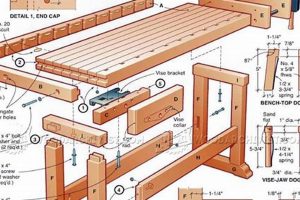
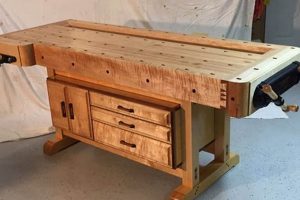
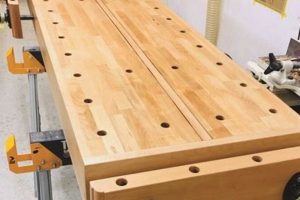
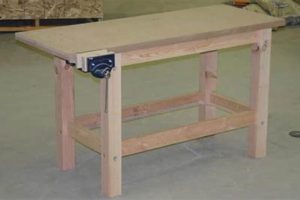
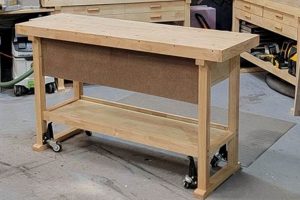
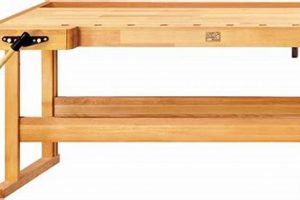
A workbench featuring a surface divided into two parallel sections, separated by a narrow gap, offers distinct advantages in woodworking. This design facilitates clamping workpieces vertically in the gap, providing secure and versatile holding options beyond traditional vises. For example, a long board can be clamped vertically in the gap to easily work on its edge.
The architecture enhances workholding capabilities, promoting efficiency and precision in joinery and assembly. Historically, such benches enabled complex tasks by firmly positioning materials, reducing movement and improving accuracy. The ability to clamp internally along the length of a board provides advantages over edge clamping, reducing the risk of bowing or warping.
Understanding the components, construction techniques, and practical applications of this bench configuration allows woodworkers to optimize their workspace. The following sections will delve into specific aspects, providing a comprehensive guide for both novice and experienced craftspeople.
Enhancements for a Split Top Woodworking Bench
Optimizing a split top bench requires careful consideration of materials, accessories, and workflow. The following tips offer guidance on maximizing its potential.
Tip 1: Material Selection: Hardwood such as maple or beech is recommended for the benchtop to withstand heavy use and resist warping. The split section should maintain dimensional stability; kiln-dried lumber is essential.
Tip 2: Gap Width: The gap separating the bench sections should be consistently sized, typically between 2 and 3 inches. This allows for versatile clamping of various workpiece thicknesses.
Tip 3: Clamping Accessories: Invest in a range of clamping accessories designed for the split. Holdfasts, T-track systems, and specialized bench dogs significantly expand workholding options.
Tip 4: Bench Dog Placement: Strategically positioned dog holes along both sides of the split enable secure clamping for a variety of tasks. Consider a consistent spacing pattern.
Tip 5: Surface Treatment: Apply a durable finish to the benchtop to protect it from spills and scratches. A mixture of oil and wax provides a suitable balance of protection and ease of repair.
Tip 6: Incorporate a Vise: While the split facilitates internal clamping, a traditional vise integrated at one end provides additional holding power for edge work and larger projects.
Tip 7: Under-Bench Storage: Optimize the space beneath the bench with drawers or shelves for storing tools and accessories. This enhances efficiency and minimizes clutter.
Implementing these enhancements will improve the functionality and lifespan of a split top workbench, leading to a more efficient and enjoyable woodworking experience.
The subsequent sections will explore specific projects and applications that benefit from this versatile bench design.
1. Workholding versatility

The split top workbench directly enhances workholding versatility through its integrated gap. The gap facilitates vertical clamping of workpieces, a functionality unavailable in traditional solid-top designs. This capability is essential when edge-jointing long boards, creating mortise and tenon joints, or securing oddly shaped items. Consider a cabinet door: the stile can be placed vertically within the gap to be clamped firmly, allowing access to the face for hinge mortises. Without this feature, securing the stile would be significantly more difficult, requiring specialized jigs or compromises in stability. The split is the direct cause of this greater clamping ability.
The importance of workholding versatility cannot be overstated; stability underpins the accuracy of nearly all woodworking operations. Consider the alternative: attempting to execute dovetail joints on a workpiece secured only from the edges. The potential for movement under the chisel’s impact increases error, impacting joint quality. With a split top, the piece can be held directly adjacent to the joint, significantly mitigating movement. In addition to holdfasts and other typical clamping implements, the addition of T-tracks to a split top bench further enhances its versatility.
Ultimately, the connection between workholding versatility and the split top design lies in its facilitation of secure, adaptable, and precise workpiece fixation. This enhanced holding power minimizes errors, increases efficiency, and empowers woodworkers to undertake more complex projects with confidence. It addresses the persistent challenge of secure and versatile clamping that has historically limited woodworking precision. The inherent design of the split top directly contributes to improved results.
2. Material Stability

Material stability is paramount for a split top woodworking bench to maintain its structural integrity and functional precision over time. The bench’s design, featuring a deliberate separation in the work surface, introduces unique considerations regarding the selection, treatment, and long-term performance of the materials used in its construction.
- Wood Species Selection
The choice of wood species directly influences the bench’s resistance to warping, twisting, and seasonal movement. Hardwoods such as maple, beech, or birch are preferred due to their density and closed-grain structure, which minimize moisture absorption and subsequent dimensional changes. Softer woods, while potentially easier to work with, are more susceptible to deformation under stress or humidity fluctuations. For example, a bench built with kiln-dried maple will exhibit significantly less warping over time compared to one constructed from pine.
- Kiln Drying and Acclimation
Proper kiln drying is essential to reduce the wood’s moisture content to a level appropriate for the intended environment. Failure to do so can lead to significant shrinkage or expansion after construction, potentially compromising the integrity of the split and the flatness of the work surface. Once kiln-dried, the wood should be acclimated to the workshop environment for several weeks before construction to allow it to stabilize at the local humidity level. This process minimizes the risk of post-construction movement.
- Joint Construction and Reinforcement
The method of joining the bench’s components also plays a critical role in material stability. Mortise and tenon joints, dovetail joints, and robust apron-to-leg connections provide strength and resistance to racking. Metal fasteners, such as screws or bolts, can further reinforce these joints, particularly in areas subject to high stress. For example, heavy-duty bolts connecting the legs to the benchtop can prevent the legs from loosening over time due to repeated use and the bench’s weight.
- Finish Application and Maintenance
Applying a durable finish to the benchtop helps to seal the wood and further reduce moisture absorption. Oil-based finishes, varnish, or polyurethane can provide a protective barrier against spills, scratches, and humidity changes. Regular maintenance, including periodic reapplication of the finish and careful attention to environmental conditions, is essential to preserve the bench’s stability and appearance over the long term. Neglecting to maintain the finish can allow moisture to penetrate the wood, leading to warping, cracking, or fungal growth.
These aspects of material stability directly affect the performance and longevity of the split top woodworking bench. By carefully considering wood species, drying processes, joint construction, and finish application, a woodworker can create a bench that remains flat, stable, and reliable for many years. Failure to address these considerations can result in a bench that becomes warped, unstable, and ultimately less effective as a woodworking tool.
3. Clamping Access
Clamping access, in the context of a split top woodworking bench, refers to the ease and versatility with which workpieces can be secured to the bench surface for various woodworking operations. The split, which is the defining feature of this bench type, directly impacts clamping access by creating a central channel for vertical clamping. Traditional workbenches typically rely on edge clamping or the use of vises, which can sometimes be limiting for certain tasks or workpiece shapes. The split allows for the insertion of clamping devices, such as holdfasts or specialized clamps, directly into the benchtop, providing secure and unobstructed access to the workpiece surface. The presence of the split is the direct cause of improved clamping in a split-top woodworking bench.
The importance of clamping access becomes evident in tasks such as edge jointing long boards or creating mortise and tenon joints. Consider a scenario where a woodworker needs to flatten the edge of a long board. With a split top, the board can be placed vertically in the split and secured with holdfasts, providing a stable and easily accessible surface for planing. Without the split, the woodworker would be forced to use edge clamps, which may not provide sufficient stability or may interfere with the planing process. The split top configuration is thus helpful. Similar advantages exist when creating mortise and tenon joints. The split allows the woodworker to clamp the workpiece vertically and securely, providing better access for chiseling the mortise. The presence of dog holes is helpful in the use of these clamps.
In summary, the split directly and positively influences clamping access by enabling secure vertical clamping, providing stable support, and facilitating unobstructed access to the workpiece. A split top woodworking bench simplifies complex woodworking tasks. The enhanced workholding improves efficiency, reduces the risk of errors, and ultimately contributes to higher-quality woodworking. Therefore, understanding the relationship between the split and clamping access is essential for woodworkers seeking to optimize their bench configuration and work processes.
4. Joinery precision

Joinery precision, the accuracy and consistency in creating interlocking wood connections, is fundamentally enhanced by the attributes of a split top woodworking bench. The bench’s design provides a stable and versatile platform, directly influencing the quality of joinery through improved workholding and accessibility. Consider the creation of dovetail joints; the ability to secure the tail board vertically within the bench’s split, utilizing holdfasts or dogs, provides a stable and vibration-dampened surface. This stability is a causal factor in achieving precise cuts and minimizing errors during the delicate chiseling process. The bench’s flatness and rigidity further contribute by preventing movement or distortion during the cutting and fitting stages, directly affecting the tightness and strength of the resulting joint.
The split also facilitates access to the workpiece from multiple angles, which is crucial for tasks like fine-tuning the fit of mortise and tenon joints. A woodworker can easily rotate the piece within the split to inspect and adjust the joint from different perspectives, ensuring a flush and seamless connection. This unobstructed view, coupled with secure clamping, allows for greater control and precision during the final fitting stages. Furthermore, the split’s utility extends beyond traditional joinery. Complex joinery requiring specialized jigs or fixtures benefits from the bench’s adaptability, allowing for secure mounting of these tools directly to the benchtop or within the split itself. This integration streamlines the workflow and ensures consistent results, improving the overall efficiency and accuracy of the joinery process.
In summary, the connection between the bench’s design and joinery precision is rooted in its enhancement of workholding, accessibility, and stability. The bench’s attributes minimize errors, improve efficiency, and ultimately contribute to the creation of strong, accurate, and aesthetically pleasing joints. This direct relationship underscores the bench’s value as a tool that not only supports woodworking tasks but actively facilitates superior craftsmanship. The split top is the cause of many precision cuts for expert woodworkers.
5. Ergonomic design

Ergonomic design, in the context of a split top woodworking bench, refers to the bench’s attributes that minimize physical strain and maximize user comfort and efficiency. The split top configuration directly influences ergonomic considerations by allowing for varied working heights and orientations. For example, the ability to clamp a workpiece vertically within the split reduces the need for bending over, alleviating back strain during tasks like hand planing or carving. The split enables a more upright posture, promoting better spinal alignment and reducing the risk of musculoskeletal disorders associated with prolonged woodworking sessions. This directly results in a more comfortable and productive work experience. The lack of ergonomic design principles in a woodworking bench will directly hurt the woodworker’s body.
The bench’s overall height is another critical ergonomic factor. A bench that is too low forces the user to hunch, while a bench that is too high can cause shoulder and neck strain. The split top design can be adapted to accommodate varying user heights by adjusting the leg length or adding risers. Moreover, the addition of features like adjustable vises and integrated tool storage contributes to a more ergonomic workspace by minimizing unnecessary reaching and movement. The layout of dog holes and the accessibility of clamping mechanisms are additional aspects that improve workflow and reduce physical exertion. A woodworker using a poorly designed bench may experience fatigue and discomfort, ultimately impacting the quality and efficiency of their work.
Ultimately, integrating ergonomic design principles into the split top woodworking bench enhances comfort and promotes long-term physical well-being. The relationship between the split top design and ergonomic considerations lies in its potential to facilitate better posture, minimize strain, and optimize workflow. A well-designed bench reduces the physical demands of woodworking, allowing the user to focus on the task at hand and produce higher-quality work with less fatigue. Ignoring these principles can result in discomfort and even injury over time, highlighting the importance of prioritizing ergonomics in woodworking bench design. Woodworkers need to consider the ergonomic aspects when deciding on the workbench.
6. Customization options
The adaptability of a split top woodworking bench extends beyond its fundamental design, offering diverse customization options that tailor the bench to individual woodworking styles, project requirements, and spatial constraints. This capacity for personalization enhances its utility and integrates it seamlessly into the woodworker’s workflow.
- Benchtop Dimensions and Material
Users can modify the benchtop’s length, width, and thickness to suit the scale of their projects and the dimensions of their workspace. Selecting different wood species, each with varying hardness, weight, and aesthetic qualities, allows further customization. For instance, a craftsman specializing in large-scale furniture may opt for a longer, thicker benchtop made of hard maple, while a hobbyist working in a small apartment might choose a smaller, lighter bench made of beech.
- Split Gap Width and Configuration
The width of the split can be adjusted to accommodate different clamping accessories and workpiece sizes. Some users may prefer a wider gap for handling thicker materials, while others may opt for a narrower gap for finer work. The addition of adjustable shims or inserts allows for further modification of the split’s configuration, adapting it to specific tasks like edge jointing or dovetailing.
- Vise Placement and Type
The location, number, and type of vises integrated into the bench can be tailored to the user’s preferred workholding methods. A traditional face vise, a leg vise, or a shoulder vise can be added to one or both ends of the bench, depending on the woodworker’s needs. The height and orientation of the vise jaws can also be adjusted to provide optimal clamping pressure and access.
- Dog Hole Patterns and Accessories
The placement and spacing of dog holes along the benchtop and split can be customized to accommodate a wide range of clamping accessories and workholding fixtures. Users can drill dog holes at regular intervals or create custom patterns to suit specific projects. The addition of accessories like bench dogs, holdfasts, and clamping squares further expands the bench’s versatility.
These customization options directly influence the efficiency and effectiveness of the split top woodworking bench. By tailoring the bench to their individual needs, woodworkers can create a personalized workspace that enhances their craft and improves the quality of their work. The ability to adapt the bench to changing project requirements and evolving woodworking styles ensures its long-term utility and value.
Frequently Asked Questions
This section addresses common inquiries regarding the design, construction, and utilization of a split top woodworking bench, providing clarity and practical information for woodworkers.
Question 1: What distinguishes a split top woodworking bench from a traditional solid-top bench?
A split top incorporates a lengthwise gap, facilitating vertical clamping and providing access to the workpiece’s edge or face. A traditional solid-top bench lacks this feature, limiting clamping options.
Question 2: What are the primary benefits of the split top design?
Improved workholding versatility, enhanced clamping access, increased joinery precision, and reduced physical strain due to ergonomic advantages are key benefits.
Question 3: What type of wood is most suitable for constructing a split top bench?
Hardwoods like maple, beech, or birch are recommended due to their density, stability, and resistance to warping. Kiln-dried lumber is essential.
Question 4: How wide should the gap between the bench sections be?
A gap of 2 to 3 inches typically allows for versatile clamping of various workpiece thicknesses. The specific width may vary depending on individual needs.
Question 5: Are specialized clamping accessories required for a split top bench?
While not strictly required, accessories like holdfasts, bench dogs, and T-track systems significantly expand the bench’s functionality and clamping capabilities.
Question 6: Is a split top bench suitable for all types of woodworking projects?
The split top design is highly versatile and adaptable, making it suitable for a wide range of projects, from furniture making to carving and joinery.
The split top woodworking bench offers a blend of traditional craftsmanship and modern design, improving the woodworking experience. The benefits of the bench are many and should be considered by professional woodworkers.
The following section will discuss maintenance and care procedures for a split top woodworking bench.
Conclusion
This exploration of the split top woodworking bench elucidates its design, advantages, and customization options. The bench’s distinctive split enhances workholding capabilities, facilitates precision in joinery, and promotes ergonomic efficiency. The discussed factors, from material selection to clamping methods, contribute to a comprehensive understanding of the bench’s functionality and its role in woodworking operations.
The decision to incorporate a split top woodworking bench into a workshop environment warrants careful consideration. Its capacity to improve work quality and user experience justifies its place as a tool that merits both investment and thoughtful application. Continuous refinement of woodworking techniques, combined with an understanding of the bench’s design principles, will optimize its potential for years to come.