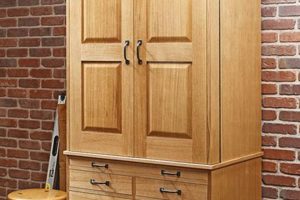
Complex undertakings in woodworking demand advanced skill, precision, and a thorough understanding of materials and techniques. These endeavors often involve intricate joinery, non-standard shapes, or the manipulation of multiple wood species. Examples include crafting elaborate furniture pieces with curved elements, building musical instruments, or creating detailed wooden sculptures. Success hinges on meticulous planning, accurate execution, and the ability to troubleshoot unexpected challenges.
Tackling challenging builds refines craftsmanship and fosters innovation. Overcoming obstacles encountered during these projects expands knowledge of wood properties and construction methods, leading to enhanced problem-solving abilities. Historically, ambitious woodworking has driven advancements in tool design and the development of new building techniques. The pursuit of mastery in this area contributes to the preservation and evolution of woodworking as both an art and a practical skill.
The following sections will delve into specific project categories, examining the unique demands of each and offering guidance for individuals seeking to elevate their woodworking capabilities. Consideration will be given to selecting appropriate designs, preparing thoroughly, and employing strategies to minimize potential complications. Detailed exploration of advanced joinery techniques and surface finishing methods will also be covered.
Guidance for Complex Woodworking Endeavors
The following guidelines are presented to aid in the successful completion of demanding woodworking undertakings. Adherence to these principles can mitigate risks and increase the likelihood of achieving desired outcomes.
Tip 1: Design Thoroughly and Accurately: Comprehensive plans, including detailed drawings and cut lists, are crucial. Ensure all dimensions are verified and that potential interferences or structural weaknesses are identified before commencing physical work. Utilize CAD software or drafting techniques for complex shapes.
Tip 2: Select Appropriate Materials: Matching wood species to the specific requirements of the project is essential. Consider factors such as strength, stability, grain pattern, and workability. Air-dried lumber, properly acclimatized to the workshop environment, minimizes warping and movement post-construction.
Tip 3: Master Advanced Joinery Techniques: Intricate projects often necessitate the use of mortise-and-tenon, dovetail, or other advanced joinery methods. Practice these techniques on scrap material to develop proficiency and ensure tight, accurate fits before applying them to the final piece.
Tip 4: Employ Precise Measurement and Cutting: Accuracy is paramount. Utilize high-quality measuring tools and cutting equipment. Consider using jigs and fixtures to ensure consistent and repeatable results, particularly when working with complex shapes or multiple identical parts.
Tip 5: Prepare for Mistakes: Recognize that errors are inevitable, even for experienced woodworkers. Develop contingency plans and stock extra material to accommodate corrections or replacements. Acknowledge limitations and seek assistance when necessary.
Tip 6: Prioritize Safety: Demanding builds often involve the use of power tools and specialized equipment. Adhere strictly to safety protocols, wear appropriate personal protective equipment, and ensure a clean and well-lit workspace.
Tip 7: Finish Strategically: Select a finishing method that complements the design and protects the wood. Test the finish on scrap material to verify the desired color and sheen. Apply multiple thin coats, allowing adequate drying time between applications.
Diligent planning, meticulous execution, and a commitment to continuous learning are indispensable for successfully navigating complex woodworking. The resulting craftsmanship provides both personal satisfaction and lasting value.
The subsequent section will provide a conclusion for this article.
1. Intricate Joinery

Intricate joinery constitutes a significant factor contributing to the designation of a woodworking endeavor as “difficult.” The complexity of the joinery directly correlates with the level of skill, precision, and time investment required for successful execution. Complex joints, such as compound dovetails, mortise-and-tenons with angled shoulders, or intricate bridle joints, demand exacting cuts and precise assembly. Failure to achieve accurate fitment compromises the structural integrity and aesthetic quality of the finished piece. Therefore, the presence of these complex connections elevates the difficulty quotient of a woodworking project.
The incorporation of elaborate joinery is often observed in high-end furniture construction, particularly in period reproductions or custom-designed pieces. For example, the construction of a Queen Anne style highboy requires mastery of dovetail joints for drawer construction, mortise-and-tenon joints for leg attachment, and intricate molding profiles to conceal joints. Another example includes constructing a timber-framed structure which relies heavily on precisely cut mortise and tenon joints, often secured with wooden pegs, to create robust and long-lasting buildings. These applications highlight the practical significance of intricate joinery in creating structurally sound and visually appealing wooden objects.
In summary, the relationship between intricate joinery and “difficult woodworking projects” is direct and substantial. The presence of complex joints necessitates advanced skills, precise execution, and a deep understanding of wood behavior. While presenting significant challenges, the mastery of intricate joinery unlocks the potential to create enduring and aesthetically remarkable pieces. The need for advanced skills leads to difficulty and time commitment. Failure to do so can have big consequences to a project.
2. Complex Geometry

The incorporation of complex geometry into woodworking designs significantly elevates the level of difficulty. This complexity arises from the need for precise calculations, specialized tooling, and advanced construction techniques to accurately realize non-standard shapes and forms. Its relevance stems from the artistic or functional needs for advanced shapes and designs.
- Curved Surfaces and Contours
The creation of curved surfaces and intricate contours demands specialized techniques such as steam bending, lamination, or the use of specialized carving tools. Constructing furniture with flowing lines or architectural elements with compound curves requires meticulous planning and execution. An example is crafting a cabriole leg for a chair, demanding a deep understanding of wood behavior when formed. Failure to properly execute curved elements can lead to structural weaknesses or aesthetic imperfections.
- Non-Euclidean Shapes
Woodworking projects that incorporate non-Euclidean shapes, such as hyperbolic paraboloids or Mbius strips, present unique challenges in terms of design, layout, and construction. These shapes often require the use of computer-aided design (CAD) software and specialized fabrication techniques to ensure accuracy. Creating mathematically complex wooden sculptures is an application that requires accurate computer aided design and cutting.
- Interlocking Forms and Tessellations
Designs featuring interlocking forms or tessellated patterns demand precise joinery and a deep understanding of spatial relationships. Achieving seamless transitions between individual components requires meticulous attention to detail and the ability to visualize the final assembly. Constructing a wooden puzzle or a parquetry floor with intricate geometric patterns exemplifies the need for advanced layout and cutting skills.
- Compound Angles and Miters
The presence of compound angles and miters introduces significant complexity to woodworking projects. Accurately cutting and joining pieces with these angles requires the use of specialized jigs and fixtures, as well as a thorough understanding of trigonometric principles. Creating a complex mitered box or a segmented turning project exemplifies the challenges posed by compound angles. Failure to accurately calculate and execute these angles results in gaps or misalignments in the finished piece.
The integration of complex geometry directly contributes to the challenging nature of certain woodworking endeavors. Successful realization of these designs necessitates mastery of advanced techniques, precise execution, and a thorough understanding of the underlying mathematical principles. These designs necessitate advanced planning and skill to avoid catastrophic errors.
3. Precision Cutting
In the realm of woodworking, the degree of precision required in cutting operations directly correlates with the difficulty of the undertaking. Intricate designs, complex joinery, and exacting tolerances all necessitate a high level of accuracy, transforming what might otherwise be a straightforward project into a significantly more challenging endeavor.
- Tight Tolerance Joinery
Many advanced woodworking techniques, such as dovetail joints or mortise-and-tenon constructions, demand extremely tight tolerances for optimal strength and aesthetic appeal. Even slight deviations from the intended dimensions can compromise the integrity of the joint, requiring rework or complete reconstruction. Crafting a seamless dovetail joint on a drawer front, for instance, requires cuts accurate to within fractions of a millimeter.
- Intricate Profiles and Curves
Creating complex profiles and curves requires precise execution to achieve the desired aesthetic effect. Minor inconsistencies in cutting can result in visible imperfections that detract from the overall quality of the piece. Reproducing a period molding profile, for example, demands the accurate replication of curves and contours using specialized tools and techniques.
- Dimensional Accuracy in Assembly
In projects involving multiple components, dimensional accuracy is crucial for proper assembly. Even small discrepancies in the size or shape of individual pieces can accumulate, leading to significant alignment issues and structural instability. Constructing a large cabinet or a complex piece of furniture requires that each component be precisely cut to ensure proper fit and function.
- Material Waste Minimization
Precision cutting minimizes material waste, which is especially important when working with expensive or rare wood species. Accurate cuts allow for efficient nesting of parts, reducing the amount of scrap generated. Utilizing advanced cutting techniques to optimize yield from a valuable piece of figured lumber demonstrates the economic benefits of precision.
The ability to execute precise cuts is a fundamental skill in woodworking, but its importance is amplified in challenging projects. The success of these projects hinges on the craftsman’s ability to consistently achieve accurate dimensions and smooth surfaces, requiring a combination of skilled technique and equipment investment. These skills lead to accurate pieces and help reduce waste.
4. Material Selection
Material selection constitutes a critical determinant in the success or failure of challenging woodworking endeavors. The inherent properties of different wood species, their workability, stability, and aesthetic characteristics, directly influence the complexity and feasibility of intricate designs. Choosing an inappropriate material can introduce unforeseen difficulties, rendering a project significantly more demanding or even impossible to complete to the desired standard. The correct wood choice is critical to success. Failure to choose the right material leads to rework and failure.
For example, constructing a finely detailed carving from a coarse-grained hardwood, such as oak, presents substantial challenges due to the difficulty in achieving smooth surfaces and crisp details. Conversely, using a soft, unstable wood like pine for a delicate, load-bearing structure increases the risk of warping, cracking, or joint failure. The selection process must consider the project’s specific requirements, including its intended use, environmental exposure, and aesthetic goals. Musical instrument construction provides another instance where material selection dictates the instrument’s tonal qualities and structural integrity; a guitar’s soundboard crafted from spruce versus mahogany yields distinct sonic characteristics. The right material can lead to successful completion.
In conclusion, material selection is not merely a preliminary step but an integral component of difficult woodworking projects. A thorough understanding of material properties and their suitability for specific applications is essential for mitigating challenges and achieving desired outcomes. Informed choices can significantly enhance the workability of materials, improve the longevity of finished pieces, and ultimately contribute to the overall success of the project. Improper material selection can lead to failure.
5. Problem Solving

Effective problem-solving is an indispensable element in the successful completion of complex woodworking tasks. The inherent challenges associated with intricate designs, unconventional materials, and unforeseen complications demand a systematic and adaptable approach to overcoming obstacles. The ability to identify, analyze, and resolve issues efficiently is crucial for mitigating risks and maintaining project momentum. Without effective problem solving skills, projects will fail.
- Design Flaws and Modifications
Complex woodworking projects often reveal design flaws or unanticipated structural weaknesses during the construction process. Addressing these issues requires the ability to critically evaluate the design, identify potential solutions, and implement modifications without compromising the overall integrity of the piece. Adapting the joinery to reinforce a weak point in a table leg demonstrates the necessity of on-the-spot problem solving. Modifying designs is common and necessary.
- Material Imperfections and Substitutions
Natural materials like wood frequently exhibit imperfections such as knots, grain irregularities, or internal stresses. When encountered, these imperfections necessitate creative problem-solving to either work around them or to make appropriate material substitutions. Repairing a split in a valuable piece of lumber with a butterfly joint is one example. Also, if materials run short, then it must be substituted.
- Tool Malfunctions and Improvisation
The reliance on specialized tools and equipment in advanced woodworking introduces the potential for malfunctions or breakdowns. The ability to diagnose tool-related problems and devise temporary solutions is essential for minimizing downtime. Using a hand plane to achieve a finish normally achieved with a power sander exemplifies this need. Without a properly working tool, improvisation skills are key.
- Unforeseen Assembly Challenges
The assembly of complex woodworking projects can present unforeseen challenges, such as misalignments, tight fits, or interference issues. Successfully navigating these challenges requires a systematic approach to troubleshooting, involving careful analysis of the problem and the implementation of appropriate corrective measures. Employing shims or modifying joints to address minor misalignments during assembly is a typical problem-solving scenario. Planning and troubleshooting can lead to success.
In summary, problem-solving is an intrinsic aspect of challenging woodworking endeavors. The ability to adapt to unforeseen circumstances, devise creative solutions, and maintain a proactive approach to overcoming obstacles is paramount for achieving successful outcomes. These traits are essential and distinguish beginner to master woodworker. The need to problem solve will dictate the overall success of the project.
6. Patience & Perseverance

The successful completion of demanding woodworking often relies as much on the artisan’s temperament as on their technical skills. Patience and perseverance are not merely desirable qualities but essential attributes for navigating the inherent challenges and setbacks encountered in such endeavors. Their influence permeates every stage of the process, from initial planning to final finishing.
- Navigating Setbacks
Complex projects inherently involve a higher probability of errors, miscalculations, or material failures. A patient approach allows for careful analysis of the problem, methodical troubleshooting, and the implementation of corrective measures without succumbing to frustration or discouragement. Perseverance ensures that setbacks are viewed as learning opportunities, rather than insurmountable obstacles. A failed dovetail joint, for example, demands patient assessment, precise rework, and a persistent commitment to achieving a perfect fit.
- Mastering Intricate Techniques
The acquisition of advanced woodworking skills, such as intricate joinery or complex carving, requires significant time and dedicated practice. Patience is essential for mastering the nuances of each technique, while perseverance ensures that the craftsman remains committed to honing their skills despite the inevitable learning curve. The process of learning to steam-bend wood, for instance, necessitates repeated attempts and meticulous adjustments to achieve the desired curvature without cracking or splintering.
- Dealing with Repetitive Tasks
Many demanding woodworking projects involve repetitive tasks, such as sanding, finishing, or assembling multiple identical components. These tasks can be tedious and time-consuming, requiring a high degree of patience to maintain focus and consistency. Perseverance is necessary to complete these tasks diligently, ensuring that each element meets the required standards of quality. The meticulous sanding of multiple layers of finish on a complexly shaped surface exemplifies this need for enduring commitment.
- Maintaining Focus and Precision
Complex woodworking demands sustained concentration and unwavering attention to detail. Patience allows the craftsman to maintain focus over extended periods, minimizing the risk of errors or oversights. Perseverance ensures that the craftsman remains committed to achieving the highest possible level of precision, even when faced with fatigue or distractions. The creation of an intricate marquetry pattern, for example, necessitates unwavering focus and meticulous placement of each individual piece.
In summary, patience and perseverance are indispensable qualities for those undertaking challenging woodworking projects. These attributes enable the craftsman to navigate setbacks, master intricate techniques, endure repetitive tasks, and maintain the focus and precision necessary for achieving successful outcomes. The absence of these qualities increases the likelihood of frustration, errors, and ultimately, project failure. This need for persistence and patience can lead to successful outcomes.
Frequently Asked Questions
The following questions address common concerns and provide insight into the complexities inherent in advanced woodworking.
Question 1: What constitutes a “difficult” woodworking project?
A project is generally considered “difficult” when it requires advanced joinery techniques, intricate designs, tight tolerances, specialized tools, or significant time investment. Projects that demand a high level of precision, problem-solving skills, and a thorough understanding of wood properties also fall into this category.
Question 2: What skills are essential for undertaking challenging woodworking?
Proficiency in advanced joinery (e.g., dovetails, mortise-and-tenon), precision cutting and shaping, accurate measurement, and finishing techniques are essential. In addition, strong problem-solving skills, patience, and a thorough understanding of wood behavior are crucial for success.
Question 3: How does material selection impact the difficulty of a project?
The choice of wood species significantly influences the complexity of a project. Certain woods are more difficult to work with due to hardness, grain patterns, or stability issues. Selecting the appropriate material for the specific application is crucial for minimizing challenges and achieving desired results. The wrong material will lead to failure.
Question 4: What tools are typically required for difficult woodworking projects?
Beyond basic woodworking tools, advanced projects may necessitate specialized equipment such as precision measuring instruments, routers with a variety of bits, spindle sanders, band saws, and potentially CNC machines for intricate cuts. A well-equipped workshop can significantly ease the completion of complex tasks. Having a CNC machine reduces time involved.
Question 5: How can potential errors be minimized in demanding woodworking endeavors?
Thorough planning, accurate design, precise measurement, and the use of jigs and fixtures are critical for minimizing errors. Practicing techniques on scrap material before committing to the final piece can also help to prevent costly mistakes. Creating jigs can help to minimize error.
Question 6: Is it advisable for beginners to attempt projects classified as “difficult”?
It is generally recommended that novice woodworkers gain experience with simpler projects before tackling complex designs. Attempting a project beyond one’s skill level can lead to frustration, wasted materials, and potentially unsafe working conditions. It is prudent to gradually increase the difficulty of projects as skills and knowledge improve.
Successfully navigating challenging woodworking requires a blend of technical proficiency, meticulous planning, and unwavering dedication. Continuous learning and a willingness to embrace challenges are essential for achieving mastery in this craft.
The subsequent section will provide a conclusion for this article.
Difficult Woodworking Projects
This exploration of demanding woodworking has underscored the multifaceted nature of such endeavors. Success hinges on a convergence of advanced technical skills, meticulous planning, appropriate material selection, and unwavering perseverance. The undertaking of projects classified as “difficult” serves not only as a testament to craftsmanship but also as a catalyst for skill enhancement and innovation within the field.
Continued engagement with complex builds fosters the evolution of woodworking techniques and contributes to the preservation of this intricate craft. A commitment to rigorous practice, informed material choices, and unwavering problem-solving will allow woodworkers to elevate their practice, push creative boundaries, and create enduring pieces that showcase the transformative potential of this demanding but rewarding discipline.