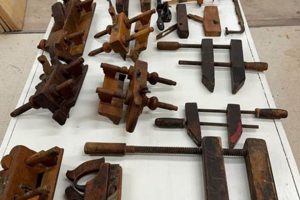
Woodworking necessitates a diverse array of implements employed to shape, cut, join, and finish timber. These implements range from hand-operated devices requiring manual dexterity to power-driven machinery that facilitates precision and efficiency. A comprehensive understanding of these devices enables craftspeople to execute projects with accuracy and achieve desired aesthetic results. For example, a dovetail saw is used for creating intricate joinery, while a planer is used for smoothing rough surfaces.
The effectiveness of woodworking projects is directly proportional to the quality and appropriateness of the tools used. Historically, skilled artisans relied on hand-held instruments, passing down techniques through generations. The introduction of motorized versions significantly increased production capabilities and allowed for greater uniformity in finished pieces. The judicious selection and maintenance of these instruments are essential for both novice and experienced woodworkers to ensure safety and optimal performance.
This exploration will delve into the categories of instruments frequently utilized in this craft. The following sections will categorize these essential devices based on their primary functions, highlighting key examples within each grouping to provide a useful framework for understanding their applications in various projects.
Guidance on Implementing Effective Woodworking Practices
The successful completion of woodworking projects is contingent upon the proper selection, use, and maintenance of the instruments employed. The following advice is designed to enhance the quality of finished products and ensure a safe working environment.
Tip 1: Sharpening and Maintenance: Regularly hone the cutting edges of chisels, planes, and saws. A sharp edge reduces effort, increases precision, and minimizes the risk of accidents. Use appropriate sharpening stones and honing guides to maintain the correct bevel angle.
Tip 2: Material Selection: Choose the appropriate wood species for the project. Consider factors such as hardness, grain pattern, moisture content, and cost. Softwoods are easier to work with but are less durable than hardwoods. Kiln-dried lumber minimizes warping and cracking.
Tip 3: Proper Joint Selection: Select joints appropriate for the load and stress requirements of the project. Dovetail joints provide exceptional strength, while miter joints offer a clean, aesthetically pleasing appearance. Use appropriate adhesives and fasteners for each joint type.
Tip 4: Secure Workholding: Employ vises, clamps, and other workholding devices to securely fix materials during cutting, shaping, and assembly. Stable workpieces contribute to increased accuracy and reduce the likelihood of errors.
Tip 5: Accurate Measurement and Marking: Utilize precise measuring instruments, such as calipers, rulers, and marking gauges, to ensure accurate dimensions. Clear and visible markings are essential for precise cuts and joinery.
Tip 6: Dust Control: Implement a dust collection system to mitigate the health hazards associated with airborne wood particles. Wear appropriate respiratory protection, such as a dust mask or respirator, when working with machinery that produces significant amounts of dust.
Tip 7: Power Tool Safety: Familiarize oneself with the operating instructions and safety features of all power tools. Always wear appropriate personal protective equipment, including eye protection and hearing protection. Disconnect power tools before making adjustments or changing blades.
Tip 8: Gradual Shaping: Remove material in small increments. Rushing the process increases the risk of errors and can damage the workpiece. This approach is particularly relevant when using power tools or shaping intricate details.
By adhering to these principles, woodworkers can elevate the quality of their craftsmanship, maximize safety, and minimize material waste.
The following sections will delve into the best practices for safe and productive woodworking environments.
1. Hand tools

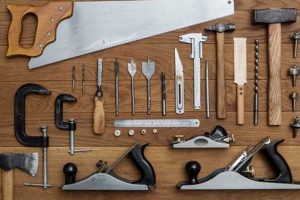
Hand tools represent a fundamental category within the broader spectrum of implements essential to woodworking. Their utilization allows for precise control and intimate interaction with the material, enabling artisans to execute detailed work that power tools may not be capable of achieving. Mastery of these devices forms the bedrock of traditional woodworking techniques.
- Chisels: Shaping and Refining
Chisels are employed to pare, shape, and remove material, particularly in joinery and detail work. Beveled-edge chisels are versatile for general shaping, while mortise chisels are designed for creating deep, square mortises. The sharpness and angle of the chisel dictate the precision of the cut, requiring regular honing to maintain optimal performance. The selection of appropriate chisels for a woodworking task is crucial for achieving clean, accurate results.
- Hand Saws: Precision Cutting
Hand saws offer control and accuracy in cutting operations. Crosscut saws are designed for cutting across the grain, while rip saws are used for cutting along the grain. Dovetail saws, with their fine teeth and rigid backs, are specifically designed for intricate joinery. The user’s skill in guiding the saw determines the straightness and accuracy of the cut, necessitating practice and a steady hand. Correct saw selection prevents tear-out and ensures a clean cut.
- Planes: Smoothing and Flattening
Hand planes are used to smooth, flatten, and dimension wood surfaces. Smoothing planes create a fine surface finish, while jack planes are used for rough shaping. Block planes, smaller and more maneuverable, are useful for end-grain work. The plane’s blade must be precisely adjusted to take thin, even shavings, requiring both knowledge of the tool and an understanding of wood grain. A properly tuned hand plane provides a superior surface compared to sanding alone.
- Hand Drills and Awls: Creating Holes
Hand drills, such as brace and bits, and awls are used for creating holes for screws, dowels, or decorative purposes. An awl is used to create a pilot hole to start a screw, while a hand drill provides more substantial boring capabilities. These tools offer greater control over hole placement and depth compared to power drills, particularly in delicate or intricate work. They are essential for tasks where precision and minimal material disruption are paramount.
The aforementioned are integral to traditional woodworking. Proficiency in their use allows craftspeople to execute projects that demand precision and control, demonstrating the enduring relevance within the broader context of woodworking.
2. Power tools

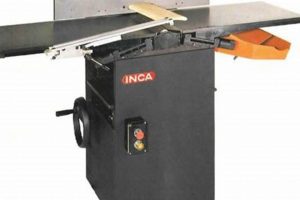
Power tools constitute a significant category within woodworking implements. They leverage electric motors or pneumatic systems to amplify user input, enabling efficient and precise execution of various woodworking tasks. Their introduction has fundamentally altered woodworking practices, increasing productivity and facilitating the creation of complex designs. For example, a table saw allows for the rapid and accurate cutting of sheet goods, while a router enables the creation of intricate edge profiles.
The adoption of power tools necessitates a comprehensive understanding of their functionalities and safety protocols. Each instrument is designed for specific tasks, and employing them correctly is paramount. A circular saw, for instance, is optimized for straight cuts, while a jigsaw excels at curved cuts. Furthermore, power tools often require specialized accessories and adjustments to achieve optimal performance. The appropriate use of safety guards, dust collection systems, and personal protective equipment is essential to mitigate risks associated with high-speed operation and material ejection.
In summary, power tools are a transformative element within the range of implements. They enhance efficiency and precision but demand diligent attention to safety. Proper tool selection, maintenance, and operational knowledge are critical for maximizing their benefits and ensuring a safe working environment. The following section will discuss the utilization of measuring tools in woodworking.
3. Measuring Tools

Accurate measurement is a cornerstone of woodworking, directly impacting the precision and quality of finished pieces. A range of instruments are available to ensure dimensional accuracy throughout the woodworking process. These instruments facilitate precise cuts, proper joinery, and consistent replication of components. The following outlines specific types of measuring instruments and their roles in woodworking operations.
- Rules and Measuring Tapes: Linear Measurement
Rules and measuring tapes provide linear measurements for determining the length, width, and height of workpieces. Precision rules, often made of steel, offer high accuracy for critical dimensions. Measuring tapes are useful for longer measurements, such as determining board feet or laying out large projects. Accurate linear measurement is essential for ensuring that components fit together correctly and that the overall dimensions of the project are within specified tolerances.
- Squares: Ensuring Right Angles
Squares, including try squares, combination squares, and speed squares, are used to verify and mark right angles. A try square is a simple tool consisting of a blade and a stock, used to check the squareness of edges and surfaces. A combination square incorporates a sliding blade and a movable head that can be set at various angles. A speed square combines features for marking angles, cutting lines, and determining roof pitches. Accurate squares are critical for ensuring that frames, boxes, and other constructions are structurally sound and visually appealing.
- Marking Gauges: Consistent Parallel Lines
Marking gauges are used to scribe parallel lines at a consistent distance from an edge. These instruments are particularly useful for marking mortise and tenon joints, dadoes, and rabbets. A marking gauge typically consists of a beam with a sharp pin that is adjusted to the desired distance from a fence. The gauge is then run along the edge of the workpiece, creating a precise, parallel line. Consistent markings are essential for creating accurate and repeatable joinery.
- Calipers: Measuring Thickness and Diameter
Calipers are used to measure the thickness of materials or the diameter of round objects with precision. Outside calipers measure external dimensions, while inside calipers measure internal dimensions. Digital calipers provide electronic readouts for increased accuracy and ease of use. Calipers are particularly useful for measuring the thickness of veneer, the diameter of dowels, and the depth of recesses. Accurate caliper measurements are essential for ensuring that components fit together correctly and that the overall dimensions of the project are within specified tolerances.
The types of measuring tools used directly influence the precision and quality of finished woodworking projects. Careful selection and proper application of these instruments are critical for achieving accurate dimensions and ensuring structural integrity.
4. Sharpening tools

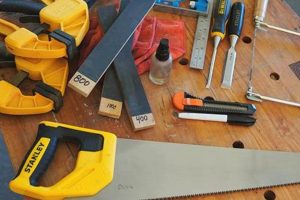
Maintaining sharp cutting edges on implements is paramount for efficient and safe woodworking practices. Sharp instruments require less force, resulting in cleaner cuts and reduced risk of injury. The specific implements utilized for honing and maintaining edges are categorized as sharpening implements, and their selection is dependent on the specific instrument being serviced.
- Whetstones (Oil Stones and Water Stones)
Whetstones are abrasive blocks used to hone the cutting edges of chisels, plane irons, and knives. Oil stones use oil as a lubricant to float away metal particles, while water stones use water for the same purpose. Whetstones are available in varying grits, ranging from coarse for removing material quickly to fine for polishing the edge. The use of whetstones ensures a keen edge, crucial for achieving clean and precise cuts. For example, a dull chisel used on a mortise and tenon joint can cause the wood to split, requiring the craftsman to replace the piece and extend construction time.
- Diamond Sharpening Plates
Diamond sharpening plates consist of a steel plate coated with diamond particles. These plates are effective for sharpening hardened steel instruments, as they can abrade the material more aggressively than traditional whetstones. Diamond plates are available in different grits and can be used dry or with water as a lubricant. Their flat surface and consistent abrasive action ensure accurate and repeatable sharpening. Their rigidity also helps prevent the blade from wearing the stone unevenly. For instance, the hard steel on a high-end plane blade needs a diamond plate for sharpening
- Honing Steels and Strops
Honing steels and strops are used to realign the cutting edge of blades after sharpening, removing any burrs or imperfections. Honing steels are typically made of hardened steel or ceramic, while strops are made of leather. These instruments do not remove significant amounts of material but rather refine the edge, extending the time between sharpening sessions. A strop refines the blade of a knife used for carving. This keeps it sharper for longer.
- Powered Sharpening Systems
Powered sharpening systems use electric motors to rotate abrasive wheels or belts, providing a faster and more efficient method of sharpening. These systems are often used for sharpening larger volumes of instruments or for reshaping damaged edges. Powered systems require careful operation to prevent overheating the blade, which can damage the temper of the steel. An example of powered systems is bench grinders that can be modified for sharpening tools.
The choice of sharpening implements directly impacts the performance and longevity of woodworking instruments. Consistent maintenance of sharp edges ensures efficient and safe woodworking practices. Without them, the other implements become useless.
5. Joinery tools

Joinery instruments represent a subset within the comprehensive range of implements employed in woodworking. These specialized instruments are designed to create strong and aesthetically pleasing connections between wood components, forming the structural framework of woodworking projects. The selection of appropriate tools is determined by the specific joint type being executed.
- Mortise and Tenon Tools: Strength and Stability
Mortise and tenon joints are characterized by a projecting tenon that fits into a corresponding mortise. Instruments such as mortise chisels, mortise machines, and tenon saws are utilized to create these robust connections. Mortise chisels are heavy-duty chisels designed for removing material from mortises, while tenon saws are used to accurately cut tenons to size. This joint is frequently used in chair and table construction due to its inherent strength and resistance to racking forces. A well-executed mortise and tenon joint creates a mechanical interlock that enhances the durability of the structure.
- Dovetail Tools: Interlocking Connections
Dovetail joints feature interlocking pins and tails that resist pulling forces, making them ideal for drawer construction and box assembly. Dovetail saws, with their fine teeth and rigid backs, provide the precision required for cutting intricate dovetail patterns. Dovetail markers are templates that aid in accurately laying out the pins and tails. The tight fit of a dovetail joint ensures structural integrity without relying solely on fasteners or adhesives, contributing to the longevity of the piece. A handmade dovetail joint is often seen as a sign of quality craftsmanship.
- Dado and Rabbet Tools: Recessed Joinery
Dado and rabbet joints involve creating recessed channels that accept another component. Dadoes run across the grain, while rabbets run along the edge of a board. Instruments such as routers, dado blades for table saws, and rabbet planes are used to create these joints. These joints are commonly used in cabinetmaking for assembling shelves and panels. A dado joint provides increased surface area for gluing, resulting in a stronger bond compared to simply butting two pieces together. Rabbets are frequently employed to create a lip for inset doors or drawer bottoms.
- Fastening Tools: Securing Joints
In addition to traditional joinery, fastening instruments play a crucial role in securing joints. Screwdrivers, drills, and nail guns are used to insert screws, drill pilot holes, and drive nails or staples, respectively. The selection of appropriate fasteners is determined by the joint type, material thickness, and desired holding power. Countersinking bits are used to create recessed holes for screw heads, ensuring a flush surface. Proper fastening techniques enhance the strength and stability of woodworking projects, preventing joint failure under stress.
- Miter Tools: Accurate Angles
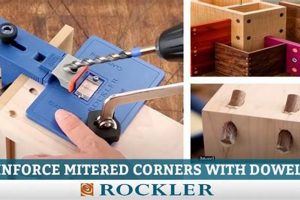
Miter tools enable woodworkers to create precise angled cuts, essential for constructing frames, boxes, and other geometric forms. Miter saws, miter boxes, and angle finders are utilized to achieve accurate miter joints. Miter saws allow for cutting precise angles in a variety of materials. A miter box provides a guide for hand saws, ensuring consistent and accurate cuts. Angle finders aid in determining the correct angle for complex miter joints, such as those found in irregular polygons. A well-executed miter joint results in a seamless transition between surfaces, enhancing the aesthetic appeal of the finished piece.
The aforementioned represent a critical subset of woodworking implements. Mastery of these devices and techniques allows craftspeople to create durable and aesthetically pleasing pieces. The range of available joinery instruments reflects the diversity of woodworking projects and the evolving needs of woodworkers. Without them, many woodworking projects would be impossible. For example, the construction of a drawer requires at least one of these implementations.
6. Finishing tools

The application of finishes constitutes a critical stage in woodworking, requiring specialized instruments to achieve desired aesthetic and protective qualities. These instruments, while distinct from shaping or joinery devices, are integral within the broader range of implements, contributing significantly to the final product’s appearance and durability.
- Brushes: Application of Liquid Finishes
Brushes are employed for the application of liquid finishes, including varnishes, paints, and stains. The type of brush bristles, whether natural or synthetic, influences the finish quality. Natural bristles are suitable for oil-based finishes, while synthetic bristles are preferred for water-based finishes. Brush selection and technique directly impact the uniformity and smoothness of the finish. For example, a high-quality brush minimizes brush strokes and ensures an even coat of varnish on a tabletop.
- Sprayers: Atomized Finish Application
Sprayers, including airless and HVLP (High Volume Low Pressure) systems, atomize finishes for uniform application. These systems are advantageous for large surfaces or intricate designs, providing a consistent coat with minimal brush marks. Sprayers require careful setup and calibration to control the finish flow and atomization, ensuring optimal results. Automotive painting utilizes sprayers to obtain a smooth, durable finish. A similar method is used in furniture making.
- Sanding Tools: Surface Preparation
While sanding is primarily a preparation step, sanding tools are essential for achieving a smooth substrate for finishing. Sanding blocks, orbital sanders, and detail sanders are used to remove imperfections, level surfaces, and create a consistent texture. The selection of sandpaper grit and sanding technique influences the adhesion and appearance of the finish. The final sanding steps dictate the final finish. For instance, an unfinished piece of furniture can appear to be ruined with bad sanding.
- Rubbing and Polishing Compounds: Enhancing Sheen
Rubbing and polishing compounds, along with appropriate pads or cloths, are used to enhance the sheen of cured finishes. These compounds remove minor imperfections, level the surface, and create a high-gloss or satin finish. The selection of compound and polishing technique influences the final appearance of the finish. A polished clear coat ensures long-lasting perfection. For example, polishing is used on guitars.
The correlation between finishing instruments and other types of woodworking implements underscores the comprehensive nature of the craft. Proper selection and skillful application of these instruments are crucial for enhancing the aesthetic appeal and protective qualities of finished woodwork, illustrating their essential role in the spectrum of woodworking processes.
Frequently Asked Questions about Woodworking Implements
The following section addresses common inquiries regarding the selection, application, and maintenance of implements in woodworking.
Question 1: What constitutes the fundamental difference between a rip saw and a crosscut saw?
The primary distinction resides in the tooth geometry. Rip saws possess teeth designed to sever wood fibers along the grain, while crosscut saws feature teeth engineered to cut across the grain. Using the incorrect saw leads to inefficient cutting and potential damage to the material.
Question 2: Why is sharpening important when utilizing chisels and plane irons?
Sharpness is crucial for safety and precision. Sharp instruments require less force, reducing the risk of slippage and enabling cleaner cuts. Dull implements tear the wood fibers, resulting in a rough and unprofessional finish.
Question 3: What are the advantages of employing digital calipers over traditional calipers?
Digital calipers offer enhanced accuracy and ease of use. The digital display eliminates the need for interpreting vernier scales, reducing the likelihood of errors. Additionally, digital calipers often provide the option to switch between metric and imperial units, increasing versatility.
Question 4: What factors should be considered when selecting a wood finish sprayer?
Key considerations include the type of finish being applied, the size of the project, and the desired finish quality. HVLP (High Volume Low Pressure) sprayers offer superior finish control and minimize overspray, while airless sprayers are suitable for larger projects requiring rapid application.
Question 5: How does one properly maintain whetstones to ensure their longevity and effectiveness?
Whetstones require periodic cleaning and flattening. Oil stones should be cleaned with a solvent to remove accumulated metal particles, while water stones should be flattened using a lapping plate or a flattening stone. Proper maintenance ensures that the whetstone retains its abrasive properties and provides a consistent sharpening surface.
Question 6: What safety precautions are essential when operating power instruments, such as table saws and routers?
Essential safety precautions include wearing appropriate personal protective equipment (eye protection, hearing protection, dust mask), using safety guards and fences, maintaining a stable stance, and never reaching over or around a rotating blade or bit. Familiarization with the instrument’s operating manual is crucial for safe operation.
In conclusion, a thorough understanding of woodworking implement selection, application, and maintenance contributes to project success. The knowledge and consideration of these frequently asked questions will guide you toward an efficient woodworking process.
The next section will focus on case studies of tool implementations in woodworking projects.
Conclusion
This exposition has detailed the diverse landscape of implements essential to woodworking. Categories ranging from hand-operated devices to power-driven machinery have been explored, emphasizing the specific functions and applications unique to each. An understanding of these implements facilitates informed selection, promoting efficiency, accuracy, and safety within woodworking practices.
The effective utilization of these instruments represents a cornerstone of successful woodworking projects. Continuous refinement of technique, coupled with diligent maintenance, will further enhance the craftsperson’s ability to transform raw materials into functional and aesthetically pleasing creations. Continued advancement and adaptation of technology will undoubtedly shape the future of woodworking, it is crucial to uphold rigorous standards of safety and craftsmanship to ensure both the integrity of the finished product and the well-being of the artisan.