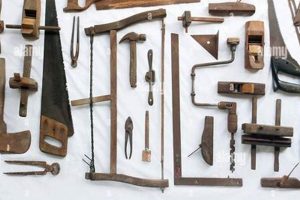
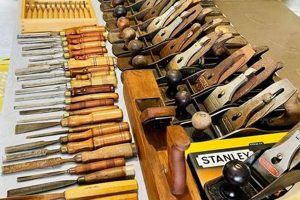
Implements required for shaping wood, encompassing both hand-operated and power-driven devices, form the basis of various woodworking projects. These instruments enable artisans to cut, shape, join, and finish lumber and other wood-based materials. A handsaw, for instance, allows for manual cutting, while a power drill facilitates creating precise holes for joinery.
The availability of appropriate implements significantly impacts the efficiency and quality of woodworking endeavors. Historically, advancements in implement technology have broadened the scope of possible projects and improved the precision and speed of production. Access to a well-equipped set promotes safety and enables the effective execution of complex designs.
Therefore, the following discussion will address the categorization of essential implements, detailing examples within each category, and considering the influence of material selection on the selection of such implements. Furthermore, safety considerations in the operation and maintenance of these items will be highlighted.
Essential Usage Guidelines
The following guidelines address critical aspects in utilizing woodworking implements effectively and safely.
Tip 1: Sharpening Implements. Maintaining sharp edges is crucial. Dull blades require more force, increasing the risk of slippage and injury. Regular honing and sharpening are required for optimal performance.
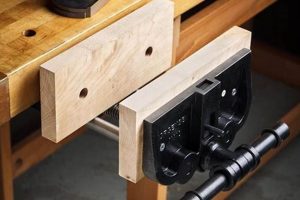
Tip 2: Secure Workpieces. Stability during operation is paramount. Utilizing clamps or vises securely anchors the material being worked upon, preventing movement that could lead to inaccurate cuts or accidents.
Tip 3: Select Appropriate Implements. Match the implement to the specific task. Employing a chisel for sawing, for example, can damage both the implement and the workpiece, in addition to posing a safety hazard.
Tip 4: Protective Gear. Eye protection, hearing protection, and dust masks mitigate the risks associated with debris, noise, and airborne particles. Consistently employing such protective measures is mandatory.
Tip 5: Maintain a Clean Workspace. A tidy environment minimizes trip hazards and facilitates efficient workflow. Regularly clearing sawdust and organizing tools prevents accidents and enhances productivity.
Tip 6: Understand Grain Direction. Working with the grain reduces the likelihood of tear-out and produces cleaner cuts. Knowledge of wood anatomy is essential for achieving optimal results.
Tip 7: Inspect Prior to Use. Before commencing any operation, a thorough examination should be conducted, examining for loose components, damaged cords, or any other defects. Addressing these issues promptly is essential.
Adhering to these usage guidelines ensures accurate woodworking output, maximizes tool longevity, and, most importantly, safeguards the user from potential hazards.
The following sections will present a detailed examination of essential implements and their appropriate application in various woodworking scenarios.
1. Cutting/Shaping Implements

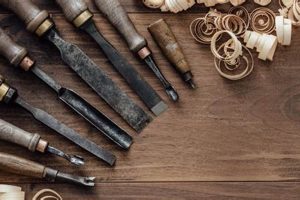
The category of cutting and shaping implements represents a foundational component of the instruments used in woodworking. These implements are directly responsible for altering the physical form of wood, enabling the creation of specific shapes and dimensions. Without functional implements for cutting and shaping, the broader array of instruments remain largely ineffectual. For instance, a hand saw, a core element of this category, permits the initial breakdown of raw lumber into usable pieces. A wood chisel, conversely, is employed for refining edges or creating intricate details. The effectiveness of other instrument, such as those used for joining, rely on the precision achieved in these initial cutting and shaping stages.
The impact of properly selected and maintained cutting and shaping instruments extends beyond mere dimensional accuracy. The quality of the cut directly influences the strength and durability of joints. A poorly executed cut can compromise the structural integrity of the overall project, leading to premature failure. Moreover, the finish of the cut dictates the amount of subsequent effort required in sanding and finishing. A clean, precise cut minimizes the need for extensive surface preparation. A practical example can be seen in cabinet making where dovetail joints need to be cut precisely using saws and chisels to ensure a strong and aesthetically pleasing joint.
In summary, cutting and shaping instruments are essential implements that directly determine the potential outcome of a woodworking project. Investing in quality implements, as well as maintaining them through proper sharpening and adjustment, is a key factor. The accuracy and precision they provide are not merely aesthetic considerations, but also directly impact the longevity and structural integrity of the finished product. The selection of such implements must align with the specific requirements of the intended task and the type of wood being worked.
2. Fastening/Joining Implements

Fastening and joining implements are indispensable elements in woodworking. The creation of stable and durable wooden structures requires effective means of uniting individual components. These implements represent a distinct category, characterized by their function in creating either permanent or temporary bonds between workpieces, thus forming an essential subset of the broader selection of instruments.
- Screws and Screwdrivers/Drills
Screws mechanically fasten wooden parts. The insertion of screws necessitates screwdrivers or power drills with appropriate driver bits. Variations in screw thread design and material composition determine suitability for different wood types and load-bearing applications. For example, using drywall screws in hardwood can result in shearing, whereas using exterior-grade screws prevents corrosion in outdoor applications.
- Nails and Hammers
Nails provide a straightforward means of joining wood. The hammer drives the nail, creating a friction-based connection. Nail types vary in size, shape, and coating to suit different purposes. Ring-shank nails, for instance, offer increased holding power compared to smooth-shank nails. Framing hammers, with their waffle-patterned faces, are specifically designed for driving nails into framing lumber, while finishing hammers feature smooth faces to minimize surface damage.
- Adhesives and Clamps
Wood adhesives, such as polyvinyl acetate (PVA) glue, create strong bonds between wood surfaces. Clamps apply pressure to maintain alignment and maximize adhesive contact during the curing process. Different adhesives offer varying degrees of water resistance and bond strength. For example, epoxy resins provide superior strength and moisture resistance compared to yellow wood glue, making them suitable for marine applications.
- Joinery Tools (e.g., Dovetail Saws and Chisels)
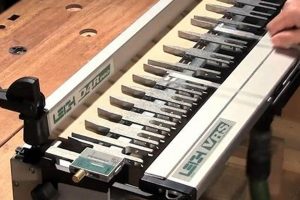
Certain joinery techniques, such as dovetailing, require specialized tools. Dovetail saws allow for precise cuts when forming interlocking joints, while chisels refine the joint for a tight fit. These hand instruments enable woodworkers to create strong, aesthetically pleasing joints without relying solely on mechanical fasteners. The inherent strength of a properly executed dovetail joint eliminates the need for nails or screws in many applications.
These fastening and joining implements, whether employing mechanical fasteners, adhesives, or specialized joinery, directly influence the structural integrity and aesthetic quality of the final product. The proper selection and application of these are vital in enabling the construction of durable and aesthetically pleasing wood structures. The combination of these instruments, along with knowledge of their correct usage, distinguishes accomplished woodworking from rudimentary carpentry.
3. Measuring/Marking Implements
Precise measurement and accurate marking are foundational to woodworking. The implements employed for these processes directly influence the dimensional accuracy and overall quality of finished wood products. Without reliable methods for quantifying and transferring dimensions, subsequent operations are rendered ineffective, and the likelihood of project success diminishes significantly.
- Rulers and Measuring Tapes
Rulers and measuring tapes provide linear measurement capabilities. Rulers offer rigidity and accuracy for short distances, while tapes allow for measuring longer spans with flexibility. The choice between the two depends on the scale of the project and the required level of precision. For example, a steel ruler is preferred for marking fine lines in joinery, while a retractable tape measure is suitable for dimensioning lumber.
- Squares (Combination, Speed, Try)
Squares ensure perpendicularity and facilitate accurate angle transfer. Combination squares offer versatility with adjustable heads for measuring angles and depths. Speed squares simplify rafter layout and angle cuts. Try squares verify the squareness of corners and edges. For instance, a combination square is used to mark a consistent depth for mortises, while a speed square aids in cutting roof rafters at the correct angle.
- Marking Gauges and Knives
Marking gauges create consistent parallel lines for mortises, rabbets, and other joinery features. Marking knives produce fine, precise lines that guide saw cuts or chisel placement. These instruments eliminate the variability associated with pencil lines and minimize tear-out. For example, a marking gauge is used to define the width of a mortise on a table leg, while a marking knife scores the wood fibers before chiseling a dovetail joint.
- Levels and Plumbs
Levels and plumbs establish horizontal and vertical references. Levels ensure surfaces are parallel to the ground, while plumbs ensure vertical alignment. These tools are crucial for installing cabinets, building frames, and ensuring structural stability. For example, a spirit level is used to verify that a tabletop is flat, while a plumb bob ensures that a post is perfectly vertical.
These implements, used in conjunction, provide a comprehensive system for establishing and transferring dimensions in woodworking. Their accuracy directly translates into the precision and quality of the final product. Investment in quality measuring and marking implements is essential for achieving professional results and minimizing material waste.
4. Finishing/Surface Implements

The completion of any woodworking project invariably necessitates surface treatment, rendering implements designed for this purpose a non-negotiable component within the inventory of instruments necessary for woodworking. These implements address the aesthetic refinement and protective enhancement of wood surfaces, thereby contributing to the overall value and longevity of the finished product.
- Sanders (Orbital, Belt, Detail)
Sanders mechanically abrade the wood surface, smoothing irregularities and preparing it for finishing. Orbital sanders excel at general surface leveling, belt sanders efficiently remove material for rapid stock removal, and detail sanders access confined spaces and intricate contours. For example, a belt sander might be used to flatten a tabletop, followed by an orbital sander to refine the surface, and a detail sander to smooth edges and corners. The correct sanding process ensures consistent finishing results.
- Planes (Smoothing, Block)
Planes, whether hand-operated or power-driven, shave thin layers of wood to achieve exceptionally smooth surfaces and precise dimensions. Smoothing planes refine surfaces after sanding, while block planes are used for end-grain work and chamfering edges. A well-tuned smoothing plane can produce a surface ready for finishing without further sanding, highlighting the importance of sharp blades and proper technique. Skillful planing can be superior to machine sanding for some applications.
- Brushes and Applicators
Brushes and applicators distribute finishes, such as stains, paints, and varnishes, evenly across the wood surface. The type of brush or applicator influences the final appearance and durability of the finish. Natural-bristle brushes are suitable for oil-based finishes, while synthetic brushes work well with water-based finishes. Spray applicators provide uniform coverage for large surfaces. Selecting the correct brush or applicator is vital to the ultimate appearance.
- Scrapers
Scrapers remove fine layers of wood to eliminate imperfections and create a smooth, burnished surface. Hand scrapers are used for localized corrections, while cabinet scrapers are employed for larger areas. A properly sharpened scraper can remove blemishes and prepare the surface for finishing. Scraping is an alternative to sanding in applications where retaining the wood grain structure is paramount.
The proper selection and application of these finishing implements are integral to the successful completion of any woodworking endeavor. These implements represent an essential investment, ensuring both aesthetic appeal and long-term protection of wood surfaces. The expertise in applying these enhances the final result.
5. Safety/Protective Equipment

Safety and protective equipment represents an indispensable component when discussing implements required for shaping wood. The operation of woodworking instruments inherently presents risks, underscoring the necessity of mitigating potential harm through the utilization of appropriate protective measures. These measures directly counteract the potential for injury arising from sharp implements, flying debris, excessive noise, and the inhalation of particulate matter.
The direct correlation between woodworking implement use and injury underscores the importance of protective equipment. For example, the use of a table saw without eye protection can result in severe ocular damage from propelled wood fragments. Similarly, operating a router or planer without hearing protection exposes the user to decibel levels capable of causing irreversible auditory damage. Dust masks or respirators become essential when sanding or cutting engineered wood products, preventing the inhalation of potentially carcinogenic formaldehyde. Failure to employ such measures directly increases the likelihood of adverse health outcomes, ranging from minor lacerations to permanent disabilities. Moreover, the use of safety equipment is not merely a suggestion but often a legal requirement in professional woodworking environments, reflecting the inherent hazards associated with the trade.
In summation, safety and protective equipment constitutes an inextricable element of the broader instrument framework essential for woodworking. These measures are not optional accessories but integral components necessary for safeguarding the health and well-being of woodworkers. A comprehensive understanding of the potential hazards, coupled with consistent and diligent application of protective protocols, ensures a safer and more sustainable woodworking practice. This proactive approach minimizes risk, fosters a responsible work environment, and ultimately contributes to the long-term viability of the craft.
Frequently Asked Questions
The following addresses frequently encountered inquiries related to the implements necessary for shaping wood, providing concise and authoritative responses.
Question 1: What constitutes a basic starting instrument collection for woodworking?
A fundamental collection should encompass a hand saw, a wood chisel set, a measuring tape, a combination square, a block plane, a sanding block, a hammer, a screwdriver set, safety glasses, and a dust mask. This selection enables basic cutting, shaping, joining, and finishing operations.
Question 2: Is it advisable to invest in power instruments from the outset?
The decision to acquire power implements immediately depends on project scope and budget. While power instruments enhance efficiency, mastering fundamental skills with hand-operated instruments is recommended before transitioning to powered alternatives. Starting with hand tools allows for greater control and understanding of woodworking techniques.
Question 3: How frequently should cutting implements be sharpened?
Sharpening frequency depends on the type of wood being worked and the intensity of use. As a general guideline, implements should be sharpened whenever a noticeable decrease in cutting performance is observed. Regular honing can prolong sharpness between major sharpening sessions.
Question 4: What factors should influence the selection of wood adhesives?
Adhesive selection should consider wood type, joint type, and environmental conditions. Polyvinyl acetate (PVA) glue is suitable for general indoor applications, while polyurethane or epoxy adhesives are recommended for outdoor or moisture-prone environments. Joint strength requirements also dictate adhesive choice.
Question 5: What are the essential safety precautions when operating power instruments?
Essential safety precautions include wearing appropriate eye and ear protection, using push sticks or feather boards to keep hands away from blades, ensuring adequate dust collection, and never disabling safety guards. Regular inspection and maintenance of power instruments are also critical.
Question 6: How does the type of wood influence the selection of appropriate instruments?
The hardness and grain structure of wood significantly affect instrument selection. Hardwoods require sharper and more durable cutting edges compared to softwoods. Denser woods may necessitate specialized drill bits or saw blades. Understanding wood properties ensures efficient and effective instrument application.
These answers provide a foundation for understanding key considerations regarding implements required for shaping wood. Prudent selection, proper maintenance, and diligent safety practices are crucial for successful woodworking outcomes.
The succeeding discourse will explore the maintenance and care protocols essential for prolonging the lifespan and optimizing the performance of these instruments.
Conclusion
The preceding exploration has cataloged fundamental implements, categorizing them by function, and detailing essential usage guidelines. These implements, ranging from cutting instruments to safety equipment, form the bedrock of woodworking practice. Understanding the capabilities and limitations of each item directly impacts the quality, safety, and efficiency of any woodworking project. Proper selection and diligent maintenance contribute directly to successful project outcomes.
Therefore, continued dedication to skill refinement and investment in quality implements are necessary for achieving mastery in shaping wood. The pursuit of excellence through a comprehensive understanding of these implements secures a sustainable future for the craft, fostering innovation and preserving the legacy of woodworking traditions. Embrace the knowledge and skill for shaping your dreams.