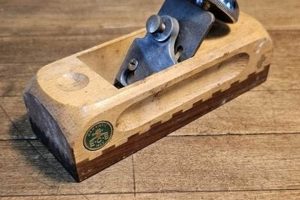
A device employed to create smooth, curved surfaces on the borders of wood pieces. The objective is often to soften sharp corners or to achieve a decorative profile. A common application involves creating a rounded edge on table tops, shelves, or other wooden furniture components.
The implementation of this process offers several advantages. It enhances safety by eliminating sharp projections, improving the tactile experience and reducing the likelihood of injury. Furthermore, it contributes to the aesthetic appeal of the finished product, imparting a more refined and professional appearance. Historically, this technique has been a staple of woodworking, evolving from hand tools to powered machinery to meet the demands of craftsmanship and mass production.
Therefore, a discussion of specific implements, techniques for their usage, and the factors influencing their selection becomes pertinent. Examining the diverse range of options available for this woodworking task provides a comprehensive understanding of their capabilities and limitations.
Considerations for Edge Rounding Tools
Effective utilization of tools designed for creating rounded edges on wood requires careful planning and technique. The following tips provide guidance for achieving optimal results.
Tip 1: Select the Appropriate Tool. Different tools are suited for varying radii and wood types. A router with a roundover bit excels at larger, consistent curves, while a hand plane may offer greater control on delicate projects.
Tip 2: Secure the Workpiece. Firmly clamp the wood to a stable surface to prevent movement during the shaping process. This ensures accuracy and reduces the risk of error.
Tip 3: Practice on Scrap Material. Before working on the final piece, test the chosen tool and technique on a similar scrap of wood. This helps to refine the approach and avoid costly mistakes.
Tip 4: Control the Speed and Feed Rate. When using power tools, maintain a consistent and controlled speed. Avoid forcing the tool, allowing it to gradually remove material for a smoother finish.
Tip 5: Employ Multiple Passes. For larger radii, consider removing material in several shallow passes rather than one deep cut. This minimizes tear-out and promotes a cleaner edge.
Tip 6: Sand for Refinement. After shaping, sand the rounded edge to eliminate any imperfections and achieve a smooth, consistent surface. Begin with a coarser grit and progress to finer grits for optimal results.
Tip 7: Grain Direction Matters. Pay close attention to the grain direction of the wood. Working with the grain minimizes tear-out and splintering, leading to a cleaner, more professional finish.
Adhering to these principles enhances the quality of edge-rounding endeavors, contributing to improved aesthetics and functionality of the finished piece.
Ultimately, mastery of edge rounding necessitates ongoing practice and a commitment to understanding the properties of the material being worked.
1. Radius of curvature

The radius of curvature is a fundamental geometric parameter directly influencing the selection and application of tools designed for edge rounding in woodworking. It defines the arc of the rounded edge and dictates the specific tooling required to achieve the desired profile.
- Router Bit Geometry
When employing a router for edge rounding, the radius of curvature directly corresponds to the cutting radius of the roundover bit. The bit’s geometry determines the profile imparted onto the workpiece. A larger radius necessitates a bit with a correspondingly larger cutting radius. Selecting the appropriate bit is paramount to achieving the intended design.
- Hand Plane Adjustments
For hand planes, achieving a specific radius of curvature requires meticulous control over the blade projection and the angle of attack. The user must incrementally adjust the plane’s settings and technique to create the desired arc. Achieving consistent results with hand planes demands considerable skill and experience.
- Sanding and Refinement Techniques
Regardless of the initial shaping method, sanding is crucial for refining the radius of curvature and achieving a smooth surface finish. Sanding blocks with varying radii can be employed to maintain the desired profile during the finishing stages. The consistency of the sanding process directly impacts the final appearance and feel of the rounded edge.
- Template Usage
For repetitive tasks or complex curves, templates can be used in conjunction with routers or hand tools to ensure consistent results. The template’s profile dictates the radius of curvature transferred to the workpiece. Templates are particularly useful for achieving precise and uniform rounded edges across multiple components.
The interplay between the intended radius of curvature and the chosen tool dictates the final quality and precision of the edge-rounding operation. Precise measurement and careful tool selection are essential for achieving predictable and desirable results. The woodworker must thoroughly consider the geometric implications of the desired radius before commencing the shaping process.
2. Material hardness
Material hardness constitutes a significant factor in woodworking, directly impacting the selection of suitable tools and techniques for achieving rounded edges. The resistance of the wood to indentation and abrasion dictates the required force and cutting-edge sharpness for effective shaping.
- Tool Steel Selection
Harder woods, such as maple or oak, necessitate tools crafted from high-speed steel (HSS) or carbide. These materials maintain their cutting edges longer than traditional carbon steel when subjected to the increased friction and abrasion associated with shaping denser woods. Conversely, softer woods like pine or basswood are more amenable to shaping with carbon steel tools.
- Power Tool Speed and Feed Rate
The optimal speed and feed rate for power tools, such as routers, are contingent upon the material hardness. Harder woods require slower speeds and shallower cuts to prevent burning or excessive tool wear. Attempting to remove too much material at once can lead to motor strain and a compromised finish. Softer woods allow for faster speeds and deeper cuts, but care must be taken to avoid tear-out.
- Sharpening Frequency
Regardless of the tool material, shaping harder woods necessitates more frequent sharpening. A dull cutting edge increases the risk of tear-out, splintering, and an uneven surface. Maintaining a keen edge is paramount for achieving clean and precise rounded edges, particularly on hardwoods. Therefore, understanding wood characteristics greatly assists in the selection of tools that maintain their sharpness.
- Hand Tool Technique
When using hand planes or chisels to round edges, material hardness influences the angle of attack and the amount of force applied. Harder woods require a steeper angle and more force, while softer woods are more easily shaped with a shallower angle and less pressure. Proper body mechanics and a firm grip are essential for controlling the tool and achieving the desired profile.
The interplay between material hardness and the choice of woodworking tools dictates the efficiency and quality of edge-rounding operations. Proper assessment of wood density and selection of appropriate tools ensures a smooth, clean finish, minimizing the risk of defects and maximizing tool longevity. A woodworker should consider hardness before doing all of their work.
3. Required precision
The level of precision demanded in a woodworking project directly dictates the appropriate implements for rounding edges. Projects requiring exacting conformity necessitate tools capable of fine adjustments and consistent performance. Deviation from the specified dimensions or curvature can compromise structural integrity or aesthetic harmony. For instance, creating a perfectly rounded handrail segment for a historic restoration demands a higher degree of accuracy than rounding the edges of a rustic picnic table.
When high precision is paramount, powered routers equipped with precision-ground roundover bits often serve as the preferred choice. These tools, when used with meticulous setup and controlled feed rates, allow for repeatable results within tight tolerances. Hand planes, while offering a tactile connection to the material, require significant skill and experience to achieve comparable accuracy. The selection of appropriate measuring tools, such as digital calipers or radius gauges, is also crucial for monitoring progress and ensuring adherence to specifications. Accurate measurement is, thus, inherently linked to selecting the precise tool.
In summary, the requisite level of precision constitutes a primary determinant in selecting instruments for edge rounding. The choice of tool and technique should align with the project’s tolerances and aesthetic goals. While certain applications permit a more relaxed approach, endeavors demanding exacting conformity necessitate precision-engineered tools and meticulous execution, underscoring the importance of understanding the relationship between required accuracy and effective edge rounding techniques.
4. Tool versatility

The adaptability of a woodworking tool designed for edge rounding significantly enhances its utility and value within a workshop. A device capable of performing multiple functions extends its applicability beyond a single specific task, contributing to efficiency and cost-effectiveness. Tools such as combination planes, for example, can execute edge rounding, chamfering, and rabbeting, reducing the necessity for numerous specialized implements. Routers, with their extensive array of interchangeable bits, provide similar versatility, allowing for the creation of diverse edge profiles and decorative effects. The greater the functionality of a given tool, the broader its potential deployment across various project types. Real-world applications demonstrate this principle: a cabinet maker might employ a single router with different roundover bits to create various edge profiles on doors, drawer fronts, and shelves, streamlining the production process.
The importance of tool versatility extends beyond mere convenience. It can directly impact the quality and consistency of finished work. A versatile tool, particularly one with adjustable settings, enables fine-tuning to accommodate variations in wood density, grain direction, or desired edge profile. This adaptability allows for a more customized approach, resulting in smoother, more refined edges. For instance, a spokeshave, while primarily designed for shaping curved surfaces, can be skillfully employed for edge rounding on irregular forms, providing a level of control that specialized tools might lack. Furthermore, the versatility of a tool often encourages experimentation and creativity, fostering a deeper understanding of woodworking techniques and promoting innovative solutions to design challenges.
In conclusion, the versatility of woodworking tools designed for edge rounding represents a crucial consideration for both hobbyist and professional woodworkers. The ability to perform multiple functions enhances efficiency, promotes adaptability, and facilitates creative exploration. While specialized tools may excel in specific tasks, versatile implements offer a broader range of capabilities, making them invaluable assets in any well-equipped woodworking environment. The challenge lies in selecting tools that strike a balance between specialized performance and general applicability, optimizing both functionality and cost-effectiveness.
5. Power source
The energy source that drives a woodworking tool directly influences its portability, power output, and overall operational characteristics, which are essential when considering devices designed to shape wood edges. The selection of an appropriate power source is critical for optimizing performance and achieving desired results.
- Corded Electric Power
Corded electric tools offer consistent power output, making them suitable for stationary or semi-stationary woodworking operations. Their reliance on a continuous power supply limits mobility but provides reliable performance for tasks such as routing and shaping edges with precision. Routers and stationary edge sanders are typical examples, where consistent power is more critical than portability.
- Battery-Powered (Cordless) Electric Power
Battery-powered tools provide enhanced portability, allowing for edge rounding in locations without readily available electrical outlets. Battery technology advancements have increased power output and runtime, making cordless options viable for many edge-rounding tasks. Cordless routers and edge trimmers offer the convenience of maneuverability but may require multiple batteries for extended projects.
- Pneumatic (Air Compressor) Power
Pneumatic tools utilize compressed air as their power source, offering a high power-to-weight ratio. Air-powered edge sanders and grinders are commonly used in professional woodworking settings, where a central air compressor system is available. These tools often provide precise control and consistent performance, but their reliance on an external air supply restricts portability.
- Manual Power
Hand tools, such as planes, spokeshaves, and chisels, rely on manual force for operation. These tools provide exceptional control and are suitable for intricate edge shaping or situations where electricity or compressed air is unavailable. While requiring more physical exertion, manual tools allow for a direct tactile connection to the material, enabling nuanced adjustments and fine detail work.
Therefore, the choice of power source for an implement intended for edge rounding must consider the specific requirements of the task, including portability, power demands, and desired level of control. Each power source offers unique advantages and limitations, impacting the overall efficiency and effectiveness of the edge-shaping process.
Frequently Asked Questions
This section addresses common inquiries regarding the selection, application, and maintenance of devices for shaping wooden edges. The information provided aims to clarify typical concerns and misconceptions.
Question 1: What is the most appropriate device for creating a uniform radius on multiple workpieces?
A router equipped with a bearing-guided roundover bit facilitates repeatable edge rounding. The bearing follows the edge of the workpiece, ensuring consistent profile replication across numerous pieces.
Question 2: How does wood hardness influence the choice of cutting tool?
Harder woods necessitate implements with sharper cutting edges and greater durability. Carbide-tipped router bits or high-speed steel hand planes are better suited for hardwoods compared to softer steel tools.
Question 3: What safety precautions are essential when employing power tools for edge rounding?
Eye protection is critical to shield against flying debris. Hearing protection mitigates noise exposure. Workpieces should be securely clamped to prevent movement. Proper ventilation minimizes dust inhalation.
Question 4: How should tear-out be addressed when shaping edges on wood with a complex grain pattern?
Employing a backer board helps support the wood fibers during cutting, reducing the likelihood of tear-out. Shallow passes and sharp cutting edges also minimize this effect.
Question 5: What is the best method for achieving a perfectly smooth rounded edge after initial shaping?
Progressive sanding, starting with a coarser grit sandpaper (e.g., 120-grit) and gradually moving to finer grits (e.g., 220-grit, 320-grit), refines the surface. Sanding blocks or contoured sanding pads maintain the desired shape during this process.
Question 6: How often should cutting edges be sharpened to maintain optimal performance?
The frequency of sharpening depends on the wood type and usage. Dull cutting edges require more force, increasing the risk of tear-out and reducing precision. Regular inspection and sharpening are vital for consistent results.
In summary, effective edge shaping involves selecting the right tool for the material and task, employing safe practices, and maintaining sharp cutting edges. Careful attention to these aspects ensures professional results and minimizes potential hazards.
The subsequent section will explore advanced shaping techniques and specialized applications.
Conclusion
The preceding examination has detailed various facets of an instrument employed to create curved borders on wooden objects. Essential considerations include radius of curvature, material hardness, precision requirements, tool adaptability, and energy source. Selection of the appropriate device, coupled with proficient application, influences the final outcome.
Continued refinement of skills and exploration of advanced techniques remain imperative. The pursuit of excellence enhances both the aesthetic and functional aspects of woodworking. Attention to detail elevates craftmanship.