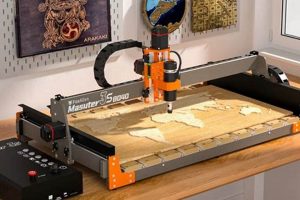
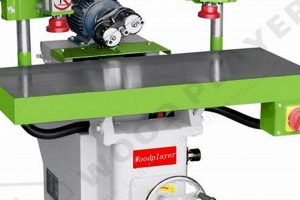
Automated routing systems used in woodworking integrate computer numerical control (CNC) technology to execute precise cuts and shaping operations on wood materials. These systems employ computer-aided design (CAD) and computer-aided manufacturing (CAM) software to translate designs into machine instructions. For instance, a furniture manufacturer might use such a system to mass-produce identical chair legs with intricate detailing, ensuring consistency and accuracy far exceeding manual capabilities.
The adoption of these automated systems offers significant advantages to woodworking businesses. They increase production efficiency by automating repetitive tasks, reduce material waste through optimized cutting paths, and improve the overall quality and precision of finished products. Historically, woodworking relied heavily on skilled craftsmanship; the introduction of automated systems has allowed for greater scalability and complexity in woodworking projects, bridging the gap between traditional techniques and modern manufacturing demands.
The following sections will delve into the core components of these automated systems, examining the different types available, outlining the practical considerations for implementation, and exploring the applications they enable across a range of woodworking disciplines. We will also discuss the software necessary for their operation and the maintenance required to ensure optimal performance.
Essential Guidance for Utilizing Automated Wood Routers
The effective use of automated wood routing systems necessitates careful planning and consistent execution. Adhering to established best practices can significantly improve output quality and operational longevity.
Tip 1: Material Selection Considerations: When operating automated wood routers, the material being processed significantly impacts tool selection and feed rates. Hardwoods, for example, require robust tooling and slower feed rates compared to softwoods to prevent tool wear and material fracturing. Consistent material grading ensures predictable machining results.
Tip 2: Optimizing Cutting Parameters: Implement rigorous testing to determine the optimal spindle speed, feed rate, and depth of cut for each specific material and tooling combination. Inadequate parameters lead to poor surface finishes, increased tool wear, and potential machine damage. Utilize CAM software simulations to predict material behavior and adjust parameters accordingly.
Tip 3: Tooling Maintenance Protocols: Regularly inspect cutting tools for wear, damage, or dullness. Dull tools generate excessive heat, leading to burning or splintering of the wood. Implement a standardized sharpening or replacement schedule to maintain optimal cutting performance. Track tool usage and performance to identify patterns and improve maintenance intervals.
Tip 4: Workholding Strategies: Secure workholding is paramount for achieving accurate and consistent results. Employ vacuum clamping, mechanical clamps, or jigs designed specifically for the material and part geometry. Insufficient workholding results in vibration, material movement, and inaccurate cuts.
Tip 5: Dust Extraction System Efficiency: Wood dust generated during the routing process presents both a health hazard and a potential source of machine malfunction. Ensure the dust extraction system is properly sized and maintained to effectively remove debris from the cutting area. Clogged filters or inadequate suction reduce efficiency and increase the risk of fire or equipment damage.
Tip 6: Software Proficiency and Training: Effective utilization of automated wood routers requires a comprehensive understanding of CAD/CAM software. Invest in thorough training for operators to ensure they can accurately translate designs into machine instructions, troubleshoot errors, and optimize cutting paths for efficiency.
Tip 7: Regular Machine Calibration: Periodically calibrate the automated wood router to maintain positional accuracy. Deviations in calibration lead to dimensional inaccuracies in the finished parts. Follow the manufacturer’s recommended calibration procedures and document all adjustments made.
Adhering to these guidelines ensures that automated wood routing systems operate efficiently and produce high-quality results. Consistent application of these best practices improves the return on investment and extends the lifespan of the equipment.
The following sections will explore safety considerations, advanced techniques, and future trends in the field.
1. Precision Cutting

Precision cutting is a foundational element in modern woodworking, particularly as it relates to computer numerical control (CNC) machines. The integration of CNC technology elevates the accuracy and repeatability of cuts, enabling complex geometries and designs previously unattainable through traditional methods.
- Dimensional Accuracy
CNC machines achieve dimensional accuracy through precise motor control and feedback systems. This results in parts that conform closely to design specifications, minimizing the need for manual adjustments or rework. For instance, cabinet components cut on a CNC machine will exhibit consistent dimensions, facilitating efficient assembly and structural integrity.
- Complex Geometries
The ability to execute complex cutting paths is a defining characteristic. CNC machines can produce intricate curves, angles, and contours that would be exceedingly difficult or impossible to replicate manually. This capability is crucial for manufacturing furniture with ornate detailing, architectural millwork, and custom-designed components.
- Material Optimization
Precision cutting reduces material waste. CNC software optimizes cutting layouts to maximize the number of parts obtainable from a single sheet of material. This is particularly beneficial when working with expensive hardwoods or engineered wood products, leading to significant cost savings and enhanced resource utilization.
- Repeatability and Consistency
One of the most significant benefits of CNC is its ability to replicate cuts with high consistency. This is vital for mass production of identical components, ensuring uniformity and facilitating efficient assembly line processes. The repeatability aspect minimizes variation between parts, contributing to the overall quality and reliability of the final product.
These facets of precision cutting, enabled by woodworking CNC machines, collectively contribute to improved product quality, increased efficiency, and reduced production costs. The ability to achieve dimensional accuracy, execute complex geometries, optimize material usage, and maintain repeatability underscores the transformative impact of CNC technology on the woodworking industry. This technology allows woodworkers to achieve more, with greater efficiency and reduced material waste.
2. Automated Operation

Automated operation represents a paradigm shift in woodworking, enabled by computer numerical control (CNC) machines. This automation transforms woodworking processes, moving from primarily manual tasks to computer-controlled execution, thereby influencing efficiency, precision, and production capacity.
- Reduced Labor Requirements
CNC machines automate many labor-intensive woodworking tasks. Once programmed, the machine executes cuts, carvings, and other operations with minimal human intervention. This results in a reduction in the number of skilled laborers required for production, particularly in repetitive manufacturing environments. For instance, a furniture manufacturer can produce complex chair components with fewer employees, as the CNC handles the majority of the cutting and shaping tasks.
- Consistent Output Quality
Automation guarantees uniformity in output, as CNC machines execute programmed instructions consistently across all production runs. This diminishes the variability inherent in manual woodworking, leading to a higher standard of product quality. Each component produced by a CNC machine conforms precisely to design specifications, ensuring consistency and minimizing defects.
- Increased Production Speed
CNC machines operate at speeds unattainable through manual methods, significantly accelerating production cycles. This increased speed allows woodworking businesses to fulfill larger orders and meet tighter deadlines. For example, a cabinet maker utilizing CNC automation can produce a set of custom cabinets in a fraction of the time required using traditional hand tools.
- Unattended Operation
Many CNC machines can operate unattended for extended periods, allowing for overnight or weekend production runs. This feature maximizes machine utilization and increases overall productivity. After setting up the machine and initiating the program, the operator can leave the machine to run autonomously, returning later to retrieve the completed parts.
The benefits of automated operation in woodworking CNC machines extend beyond mere efficiency gains. They impact product consistency, labor costs, and the scalability of woodworking operations. The shift toward automation allows woodworking businesses to compete more effectively in the market, producing high-quality products at competitive prices.
3. Design Flexibility

The integration of computer numerical control (CNC) technology within woodworking systems fundamentally alters the scope of achievable designs. Design flexibility, in this context, refers to the capacity to produce intricate and complex forms, customized components, and unique geometries with relative ease. The utilization of CNC machines introduces a direct causal link between the conceptual design and the physical realization. A design conceived in computer-aided design (CAD) software can be translated into precise machine instructions, thereby circumventing the limitations imposed by manual techniques. Consider, for example, the creation of a serpentine-front chest of drawers. The complex curves inherent in such a design would present significant challenges for traditional woodworking methods. However, a CNC machine can execute the necessary cuts with accuracy and repeatability, rendering the design feasible and scalable.
The importance of design flexibility as a component is paramount. It allows for the creation of bespoke furniture, architectural millwork, and artistic wood sculptures that cater to individual preferences or specific project requirements. This capability expands the market reach of woodworking businesses, enabling them to offer customized solutions that differentiate them from mass-produced alternatives. For instance, an architect designing a custom home can collaborate with a woodworking company utilizing CNC technology to produce unique trim details, door designs, and cabinetry that seamlessly integrate with the overall aesthetic of the building. This level of design integration is simply not achievable without the capabilities afforded by CNC automation.
In summary, the design flexibility inherent is a transformative attribute. It empowers woodworkers to realize complex and customized designs that would otherwise be impractical or impossible to execute. This capability enhances the value proposition of woodworking services, expands market opportunities, and fosters innovation within the industry. The challenges associated with this technology lie in the initial investment, the need for specialized software proficiency, and the ongoing maintenance of the machinery. Nevertheless, the benefits accrued in terms of design capability and production efficiency demonstrably outweigh these challenges, establishing as a crucial component of modern woodworking practices.
4. Material Efficiency

The intersection of material efficiency and automated wood routers constitutes a significant advancement in woodworking practices. These systems directly impact material utilization through optimized cutting strategies, reducing waste and lowering production costs. The relationship is causal: the precision of CNC technology enables more efficient nesting of parts, tighter kerf widths, and the reuse of offcuts, directly resulting in minimized material consumption. As a component, material efficiency serves as a key performance indicator of the overall effectiveness and cost-competitiveness. Consider a cabinet manufacturer: Traditional methods might result in 15-20% material waste, whereas a CNC-optimized cutting plan can reduce this figure to below 5%, representing substantial cost savings and environmental benefits.
Further practical application of this understanding lies in the implementation of advanced nesting software. This software analyzes part geometries and arranges them on a virtual sheet to minimize scrap material. It factors in grain direction, material defects, and tool path optimization to derive the most efficient layout. For example, in the production of custom furniture, CNC machines can cut intricate shapes and patterns from a single sheet of wood, maximizing material yield and reducing the need for multiple sheets. The software also tracks offcuts, allowing them to be used for smaller parts or in subsequent projects, further reducing waste.
In summary, automated wood routers significantly enhance material efficiency through precise cutting, optimized nesting, and waste reduction strategies. This efficiency is a crucial factor in reducing production costs, minimizing environmental impact, and maximizing profitability. While the initial investment in CNC technology may be substantial, the long-term savings derived from improved material utilization justify the expense, positioning these systems as essential tools for sustainable and cost-effective woodworking operations. Challenges remain in fully integrating software and machinery to account for every variable but these challenges are also future growth oppurtunities.
5. Production Scalability

The relationship between production scalability and automated wood routers is fundamentally driven by the capacity to increase output volume without proportionally increasing resource expenditure. This is a direct result of the reduced labor input per unit produced, the enhanced precision that minimizes rework and waste, and the ability to replicate complex designs consistently. Automated wood routers allow woodworking businesses to transition from small-scale, bespoke production to larger batch or continuous manufacturing processes. The introduction of this technology is therefore a key enabler of scaling operations. Scalability becomes a critical operational metric in industries dealing with fluctuating market demands or responding to large-volume contracts.
Consider the example of a custom door manufacturer. Prior to the adoption of automated routing, production capacity was limited by the time and skill required for manual cutting and shaping of door components. Each door required significant labor input, restricting output to a few units per week. Upon integrating automated routing, the same manufacturer can produce dozens or even hundreds of doors per week, depending on the machine capacity and program efficiency. This is due to the system’s ability to run autonomously, following pre-programmed instructions with a minimum of human intervention. Furthermore, the increased precision reduces the need for manual fitting and adjustments, further accelerating the production process. The ability to efficiently handle high-volume orders is now possible.
In summary, automated routing directly enables production scalability in woodworking through increased output capacity, reduced labor costs, and enhanced precision. This scalability allows businesses to respond effectively to market demands, take on larger contracts, and improve overall competitiveness. The challenges of initial investment and operator training are offset by the long-term benefits of increased production efficiency and the ability to adapt to changing market conditions. Continued innovation in automated routing technology will likely further expand scalability capabilities, enabling even greater levels of output and customization in the future of woodworking.
Frequently Asked Questions About Woodworking CNC Machines
This section addresses common inquiries regarding the operation, maintenance, and application of automated routing systems within the woodworking industry.
Question 1: What level of operator skill is required to effectively utilize automated woodworking systems?
Successful operation requires a foundational understanding of computer-aided design (CAD) and computer-aided manufacturing (CAM) software, as well as a working knowledge of machine operation and safety procedures. Comprehensive training is recommended to maximize efficiency and minimize the risk of errors or accidents.
Question 2: What are the primary maintenance requirements for automated routing systems?
Regular maintenance includes cleaning, lubrication, inspection of cutting tools, and calibration. Adherence to the manufacturer’s recommended maintenance schedule is critical to ensure optimal performance and extend the lifespan of the equipment. Neglecting maintenance can lead to reduced accuracy, increased downtime, and costly repairs.
Question 3: What types of wood materials are suitable for processing with automated routing systems?
These systems can process a wide range of wood materials, including hardwoods, softwoods, plywood, medium-density fiberboard (MDF), and particleboard. The appropriate cutting parameters and tooling must be selected based on the specific material characteristics to achieve optimal results and prevent damage to the machine or material.
Question 4: How does the precision of automated cutting compare to traditional woodworking methods?
Automated cutting offers significantly higher precision and repeatability compared to traditional methods. CNC machines can execute complex cuts with tolerances as small as a few thousandths of an inch, ensuring consistent dimensions and minimizing the need for manual adjustments. This increased precision leads to improved product quality and reduced material waste.
Question 5: What are the safety considerations associated with operating automated routing systems?
Safety is paramount when operating automated routing systems. Operators must wear appropriate personal protective equipment (PPE), including safety glasses, hearing protection, and dust masks. The machine should be equipped with safety features such as emergency stop buttons and interlocks to prevent accidents. Proper ventilation is essential to remove wood dust, which can pose a health hazard.
Question 6: What is the typical return on investment (ROI) for implementing automated routing systems in a woodworking business?
The ROI varies depending on factors such as production volume, product complexity, and labor costs. However, the increased efficiency, reduced material waste, and improved product quality typically result in a significant return on investment within a reasonable timeframe. A thorough cost-benefit analysis is recommended before investing in automated routing systems.
These frequently asked questions provide a concise overview of key considerations for those interested in utilizing automated routing systems for woodworking applications. Proper training, diligent maintenance, and adherence to safety protocols are essential for maximizing the benefits of this technology.
The following section will discuss case studies highlighting successful implementations of these systems across various woodworking sectors.
Conclusion
The preceding sections have comprehensively examined woodworking CNC machines, detailing their operational parameters, design capabilities, impact on material efficiency, and contribution to production scalability. This analysis has illuminated the transformative role of this technology in modernizing woodworking practices, enabling greater precision, efficiency, and design flexibility. The integration of automated routing systems allows businesses to optimize resource utilization, reduce labor costs, and produce high-quality products with repeatable accuracy.
As technology continues to evolve, the capabilities and accessibility of woodworking CNC machines are expected to expand further. Investment in this technology, coupled with ongoing training and adherence to safety protocols, remains a strategic imperative for woodworking businesses seeking to enhance their competitiveness and capitalize on emerging market opportunities. Continued exploration and refinement of these systems will undoubtedly shape the future of the woodworking industry.