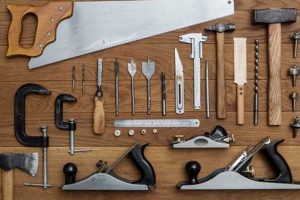
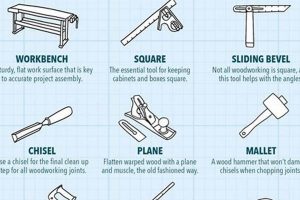
Fundamental implements required for initiating projects involving shaping and joining wood are essential for beginners. These items, typically hand-operated or small power tools, allow for performing core woodworking tasks like cutting, measuring, shaping, and fastening. Examples include saws for creating cuts, planes for smoothing surfaces, chisels for detail work, measuring tapes for accuracy, and hammers for joining pieces.
Possessing these implements enables individuals to learn foundational woodworking skills, promoting creativity and self-sufficiency. The acquisition and mastery of these instruments provide a cost-effective entry point into the craft, allowing for gradual expansion of capabilities and project complexity. Historically, these tools have formed the bedrock of woodworking traditions, passed down through generations, fostering a connection to time-honored craftsmanship.
The subsequent sections will delve into specific categories of implements. Detailed explanations will be provided regarding their function, proper usage, and recommended features for optimal performance, facilitating the selection of the most appropriate equipment for introductory woodworking endeavors.
Tips on Essential Woodworking Implements for Beginners
This section provides guidance on the selection, maintenance, and usage to maximize the effectiveness and longevity of your fundamental woodworking inventory.
Tip 1: Prioritize Quality over Quantity: Investing in fewer, higher-quality implements initially proves more beneficial than acquiring numerous inexpensive alternatives. Durable tools retain their edge and accuracy longer, resulting in superior project outcomes and reduced long-term replacement costs.
Tip 2: Master Sharpening Techniques: Sharp edges are paramount for safety and precision. Learning to hone and sharpen blades on saws, planes, and chisels enhances performance and minimizes the risk of accidents. Regularly sharpened tools require less force, improving control and accuracy.
Tip 3: Practice Proper Storage: Protect equipment from moisture and physical damage. Utilize toolboxes, racks, or designated storage areas to prevent rust, corrosion, and dulling. Proper storage extends tool life and maintains optimal working condition.
Tip 4: Understand Wood Grain Direction: Awareness of wood grain orientation is crucial for efficient and clean cuts. Cutting with the grain minimizes tear-out and splintering. Learning to identify grain direction improves cutting accuracy and reduces material waste.
Tip 5: Secure Workpieces Effectively: Stable and secure workholding is fundamental for safe and accurate woodworking. Employ clamps, vises, and workbenches to prevent movement during cutting, shaping, and fastening operations. Proper workholding enhances precision and minimizes the risk of injury.
Tip 6: Adhere to Safety Protocols: Always wear appropriate personal protective equipment, including safety glasses, hearing protection, and dust masks. Familiarize oneself with the operating procedures and safety guidelines for each tool before use. Maintaining a safe workspace minimizes the potential for accidents.
Implementing these guidelines will contribute to a more efficient, safe, and enjoyable entry into woodworking. The commitment to quality, maintenance, and safe operating practices will yield superior results and foster a deeper appreciation for the craft.
The concluding section will summarize the key aspects of establishing a foundation in woodworking and provide resources for continued learning and skill development.
1. Accurate Measurement

Precise dimensional assessment is a cornerstone of successful woodworking. Utilizing basic tools effectively hinges on obtaining correct initial measurements and consistently transferring those measurements to workpieces. Without accuracy, projects are prone to errors, resulting in wasted material, structural instability, and compromised aesthetics.
- The Role of Measuring Instruments
Measuring instruments, such as tape measures, rulers, combination squares, and marking gauges, facilitate precise length, width, depth, and angle determination. A tape measure provides overall dimensions, while a ruler offers finer increments. A combination square allows accurate perpendicular marking and depth gauging. A marking gauge scribes parallel lines for consistent material removal, crucial for joinery.
- Impact on Material Yield
Correct measurement minimizes material waste. Erroneous cuts stemming from inaccurate measurements lead to unusable offcuts, increasing project costs and diminishing resource efficiency. Consistent and validated measurements ensure optimal material usage, contributing to both economic and environmental sustainability.
- Influence on Joint Integrity
Joinery relies heavily on dimensional precision. Mortise and tenon, dovetail, and rabbet joints require accurate matching of mating components. Deviations from intended dimensions compromise joint strength, stability, and visual appeal. Precise measurements during layout and cutting ensure tight-fitting and structurally sound joints.
- Importance in Project Planning
Accurate measurements extend beyond individual components to encompass overall project dimensions. Precise assessment of available space, accounting for existing structures or desired fit, is crucial during the planning phase. Reliable measurements inform material selection, cutting lists, and assembly sequences, streamlining the woodworking process.
The integration of accurate measurement techniques with fundamental woodworking implementations is fundamental. Mastery of measuring instruments and the discipline of precise layout work are indispensable skills for any woodworker. These skills, when diligently applied, mitigate errors, optimize material usage, and enhance the overall quality and longevity of finished projects.
2. Precise cutting

Precise material removal is a central requirement in woodworking. Achieving accuracy in cutting is directly dependent on understanding and effectively using fundamental implements.
- Saw Selection and Technique
The selection of an appropriate saw, be it a handsaw, backsaw, or coping saw, determines the quality of the cut. Handsaws offer versatility for general-purpose cuts, backsaws provide rigidity for fine joinery, and coping saws navigate intricate curves. Proper stance, grip, and blade angle are crucial for straight, clean cuts. Incorrect saw usage leads to uneven edges, splintering, and compromised structural integrity.
- Chisel Control and Application
Chisels, in conjunction with mallets, execute precise material removal for shaping, cleaning joints, and creating decorative features. The angle of the chisel, the sharpness of the blade, and controlled mallet strikes dictate the accuracy of the cut. Improper chisel technique results in gouges, crushed fibers, and inaccurate shapes.
- Measuring and Marking Accuracy
Precise cutting is inextricably linked to accurate measurement and marking. A clear, precise reference line is essential for guiding the saw or chisel. The use of squares, marking gauges, and sharp pencils ensures accurate layouts. Deviations in marking directly translate to errors in the finished cut, rendering the process ineffective.
- The Role of Sharpening
Sharpness of cutting edges directly correlates with cutting precision and user safety. Dull tools require excessive force, increasing the risk of slippage and inaccurate cuts. Maintaining sharp saws and chisels through regular sharpening ensures clean, controlled cuts with minimal effort.
Effective material removal with hand implements requires a synthesis of skill, proper tool selection, and consistent adherence to safety protocols. The proficiency in cutting constitutes a prerequisite for advancing to more complex woodworking techniques and attaining professional-level results.
3. Smooth surfacing
Attaining a flawless surface finish on wood is intrinsically connected with the effective employment of foundational woodworking equipment. Smoothing operations fundamentally transform rough, uneven textures into refined surfaces ready for finishing. Planing, scraping, and sanding form the core processes, each reliant on the correct application of specific implements. Hand planes, scrapers, and sanding blocks equipped with progressively finer grits abrade wood fibers, eliminating imperfections. A poorly tuned plane or incorrect sanding technique results in unevenness, scratches, or burn marks, compromising the final result. Woodworkers achieve aesthetic and tactile quality by understanding the interaction between wood grain, tool geometry, and applied force. A table crafted with precisely planed surfaces exhibits both visual appeal and structural integrity, exemplifying the synergy between surface quality and construction.
The use of smoothing planes epitomizes this connection. These implements, when meticulously tuned and employed, shear off thin shavings of wood, revealing a uniformly flat and pristine surface. Factors such as blade sharpness, plane sole flatness, and consistent stroke pressure are paramount. The process demands skill and patience. Incorrect usage results in tear-out, where wood fibers lift and fracture, creating unsightly defects. Scrapers, alternatively, excel at removing minute imperfections, especially against the grain where planes may struggle. These tools, with their finely burnished edges, create a polished surface by delicately shaving away irregularities. Sanding, although often employed as a final step, requires judicious application. Excessive sanding can round edges and soften details, diminishing the crispness of joinery. Therefore, it serves best for refining surfaces already brought close to perfection by planes and scrapers.
In summary, realizing a desirable surface finish depends on the skillful integration of fundamental woodworking implements. The process requires understanding the properties of wood, the capabilities and limitations of tools, and the application of correct techniques. Challenges include tear-out, unevenness, and over-sanding, each requiring specific remedies. The pursuit of smooth surfaces represents a cornerstone of woodworking, directly impacting the aesthetic appeal, tactile quality, and functional performance of finished projects. The ability to achieve this quality through a grasp of the fundamental tools is a basic indicator of woodworking expertise.
4. Secure Fastening

The integrity of a woodworking project fundamentally relies on the effectiveness of joinery, which is, in turn, dependent on achieving secure fastening. The implements available significantly influence the types of joints that can be reliably executed and the overall structural stability of the finished piece. The appropriate application of these implements ensures that components remain rigidly connected under load and through environmental changes.
- Screw Driving and Pilot Holes
Screws represent a common method of joining wood, offering significant holding power. However, directly driving screws into wood can lead to splitting, particularly with hardwoods. Basic woodworking involves the use of drills to create pilot holes, precisely sized to the screws shank. This technique reduces stress on the wood fibers, allowing the screw to bite securely without compromising the material. Examples include cabinet construction, where screws reinforce butt joints, and furniture assembly, where screws secure legs and aprons.
- Nail Driving and Countersinking
Nails provide a simpler, faster means of fastening, especially in applications where strength requirements are moderate. A hammer, in conjunction with nails of appropriate length and gauge, creates mechanical bonds. Countersinking, achieved with a nail set, allows the nail head to be driven below the surface, enabling a flush finish and subsequent filling for aesthetic purposes. This technique is frequently observed in trim work and panel installation.
- Clamping Techniques and Glue Adhesion
Adhesive bonding plays a critical role in modern woodworking. Clamps apply pressure to joints while the glue cures, ensuring tight, gap-free bonds. Various clamp types, including bar clamps, pipe clamps, and spring clamps, cater to different joint configurations and sizes. Proper clamping aligns components and maximizes glue surface contact, leading to stronger, more durable assemblies. Examples can be seen in edge joining boards for tabletops and assembling complex casework.
- Joint Reinforcement with Dowels and Biscuits
Dowels and biscuits provide mechanical reinforcement to glued joints, increasing their resistance to shear forces. Drills and biscuit jointers create precisely aligned holes or slots into which these reinforcing elements are inserted. The swelling action of the glue-soaked dowels or biscuits creates a tight, interlocking bond. These techniques are commonly used in frame and panel construction and mitered corner joints.
The ability to create strong, reliable fastenings rests upon the competent utilization of foundational woodworking equipment. Understanding the principles of screw mechanics, nail driving, adhesive bonding, and joint reinforcement enables woodworkers to construct pieces that withstand the test of time. Mastering these core techniques within the context of woodworking is essential for achieving professional standards of quality and durability.
5. Safe operation

Effective and responsible engagement with essential woodworking implements is contingent upon prioritizing safe operational practices. The potential for injury arising from improper tool handling necessitates stringent adherence to established safety guidelines. Lack of attention to these measures correlates directly with elevated risks of lacerations, abrasions, and more severe incidents. Understanding the intrinsic hazards associated with each tool is paramount, as is the consistent employment of personal protective equipment, including eye protection, hearing protection, and respiratory safeguards. For instance, utilizing a chisel without appropriate hand protection significantly increases the likelihood of injury should the tool slip during use. Ignoring manufacturer’s instructions regarding safe operating parameters represents a direct contravention of established safety protocols, thereby elevating the likelihood of incidents.
The connection between implements and safety extends beyond mere physical protection. Proper setup and maintenance of equipment are equally critical. A dull saw requires increased force to achieve a cut, resulting in reduced control and heightened risk of slippage. Similarly, a loose handle on a hammer compromises the user’s ability to exert precise force, increasing the potential for misdirected blows and subsequent injury. Creating a clear, uncluttered workspace further mitigates hazards by reducing the likelihood of trips, falls, and accidental contact with sharp implements. Consistent adherence to these principles ensures a safer and more productive working environment.
In conclusion, safe operation constitutes an indivisible element of basic woodworking. It is not a supplementary consideration but rather an integral aspect of the practice. The acquisition and application of woodworking implements must always be paired with a comprehensive understanding of relevant safety procedures. Challenges in maintaining consistent safety practices often stem from complacency, time constraints, or a lack of formal training. These challenges can be addressed through continuous education, the implementation of rigorous safety protocols, and a proactive commitment to fostering a culture of safety within the workshop.
6. Efficient sharpening
The maintenance of sharp cutting edges is indispensable for the effective utilization of implements foundational to woodworking. The state of a tool’s cutting edge directly affects both the precision and safety of woodworking operations. Dull tools necessitate increased force, leading to reduced control and a higher probability of slippage, potentially causing inaccuracies or injury. Therefore, integrating efficient sharpening techniques into basic woodworking practices is not merely advantageous; it is essential for optimal results and user safety. The correlation between implement sharpness and project outcome is direct and demonstrable. Consider the task of creating a dovetail joint; a dull chisel will crush wood fibers instead of cleanly severing them, resulting in ill-fitting joints and compromised structural integrity. A sharp chisel, conversely, facilitates precise material removal, yielding tight, strong joinery.
Efficient sharpening encompasses a range of methods and instruments, from oilstones and waterstones to diamond plates and honing guides. The selection of an appropriate sharpening system depends on the type of tool being maintained and the desired level of refinement. Regardless of the chosen method, the fundamental principle remains consistent: the controlled abrasion of the cutting edge to create a microscopically keen profile. For example, a woodworker employing a hand plane relies on a sharp blade to produce smooth, uniform surfaces. A dull blade will chatter across the wood, leaving behind a rough, uneven finish. Regular sharpening ensures that the plane consistently shaves thin, clean ribbons, resulting in a superior surface quality. Likewise, a sharp saw blade requires less force to initiate and maintain a cut, minimizing fatigue and maximizing accuracy.
In conclusion, the integration of efficient sharpening practices into the workflow is not separate from, but rather integral to, the basic tools to start woodworking. The proficiency in maintaining sharp cutting edges directly impacts the quality of workmanship, the safety of operations, and the longevity of the implements themselves. Woodworkers committed to excellence must prioritize honing their sharpening skills alongside their mastery of other foundational woodworking techniques. Challenges associated with sharpening, such as achieving consistent angles and recognizing a properly sharpened edge, can be overcome through practice, education, and the adoption of systematic sharpening routines.
7. Durable quality

The concept of robust construction constitutes a critical consideration when acquiring entry-level woodworking implements. The inherent longevity and resilience of such instruments profoundly influence the overall effectiveness and cost-efficiency of woodworking endeavors. Selecting tools built to withstand sustained usage contributes directly to project success and reduces the need for frequent replacements, thereby enhancing the sustainability of the practice.
- Material Composition and Construction
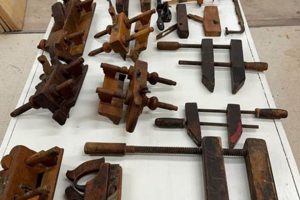
The materials used in the manufacture of a tool directly dictate its durability. High-carbon steel blades in saws and chisels retain their edges longer and resist deformation, ensuring consistent cutting performance. Hardwood handles on planes and hammers provide a comfortable grip and withstand repeated impacts without cracking or splitting. Cast iron bodies on planes offer stability and resistance to wear. In contrast, tools constructed from inferior materials, such as brittle plastics or low-grade steel, are prone to failure under stress, rendering them unreliable and potentially hazardous. An example of durable quality would be a vintage hand plane with a cast iron body, which, if properly maintained, can outlast several modern counterparts.
- Precision Machining and Assembly
The accuracy and care with which a tool is manufactured significantly impact its long-term functionality. Precisely machined components ensure smooth operation and minimize wear. Securely fastened handles and robust blade adjustment mechanisms prevent loosening or failure during use. Tight tolerances minimize play and wobble, contributing to accurate results. An example is a backsaw with a precisely set blade and a rigid spine, enabling straight, accurate cuts over extended periods. Poorly manufactured tools, characterized by loose joints, rough edges, and imprecise adjustments, degrade rapidly and compromise the quality of the work.
- Corrosion Resistance and Protective Coatings
Exposure to moisture and environmental factors can lead to corrosion, which degrades metal components and diminishes tool performance. Durable tools incorporate protective coatings, such as rust inhibitors and powder coatings, to mitigate corrosion and extend their lifespan. Proper maintenance, including regular cleaning and lubrication, further enhances corrosion resistance. A well-maintained chisel with a protective oil coating can withstand years of use in various climates. Tools lacking these safeguards are susceptible to rust and pitting, compromising their structural integrity and cutting ability.
- Ergonomic Design and User Comfort
While not directly related to material strength, ergonomic design influences the long-term usability of a tool. Comfortable handles reduce hand fatigue and minimize the risk of repetitive strain injuries. Balanced weight distribution enhances control and reduces strain on the user. A well-designed hammer allows for efficient nail driving with minimal effort. Poorly designed tools, characterized by uncomfortable grips and awkward weight distribution, lead to fatigue and increase the likelihood of errors and accidents. The durability of the user is therefore indirectly linked to the durability of the tool, creating an ergonomic harmony that facilitates project completion.
These facets collectively underscore the significance of “Durable quality” in the context of foundational woodworking tools. Implements characterized by superior materials, precise machining, corrosion resistance, and ergonomic design offer greater longevity, enhanced performance, and improved safety. Investing in such tools represents a prudent decision for aspiring woodworkers seeking to establish a sustainable and rewarding practice. These investments, in turn, enhance productivity and reduce long-term expenditures by decreasing the need for replacement or repair.
Frequently Asked Questions Regarding Basic Tools to Start Woodworking
This section addresses frequently encountered inquiries concerning the essential implements required for initiating woodworking projects. The intention is to provide concise, informative answers to common questions.
Question 1: What constitutes the minimum set of implements required to begin woodworking?
The foundational assemblage typically encompasses a measuring tape, a combination square, a hand saw, a set of chisels, a mallet, a hand plane, a drill, and a selection of clamps. These implements enable the performance of core woodworking tasks, including measuring, cutting, shaping, joining, and fastening.
Question 2: Is it advisable to purchase inexpensive sets of woodworking implements as a beginner?
While cost is a consideration, prioritizing quality over quantity is generally recommended. Inferior tools may compromise performance and longevity, potentially hindering skill development and increasing frustration. Selecting fewer, higher-quality implements often proves more beneficial in the long term.
Question 3: What are the essential safety precautions to observe when utilizing basic woodworking tools?
Eye protection, hearing protection, and respiratory protection are paramount. Maintaining sharp tools, securing workpieces, and adhering to manufacturer’s instructions for each implement are also critical for preventing accidents. A clean and well-lit workspace further enhances safety.
Question 4: How frequently should woodworking tools be sharpened?
The frequency of sharpening depends on the type of wood being worked and the intensity of tool usage. As a general guideline, cutting edges should be honed whenever a noticeable reduction in sharpness is observed. Regular sharpening ensures efficient cutting and minimizes the risk of accidents.
Question 5: What are the fundamental skills required to effectively utilize basic woodworking tools?
Accurate measurement, precise cutting, proper sharpening, secure fastening, and safe tool handling constitute core competencies. Proficiency in these areas enables the execution of a wide range of woodworking projects with confidence and precision.
Question 6: How does one properly maintain basic woodworking implements to extend their lifespan?
Regular cleaning, lubrication of moving parts, and appropriate storage are essential for preserving the condition of woodworking tools. Protecting tools from moisture and physical damage prevents rust, corrosion, and dulling. A dedicated storage area ensures organizational efficiency and prevents accidental damage.
The adoption of best practices regarding tool selection, safe usage, and proper maintenance contributes to a more efficient and rewarding woodworking experience. Consistent attention to these details enhances project outcomes and prolongs the lifespan of valuable implements.
The subsequent section will delve into resources for continued learning and skill development, providing a pathway for aspiring woodworkers to expand their knowledge and capabilities.
Conclusion
This exploration has defined “basic tools to start woodworking” as a prerequisite for engaging with the craft. Discussion has encompassed the function, maintenance, and safe employment of these implements, underlining the importance of precision, efficiency, and durability. A proper understanding and skilled application of these implements constitute the foundation upon which more advanced woodworking techniques are built.
The mastery of these tools enables the transformation of raw materials into functional and aesthetically pleasing objects. Continued dedication to refining these fundamental skills ensures the perpetuation of woodworking as a valuable and enduring art form. The ongoing pursuit of knowledge and proficiency with “basic tools to start woodworking” provides a pathway to creative expression and skilled craftsmanship.