



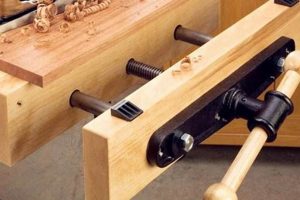
Workholding solutions utilizing cylindrical or rectangular pegs, in conjunction with clamping mechanisms, represent a common technique in woodworking. These systems secure material to a workbench, allowing for precise and stable operations. For example, a workpiece might be held firmly against a bench dog using a cam clamp inserted into an adjacent dog hole, preventing movement during routing or sanding.
The effectiveness of these workholding approaches stems from their ability to distribute clamping force evenly, minimizing the risk of damage to delicate wood surfaces. Historically, woodworkers have relied on variations of this method for centuries, adapting designs to suit evolving tools and techniques. The versatility of these systems contributes significantly to accuracy and efficiency in various woodworking tasks.
The subsequent sections will delve into specific types of these solutions, examine their practical applications, and compare their advantages and disadvantages within diverse woodworking contexts. Furthermore, material selection, maintenance procedures, and innovative adaptations will be explored.
Practical Guidance for Effective Workholding
Optimizing the use of these workholding components enhances woodworking precision and safety. The following guidance provides specific techniques for maximizing their performance and longevity.
Tip 1: Ensure Precise Hole Alignment: The accuracy of dog holes directly impacts the effectiveness of the system. Use a precision drilling guide or a purpose-built dog hole drilling jig to maintain consistent spacing and perpendicularity.
Tip 2: Select Appropriate Materials: The choice of material for both the pegs and clamping elements influences durability and grip. Hardwoods such as maple or beech offer superior resistance to wear and deformation compared to softer woods.
Tip 3: Employ Protective Shims: To prevent marring delicate workpieces, utilize thin shims of cork or leather between the clamping surface and the wood. This distributes pressure evenly and minimizes indentation.
Tip 4: Adjust Clamping Pressure Judiciously: Overtightening can damage both the workpiece and the clamping mechanism. Apply sufficient pressure to secure the material without causing visible deformation or stress.
Tip 5: Maintain Cleanliness: Regularly clean the pegs and clamping components to remove sawdust and debris, which can reduce friction and compromise holding power. A stiff brush or compressed air is suitable for this purpose.
Tip 6: Consider Tapered Pegs: Tapered designs provide enhanced holding power due to the wedging action they create within the dog hole. These are particularly useful for securing heavier or more irregularly shaped workpieces.
Tip 7: Explore Combination Systems: Integrate the peg-based system with other workholding methods, such as vises or adhesive mats, to address specific project requirements and material characteristics. This multifaceted approach maximizes stability and control.
Implementing these practical tips will result in enhanced stability, increased precision, and reduced risk of damage to valuable woodworking projects. Careful attention to detail in setup and maintenance is crucial for realizing the full potential of these workholding solutions.
The subsequent sections will address more advanced applications, troubleshooting common issues, and exploring innovative modifications that extend the capabilities of these versatile woodworking tools.
1. Material Holding

Material holding, in the context of woodworking, refers to the secure and stable positioning of a workpiece to facilitate accurate and safe execution of various operations. The effectiveness of bench dog clamps in this aspect is paramount. Inadequate material holding can result in inaccurate cuts, damaged workpieces, and potential injury to the operator. Consider a scenario where a board is not adequately secured while being routed; the router bit could catch, causing the board to shift violently and potentially damage the workpiece or injure the user. Conversely, well-implemented material holding using bench dog clamps ensures that the workpiece remains stationary, allowing for precise and controlled cuts.
The selection of appropriate bench dog clamps directly influences the quality of material holding. Factors such as the size and shape of the workpiece, the type of wood being used, and the specific woodworking operation being performed dictate the type of clamp required. For instance, larger workpieces may necessitate multiple clamps strategically positioned to distribute clamping force evenly and prevent bowing or warping. Softer woods may require padded clamp faces to prevent indentation. Complex joinery operations may benefit from adjustable clamps that can conform to irregular shapes. Furthermore, the proper arrangement and spacing of dog holes on the workbench is essential for optimizing the versatility and effectiveness of the system.
In summary, material holding is a critical function facilitated by bench dog clamps in woodworking. Understanding the interplay between clamping force, workpiece characteristics, and clamp selection is essential for achieving accurate, safe, and efficient woodworking results. Poor material holding leads to increased risk of errors and injury, while optimized material holding enhances the quality and precision of the final product. Future advancements in bench dog clamp design and material science may further improve material holding capabilities, expanding the possibilities for complex and intricate woodworking projects.
2. Clamping Force

Clamping force, in the context of woodworking involving bench dog clamps, represents the pressure exerted by the clamp to secure a workpiece against a reference surface, typically the workbench. This force is critical for maintaining stability during operations such as cutting, shaping, or joining. Insufficient clamping force allows the workpiece to shift, leading to inaccuracies and potentially hazardous situations. Excessive force, conversely, can damage the material, especially with softer wood species, resulting in compression marks or even splitting.
The effectiveness of bench dog clamps hinges on the precise calibration of clamping force. Different woodworking tasks demand varying levels of pressure. For example, delicate carving might require minimal force to avoid crushing the wood fibers, whereas routing operations often necessitate substantial force to counteract the lateral pressure exerted by the router bit. The design of the clamp itself, including the materials used and the mechanical advantage it provides, directly influences the achievable clamping force. A cam-action clamp, for instance, can generate significant force with minimal user effort, while a simple wooden peg clamp relies on friction and wedge action, typically providing less force. Consider a scenario where assembling a dovetail joint using hand tools where adequate clamping pressure along the joint is mandatory or the final product will be substandard. Proper force also impacts joint longevity and sturdiness.
In summary, clamping force is an indispensable component of bench dog clamp systems in woodworking. An understanding of the relationship between clamp design, material properties, and operational requirements is essential for achieving optimal results. Challenges remain in developing clamps that provide both high clamping force and precise control, minimizing the risk of damage to delicate workpieces. The continuous evolution of clamp designs aims to address these challenges, enhancing the versatility and reliability of bench dog clamp systems in diverse woodworking applications.
3. Hole Alignment

Hole alignment, in the context of woodworking bench dog clamp systems, is a critical factor that directly influences the precision, stability, and overall effectiveness of workholding. Accurate and consistent hole alignment ensures that bench dogs and clamps can be positioned optimally to secure workpieces effectively. Misalignment compromises clamping force and can lead to inaccurate cuts or instability during woodworking operations. The discussion below details key facets of hole alignment and its impact.
- Grid System Integrity
The alignment of dog holes within the workbench forms a grid system that dictates the positioning options for workholding. When the grid is inconsistent, the ability to securely clamp workpieces diminishes significantly. For example, if holes are not spaced at regular intervals or are not parallel to the edges of the bench, it becomes challenging to use multiple clamps simultaneously to distribute pressure evenly. Irregular grid systems can result from inaccurate drilling during bench construction or from subsequent wear and tear that distorts hole placement.
- Perpendicularity and Depth
Dog holes must be drilled perpendicular to the bench surface and to a consistent depth. Angled holes prevent the proper seating of bench dogs and clamps, reducing their holding power and increasing the risk of slippage. Similarly, inconsistent hole depth can lead to uneven clamping pressure, especially when using clamps that rely on a specific engagement depth for optimal performance. Deviation from perpendicularity introduces non-uniform stress distribution on the workpiece during clamping.
- Concentricity and Diameter Consistency
The diameter of the dog holes must be consistent and uniform to ensure that bench dogs and clamps fit snugly and securely. Holes that are too large allow the dogs to wobble, reducing stability, while holes that are too small may prevent the dogs from seating fully. Concentricity errors, where the hole is not perfectly round, further compromise the fit and reduce clamping effectiveness. High-quality drilling tools and techniques are required to maintain consistent hole diameter and roundness.
- Impact on Joinery
Precision joinery relies heavily on accurate workholding, which in turn depends on proper hole alignment. When constructing joints such as dovetails or mortise-and-tenons, any movement of the workpiece during cutting or assembly can compromise the precision of the joint. Well-aligned dog holes facilitate the secure positioning of workpieces, allowing for precise cuts and accurate alignment during glue-up. Without reliable hole alignment, achieving tight-fitting and structurally sound joints becomes significantly more challenging.
In conclusion, hole alignment is an integral component of any woodworking bench dog clamp system. Consistent alignment ensures optimal clamping force distribution, enhances workpiece stability, and ultimately contributes to more accurate and safer woodworking operations. The initial precision during bench construction, coupled with ongoing maintenance to preserve hole integrity, is essential for maximizing the potential of bench dog clamp systems.
4. Workpiece Stability
Workpiece stability, in the context of woodworking, directly correlates with the effectiveness of bench dog clamps. These clamps, when properly utilized, secure the material undergoing fabrication, preventing movement during operations. Instability introduces inaccuracies and compromises the quality of the final product. For instance, routing a dado requires a stationary workpiece; any shift will result in a misaligned groove. Similarly, during hand planing, a stable piece allows for consistent removal of material, leading to a flat and even surface. Bench dog clamps, therefore, provide a necessary foundation for precision and control in woodworking.
The design and configuration of the clamp system influence the degree of stability achieved. A well-designed system distributes clamping force evenly across the workpiece, minimizing the risk of warping or distortion. The number and placement of dogs are critical considerations. Larger workpieces may require multiple dogs to prevent bowing, while smaller pieces may only need a single dog in conjunction with a vise. Furthermore, the type of clamping mechanismcam clamps, screw clamps, or simple wedgesaffects the clamping force and the ease of adjustment. Choosing the appropriate system for a given task is essential for maintaining workpiece stability and achieving desired results.
In conclusion, workpiece stability is a prerequisite for accurate and efficient woodworking, and bench dog clamps are instrumental in achieving this stability. The effectiveness of these clamps depends on proper design, configuration, and application. Neglecting workpiece stability can lead to errors, waste material, and potentially dangerous situations. A thorough understanding of the principles of workholding and the capabilities of different clamp systems is therefore essential for any woodworker seeking to produce high-quality and consistent results.
5. System Versatility

System versatility, in the context of woodworking bench dog clamp systems, refers to the adaptability and range of applications that the system can effectively accommodate. A versatile system enhances efficiency by allowing for varied workholding solutions with minimal reconfiguration. Its relevance centers on the ability to address diverse project requirements with a standardized set of components.
- Accommodating Variable Workpiece Sizes
A versatile system should effectively secure workpieces ranging from small, delicate components to large, unwieldy boards. This adaptability is achieved through adjustable clamp spacing, variable dog heights, and the ability to integrate auxiliary clamping mechanisms. For example, a system that can quickly transition from holding a small drawer component for dovetailing to securing a large tabletop for sanding demonstrates high versatility. The implication is reduced setup time and increased workflow efficiency.
- Handling Irregular Shapes and Contours
Woodworking projects often involve workpieces with non-uniform shapes or complex contours. A versatile bench dog clamp system includes components that can conform to these irregularities, providing secure and stable support. This might include flexible clamps, shaped dogs, or the ability to create custom jigs that integrate with the existing system. For instance, securing a curved chair leg for shaping requires a system that can provide consistent pressure along the contour. The result is improved control and reduced risk of damage.
- Integrating with Auxiliary Workholding Methods
System versatility extends to the ability to seamlessly integrate with other workholding tools and techniques, such as vises, featherboards, and adhesive mats. A system that can be used in conjunction with these methods provides a comprehensive approach to workholding, addressing a wider range of challenges. For example, combining bench dog clamps with a vise for edge jointing long boards can provide superior stability and accuracy. This integration enhances overall workholding capabilities and reduces the need for specialized setups.
- Supporting Diverse Woodworking Operations
A versatile bench dog clamp system should facilitate various woodworking operations, including cutting, shaping, joining, and finishing. This requires a range of clamping options and configurations that can be adapted to the specific demands of each operation. For example, a system that can be easily reconfigured for routing, sawing, or sanding demonstrates high versatility. The implication is a more streamlined workflow and a reduction in the number of specialized tools required.
These facets underscore the importance of system versatility in bench dog clamps for woodworking. By providing adaptability across workpiece sizes, shapes, and operations, a versatile system enhances efficiency, precision, and overall productivity in the woodworking process. The capacity to integrate with auxiliary workholding methods further extends the system’s capabilities, making it an essential asset for any serious woodworker.
Frequently Asked Questions
This section addresses common inquiries regarding the selection, application, and maintenance of bench dog clamps in woodworking. The information provided aims to clarify key aspects of these workholding devices, enabling informed decision-making.
Question 1: What materials are optimal for constructing bench dog clamps?
Durable hardwoods such as maple, beech, or birch are recommended for the construction of bench dog clamps. These materials exhibit resistance to deformation under pressure and provide a stable clamping surface. Softwoods are generally unsuitable due to their susceptibility to compression and wear.
Question 2: How does hole spacing affect the performance of a bench dog clamp system?
Consistent and accurate hole spacing is crucial for maximizing the versatility and effectiveness of a bench dog clamp system. A standardized grid pattern allows for predictable clamp placement and even distribution of clamping force. Irregular or inconsistent spacing compromises stability and limits workholding options.
Question 3: What clamping force is necessary for typical woodworking operations?
The required clamping force varies depending on the operation and material. Delicate tasks, such as carving, require minimal force to prevent damage. Routing and sawing operations necessitate greater force to resist lateral movement. The clamping force should be sufficient to secure the workpiece without causing indentation or deformation.
Question 4: How can slippage be prevented when using bench dog clamps?
Slippage can be minimized by ensuring clean clamping surfaces, using textured or non-slip clamp faces, and applying appropriate clamping pressure. Tapered bench dogs can also provide enhanced holding power due to their wedging action within the dog hole. Inspect the bench dog and hole integrity.
Question 5: What maintenance procedures are recommended for bench dog clamps?
Regular cleaning to remove sawdust and debris is essential for maintaining optimal performance. Clamps should be inspected periodically for signs of wear or damage. Wooden components may benefit from occasional lubrication to prevent binding.
Question 6: Can bench dog clamps be used with workpieces of irregular shapes?
While standard bench dog clamps are best suited for flat, rectangular workpieces, auxiliary clamping devices and custom jigs can be integrated to accommodate irregular shapes. Flexible clamps and shaped dogs can conform to contours, providing stable support for non-standard workpieces.
Understanding the fundamental principles of bench dog clamp systems, including material selection, hole spacing, clamping force, and maintenance, is critical for achieving accurate and safe woodworking outcomes.
The subsequent section will provide case studies illustrating the practical application of bench dog clamps in various woodworking projects.
Conclusion
This article has explored the utility of bench dog clamps for woodworking, emphasizing their role in securing workpieces for precision and safety. Key considerations include material selection for the clamps themselves, optimal hole alignment within the workbench, appropriate clamping force, and the versatility of the overall system. The importance of stable material holding during various woodworking operations has been consistently highlighted.
The effective deployment of bench dog clamps contributes directly to the quality and accuracy of woodworking projects. Further research and refinement of clamp designs, coupled with a thorough understanding of workholding principles, promise to enhance the capabilities of woodworkers in both traditional and contemporary settings. The continued development of these tools is crucial for advancing the craft.
![Top-Rated: Best Quick Clamps for Woodworking Projects [2024] | Step-by-Step Guides, Tools & Inspiration to Build Beautiful Wooden Decor on a Budget](https://woodfromhome.com/wp-content/uploads/2026/04/th-264-300x200.jpg "Top-Rated: Best Quick Clamps for Woodworking Projects [2024] Step-by-Step Guides, Tools & Inspiration to Build Beautiful Wooden Decor on a Budget")