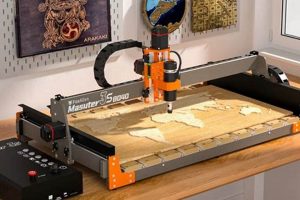
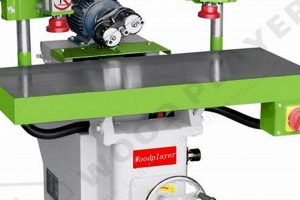
A digitally controlled subtractive manufacturing process applied to wood, this technique utilizes a computer numerical control (CNC) router to precisely cut, shape, and engrave wood materials. An example involves creating intricate cabinet doors with complex designs from a digital blueprint.
Its significance lies in the ability to produce accurate and repeatable components with minimal waste, leading to increased efficiency and reduced labor costs compared to traditional woodworking methods. Historically, manually operated routers limited production speed and complexity, but automation has expanded design possibilities and production capabilities.
The following sections will delve into the components of this automated system, its operational principles, the types of projects suitable for it, and considerations for choosing the right equipment.
Essential Considerations for Automated Wood Shaping
This section outlines crucial aspects to consider when implementing digitally controlled wood shaping technology for optimal performance and results.
Tip 1: Material Selection: The wood type significantly impacts cutting parameters and tool life. Softer woods require higher feed rates, while hardwoods necessitate slower speeds and potentially multiple passes. Understanding material properties is fundamental.
Tip 2: Tooling Optimization: Employing the appropriate cutting tool is essential for achieving desired finish quality and minimizing tool wear. Different bit geometries are designed for specific operations, such as roughing, finishing, or engraving. Consider using compression bits to mitigate chipping.
Tip 3: Precise Fixturing: Securely holding the workpiece is paramount for accuracy and safety. Vacuum tables, clamping systems, and custom jigs are common fixturing solutions. Ensure the chosen method prevents movement during the cutting process.
Tip 4: Software Proficiency: Competent utilization of the computer-aided design (CAD) and computer-aided manufacturing (CAM) software is critical. Accurate design and efficient toolpath generation are essential for maximizing material utilization and minimizing cutting time.
Tip 5: Dust Extraction Implementation: Efficient dust collection is not only important for operator health but also for maintaining machine performance. Fine dust particles can negatively affect linear guides, ball screws, and electronic components. Invest in a robust dust collection system.
Tip 6: Regular Maintenance Scheduling: Consistent maintenance is vital for prolonging the life of the equipment and preventing costly downtime. Regularly inspect and lubricate moving parts, check for wear on cutting tools, and clean the machine thoroughly.
Tip 7: Calibration and Alignment Verification: Periodically check and adjust the machine’s calibration and alignment to ensure accuracy. Misalignment can lead to dimensional errors, poor finish quality, and increased tool wear.
Adhering to these recommendations contributes to efficient operation, improved product quality, and extended equipment lifespan, ultimately maximizing the return on investment.
The concluding section will summarize the key benefits of this technology and offer final thoughts on its role in modern woodworking practices.
1. Precision

Precision is an inherent and crucial characteristic of computer numerical control (CNC) routing in woodworking. The technologys ability to execute designs based on digital instructions translates to a significant degree of accuracy in the final product, directly influencing its functionality and aesthetic appeal. Deviations from intended dimensions, even minor ones, can compromise structural integrity or render components incompatible within an assembly. For example, in the creation of interlocking joints for furniture, precise cuts are essential for a secure and stable connection.
This level of accuracy is achieved through the coordinated operation of several factors. High-resolution stepper motors drive the router head along predefined paths with minimal error. Calibrated measuring systems provide feedback to the control unit, allowing for real-time adjustments and correction of any discrepancies. Furthermore, the rigidity of the machine frame minimizes vibration and deflection, maintaining the relative position between the cutting tool and the workpiece. In the context of producing architectural millwork, for instance, CNC routing ensures consistent replication of intricate profiles across multiple pieces.
While CNC routing inherently offers enhanced precision compared to manual methods, achieving optimal results requires diligent attention to detail. Calibration routines must be performed regularly. Tool wear must be monitored and compensated for. Environmental factors such as temperature and humidity can impact material dimensions and necessitate adjustments to cutting parameters. By understanding and addressing these potential sources of error, woodworking professionals can fully leverage the precision capabilities of CNC routing to create high-quality and reliable products.
2. Automation

Automation fundamentally reshapes woodworking processes through the integration of computer numerical control. This transition minimizes manual intervention, enhancing efficiency and consistency in production.
- Reduced Labor Requirements
Automated systems necessitate fewer manual operations. Once programmed, the system executes tasks autonomously, decreasing the reliance on skilled labor for repetitive cuts and shapes. This shift allows skilled woodworkers to focus on design and finishing, increasing overall productivity.
- Enhanced Production Speed
Computer-controlled routing significantly accelerates production timelines. Machines operate continuously, exceeding the capabilities of manual labor. The precise and rapid execution of cutting paths leads to quicker turnaround times and increased output volume.
- Improved Consistency and Repeatability
Automation ensures consistent outcomes across multiple pieces. The programmed parameters dictate each cut, eliminating variations that may occur with manual woodworking. This uniformity is essential for mass production and projects requiring identical components.
- Complex Design Implementation
Automation enables the creation of intricate and complex designs that would be challenging or impossible to achieve manually. The machines can accurately execute intricate carvings, complex joinery, and three-dimensional shapes, expanding design possibilities within woodworking.
The multifaceted benefits of automation in computer-controlled woodworking present a clear pathway toward improved efficiency, precision, and design complexity, transforming traditional methods into a technologically driven manufacturing process.
3. Materiality
Materiality is a central consideration in computer numerical control (CNC) router woodworking, governing the entire process from design to execution. The specific properties of the chosen material directly influence cutting parameters, tool selection, and the resultant quality of the finished product. An understanding of these relationships is essential for maximizing efficiency and minimizing waste.
- Wood Density and Hardness
Density and hardness significantly affect cutting speeds and feed rates. Softer woods, such as pine, require faster feed rates and shallower cuts to prevent splintering. Harder woods, like maple or oak, necessitate slower speeds and potentially multiple passes to achieve a clean cut. Inadequate adjustment for material density can lead to tool breakage, workpiece damage, and compromised surface finish.
- Grain Orientation
The direction of the wood grain relative to the cutting path influences the surface finish and edge quality. Cutting against the grain can cause tear-out, while cutting with the grain generally yields a smoother surface. Optimizing toolpaths to align with the grain direction is crucial for achieving desired aesthetics and minimizing post-processing requirements. Consider the impact when routing intricate patterns or complex profiles.
- Moisture Content
Moisture content impacts wood stability and dimensional accuracy. Changes in moisture levels can cause warping, cupping, or twisting, affecting the precision of CNC-routed components. It is imperative to use properly seasoned wood with a stable moisture content to ensure reliable results. Additionally, adjustments may be necessary during the design phase to account for potential shrinkage or expansion.
- Material Composition (e.g., Plywood vs. Solid Wood)
Different wood materials possess distinct structural properties and machining characteristics. Plywood, for instance, exhibits uniform strength in multiple directions, but its layered construction can be prone to chipping along the edges. Solid wood, while offering superior aesthetics and structural integrity, is susceptible to grain direction issues and potential warping. Selecting the appropriate material based on the intended application and understanding its specific limitations are paramount considerations.
The interplay between wood characteristics and CNC routing parameters underscores the importance of informed material selection. Successfully leveraging the capabilities of CNC technology requires a comprehensive understanding of the material properties and their impact on the machining process. Whether crafting intricate inlays or producing large-scale structural components, the selection and preparation of the material serve as foundational elements for a successful outcome.
4. Tooling

The selection of appropriate tooling is paramount for effective computer numerical control (CNC) router woodworking. The cutting tool directly dictates the achievable precision, surface finish, and material removal rate. Incompatible or worn tooling introduces inaccuracies, increases the risk of material damage, and reduces overall efficiency. For example, using a dull upcut spiral bit on plywood can lead to significant tear-out on the top surface, necessitating extensive post-processing or rendering the piece unusable. Conversely, a sharp compression bit, designed specifically for plywood, produces clean edges with minimal splintering.
Tooling encompasses a wide array of specialized bits, each designed for a specific purpose. Straight bits are suitable for general-purpose cutting and creating dados or rabbets. V-bits are employed for engraving and creating decorative features. Ball-nose bits are utilized for 3D carving and creating smooth contours. The choice of bit material, such as high-speed steel or carbide, also influences tool life and performance. Carbide bits, while more expensive, offer superior wear resistance and are essential for machining abrasive materials like hardwoods or composite boards. Proper maintenance, including regular sharpening and cleaning, is crucial for prolonging tool life and maintaining cutting accuracy. Regularly inspecting tools and replacing worn bits is vital for consistent results.
In summary, tooling represents a critical component of computer-controlled router applications in woodworking. Its selection and maintenance directly impact the quality, efficiency, and cost-effectiveness of the entire process. A thorough understanding of different tool types and their respective applications is essential for achieving optimal results and maximizing the potential of CNC woodworking technology. Failure to prioritize appropriate tooling can result in wasted material, increased labor costs, and compromised product quality.
5. Design

Design constitutes the foundational blueprint for any successful application of computer numerical control (CNC) router technology in woodworking. The digital design, created using computer-aided design (CAD) software, directly dictates the toolpaths, cutting parameters, and ultimately, the final product. Without a precise and well-considered design, the potential benefits of automated woodworking, such as accuracy and repeatability, cannot be realized. For example, the creation of intricate furniture components or complex architectural millwork relies heavily on the initial design phase, where dimensions, joinery details, and aesthetic elements are meticulously defined. A flawed design, regardless of the machine’s capabilities, will inevitably result in a flawed end product.
The design process also necessitates a thorough understanding of the capabilities and limitations of the CNC router. Factors such as the available cutting tools, the machine’s work envelope, and material properties must be considered during the design phase. Failure to account for these limitations can lead to design features that are impractical or impossible to execute, resulting in wasted material and increased production time. The use of computer-aided manufacturing (CAM) software further enhances the design process by allowing users to simulate toolpaths, optimize cutting strategies, and identify potential issues before actual machining begins. This simulation capability is particularly valuable for complex designs, enabling users to refine their approach and minimize the risk of errors.
In essence, design serves as the bridge between conceptualization and realization in CNC router woodworking. A well-executed design, coupled with a skilled understanding of the technology’s capabilities, unlocks the potential for creating intricate, precise, and aesthetically pleasing wooden objects. The investment in thorough design and planning ultimately contributes to reduced waste, improved efficiency, and enhanced product quality, solidifying its importance in the modern woodworking landscape. Challenges related to design complexity can be mitigated through advanced software and operator training, further reinforcing the connection between design proficiency and successful CNC router operations.
6. Scalability

The integration of computer numerical control (CNC) router technology directly influences the scalability of woodworking operations. This refers to the capacity to increase production volume and product variety while maintaining consistent quality and cost-effectiveness. Traditional woodworking methods often present limitations in scaling due to reliance on manual labor and specialized skills. The implementation of CNC routers mitigates these constraints by automating processes and reducing the need for extensive handcrafting. This allows businesses to accept larger orders and diversify their product lines without proportionally increasing labor costs. For instance, a small cabinet shop could transition from producing a few custom pieces per week to manufacturing modular cabinet systems in larger quantities, all while adhering to precise dimensional standards.
Scalability extends beyond mere volume. CNC routers facilitate mass customization, enabling businesses to offer variations in design, size, or material without incurring significant production penalties. This is achieved through the reprogrammability of CNC machines, allowing for quick adjustments to toolpaths and cutting parameters. A furniture manufacturer, for example, could offer customers a range of options in terms of wood species, finishes, and hardware choices, while still leveraging the efficiency of automated production. This capability differentiates businesses in competitive markets and allows them to cater to specific customer needs. Furthermore, scalability is intertwined with supply chain management. Accurate material usage calculations and automated inventory control, enabled by CNC technology, help optimize material procurement and reduce waste, contributing to overall operational efficiency.
In conclusion, CNC router technology serves as a crucial enabler of scalability in woodworking. Its capacity to automate processes, reduce labor dependence, and facilitate mass customization translates into increased production volume, product variety, and responsiveness to market demands. While initial investment in CNC equipment and software may be substantial, the long-term benefits in terms of scalability and operational efficiency make it a strategically sound decision for woodworking businesses seeking to expand their capabilities and remain competitive in the modern manufacturing landscape.
Frequently Asked Questions
This section addresses common inquiries and misconceptions regarding the application of computer numerical control (CNC) router technology within the woodworking field.
Question 1: What level of expertise is required to operate equipment effectively?
Operating CNC routers necessitates a combination of woodworking knowledge and technical proficiency. Familiarity with CAD/CAM software, machine operation, and material properties is essential. Training programs and certification courses are available to develop the necessary skills.
Question 2: How does this differ from traditional woodworking methods?
Computer-controlled routing fundamentally alters the woodworking process by automating the cutting and shaping of materials. It offers increased precision, repeatability, and design complexity compared to manual techniques, while reducing labor requirements for repetitive tasks.
Question 3: What are the primary maintenance requirements for such equipment?
Regular maintenance is critical for optimal performance and longevity. This includes lubricating moving parts, inspecting and replacing worn tooling, cleaning the machine, and verifying calibration. Adhering to a preventative maintenance schedule minimizes downtime and costly repairs.
Question 4: What safety precautions should be observed during operation?
Safety protocols are paramount when operating high-speed machinery. This involves wearing appropriate personal protective equipment, such as eye and ear protection, ensuring proper dust extraction, and adhering to established safety procedures. Emergency stop mechanisms must be readily accessible and operational.
Question 5: What is the expected lifespan of such woodworking equipment?
The lifespan is influenced by factors such as machine quality, usage frequency, and adherence to maintenance schedules. With proper care and maintenance, a well-built CNC router can provide reliable service for many years. Component replacements and upgrades may be necessary over time.
Question 6: What types of wood materials are compatible?
Computer-controlled routers are versatile and can process a wide range of wood materials, including hardwoods, softwoods, plywood, MDF, and composite boards. However, cutting parameters and tooling must be adjusted based on the specific properties of the chosen material.
Understanding these key aspects contributes to a more informed approach to integrating computer-controlled routing into woodworking practices.
The subsequent section will explore real-world applications of this automated technology in various woodworking industries.
Conclusion
This exploration of cnc router machine woodworking has illuminated the transformative impact of computer numerical control on the woodworking industry. Precision, automation, materiality, tooling, design, and scalability emerge as crucial factors influencing the effectiveness and efficiency of this technology. Understanding these facets is essential for maximizing the potential of cnc router machine woodworking.
The advancements in automated woodworking represent a significant evolution in manufacturing capabilities. Continued innovation in hardware, software, and material science will further refine and expand the applications of this process, shaping the future of woodworking across diverse sectors.